What is intake management? Streamline law firm client onboarding

TL;DR:
- Effective intake management is crucial for converting leads into signed clients, not just administrative support.
- Automating follow-up and qualification processes increases conversion rates by reducing errors and delays.
- Prioritizing structured, consistent intake systems boosts law firm growth and enhances client trust.
Intake management is one of the most undervalued systems inside a personal injury law firm. Most owners treat it as a glorified answering service, a necessary but unremarkable function handled at the front desk. The reality is sharply different. A well-built intake management system directly determines how many leads become signed clients, how quickly your team responds under pressure, and whether a prospective client chooses your firm or calls the next number on their list. If you are losing cases before the retainer is signed, the problem is almost never a shortage of leads. It is almost always intake.
Table of Contents
- The fundamentals: What is intake management?
- Key components of an efficient intake management system
- How intake management supercharges client conversion
- Pitfalls and expert pro tips for upgrading intake in personal injury firms
- Why law firm intake management is your greatest untapped asset
- Explore law firm intake solutions to supercharge your growth
- Frequently asked questions
Key Takeaways
| Point | Details |
|---|---|
| Intake drives growth | A robust intake management system is essential to turning leads into profitable cases. |
| Automate for efficiency | Automation eliminates repetitive work and helps staff focus on high-value client interactions. |
| Tailor workflows | Customizing intake forms with practice-area logic boosts qualification speed and accuracy. |
| Standardize your process | Consistent intake across all channels prevents lost opportunities and data errors. |
| Start small, scale up | Implement improvements in steps—beginning with forms and progressing to automated workflows. |
The fundamentals: What is intake management?
Intake management is the structured system your firm uses to capture, qualify, and onboard new clients from their very first point of contact through to case opening. It is not a single step or a single staff member’s job. It is a full pipeline that includes initial inquiry capture, case screening, information collection, follow-up communication, and the administrative handoff to your legal team.
Think about what actually happens when a prospective client calls your firm after a car accident. They are likely stressed, confused, and weighing multiple options at once. Your intake system is responsible for everything from the moment that call is answered to the moment the retainer lands in their inbox. Every gap in that chain is a potential lost case.
Here is what a complete intake management system covers:
- Lead capture: Collecting inquiries from phone, web forms, live chat, referrals, and social media
- Case qualification: Determining whether the prospective client’s situation matches your practice area and criteria
- Data collection: Gathering accurate, relevant details about the incident, injuries, and circumstances
- Follow-up workflows: Re-engaging leads who did not convert immediately
- Client onboarding: Sending retainer agreements, welcome materials, and coordinating with the legal team
“A universal intake form with practice-area logic scales across channels and creates a consistent foundation for every new client interaction.”
This is fundamentally different from administrative support. Your receptionist answering calls is not intake management. Intake management is the system that surrounds that receptionist, tells them what to ask, what to record, what to do next, and how to follow up if the prospect does not sign immediately. One is a task. The other is a revenue-generating process tied directly to your firm’s pipeline management for law firms.
When you build intake management correctly, every inquiry gets handled with the same level of care and consistency, regardless of who is working that day or how busy the office is.
Key components of an efficient intake management system
A modern intake system is not just a checklist on paper. It is a layered architecture with distinct components, each of which plays a role in moving a lead from curious stranger to signed client.
Here are the five core components, in sequence:
- Multi-channel lead capture: Leads come in through your website contact form, direct calls, referral networks, social media messages, and even text messages. A strong intake system captures all of them in one place so nothing slips through.
- Consistent case qualification: Every inquiry should go through the same screening criteria. Who was at fault? What type of injury occurred? Is the statute of limitations still open? This step protects your firm from investing time in cases that will not convert.
- Standardized data collection: Using practice-area-specific forms ensures you collect the right information the first time. A car accident intake form looks very different from a slip-and-fall form, but both should be standardized within their category.
- Defined staff responsibilities: Intake works best when roles are clear. Intake specialists handle first contact and qualification. Legal assistants handle document collection. Attorneys are looped in only when necessary. Blurred responsibilities create inconsistency.
- Automation for repetitive tasks: Confirmation emails, appointment reminders, document request follow-ups, and retainer delivery can all be automated. According to best practices for automating intake, automating non-judgment tasks frees your staff to focus on conversations that actually require human empathy and critical thinking.
| Component | Manual approach | Automated approach |
|---|---|---|
| Lead capture | Spreadsheets, sticky notes | CRM auto-logging across all channels |
| Case qualification | Varies by staff member | Standardized screening script or form |
| Data collection | Paper forms, phone notes | Digital forms with conditional logic |
| Follow-up | Ad hoc calls or emails | Scheduled automated touchpoints |
| Retainer delivery | Manual PDF and email | Auto-generated, e-sign enabled |
The comparison above makes one thing obvious: manual processes introduce inconsistency at every stage. And inconsistency costs you clients. When you automate intake for conversions, you are not cutting corners. You are removing the fragile, human-error-prone steps so your team can spend their energy where it matters most.
Pro Tip: Start by mapping your current intake process from first call to signed retainer on a single sheet of paper. Identify every step where a lead could fall through or experience a delay. That map is the blueprint for your first round of improvements. Small fixes in the right places yield outsized results fast.
You will also want to review client intake best practices to benchmark your current approach against what high-performing firms are doing. The gap is often larger than expected.
How intake management supercharges client conversion
Once your intake structure is solid, the results show up in your conversion numbers fast. The connection between intake quality and signed cases is direct and measurable. Leads do not disappear randomly. They leave because of slow responses, poor follow-up, or a confusing experience.
Consider these patterns seen consistently across personal injury practices:
- Speed of first response: The probability of reaching a lead drops dramatically after the first five minutes. A firm that responds within two minutes converts at a significantly higher rate than one that responds in two hours. Prospective clients in distress do not wait patiently. They call the next firm.
- Follow-up consistency: Most leads require multiple touchpoints before they commit. Without a structured follow-up sequence, the majority of undecided prospects simply go cold. Automated follow-ups keep your firm visible and build confidence.
- Error-free data collection: Incomplete or inaccurate case information creates downstream problems that cost time, erode trust, and sometimes kill cases entirely. A universal intake form with practice-area logic reduces errors by asking the right questions in the right context.
| Intake optimization | Impact on conversion |
|---|---|
| Response time under 5 minutes | Significantly higher contact rates |
| Automated 3-touch follow-up sequence | Higher close rates on undecided leads |
| Standardized qualification criteria | Fewer wasted consultations |
| Digital retainer delivery | Faster signing and reduced drop-off |
The firms that see the sharpest conversion gains are not necessarily the ones spending more on ads. They are the ones who stopped leaking leads at the intake stage. Improving your intake communication strategies alone can recover a meaningful portion of the revenue you are currently losing.
One often-overlooked factor is tone and clarity during first contact. Prospective personal injury clients are often in a vulnerable state. A structured intake process that feels warm, organized, and professional builds trust immediately. It signals that your firm is competent and that their case will be handled with care.

The legal intake conversion insights for 2026 show that firms investing in intake infrastructure are consistently outperforming those focused primarily on lead generation spend. More leads do not fix a leaky intake process. A tighter intake process converts the leads you already have.
Pitfalls and expert pro tips for upgrading intake in personal injury firms
Even firms that understand the value of intake management often stumble during implementation. Knowing the pitfalls ahead of time makes the difference between a failed initiative and a durable system that keeps improving.
Here are the most common mistakes personal injury firms make with intake:
- No clear ownership of the intake process: If every staff member is responsible for intake, effectively no one is. Assign a dedicated intake lead who owns the process, tracks the numbers, and flags breakdowns.
- Inconsistent follow-up across channels: A lead who contacts you by web form and a lead who calls should receive the same quality of follow-up. Without a unified system, web leads routinely fall through while phone leads get attention.
- Forms that are too generic: Using the same intake form for every type of case means you are always collecting too little or too much information. Practice-area-specific logic in your forms dramatically improves data quality and the speed of qualification.
- Resistance to automation tools: Many small firms fear that automating intake will feel impersonal. In practice, fast and organized communication feels more professional to clients, not less. The personal touch belongs in your conversations, not in your reminder emails.
- Training gaps when new tools are introduced: Rolling out a new intake platform without proper staff training guarantees inconsistent adoption. Run structured training sessions and create short reference guides for every workflow change.
“A universal intake form with practice-area logic scales across channels and eliminates the inconsistency that sinks so many intake improvement efforts.”
When choosing the right fit for your firm, reviewing resources like this guide on choosing a personal injury attorney can reveal what prospective clients are actually looking for in their first interactions. That perspective is useful when designing your intake communication and qualification scripts.
Barriers to change are real. Staff may worry about job security when automation enters the picture. The answer is not to avoid the conversation but to frame it honestly. Automation handles the mechanical, time-consuming work. It does not replace the human judgment required to build rapport, assess a lead’s emotional state, or navigate a complex conversation.
A practical client communication guide can help your team adopt new intake communication habits alongside any tools you introduce.
Pro Tip: Do not try to overhaul your entire intake system at once. Pick one workflow, such as the automated follow-up sequence for new web leads, implement it fully, train your team, and measure results for 30 days. Then layer in the next improvement. Incremental wins build momentum and buy-in far better than a sweeping rollout that overwhelms everyone.
Why law firm intake management is your greatest untapped asset
Here is the view most firm owners do not want to sit with: your marketing budget is doing some of the work, but your intake system is undoing it. Every dollar you spend on Google Ads or referral development produces a lead. What happens to that lead next is entirely up to your intake process. If the process is weak, the marketing spend is partially wasted.
The conventional wisdom in law firm growth circles is that more leads equal more cases. That framing keeps firms perpetually focused on the top of the funnel while ignoring the massive losses happening in the middle. The honest truth is that most personal injury firms have enough leads to grow significantly. They just cannot hold onto them.
Shifting the mental model from intake as a cost center to intake as a growth driver changes what you invest in. Instead of asking, “How do we get more calls?”, you start asking, “How do we convert a higher percentage of the calls we already receive?” The second question is more powerful and almost always more affordable to act on.
Investment in intake technology and process design yields compounding returns. When your intake is tight, your staff works more efficiently, your conversion rates climb, and your client experience improves simultaneously. That combination drives referrals, which then feed back into intake, creating a self-reinforcing cycle of growth.
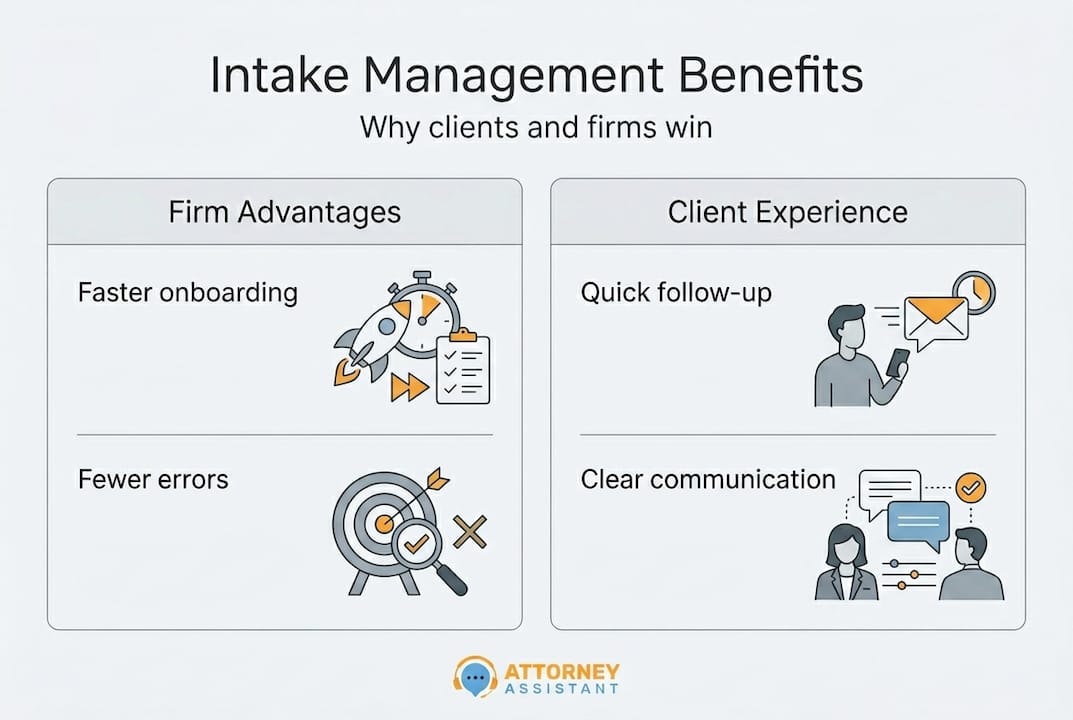
Automating non-judgment intake tasks does not reduce the value of your team. It elevates it. When your intake specialists are freed from sending confirmation emails and chasing missing forms, they can focus entirely on the conversations that require skill and empathy. That is where their value truly lives. Reviewing intake best practices insights regularly ensures your system evolves as your firm grows rather than becoming the bottleneck that limits it.
The firms that treat intake as a strategic priority do not just convert more leads. They build reputations as organized, responsive, and trustworthy. And in personal injury law, reputation is everything.
Explore law firm intake solutions to supercharge your growth
Most firms are one system away from a meaningful jump in signed cases. The educational framework above is the starting point, but knowing what to build and having the right tools to build it are two different things.
Attorney Assistant helps personal injury firms stop losing clients to slow responses, inconsistent follow-up, and disorganized intake workflows. We handle the intake, follow-up, and administrative processes that your team does not have time to maintain at scale. If your firm is ready to convert more of the leads you are already generating, explore our free intake tools to see exactly where your current system is leaving revenue on the table. The first step toward fewer missed cases is a clearer intake process, and we can help you build it.
Frequently asked questions
How does intake management differ from standard client intake?
Intake management is a strategically designed system that streamlines, automates, and tracks the entire client onboarding process. Standard intake typically covers only initial data collection without a structured follow-up or qualification framework, meaning leads that do not convert immediately are often lost.
What are the top benefits of automating law firm intake?
Automation improves lead response time, reduces human error in data collection, and allows your team to spend more time on qualified prospects. As noted in research on non-judgment tasks, automating repetitive workflows frees staff to focus on higher-value interactions that directly drive conversion.
Can a small personal injury firm implement intake management cost-effectively?
Yes. Small firms can begin with standardized digital intake forms and a simple follow-up email sequence, then layer in automation tools as volume grows. Starting small and scaling deliberately is far more effective than waiting until the perfect system is in place.
What is the most common mistake in law firm intake management?
Failing to standardize the intake process across all incoming channels is the most frequent and costly mistake. A universal intake form with practice-area logic ensures consistent data collection regardless of whether the lead came in by phone, web form, or referral.
Recommended
Related Articles

Call Flow Customer Service for Law Firms: A Practical Guide
Design a call flow customer service system for your law firm that captures leads, qualifies matters, and signs cases. Practical guide

Fear of Talking on Phone: 7 Practical Confidence Tips
Overcome fear of talking on phone with practical scripts, role-play, exposure exercises, and intake tools built for legal teams.

Appointment Setting Online: A Law Firm Guide
Master appointment setting online for law firms with proven strategies that turn leads into booked consultations and grow your practice.