Law firm client intake best practices: boost conversions

Client intake is the revenue engine of your personal injury law firm, yet most firms treat it as a back-office formality. Every missed call, slow follow-up, or clunky intake form is a signed case walking out the door. A unified digital intake process can eliminate over 1,329 administrative hours per year for mid-sized firms. This article gives you a step-by-step blueprint covering the core criteria, proven team practices, technology tools, and immediate action steps to convert more leads into signed cases without adding headcount.
Table of Contents
- Core criteria for effective client intake
- Best practices for personal injury intake teams
- Leveraging technology: AI and modern intake tools
- Side-by-side comparison: Manual vs. tech-enabled intake
- Quick action steps for intake optimization
- Unlock even greater client intake efficiency
- Frequently asked questions
Key Takeaways
| Point | Details |
|---|---|
| Unified digital intake | A single intake hub can save over 1,300 admin hours annually. |
| AI pre-qualification | AI tools offer 99.9% answer rates and dramatically cut intake costs. |
| Weekly audits | Regular process reviews and script updates improve conversions. |
| Empowered intake teams | Specialist training in law, empathy, and scripts maximizes success. |
| Technology integration | Modern intake tech directly boosts client conversion and trust. |
Core criteria for effective client intake
Before you can fix your intake process, you need to know what a high-performing one actually looks like. Think of intake criteria as the checklist your process must pass before a single lead enters the pipeline.
Every effective intake process shares these non-negotiable qualities:
- Empathy-first communication: Injured clients are scared and overwhelmed. Intake specialists who lead with empathy build trust faster and reduce early drop-off.
- Legal knowledge baseline: Specialists must understand statute of limitations (SOL) rules, basic negligence standards, and liability concepts so they can qualify leads accurately.
- Scripted consistency: Tested scripts reduce human error, ensure compliance, and create a repeatable experience across every call and form submission.
- Early conflict checks: Running conflict check protocols before investing attorney time protects the firm from ethical violations and wasted resources.
- HIPAA compliance: Personal injury cases involve medical records. Your intake workflow must handle protected health information correctly from the first touchpoint.
- Speed and transparency: Clients who wait more than a few hours for a response often move on to the next firm on their list.
The firms that train intake specialists on legal basics, empathy, and scripted workflows see measurably lower drop-off rates. A unified intake hub, where the client completes the form, signs the retainer, and pays in one session, removes friction at every stage.
Pro Tip: Assign one person to own the intake process end-to-end. Shared ownership creates gaps. A dedicated intake specialist role creates accountability and dramatically improves follow-through.
A streamlined intake process is not just about speed. It is about making the client feel heard, informed, and confident they chose the right firm before they even meet an attorney.

Best practices for personal injury intake teams
With the core criteria in mind, here are the most effective best practices for law firm intake teams in the PI space.
- Train your team on PI-specific legal basics. Every intake specialist should know what makes a viable personal injury case, including fault, damages, and filing deadlines. This knowledge lets them qualify leads without pulling an attorney into every call.
- Build and test empathy scripts. Scripts are not robotic. A well-written script guides the conversation while leaving room for genuine human connection. Rotate scripts regularly and measure outcomes to find what converts.
- Outsource for 24/7 coverage. Leads do not arrive on a 9-to-5 schedule. Outsourcing intake to trained specialists ensures round-the-clock coverage without the overhead of a full-time night shift. Training intake teams with legal-specific criteria is the key differentiator between outsourcing that works and outsourcing that wastes money.
- Use AI to pre-qualify leads. AI tools can screen initial inquiries against your case criteria before a human specialist ever picks up the phone. This keeps your attorneys focused on high-value cases. Exclusive leads convert best, and AI pre-qualification is the fastest way to identify them.
- Capture and nurture leads that are not ready to sign. Not every caller is ready to retain on the first contact. A structured follow-up sequence, using email, text, and callbacks, keeps your firm top of mind until they are ready.
“The firms that outsource or train intake teams with legal criteria and use AI pre-qualification consistently focus attorney time on the highest-value cases, which is where conversion rates climb.”
Pro Tip: Set a weekly 30-minute intake review. Pull call recordings, review form completion rates, and rotate one script element. Small weekly improvements compound into significant annual gains. Use templates for legal intake as your starting point so you are not building from scratch.
Leveraging technology: AI and modern intake tools
No best practices list is complete without technology. AI and digital tools massively multiply your intake ROI when deployed correctly.
AI-powered intake tools now deliver a 99.9% answer rate with up to 90% cost savings compared to traditional staffing models. That is not a marginal improvement. That is a structural shift in how intake operates.
Here is what modern intake technology actually automates:
- 24/7 chatbot and AI intake: Automated tools field initial client questions at any hour, capture contact details, and route qualified leads to the right specialist without human intervention.
- AI lead pre-qualification: Using your firm’s case criteria, AI screens inquiries and scores them before a specialist invests time. Learn more about AI in legal intake and how it changes the economics of client acquisition.
- Document collection and e-signatures: Clients upload medical records, accident reports, and sign retainers digitally. No faxing, no scanning, no chasing.
- Conflict check automation: Integrated platforms run conflict checks instantly against your existing client database, flagging issues before they become ethical problems.
- CRM integration and follow-up sequences: Every lead is logged, tagged, and enrolled in a follow-up workflow automatically. Nothing falls through the cracks.
Platforms like Clio and similar practice management tools are associated with conversion rate improvements in the 10 to 12 percent range for firms that implement them fully. The future of AI in law points toward even deeper automation of intake, conflict resolution, and case triage. Firms that adopt now build a compounding advantage over those that wait.
Side-by-side comparison: Manual vs. tech-enabled intake
To make these decisions real, here is a direct comparison between manual and modern tech-driven intake approaches.
| Factor | Manual intake | Tech-enabled intake |
|---|---|---|
| Availability | Business hours only | 24/7 automated coverage |
| Response time | Hours to days | Seconds to minutes |
| Error rate | Higher, human-dependent | Lower, system-enforced |
| Admin hours | High, repetitive tasks | Reduced by 1,329+ hrs/yr |
| Conflict checks | Manual, often delayed | Automated, instant |
| Lead nurturing | Inconsistent | Automated sequences |
| Conversion rate | Baseline | 10 to 12% higher |
| Cost per intake | High staffing overhead | Up to 90% lower with AI |
Unified intake and integrated digital systems are directly associated with higher conversion rates and reduced admin backlog. The table above makes the operational case clear.
Pro Tip: You do not have to flip the switch overnight. A hybrid model, where trained specialists handle complex calls while AI manages initial screening and follow-up, gives firms in transition the best of both worlds. Explore technology-enhanced intake options that layer onto your existing workflow rather than replacing it entirely.
The biggest risk is not adopting the wrong technology. It is doing nothing while competing firms automate and pull ahead on response speed and conversion.
Quick action steps for intake optimization
Let’s distill these practices into simple, prioritized action steps your firm can start this quarter.
- Audit your existing intake scripts and qualification workflows. Pull the last 30 days of intake calls and forms. Identify where leads drop off, where scripts go off-track, and where qualification criteria are inconsistently applied. This audit is the foundation for every improvement that follows. Audit intake processes weekly and rotate scripts to maintain performance over time.
- Select and train specialists or vet outsourcing partners. Whether you build in-house or outsource, your intake team needs PI-specific legal training, empathy coaching, and scripted workflows. Vague job descriptions produce vague results. Set clear intake department goals before you hire or contract.
- Deploy or upgrade to a unified intake and digital management platform. Choose a platform that handles form submission, retainer signing, payment, conflict checks, and CRM logging in one session. The fewer steps a client has to take, the higher your completion rate.
- Instigate weekly process reviews and script rotations. Block 30 minutes every week to review intake metrics, listen to call recordings, and test one script variation. Treat intake like a marketing channel, because it is. Consistent iteration is what separates firms that plateau from firms that grow.
These four steps are not a one-time project. They are an ongoing operating rhythm that keeps your intake process sharp as your firm scales.
Unlock even greater client intake efficiency
The best practices in this article give you a clear picture of what high-performing intake looks like. But knowing what to do and having the infrastructure to do it consistently are two different things.
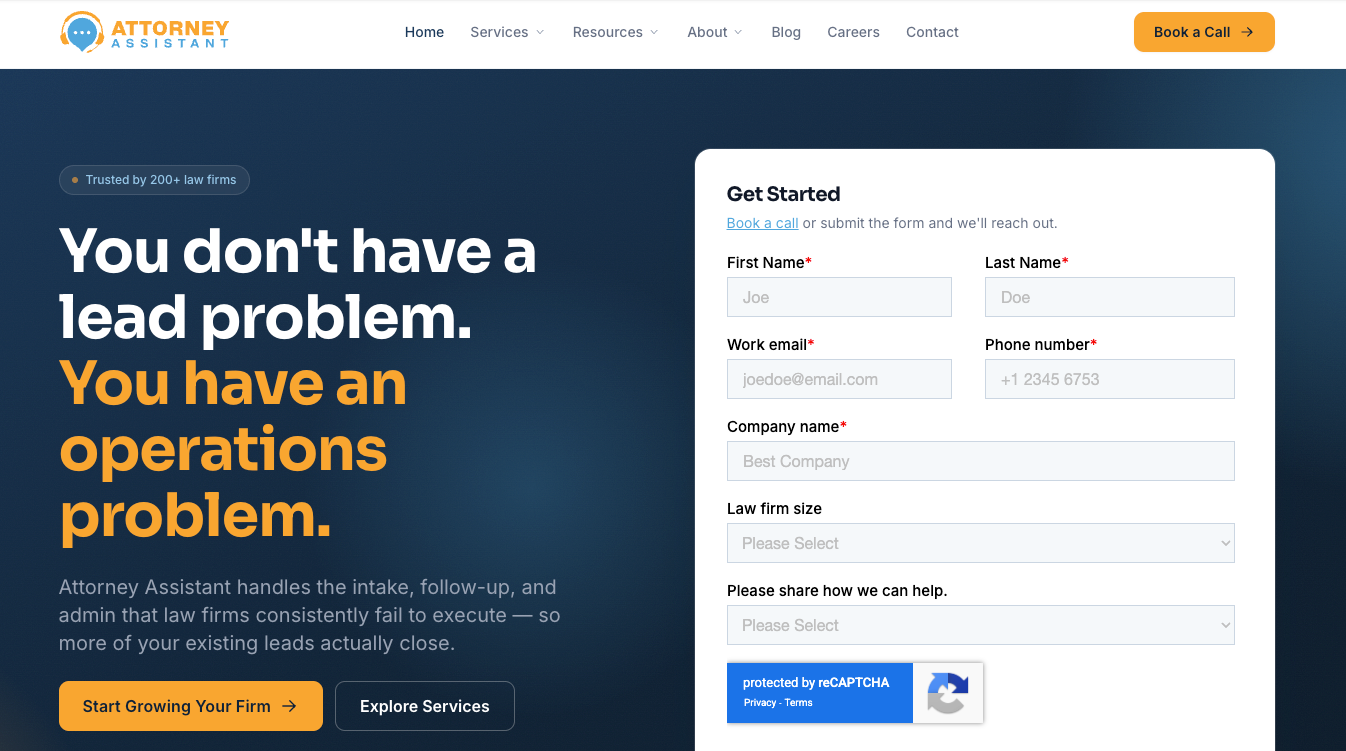
Attorney Assistant is purpose-built for personal injury law firms that want to stop leaking revenue from the leads they already have. From 24/7 intake coverage to automated follow-up and administrative workflow management, the platform handles the operational details so your team can focus on winning cases. Visit the Attorney Assistant intake solutions page to see how the system maps to your current process. Or join the free intake webinar to see a live walkthrough of how mid-sized PI firms are cutting admin backlog and increasing signed cases without adding staff.
Frequently asked questions
What is the most important trait in a client intake specialist?
The most effective specialists combine empathy with a working knowledge of legal basics and follow tested intake scripts consistently. All three traits together, not just one, drive the highest conversion rates.
How does AI impact law firm client intake?
AI enables round-the-clock lead response and pre-qualifies clients using your case criteria, delivering a 99.9% answer rate and up to 90% cost savings compared to traditional staffing. It removes the bottleneck of business-hours-only coverage.
Is a unified digital intake platform necessary?
For mid-sized PI firms, yes. A single-session platform where clients complete forms, sign retainers, and pay can reduce admin by 1,329 hours per year while increasing client trust through a smoother experience.
How often should client intake processes be audited?
Weekly audits and script rotations are the standard for high-performing intake teams. Monthly reviews are the minimum. Anything less and you are flying blind on one of your firm’s most critical revenue functions.
Recommended
Related Articles

Stop Revenue Leakage in Your Law Firm: Key Causes
Discover where personal injury law firms lose revenue through intake gaps and slow follow-up, and learn proven fixes to recover $960k+ in missed cases annually.

Legal intake tips to boost case conversion in 2026
Discover proven legal intake tips that help PI law firms boost case conversion, reduce admin time, and stop losing leads to missed calls and slow follow-up.

Top 5 shesagiven.com Alternatives 2026
Explore 5 shesagiven.com alternatives to enhance lead conversion and streamline your intake process.