24/7 Virtual Receptionists for Law Firms That Sign Cases
A prospective client calls at 8:43 p.m. after finding your firm through a campaign you paid to run. Nobody answers. The caller doesn't leave a voicemail, because most callers don't. By morning, they've contacted another firm, and your carefully funded marketing has delivered an opportunity to someone else.
That's the operational problem 24/7 virtual receptionists are meant to solve for law firms. Not merely picking up the phone, but answering live, collecting useful facts, qualifying the matter, routing urgent calls, scheduling consultations, and continuing follow-up until the opportunity reaches the next clear stage.
A firm can have excellent attorneys and a respectable marketing budget, yet still lose matters because intake depends on whoever happens to notice a missed call. If your process lives primarily inside someone's memory, you've built the world's least reliable CRM. The practical question isn't whether a receptionist can answer. It's whether your firm has a dependable path from first contact to signed matter.
This guide looks at that path, beginning with what live virtual reception does, then examining after-hours economics, handoff design, integration, and the broader staffing capacity needed to carry new work once it arrives. For a useful diagnosis of the underlying phone problem, review why law firms lose opportunities by not answering the phone.
Table of Contents
- Why Your Phones Still Ring After You Leave
- What 24/7 Virtual Receptionists Actually Do for Law Firms
- Why After Hours Coverage Directly Affects Case Signings
- How Live Intake Differs From Taking a Message
- Integrating 24/7 Coverage Without Breaking Your Intake Process
- Where Virtual Receptionists Fit in Your Larger Operations
- Building Reliable Intake That Works While You Sleep
Why Your Phones Still Ring After You Leave
Legal inquiries don't respect office hours. A person injured in a collision may search late at night. A family dealing with an arrest may call on a weekend. A potential client who has finally decided to act rarely checks whether your intake coordinator has finished dinner before reaching for the phone.
The familiar sequence is painfully simple. The call rings, rolls to voicemail, and produces either a rushed message or nothing at all. Someone sees the notification the next morning, decides the caller probably isn't serious, and adds a callback to a list already crowded with tasks. Technically, calling someone back four days later is follow-up. It isn't particularly useful follow-up.
A widely cited legal-services benchmark says 64% of inquiry calls happen outside normal business hours, while 80% of callers won't leave a voicemail. The same source reports that responding within five minutes makes a lead 21 times more likely to convert than waiting 30 minutes, and says businesses using 24/7 answering services can capture 30% to 50% more leads. These figures come from after-hours legal answering service research, and they explain why round-the-clock live reception is better understood as intake protection than as a hospitality upgrade.
The difference between coverage and capacity
A traditional answering service may record a name, number, and short message. That can be helpful for a general inquiry. It's insufficient when the firm needs to understand the matter, identify urgency, apply screening criteria, and decide what should happen next.
A 24/7 virtual receptionist for a law firm should function as an always-open front desk with a defined intake playbook. The team should know:
- Who is calling: Name, contact details, preferred language, and referral source.
- Why they're calling: Matter type, incident context, jurisdictional information, and immediate concern.
- What happens next: Qualification, scheduling, a warm transfer, a detailed message, or structured outbound follow-up.
- What gets recorded: Disposition, owner, deadline, and the next action inside the firm's system.
The point is continuity. A live answer without qualification is just a more pleasant dead end. A qualified call without follow-up is a well-documented dead end.
What 24/7 Virtual Receptionists Actually Do for Law Firms
Think of a law firm's front desk as a small control room. One person answers the phone, another identifies whether the caller fits the practice, someone checks attorney availability, and a case-opening process records the details. A 24/7 live intake team performs those functions across nights, weekends, holidays, and overflow periods, using the firm's rules rather than improvising from a generic script.
The first function is live answering. The caller reaches a person instead of a voicemail tree. That person uses the firm's greeting, confirms the reason for the call, and keeps the conversation moving. If the caller needs immediate attorney attention, the team follows the firm's transfer rules. If not, it gathers the information needed for a proper evaluation.
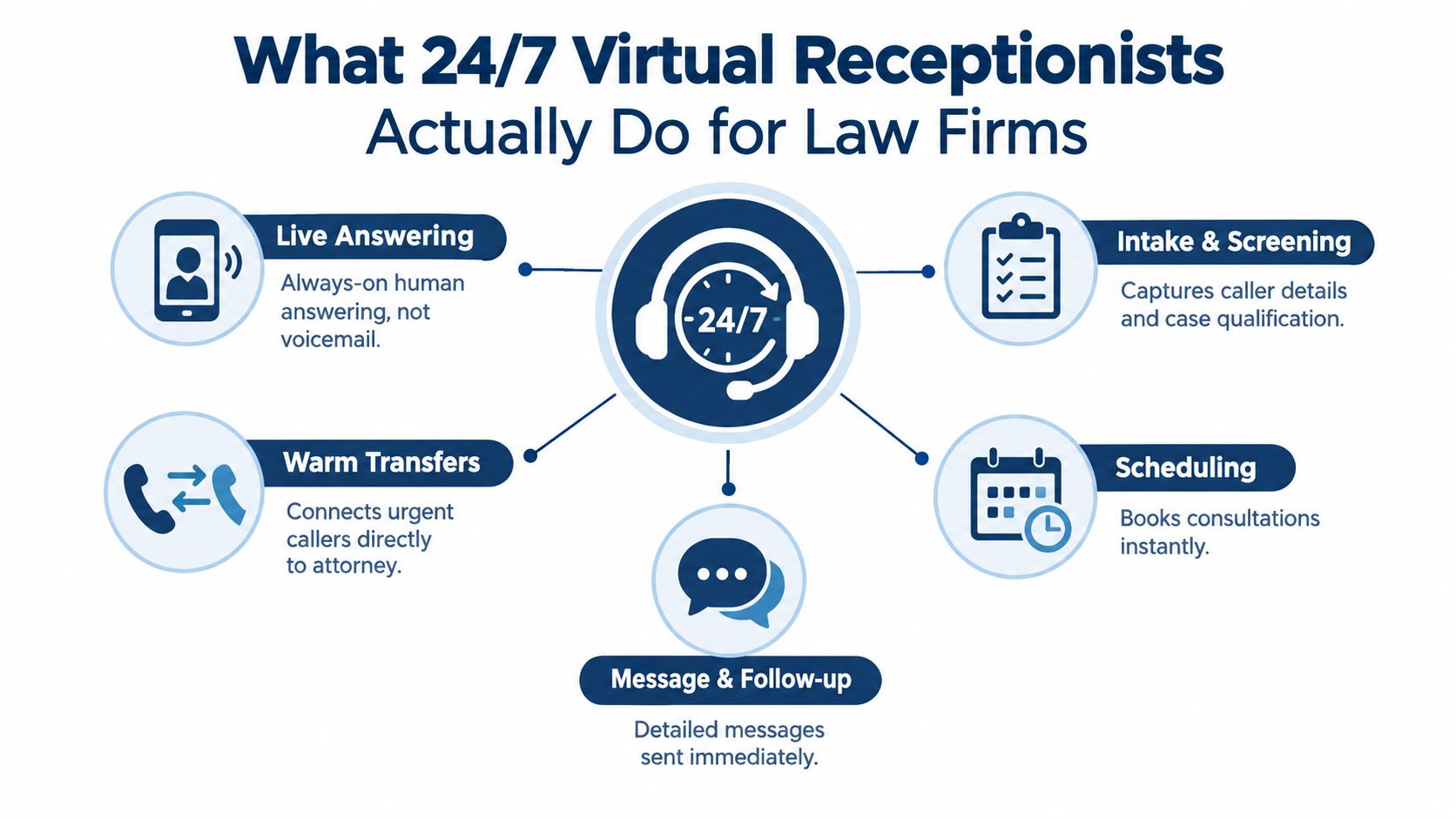
Five functions that turn answering into intake
Live answering means a human responds during the hours your internal team isn't available. Coverage should include nights and weekends, not merely a promise that calls will be returned during the next business day.
Intake and screening means the receptionist asks the questions that matter for the practice area. A personal injury workflow may need incident details and treatment status. An immigration workflow may need a different set of facts entirely. The script should support judgment by the firm, not attempt to provide legal advice.
Warm transfers connect an appropriate caller to an attorney or designated staff member when the matter meets predefined criteria. The receiving person should get context, not a mysterious call from a stranger who says, “I have someone for you.”
Scheduling places a consultation on the correct calendar, with the right time zone, meeting method, and reminders. Appointment setting only helps when the booked appointment reaches the firm and someone owns the next step.
Follow-up continues the conversation after the initial call. That may involve sending a form, confirming a consultation, returning a call, or making structured outreach when the prospect hasn't completed the next step.
This distinction is worth clarifying before comparing providers. A useful resource on how AI receptionist and answering service models compare can help separate automated message handling from services that include qualification, routing, and follow-up.
Practical rule: Taking a message is an event. Intake is a managed process.
Why After Hours Coverage Directly Affects Case Signings
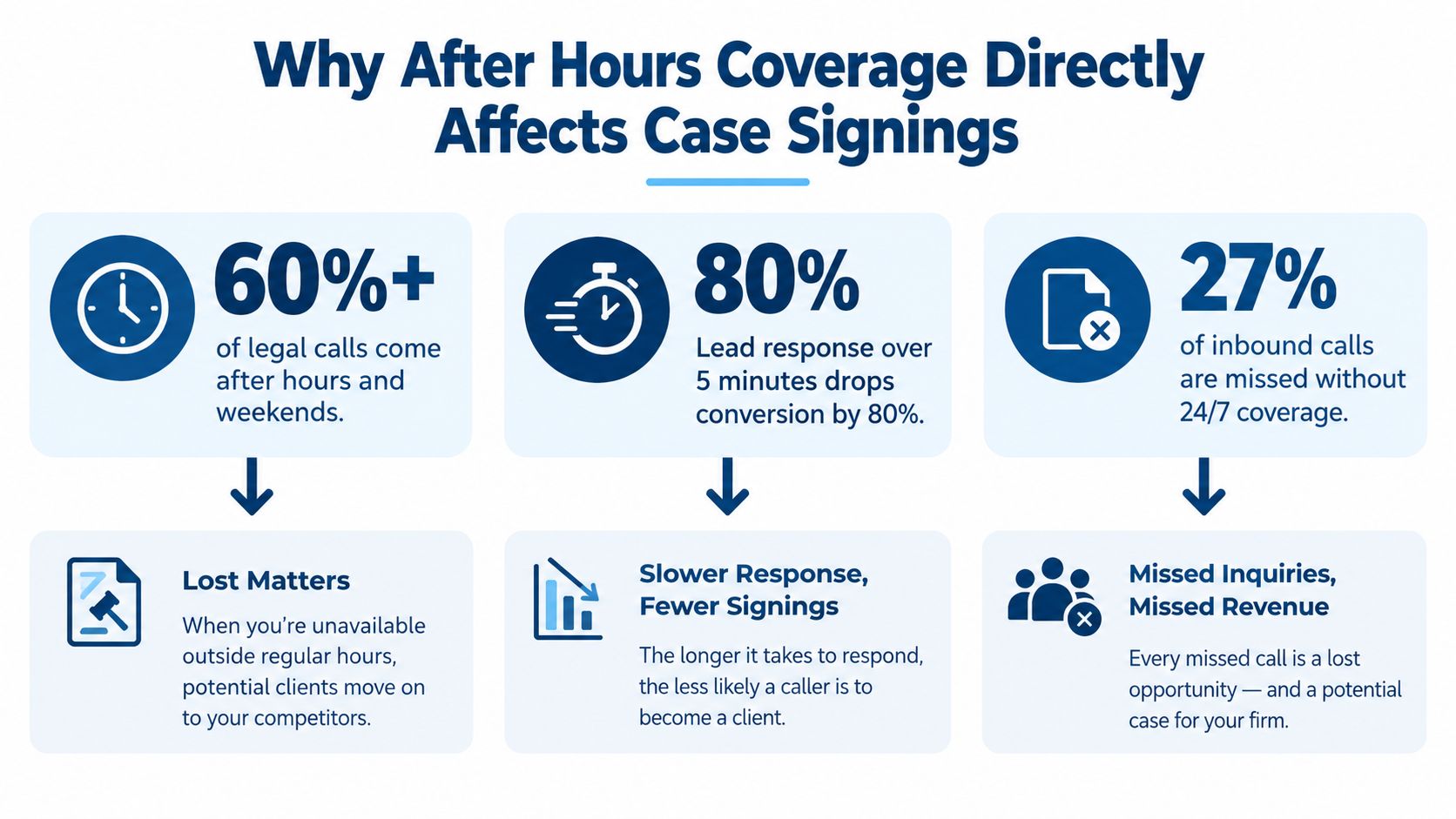
After-hours coverage matters because two clocks start running at the same time. The first is the caller's decision clock. The second is the firm's response clock. If the firm waits while another office answers, the caller's willingness to continue often disappears before anyone opens the message.
A lead-response benchmark cited in research reports that leads contacted within five minutes close at 32%, while leads contacted after 24 hours close at 12%. It also says contact an hour later can make a lead 60 times less likely to qualify. Those figures are presented in lead-response research on after-hours capture, and the operational lesson is straightforward: speed isn't a decorative service feature. It's part of qualification.
Law-firm reporting adds another layer. One source states that 35% of inbound calls to small and midsized firms go unanswered, while 62% of potential clients hire the first firm that responds. A firm doesn't need to lose every missed call for the economics to become uncomfortable. It only needs to lose the matters that would have justified the campaign, staffing, or practice-area investment behind those calls.
Why a callback queue is a weak substitute
A callback queue assumes the prospect will still answer later, still remember the firm, and still be willing to repeat the story. It also assumes the internal team will notice the queue, prioritize it correctly, and act within the relevant window. That's a lot of optimism to build into a revenue process.
The speed-to-lead benchmark from InsideSales research says contacting an inbound lead within five minutes makes it 21 times more likely to qualify than waiting 30 minutes. It also reports that contact within one minute raises conversion by 391% compared with a 24-hour delay. For legal intake, this favors live answering, warm-transfer criteria, same-minute logging, and a defined next action.
The answer isn't to answer every call with the same script. It's to protect the first interaction, distinguish urgent from routine matters, and preserve the caller's context through the handoff.
How Live Intake Differs From Taking a Message
The difference between an answering service and live intake isn't vocabulary. It's what happens after the call ends.
A message-taking model records the caller's information and sends it to the firm. The firm then decides whether the inquiry is viable, who should respond, how quickly to respond, and whether to try again. That model can work for low-stakes calls. It becomes fragile when inquiries arrive outside office hours or when several people share responsibility for callbacks.
A live intake model moves those decisions into a controlled workflow. The receptionist follows the firm's screening criteria, captures the relevant facts, schedules or transfers the caller when appropriate, and logs the disposition so the internal team knows what remains. Live answering services for law firms can be useful to review when distinguishing simple coverage from a process designed around intake outcomes.
| Capability | Answering Service | 24/7 Live Intake Team |
|---|---|---|
| Speed | Takes a message for later review | Answers live and begins qualification immediately |
| Qualification | Usually limited to caller details and a short reason for calling | Uses practice-specific screening questions and disposition rules |
| Follow-up | Often depends on an internal callback | Uses persistent, structured follow-up assigned to a defined workflow |
| Transfers | May transfer according to basic instructions | Uses warm-transfer criteria and provides context to the receiving team |
| Scheduling | May record a request for a callback | Books consultations against approved availability |
| Language coverage | Varies by provider and plan | Can be designed for English and Español coverage |
| Quality assurance | May focus on answer rate or message accuracy | Reviews call quality, script adherence, qualification, and handoff continuity |
| Outcome tracking | Often ends at message delivery | Tracks progress toward consultation, retained matter, or a documented closeout |
The operational test
Ask what the service does when the caller isn't ready to schedule. If the answer is “we send the message,” you have coverage, not necessarily intake. A proper process should define the next attempt, the owner, the message, and the point at which the prospect is closed out.
The same test applies to a caller who appears qualified but doesn't answer the first callback. One call followed by silence isn't persistence. It's a voicemail with better branding.
A live receptionist should leave the firm with a next action, not merely a new notification.
Integrating 24/7 Coverage Without Breaking Your Intake Process
A virtual receptionist works best when the firm treats it as part of intake infrastructure. Forwarding the phone and hoping the new team figures things out is how firms create a second version of the same chaos, now with more logins.
Start with the call map. Identify the main number, practice-area lines, paid campaign numbers, overflow rules, holiday routing, and emergency escalation path. Define what happens when the internal team doesn't answer a warm transfer. “Try someone else” is not a routing policy.
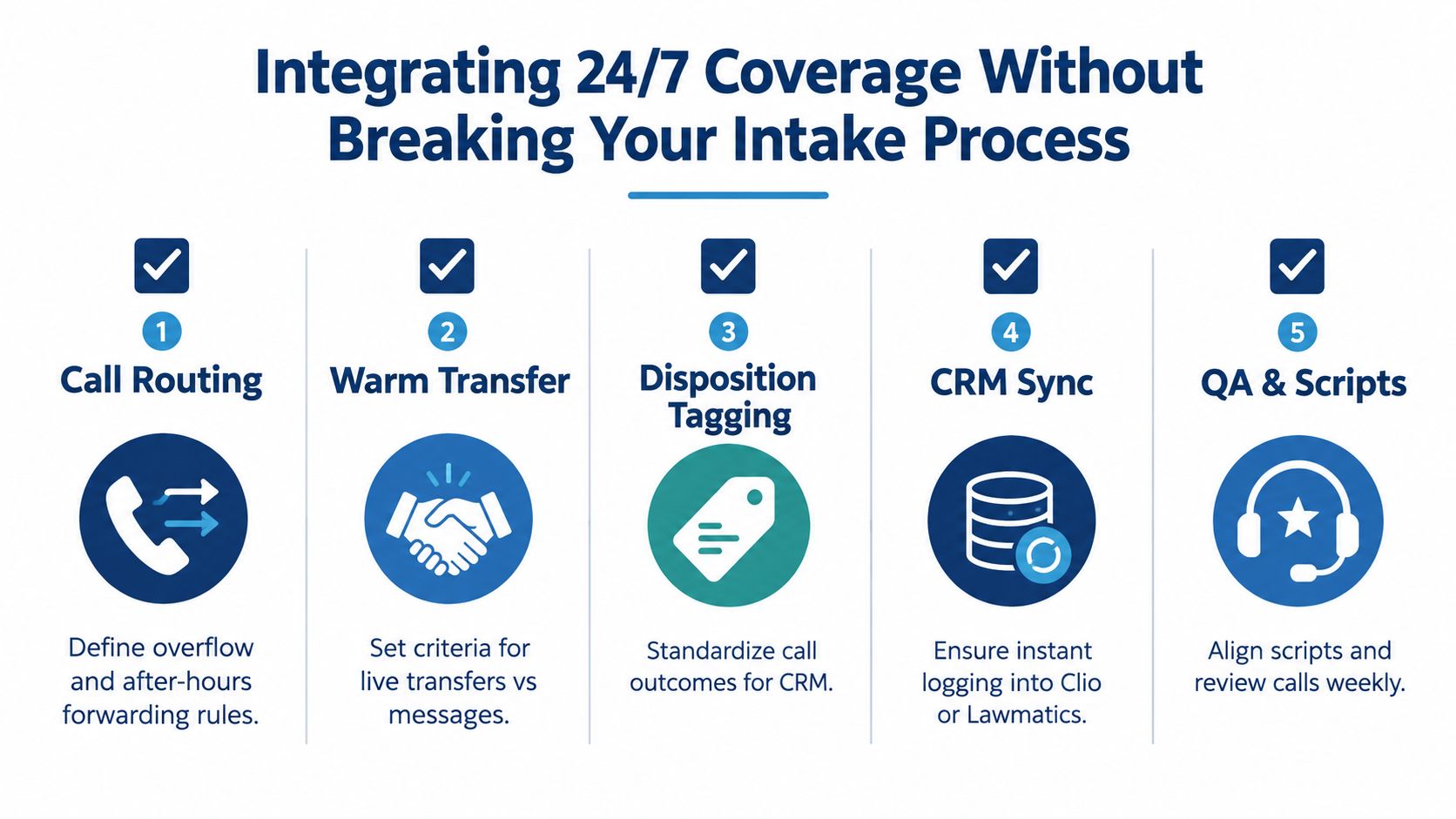
A practical integration checklist
- Set routing rules: Decide which calls go directly to live intake, which overflow after a defined condition, and which reach an on-call attorney.
- Define warm transfers: Specify the facts that justify an immediate transfer, the people who can receive it, and the fallback if nobody picks up.
- Standardize dispositions: Use consistent outcomes such as qualified, unqualified, consultation booked, transfer completed, follow-up required, or wrong number.
- Sync the CRM: Log the caller, matter type, notes, disposition, owner, and next action in the system the firm uses, whether that's Clio, Lawmatics, or another approved platform.
- Set response targets: Measure missed-call-to-first-human-contact and missed-call-to-booked-lead, not only whether someone eventually answered.
- Review call quality: Listen for inaccurate screening, incomplete notes, weak explanations, and handoff failures. Update scripts when the same problem appears repeatedly.
- Support bilingual callers: If the firm serves Spanish-speaking communities, confirm that English and Español coverage is available and that translated scripts reflect the firm's actual process.
A patient-intake workflow offers a useful comparison because it also depends on precise questioning, documentation, escalation, and continuity. Reviewing the role of a patient intake coordinator can help intake leaders identify which parts of their own process require structured ownership, even though legal screening rules are different.
One 2026 law-firm intake benchmark reported that 40.9% of after-hours phone calls did not receive a live response. The same operational guidance recommends tracking the entire path from first human contact to booked matter, with event-driven routing, disposition coding, and service-level monitoring. After-hours answering guidance for law firms provides a useful starting point for mapping that coverage.
Handoff standard: Every after-hours call should be answered live, transferred, or followed up within a defined response window. “Someone will see it tomorrow” isn't a system.
Where Virtual Receptionists Fit in Your Larger Operations
Answering more calls only helps if the firm can carry the work afterward. A signed matter creates tasks: file opening, conflict checks, document collection, records requests, calendar entries, client communication, and case management. Intake without downstream capacity can turn a revenue opportunity into a new item on an already overcrowded list.
Administrative work is a significant drain on legal capacity. The American Bar Association reported that more than 40% of timekeepers spent more than 35% of their time on nonbillable work, a level translated in its press release into at least 700 hours per year for a modestly billing lawyer. A separate survey summary found that 50% of respondents ranked administrative or practice-management tasks among the top drivers of nonbillable hours. Those findings are discussed in the American Bar Association's report on legal automation adoption.
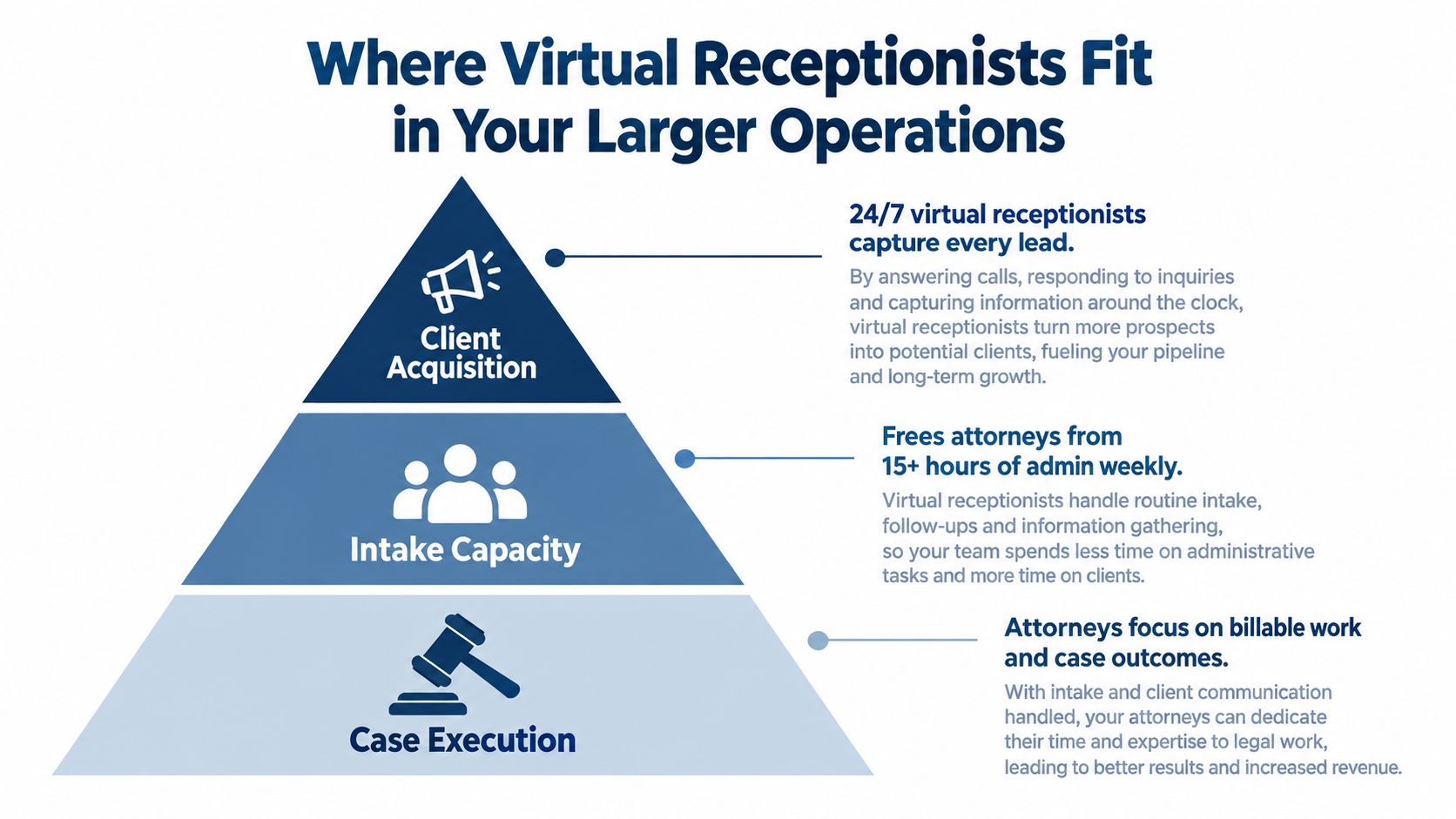
Frontline and Staffline solve different bottlenecks
Attorney Assistant's operating model separates the front-end opportunity from the ongoing case workload. Frontline provides 24/7 live intake, including answering, qualification, follow-up, warm transfers, appointment setting, and retainer signing. It's built around consistent movement toward a signed matter, not a single message delivered to an inbox.
Staffline provides dedicated, full-time legal support professionals assigned to one firm. They work inside the firm's systems and learn its specific workflows, supporting case management, records and bill retrieval, lien reduction, file opening, calendar and inbox management, CRM hygiene, intake, and administrative work. The firm trains the professional on its procedures, while Attorney Assistant sources, vets, trains, and helps co-manage performance.
That distinction matters because Attorney Assistant isn't only an intake provider or a generic virtual assistant company. Frontline signs the case. Staffline carries it. Attorneys can then spend less time hunting for records or cleaning up CRM fields and more time on legal work and client outcomes.
A receptionist can protect the opportunity. Dedicated support helps the firm absorb it.
Building Reliable Intake That Works While You Sleep
The right coverage level depends on the calls your firm receives, not on a generic promise of “24/7.” Start by separating call types. Identify which practice areas generate urgent inquiries, which campaigns produce after-hours traffic, which callers need immediate attorney attention, and which can move through scheduled consultation workflows.
Then measure the leakage points. Review missed calls, time to first human contact, consultation bookings, follow-up completion, and booked-matter conversion. One legal-intake benchmark defines a missed call as an inbound call not answered by a live person within 60 seconds, a voicemail without callback within four business hours, or a call abandoned during a hold. It reports that responding within five minutes drives a 400% conversion lift compared with returning the call the next business day. The definitions and benchmark appear in the 2026 legal intake benchmark report.
A decision framework for firm leaders
Use these questions before choosing a provider or changing your routing:
- Which calls justify live coverage? Prioritize high-value practice areas, paid campaign lines, and urgent matter types.
- What must happen during the first conversation? Define qualification, scheduling, transfer, and required documentation.
- Who owns the next action? Every follow-up needs an owner and a deadline.
- What does success mean? Track the journey from missed call to human contact to booked consultation to signed matter.
- Can the firm support additional matters? If not, pair intake coverage with dedicated case and administrative support.
The broader missed-call problem is not theoretical. A CallRail-based summary cited in legal-intake reporting says 28% of calls to law firms go unanswered, while another summary of a 1,200-call test found 35% of business-hours calls to small and midsized firms went completely unanswered. Those figures are compiled in legal client intake statistics.
Don't judge a 24/7 virtual receptionist by how friendly the greeting sounds. Judge the system by whether qualified callers reach a clear next step and whether your team can see, own, and complete that step.
Attorney Assistant provides Frontline, a 24/7 live intake team that answers, qualifies, follows up, schedules, transfers, and supports retainer signing, alongside Staffline, dedicated legal support professionals who work inside your firm's systems. Visit Attorney Assistant to examine where missed calls, inconsistent follow-up, or overloaded staff are costing your firm capacity.
Related Articles
Case Management App for Law Firms in 2026: How to Choose
Compare case management app options for law firms on intake, documents, calendaring, security and pricing, with a checklist to pick the right fit.
Case Management Notes: A Law Firm's How-To Guide
Learn how to write case management notes that hold up, with a defensible structure, privilege safeguards, handoff tips, and a smarter way to staff the work.

Medical Records Coordinator: What the Role Actually Does
A medical records coordinator manages records retrieval, summaries, billing, and liens for law firms. Learn duties, KPIs, and when to outsource vs hire.