Best AnsweringLegal.com Alternatives for Law Firms 2026

For law firms focused on converting leads into signed cases, Attorney Assistant is the strongest practical alternative to Answering Legal. It goes beyond call answering to cover the full intake-to-retainer workflow, including follow-up, CRM hygiene, and Clio/MyCase integration. If you want a pure answering service comparison, here is how the field breaks down:
- Human-first services (Ruby, Abby Connect, LEX Reception): Best for firms that want trained live agents handling sensitive calls with warm-transfer capability. Pricing is typically per-minute or per-call, which works well at lower volumes.
- AI-native flat-rate services (Dialzara, Posh): Best for solo practitioners and small firms that need 24/7 coverage at a predictable monthly cost without per-minute billing surprises.
- Hybrid models (Smith.ai, AnswerForce): Best for growth-stage firms that need both live agents and AI-assisted triage, with published integrations for Clio and MyCase.
- Attorney Assistant: Best for small to mid-size personal injury and contingency-fee firms that need intake, follow-up, and operational support in one co-managed system, not just a receptionist on the other end of the line.
Named vendor profiles follow below, along with a comparison table and a decision flow to help you match the right model to your firm’s call volume and practice area.
Table of Contents
- Why law firms move away from Answering Legal
- What should you look for in an Answering Legal alternative?
- Alternatives at a glance: how do they compare?
- Detailed profiles: which Answering Legal alternative fits your firm?
- Which alternative fits your firm? A decision flow
- Why structured legal intake converts better than call answering alone
- Key Takeaways
- What most firms get wrong when switching answering services
- Attorney Assistant handles what answering services leave behind
- Useful sources and vendor pages
- FAQ
Why law firms move away from Answering Legal
Answering Legal is a legitimate service, and it works for some firms. But the complaints that push firms to look for call answering alternatives tend to cluster around three operational failures.
Billing surprises. Per-minute pricing sounds manageable until a complex intake call runs long or a caller needs to be transferred twice. Minute-rounding and overage charges inflate the real monthly cost well above the base plan. Firms that run 60 or more qualified intake calls per month often find that metered pricing punishes their growth.
Intake quality gaps. Answering a call is not the same as qualifying a lead. If the agent on the other end cannot run a structured intake script, check for conflicts, or warm-transfer to an attorney when a caller is in crisis, the firm still loses the case. Treating intake as an entry-level admin task is one of the most common operational mistakes in law firms, and it shows up directly in retainer rates.
Weak integrations. If call data does not flow automatically into Clio or MyCase, someone on your staff is manually re-entering it. That creates errors, delays conflict checks, and adds administrative cost that never shows up on the answering service invoice.
“The first firm to respond has a critical conversion advantage. In urgent practice areas like personal injury and DUI, a five-minute delay often means the prospect contacts the next firm on their list.” YMM Digital, Inbound Call Handling for Law Firm Intake Teams
The downstream cost is real. Wasted marketing spend, lost cases, and administrative cleanup from incomplete intake records add up faster than most managing partners realize. Most intake failures do not happen at the moment of first contact. They happen in the minutes and hours after, when slow follow-up and unclear ownership let a warm lead go cold.
Pro Tip: Before you switch services, pull your last 90 days of call data and count how many inbound calls resulted in a scheduled consultation. If that number is below 40–60 calls per week, the problem is almost certainly intake quality and follow-up speed, not call volume.
What should you look for in an Answering Legal alternative?
Not all professional answering solutions are built for legal intake. Here is a prioritized checklist to use when evaluating any replacement service.
- Pricing model and volume math. Flat-rate unlimited plans eliminate overage risk. Per-minute plans can be cheaper at low volumes but become expensive fast. Flat-rate AI-native models often outperform metered plans on cost predictability for firms handling more than 40–80 calls per month. Run the math at your actual volume before committing.
- Speed-to-lead SLA. Ask every vendor for their published live-answer rate and average pickup time. A service that routes to voicemail after four rings is not a live answering service in any meaningful sense.
- Intake depth. Can the agent run a structured qualification script? Does the service capture practice-area-specific fields (incident date, injury type, at-fault party)? Can they flag conflicts and warm-transfer to an attorney when a caller is distressed? These are not nice extras. They are the difference between a receptionist and an intake function.
- Integrations and data ownership. Native sync with Clio, MyCase, or Lawmatics eliminates manual re-entry. Structured intake systems that integrate with practice-management platforms reduce errors and speed conflict checks. Ask who owns the data if you cancel.
- HIPAA and data security. For personal injury and medical-malpractice firms, any service that touches protected health information needs a signed Business Associate Agreement and documented security controls.
- Bilingual support. If your market includes Spanish-speaking callers, confirm whether bilingual coverage is included in the base plan or billed as a premium add-on.
- Contract terms. Month-to-month flexibility matters when you are evaluating a new vendor. Watch for setup fees, minimum commitments, cancellation penalties, and premium after-hours rates that do not appear in the headline price.
- Onboarding timeline. A service that takes six weeks to configure is a liability if you are switching because calls are being dropped today.
Pro Tip: Run a 30-day side-by-side trial before you fully cancel your current service. Route 20% of new inbound calls to the new vendor and compare answer rate, lead-to-consult conversion, and intake completeness. One interview question that reveals intake quality fast: “Walk me through what your agent says when a caller is crying and says they were just in an accident.” The answer tells you everything about training depth.
For a deeper look at client qualification frameworks, Attorney Assistant’s guide covers the specific fields that matter most for personal injury intake.
Alternatives at a glance: how do they compare?
The table below maps each service category across the dimensions that matter most for legal intake. Vendor names appear in the detailed profiles below; this table uses category labels to keep the comparison honest.
| Dimension | Human-First Services | AI-Native Flat-Rate | Hybrid Model | Attorney Assistant |
|---|---|---|---|---|
| Pricing model | Per-minute or per-call | Flat monthly | Flat + per-call tiers | Subscription + action-based |
| Best for | Solo to small firms, sensitive practice areas | Solo, small, budget-conscious | Growth-stage, mixed volume | Small to mid-size PI/contingency firms |
| 24/7 coverage | Yes (most) | Yes | Yes | Yes |
| Clio / MyCase integration | Varies by vendor | Limited | Published native sync | Yes |
| HIPAA / data security | Varies; ask for BAA | Varies | Published BAA available | Yes |
| Onboarding time | 1–2 weeks | 24–72 hours | 1–3 weeks | 1–2 weeks |
| Warm-transfer / escalation | Yes | Limited | Yes | Yes |
| Bilingual support | Varies | Varies | Yes (some) | Yes |
| Contract terms | Month-to-month or annual | Month-to-month | Month-to-month or annual | Monthly subscription |
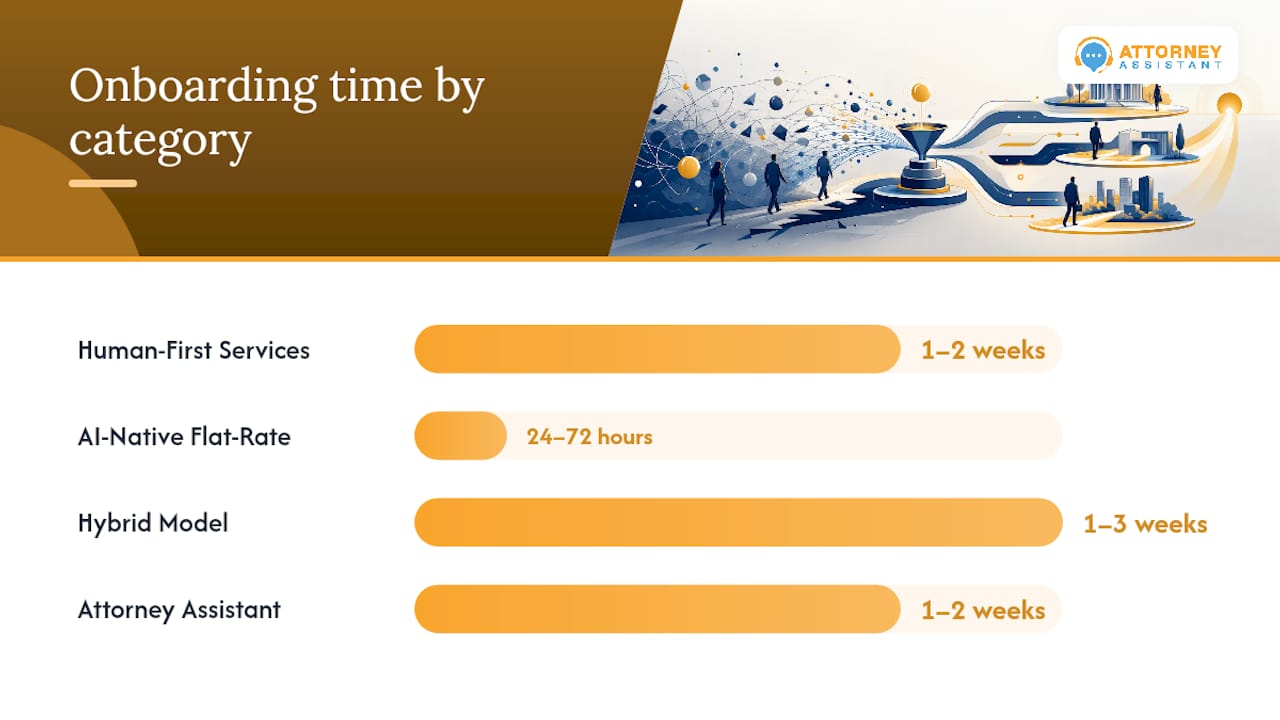
Legend: “Varies” means the feature exists at some vendors in the category but is not universal. “Published” means the vendor publicly documents the integration or compliance posture.
Pricing shape is not the same as real cost at your volume. A per-minute service at $1.75/minute sounds cheap until you factor in 6-second rounding increments and a 10-minute average call. At 60 calls per month, that math produces a very different number than a flat-rate plan at $350/month. Run both scenarios against your actual average call duration before you sign anything.
- Ask every vendor for a sample invoice from a comparable firm, not just a rate card.
- Confirm whether after-hours calls are billed at a premium rate or included in the base plan.
- Check whether Clio/MyCase sync is native or runs through Zapier (Zapier adds latency and a separate subscription cost).
Detailed profiles: which Answering Legal alternative fits your firm?
Answering Legal (baseline)
A legal-specific answering service with 24/7 live agents trained on legal calls. Pricing is per-minute, which works at low call volumes but becomes expensive as intake activity grows. Integrations with Clio and MyCase are available. Bilingual support is offered. The primary complaints are billing unpredictability at higher volumes and intake depth that stops at message-taking rather than structured qualification.
Pros: Legal-specific training, 24/7 live coverage, published Clio integration. Cons: Per-minute billing surprises, limited structured intake depth, weak follow-up capability. Best for: Firms with low inbound volume that need basic live coverage and are not yet focused on intake conversion metrics.
Ruby
Ruby offers virtual receptionist services with a strong reputation for caller experience. Pricing is per-minute with tiered plans. Agents are trained for warmth and professionalism but are generalists, not legal intake specialists. Clio integration is available. HIPAA compliance posture should be confirmed directly. No structured legal qualification scripts by default.
Pros: High caller satisfaction, reliable live coverage, month-to-month options available. Cons: Generalist training limits intake depth for complex legal calls; per-minute billing adds up at volume; no built-in follow-up workflow. Best for: Firms that prioritize caller experience and need overflow coverage, not firms whose primary problem is lead-to-retainer conversion.
Smith.ai
Smith.ai is a hybrid service combining live agents with AI-assisted call handling. It offers structured intake scripts, outbound follow-up calls, spam filtering, and published integrations with Clio, MyCase, and several CRMs. Pricing is per-call with tiered plans. HIPAA compliance is documented. Bilingual (Spanish) support is available. Onboarding typically runs one to two weeks.
Pros: Structured intake capability, outbound follow-up, strong integration list, HIPAA-documented. Cons: Per-call pricing can still produce overage costs at high volume; intake depth depends on how well your scripts are configured during onboarding. Best for: Growth-stage firms that need more than message-taking and want a published integration with their practice management platform.
LEX Reception
LEX Reception focuses exclusively on legal clients. Agents receive legal-specific training and can handle sensitive calls with empathy. Pricing is per-minute with legal-focused plans. Clio integration is available. The service positions itself on intake quality rather than price. Onboarding is typically one to two weeks.
Pros: Legal-only focus, empathy training, Clio integration, 24/7 coverage. Cons: Per-minute pricing; intake depth varies by plan; limited outbound follow-up capability. Best for: Firms in sensitive practice areas (family law, criminal defense, PI) where caller experience on the first contact is the top priority.
AnswerForce
AnswerForce offers 24/7 live answering with bilingual support and published integrations including Clio. Pricing is tiered by minutes used. The service covers after-hours and overflow scenarios well. Intake scripts can be customized. HIPAA compliance should be confirmed per plan.
Pros: Strong after-hours coverage, bilingual support, Clio integration, customizable scripts. Cons: Minute-based billing; intake qualification depth depends on script setup; not legal-exclusive. Best for: Firms that need reliable after-hours and weekend coverage with bilingual capability and do not yet need a full intake specialist function.
Abby Connect
Abby Connect assigns dedicated receptionist teams to each client, which improves caller familiarity and consistency. Pricing is per-minute. Legal clients are a core segment. Warm-transfer capability is strong. Onboarding is typically one to two weeks. HIPAA compliance should be confirmed.
Pros: Dedicated team model improves consistency, strong warm-transfer capability, legal-focused. Cons: Per-minute billing; dedicated team model means coverage gaps if your team is unavailable; limited structured intake depth. Best for: Firms that want callers to speak with the same small group of agents consistently and value relationship continuity over intake conversion metrics.
Posh
Posh is an AI-assisted virtual receptionist service with flat-rate pricing. It handles call routing, message-taking, and basic qualification. Setup is fast, often within 24–72 hours. Integrations are more limited than human-first services. HIPAA posture should be confirmed directly.
Pros: Flat-rate pricing eliminates overage risk, fast setup, 24/7 availability. Cons: AI-assisted model limits empathy on sensitive calls; intake depth is basic; integration options are narrower. Best for: Solo practitioners and very small firms that need 24/7 coverage at a fixed, predictable cost and have low intake complexity.
Dialzara
Dialzara is an AI-native answering service with flat-rate monthly pricing. It handles inbound calls, routes to the right person, and captures basic intake information. Setup is fast. The service is designed for cost predictability. Intake depth is limited compared to human-first services.
Pros: Flat-rate pricing, fast onboarding, 24/7 AI coverage, no per-minute billing. Cons: AI-only model is not suitable for emotionally complex calls; limited structured legal intake; warm-transfer capability is basic. Best for: Firms that want to eliminate missed calls at the lowest possible cost and handle qualification internally once the call is routed.
Attorney Assistant
Attorney Assistant is not a virtual receptionist service. It is a legal operations service that covers the full intake-to-retainer workflow, including live call coverage, structured qualification, outbound follow-up, retainer signing, Clio/MyCase integration, and back-office support. Pricing is subscription-based with action-based billing for specific tasks. Onboarding runs one to two weeks. HIPAA-aware workflows are built into the model for PI and medical-record-heavy firms.
Pros: Full intake-to-retainer coverage, outbound follow-up included, Clio/MyCase integration, co-managed operational model, no per-minute billing surprises. Cons: Broader scope means it is not the right fit for firms that only need basic call coverage; pricing reflects the operational depth. Best for: Small to mid-size personal injury and contingency-fee firms whose primary problem is lead leakage, not call volume.
Pro Tip: When evaluating any vendor, ask specifically: “What happens to a lead that does not answer our callback?” If the answer is “we log it and move on,” that vendor is not solving your follow-up problem. The right answer involves a multi-touch follow-up sequence with defined ownership.
For more on the role of a dedicated intake specialist versus a general receptionist, Attorney Assistant’s guide breaks down where each model fits.
Which alternative fits your firm? A decision flow
Work through these steps before you book a vendor demo.
- Count your inbound calls per month. Under 40 calls: per-minute pricing is probably fine. 40–80 calls: run the flat-rate math. Over 80 calls: per-minute billing is almost certainly costing you more than a flat or subscription model.
- Classify your practice area urgency. Personal injury, DUI, and criminal defense callers are in crisis. They need a live human with empathy training, not a voicemail or an AI router. Estate planning and business law callers tolerate a callback window. Match the service model to the emotional stakes of the call.
- Map your integration requirements. If your firm runs on Clio or MyCase, native sync is not optional. Zapier-based integrations add latency and a separate cost. Confirm whether the integration is native before you sign.
- Check your follow-up gap. If your firm does not have a defined process for following up with leads that do not convert on the first call, a pure answering service will not fix that. You need a service that includes outbound follow-up or a separate intake function.
- Define your contract tolerance. If you are not sure the service will work, insist on month-to-month terms for the first 90 days. Any vendor confident in their results should offer this.
Questions to ask in every vendor demo:
- What is your published live-answer rate and average pickup time?
- How do you handle minute rounding and overage charges?
- Is Clio/MyCase sync native or Zapier-based?
- What conflict-check fields do your agents capture?
- What is your onboarding timeline and who configures the intake script?
- What is your data retention policy and who owns the data if we cancel?
- Do you offer a trial period or a money-back guarantee?
Scoring rubric for vendor trials (weight these as you see fit):
| Criterion | Weight |
|---|---|
| Live answer rate (target: 95%+) | 30% |
| Lead-to-consult conversion rate | 30% |
| Intake completeness (fields captured per call) | 20% |
| Integration reliability (no manual re-entry) | 10% |
| Billing predictability (no surprise overages) | 10% |
A dedicated intake specialist handles roughly 40–60 qualified intake calls per week. Firms scaling past that threshold need either multiple intake staff or a hybrid model with AI-assisted triage to avoid punitive overage costs.
Why structured legal intake converts better than call answering alone
The difference between answering a call and converting a lead is not the phone. It is what happens during and after the call. Structured intake systems standardize qualification criteria, reduce administrative rework, and increase conversion by automating data capture and follow-up. The American Bar Association’s guidance on integrating intake with practice management is clear: manual data entry is a source of errors, delays, and lost cases.
Speed-to-lead stat: The first firm to respond to an inbound inquiry has a decisive conversion advantage. In urgent practice areas, a five-minute delay often means the prospect has already called the next firm on their list.
The operational implication is straightforward. A service that answers the call but cannot capture incident date, injury type, insurance status, and at-fault party information on the first contact forces your staff to call back and re-qualify. That callback rarely happens within five minutes. By then, the lead is gone.
For firms evaluating legal practice management tools alongside their answering service, the integration question is inseparable from the intake quality question.
What to capture on the first call (PI example):
- Caller name, phone, and preferred contact method
- Incident date, type, and location
- Injury description and current medical treatment status
- At-fault party and insurance information
- Statute of limitations proximity
- Conflict-check fields (opposing party name)
After-hours live answering and structured outbound follow-up (SMS and email) materially increase consultation show rates. Callers who do not reach a live agent after hours rarely call back the next morning. They move on.
Most intake failures occur after first contact due to slow follow-up and unclear ownership. Instrumenting the intake workflow from day one, tracking answer rate, time-to-contact, consultation show rate, and lead-to-retainer conversion, is how you hold a vendor accountable and catch leakage before it becomes a pattern.
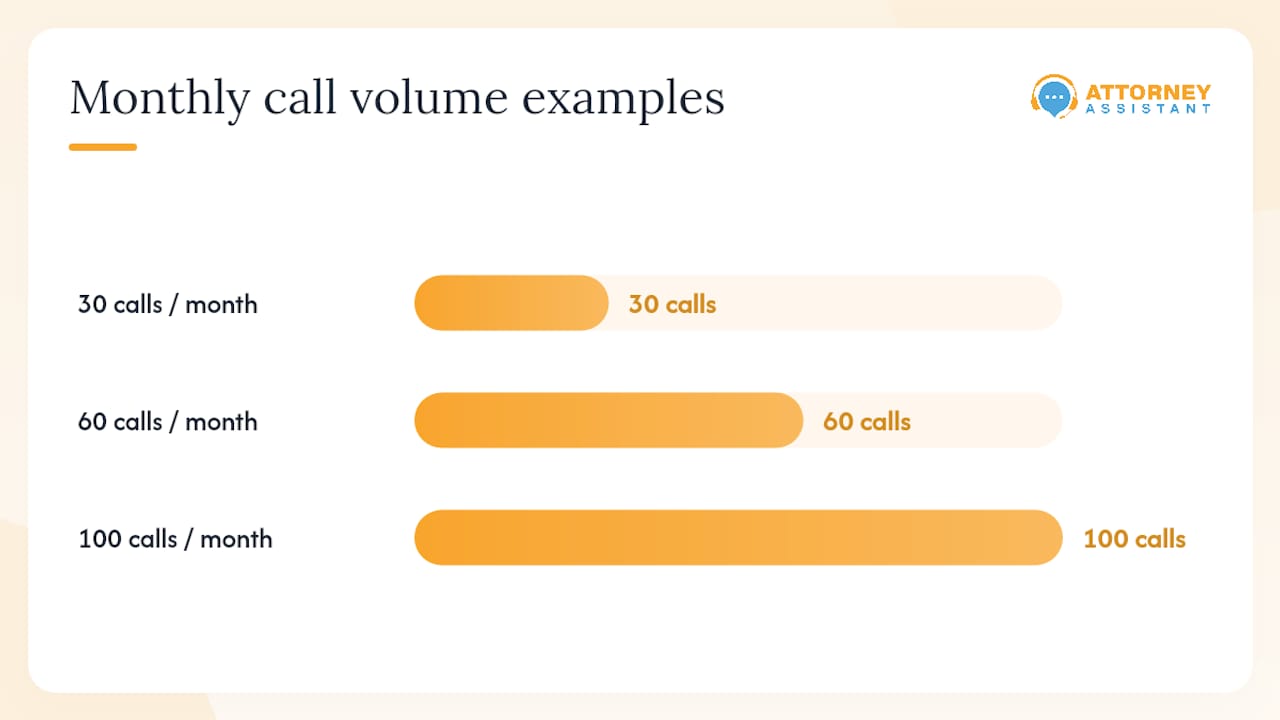
Break-even guide: per-minute vs. flat-rate at different call volumes
| Monthly call volume | Avg. call duration | Per-minute cost (est. $1.75/min) | Flat-rate equivalent |
|---|---|---|---|
| 30 calls | 8 min | — | — |
| 60 calls | 8 min | — | — |
| 100 calls | 8 min | — | — |
These are illustrative estimates based on published rate benchmarks. Your actual cost depends on minute-rounding increments, overage tiers, and after-hours premiums. Run this math with your own call log before signing any contract. Flat-rate models avoid overage risk and often outperform metered plans for firms exceeding 40–80 calls per month.
Key Takeaways
Switching from Answering Legal to the right alternative requires matching your firm’s call volume, practice area urgency, and integration requirements to the correct service model, not just the lowest price.
| Point | Details |
|---|---|
| Pricing model determines real cost | Run per-minute math at your actual call volume; flat-rate wins above 40–80 calls/month. |
| Intake depth drives conversion | A service that only answers calls without structured qualification loses leads after the first contact. |
| Integration is non-negotiable | Native Clio or MyCase sync eliminates manual re-entry errors that slow conflict checks and onboarding. |
| Measure from day one | Track answer rate, lead-to-consult conversion, and intake completeness during any trial period. |
| Attorney Assistant covers the full workflow | For PI and contingency-fee firms, Attorney Assistant handles intake, follow-up, and operations, not just call answering. |
What most firms get wrong when switching answering services
The conventional wisdom in this category is that switching answering services is a vendor swap: cancel one, sign another, forward the phones. That framing is wrong, and it is why so many firms switch two or three times and still have the same conversion problem.
The answering service is not the intake system. It is the front door. What happens after the call is answered, the qualification, the follow-up, the data entry, the retainer signing, is where cases are won or lost. A firm that replaces Answering Legal with a shinier human-first service but keeps the same broken follow-up process will get the same results.
The vendors worth evaluating are the ones that force you to think about what happens after the call. Virtual receptionists and intake specialists serve genuinely different roles, and the best model for a growing firm is usually a hybrid: live coverage at the top of the funnel, with a structured intake and follow-up function behind it. That is not a staffing argument. It is an operations argument.
The firms that convert the most leads are not the ones with the most calls. They are the ones with the fastest response time, the most complete intake data, and the most persistent follow-up. Those three things are a system, not a service.
Attorney Assistant handles what answering services leave behind
Most answering services stop at the call. Attorney Assistant starts there and keeps going: structured intake, outbound follow-up, retainer signing, Clio and MyCase integration, and back-office support built into a co-managed operational model. For personal injury and contingency-fee firms, that means near-100% live answer rates, multi-touch follow-up sequences, and intake data that flows directly into your practice management platform without manual re-entry.
Pricing is subscription-based with action-based billing for specific tasks, so you are not paying per-minute overages when a complex intake call runs long. Onboarding runs one to two weeks. Data ownership stays with your firm. For PI firms that also need medical record retrieval and summarization, that capability is built into the same operational model.
If your firm is losing cases because calls go unanswered, leads go unfollowed, or intake data never makes it into Clio, the problem is operational, not marketing. Book a call with Attorney Assistant to walk through where your intake is leaking and what it would take to close it.
Useful sources and vendor pages
- Optimizing Client Intake: 9 Essential Steps for Law Firms
- Inbound call handling for law firm firm intake teams — Law Firm Marketing Agency - YMM Digital
- Legal Intake Specialist vs Virtual Receptionist for Law Firms (2026 Cost + ROI) | DocketHire
- How Law Firms Lose Clients During Intake (And How to Fix It) | Legalboards
FAQ
What is the best answering service alternative to Answering Legal for law firms?
The best alternative depends on your firm’s call volume and intake needs. Attorney Assistant is the strongest option for firms that need full intake-to-retainer coverage, while Smith.ai and LEX Reception are solid choices for firms that primarily need live call answering with legal-specific training.
How much does switching answering services typically cost?
Setup fees vary by vendor, and most services require one to four weeks of onboarding time. Budget for potential overlap costs if you run a side-by-side trial before fully canceling your current service.
Do legal answering services need to be HIPAA compliant?
For personal injury, medical malpractice, and any practice area where callers share protected health information, yes. Ask every vendor for a signed Business Associate Agreement and documented security controls before sharing any patient or medical data.
What is the difference between a virtual receptionist and a legal intake specialist?
A virtual receptionist handles call answering, routing, and message-taking at the top of the funnel. A legal intake specialist focuses on structured qualification, follow-up, and conversion ownership. Growing firms often need both functions, either from a single hybrid service or from separate providers.
How do I measure whether a new answering service is actually working?
Track four metrics from day one: live answer rate (target 95% or higher), time-to-first-contact after a missed call, lead-to-consultation conversion rate, and intake completeness (fields captured per call). Hold a weekly scorecard review during the first 60 days of any new vendor relationship.
Recommended
Related Articles

Best PATLive Alternatives for Business Owners in 2026
Discover top PATLive.com alternatives for law firms in 2026. Boost lead capture with tailored solutions, including AI and 24/7 support.
Call Answering Service for Law Firms: What Actually Works
A call answering service for law firms should sign cases, not take messages. Learn pricing models, vendor criteria, and 24/7 intake that converts.

Case Management Notes: A Law Firm's How-To Guide
Learn how to write case management notes that hold up, with a defensible structure, privilege safeguards, handoff tips, and a smarter way to staff the work.