Best Back Office Betties Alternatives for Law Firms

TL;DR:
- Most small and mid-sized U.S. law firms should replace Back Office Betties with a flat-rate or action-based intake model featuring native CRM integration. These options, such as Attorney Assistant, improve speed-to-lead and cost efficiency, especially at higher call volumes, and require 2–4 weeks for full setup. Transitioning is crucial for better lead management, budget control, and maximizing conversion rates.
For most small and mid-sized U.S. law firms, the best replacement for Back Office Betties is a flat-rate or action-based intake model with native CRM integration — and Attorney Assistant is the recommended co-managed option for firms that want intake, follow-up, and operations handled together.
Here is a quick shortlist mapped to firm profile:
- Low call volume (under 40 calls/month): Per-minute human receptionist services still make financial sense at this scale. The math works until volume climbs.
- High-volume or growth-stage firms: Flat-rate AI-first or hybrid AI+human services remove overage exposure. Per-minute models become more expensive above roughly 40–80 intake calls per month versus flat-rate unlimited plans.
- Bilingual or heavy after-hours coverage needs: Human-first services with 24/7 staffing and Spanish-language capability. Nights and weekends are where leads leak fastest.
- High-touch brand or complex intake: Co-managed intake operations like Attorney Assistant, where a dedicated team handles intake scripting, CRM mapping, follow-up cadence, and escalation.
- Budget-constrained solo or small firms: Entry-level AI-native intake platforms with Zapier-based CRM handoffs. Lower cost, but expect more internal configuration work.
The single most important selection criteria, in order: speed-to-lead enforcement, pricing model fit at your actual call volume, and native CRM sync (Clio, Filevine, or Lawmatics). Everything else is secondary.
| Option | Best For | Pricing Model | Typical Month | Coverage |
|---|---|---|---|---|
| Co-managed intake (Attorney Assistant) | PI and contingency firms needing full intake ops | Subscription + action-based | Varies by scope | 24/7 |
| Flat-rate AI+human hybrid | High-volume firms, predictable budget | Flat monthly | $300–$800 | 24/7 |
| Human-first receptionist service | Brand-sensitive, complex intake | Per-minute or per-call | $300+ (varies) | 24/7 or business hours |
| Managed VA service | Admin-heavy firms, dedicated coverage | Hourly or monthly retainer | $200+ (varies) | Business hours |
| AI-native intake platform | Budget-conscious, tech-comfortable firms | Flat or usage-based | $100–$400 | 24/7 |
Table of Contents
- How do these intake options actually compare side by side?
- What each alternative actually delivers — and where each one falls short
- What is Back Office Betties and why do firms look for alternatives?
- How do you choose the right alternative for your firm?
- Why speed-to-lead and always-on intake directly affect your revenue
- Key Takeaways
- What firms get wrong when they switch intake vendors
- Attorney Assistant handles what other services leave on the table
- Useful sources
- FAQ
How do these intake options actually compare side by side?
The table below covers the vendors the SERP consensus consistently surfaces as Back Office Betties alternatives: Attorney Assistant, Smith.ai, Ruby, NextPhone, AnswerConnect, Abby Connect, PATLive, Stealth Agents, and MyOutDesk.
| Provider | Best For | Pricing Model | Typical Month | Coverage | Legal Specialization | Clio/CRM Integration | Model | Bilingual | Onboarding | SLA/Answer Rate |
|---|---|---|---|---|---|---|---|---|---|---|
| Attorney Assistant | PI/contingency firms, full intake ops | Subscription + action-based | Custom | 24/7 | High (PI focus) | Native Clio + CRM mapping | Hybrid AI+human | Yes | 2–4 weeks | Near-100% call answer rate |
| Smith.ai | Firms wanting AI-assisted live agents | Per-call or monthly plan | $210–$600+ | 24/7 | Moderate | Clio, Lawmatics, Zapier | Hybrid AI+human | Yes | Days–1 week | Published SLA |
| Ruby | Brand-sensitive, high-touch firms | Per-minute | $300+ (varies) | Business hours + some after-hours | Moderate | Zapier-based | Human-first | Yes | Days | Not published |
| NextPhone | Legal-specific intake, flat-rate | Flat monthly | $300–$600 | 24/7 | High | Clio native | Human+AI hybrid | Yes | 1–2 weeks | Published |
| AnswerConnect | General small business, after-hours | Per-minute | $350+ | 24/7 | Low–moderate | Zapier | Human | Yes | Days | Not published |
| Abby Connect | Boutique firms, dedicated receptionists | Per-minute or flat | $299–$1,000+ | Business hours + after-hours | Moderate | Zapier | Human-first | Yes | 1 week | Not published |
| PATLive | Budget-conscious, basic coverage | Per-minute | $149+ | 24/7 | Low | Zapier | Human | No | Days | Not published |
| Stealth Agents | Admin-heavy, offshore VA support | Hourly or monthly | $8–$15/hr | Business hours | Low | Manual/Zapier | Human VA | Yes | 1–2 weeks | Not published |
| MyOutDesk | Firms needing dedicated virtual staff | Monthly retainer | $1,988+/mo | Business hours | Low–moderate | Manual | Human VA | Yes | 2–4 weeks | Not published |
Pricing model break-even math: At 40 intake calls per month averaging 5 minutes each, a per-minute service at $1.75/minute costs roughly $350. A flat-rate plan at $300/month is already cheaper. At 80 calls, that same per-minute model runs $700 or more, while the flat-rate stays fixed. The crossover happens fast for any firm running active marketing.
- Pricing model: Flat-rate or action-based removes overage risk. Per-minute works only at very low volume.
- CRM integration depth: Native beats Zapier. Zapier beats manual. Manual re-entry kills the efficiency you paid for.
- Legal specialization: Vendors built for law firms script intake differently. Generic answering services miss conflict-check steps and retainer language.
- Coverage hours: If your marketing runs nights and weekends, your intake must too.
Stat: Outsourced after-hours intake typically costs $300–$800 per month versus $3,500–$6,000 or more for an in-house intake coordinator, according to Great Marketing AI’s 2026 cost analysis. The gap is significant enough that most growth-stage firms can fund a hybrid model for less than one in-house hire.
What each alternative actually delivers — and where each one falls short
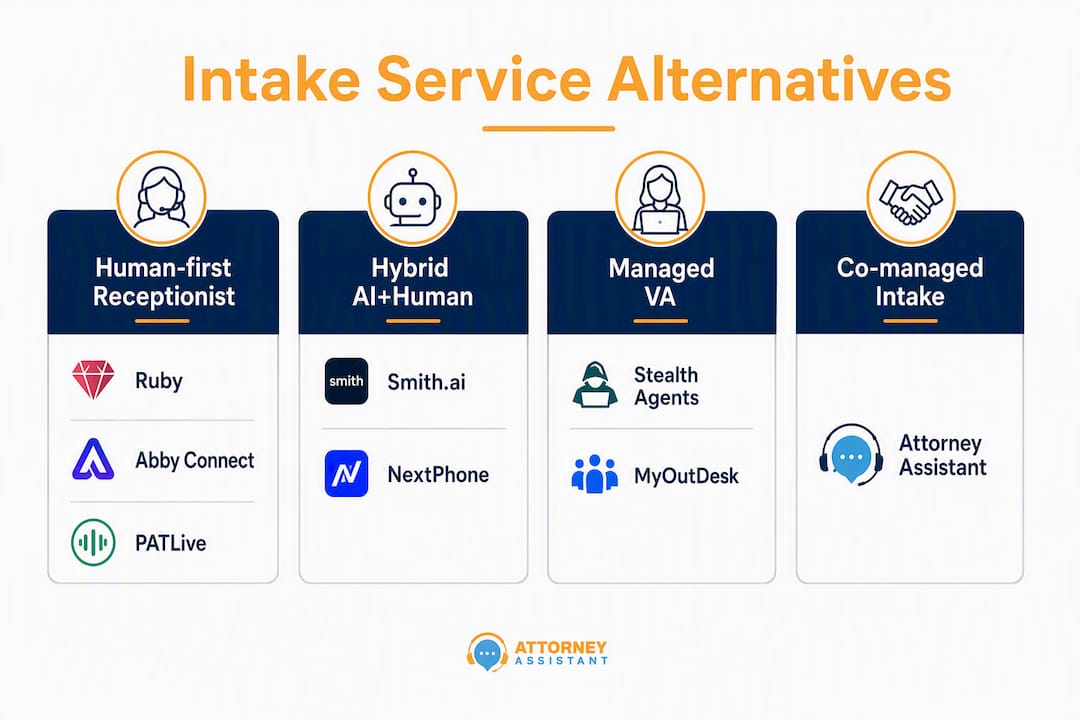
The market breaks into four operational categories. Here is what each one means in practice.
Human-first receptionist services (Ruby, Abby Connect, AnswerConnect, PATLive)
These services put a live agent on every call. Ruby and Abby Connect position themselves as premium, brand-focused options; AnswerConnect and PATLive compete more on price and 24/7 availability.
The core tradeoff is cost volatility. Per-minute services often round up each call to the next full minute, so a 4-minute-and-10-second call bills as 5 minutes. Multiply that across 200 calls a month and the rounding alone adds meaningful cost. Ruby’s monthly cost varies depending on minutes used. PATLive starts at a lower monthly cost but increases as usage grows.
Pros: Warm, human caller experience. Bilingual options available. Minimal setup friction.
Cons: Per-minute billing punishes busy firms. CRM integration is typically Zapier-only, not native. Limited legal specialization at the lower price tiers. After-hours coverage varies by plan.
Migration note: Switching from Back Office Betties to a human-first service is the fastest transition, often live within days. The risk is replicating the same per-minute cost structure you were trying to escape.
Hybrid AI+human services (Smith.ai, NextPhone)
Smith.ai uses AI-assisted live agents to handle intake, qualify leads, and book appointments. NextPhone is built specifically for legal intake with flat-rate pricing and native Clio integration. Both offer 24/7 coverage and published pricing, which matters when you are comparing vendors on a demo call.

Smith.ai’s per-call pricing model is more predictable than per-minute but still usage-based. NextPhone’s flat-rate structure removes overage exposure entirely, which is why it fits high-volume firms better. Switching timelines for full CRM mapping and script design typically run 2–4 weeks, though basic call routing can go live in days.
Pros: Better conversion scripting than generic services. Native or near-native CRM integrations. Published SLAs available. Bilingual support.
Cons: Smith.ai costs climb with call volume. NextPhone’s legal focus means less flexibility for non-legal admin tasks. Neither handles post-intake follow-up or back-office workflows.
Pro Tip: Ask any hybrid vendor to show you a live Clio integration demo, not a screenshot. If they cannot demonstrate data flowing from a call into a Clio matter in real time, the integration is likely Zapier-based and will require manual oversight.
Managed VA services (Stealth Agents, MyOutDesk)
These are human virtual assistants, not receptionists. Stealth Agents offers offshore VA support at $8–$15 per hour, useful for admin-heavy tasks like document prep, scheduling, and data entry. MyOutDesk provides dedicated US-based virtual professionals at $1,988+ per month, positioned more as a long-term staffing solution.
Neither is purpose-built for legal intake. CRM integration is typically manual or Zapier-based. They work best as a complement to an intake service, not a replacement for one.
Pros: Flexible task scope. Dedicated staff builds firm-specific knowledge over time.
Cons: Not built for speed-to-lead. No published SLA on call answer rates. Onboarding for MyOutDesk runs 2–4 weeks. Stealth Agents requires internal management to stay productive.
Co-managed intake operations (Attorney Assistant)
Attorney Assistant is the option for firms that want intake, follow-up, CRM hygiene, and administrative workflows handled together under one operational model. The distinction from the other categories is scope: Attorney Assistant co-manages the intake process rather than just answering calls.
That means script design, CRM field mapping, speed-to-lead enforcement, follow-up cadence, and 24/7 coverage are all part of the engagement. For personal injury and contingency-fee firms where a single signed case can be worth $10,000–$100,000+, the cost-per-signed-case math looks very different from a $400/month answering service.
Switching costs to plan for: Setup fees vary by vendor. Training time for script design and CRM mapping typically runs 1–2 weeks internally. Check your current Back Office Betties contract for termination clauses before setting a go-live date.
What is Back Office Betties and why do firms look for alternatives?
Back Office Betties is a virtual receptionist service built specifically for law firms. It offers live call answering, intake scripting, appointment scheduling, and after-hours coverage. Its pricing model is per-minute, structured in tiered minute-cap plans.
That model works well at low call volumes. Once a firm’s marketing starts producing consistent lead flow, the math shifts.
Common reasons firms start looking for alternatives:
- Per-minute overage exposure: Exceeding your minute cap triggers overage charges. A busy month can produce a bill that is 30–50% higher than the base plan.
- Minute rounding: Per-minute services often round up each call to the next full minute, adding hidden cost that compounds across high call volumes.
- Limited CRM integration: Native Clio integration is not always available. Zapier-based handoffs require configuration and ongoing maintenance.
- Limited post-intake follow-up: Back Office Betties answers calls and captures intake data. It does not enforce follow-up cadence, re-engage cold leads, or manage CRM hygiene.
- Scaling cost: As marketing spend increases and call volume grows, per-minute costs grow with it, often faster than revenue.
Pricing ballpark: Back Office Betties plans typically start at a moderate monthly fee for a base minute allotment, with overages billed per additional minute. At higher volumes, monthly costs increase accordingly. These figures are based on publicly available plan information and should be verified directly with the vendor, as pricing changes.
Per-minute models remain defensible for firms receiving fewer than 30–40 intake calls per month. Below that threshold, the per-minute structure is often cheaper than a flat-rate plan. At higher volumes, flat-rate plans generally become more cost-effective.
How do you choose the right alternative for your firm?
The right choice depends on your call volume, practice area, CRM stack, and how much of the intake process you want to own internally versus outsource. Industry analysis recommends pairing in-house daytime intake with an outsourced after-hours layer to minimize cost per signed case for growth-focused PI firms.
Prioritized decision checklist:
- Run your call volume math. Pull last month’s call count and average call duration. Calculate what per-minute billing would cost versus a flat-rate plan at that volume. The crossover is usually around 40–80 calls per month.
- Confirm native CRM integration. Ask specifically: “Is your Clio integration native or Zapier-based?” Native means data flows automatically. Zapier means someone has to maintain the workflow and troubleshoot when it breaks.
- Test speed-to-lead. Call the vendor’s demo line at 9 PM on a Tuesday. If it rings more than three times or goes to voicemail, that is your answer rate in practice.
- Check bilingual coverage. If any portion of your leads speak Spanish as a primary language, confirm the vendor has US-based bilingual staff, not just a translation service.
- Ask about SLA guarantees. “What is your published answer rate?” If they cannot give you a number, it is not guaranteed.
- Review data ownership and HIPAA posture. Who owns the call recordings? Where is intake data stored? Is the vendor willing to sign a BAA?
- Negotiate a trial period. Two to four weeks is enough to measure cost-per-signed-case improvement. Any vendor unwilling to offer a trial period is a red flag.
Questions to ask on a demo call:
- How do you pass intake data into Clio? Show me a live example.
- Do you support automated calendar booking into my attorneys’ schedules?
- What happens when a caller needs a conflict check during intake?
- How do you handle after-hours calls differently from business-hours calls?
- What is your escalation path when a call requires attorney involvement?
Red flags to watch for:
- Vague SLA language (“we aim to answer quickly”) with no published metric
- Per-minute rounding policies buried in the contract
- “Integration” that turns out to be a Zapier template you configure yourself
- No law-firm-specific case studies or references
- Setup fees that were not disclosed on the pricing page
Trust signals that matter: Published pricing, law-firm case studies, Clio or Lawmatics integration badges, US-based bilingual staff, and a written SLA with a defined answer rate. A vendor that publishes all five is worth a demo. A vendor that hedges on any of them deserves harder questions.
Pro Tip: Before your first vendor demo, pull three months of intake data: total calls, average duration, and how many leads converted to signed cases. Vendors who ask for this data upfront are building a real ROI model. Vendors who skip it are selling features, not outcomes.
Include your office manager, intake attorney, and whoever manages your CRM in the vendor evaluation. The office manager will live with the workflow daily. The intake attorney will feel the quality difference in lead handoffs. The CRM administrator will catch integration gaps the vendor glosses over.
Why speed-to-lead and always-on intake directly affect your revenue
Firms using automated or hybrid systems that ensure near-instant lead qualification see higher conversion in high-stakes practice areas. This is not a marginal effect. In personal injury, a lead that does not get a response within the first hour is often already talking to another firm.
The core problem with per-minute billing: It punishes firms for being successful. Longer, higher-quality intake conversations cost more. A thorough intake call that properly qualifies a strong PI lead might run 8–10 minutes. At $1.75 per minute, that is $14–$17.50 per call. Run 100 of those a month and you are paying $1,400–$1,750 just in call costs, before any other fees. Flat-rate or action-based pricing aligns vendor incentives with your revenue goals instead.
The market in 2026 is split between human-first, AI-first, and hybrid models, each with different cost and conversion tradeoffs. Human-first services deliver warm caller experiences but carry cost volatility. AI-native platforms are cheapest but may miss nuance in complex intake conversations. Hybrid models, where AI handles initial qualification and humans handle escalation, tend to produce the best combination of cost predictability and conversion quality.
Failure to integrate intake data directly into the firm CRM is the most common hidden pitfall during vendor transitions. A receptionist who captures a lead’s information on a call but enters it manually into a spreadsheet creates a re-entry gap. That gap is where leads go cold. Native CRM integration closes it automatically.
Pro Tip: Set a speed-to-lead SLA before you sign any vendor contract: define the maximum time between a lead’s first call and a qualified follow-up attempt. If your vendor cannot commit to a specific number in writing, build it into your internal SOP instead and measure compliance weekly during the trial.
- Always-on coverage (24/7) is now a competitive requirement in PI and high-stakes practice areas, not a premium feature.
- Flat-rate pricing aligns vendor incentives with firm growth; per-minute pricing does the opposite.
- Native CRM sync protects conversion by eliminating manual re-entry gaps.
- Intake response time is the single most controllable variable in your lead-to-signed-case conversion rate.
Key Takeaways
The most defensible replacement for Back Office Betties is a flat-rate or action-based intake model with native CRM integration, matched to your actual call volume and practice area.
| Point | Details |
|---|---|
| Pricing model drives total cost | Per-minute billing becomes more expensive than flat-rate above roughly 40–80 calls per month. |
| Native CRM integration is non-negotiable | Zapier-based handoffs require maintenance and break; native Clio sync protects lead data automatically. |
| Speed-to-lead is the top conversion lever | Firms with near-instant lead qualification see measurably higher conversion in PI and contingency practices. |
| Switching takes 2–4 weeks for full setup | Basic call routing goes live in days; CRM mapping, script design, and staff onboarding take 2–4 weeks. |
| Attorney Assistant covers the full intake cycle | Attorney Assistant co-manages intake, follow-up, CRM hygiene, and 24/7 coverage as one operational engagement. |
What firms get wrong when they switch intake vendors
The most common mistake is treating a vendor switch as a phone-routing change. It is not. Intake is a revenue process, and switching vendors without mapping your intake fields to your CRM first is how you lose leads during the transition.
The second mistake is failing to enforce SLA during the trial period. Firms often give a new vendor a grace period to “get up to speed.” That grace period is exactly when you should be measuring hardest. Call answer rate, time-to-first-response, and lead-to-appointment conversion should all be tracked from day one of the pilot. If the numbers are not there in week two, they will not improve by month three.
The third mistake is underestimating multilingual needs. A firm serving a predominantly Spanish-speaking market that signs with a vendor offering “bilingual support” without confirming US-based Spanish-speaking staff will discover the gap on a live call with a real lead.
One operational pattern that consistently produces better outcomes: firms that run a two-week parallel pilot, keeping their existing service active while testing the new vendor on a secondary line, get clean comparison data without risking live lead flow. The cost of running two services for two weeks is almost always less than the cost of a botched transition.
Per-minute plans also carry a counterintuitive risk as call quality improves. Better intake scripting produces longer, more thorough conversations. Longer conversations cost more per call. Plan the math before you assume a better service will cost the same or less.
Attorney Assistant handles what other services leave on the table
Most of the services reviewed here answer calls. Attorney Assistant fixes the intake process that surrounds those calls: the follow-up that does not happen, the CRM fields that never get populated, the leads that go cold because no one called back within the hour.
Attorney Assistant works as an operations partner embedded in your firm’s daily workflow. A pilot engagement includes intake script design, CRM field mapping (native Clio integration), 2–4 weeks of SLA-monitored call coverage, and follow-up cadence enforcement. The goal is a measurable reduction in cost-per-signed-case, not just a lower phone bill.
For personal injury and contingency-fee firms where intake speed directly affects revenue, the difference between answering a call and converting a lead is the work that happens after the call ends. That is what Attorney Assistant is built to do.
If you want to see how this works for your firm’s specific call volume and practice area, book a call with the Attorney Assistant team and we will walk through the numbers together.
Useful sources
Pricing and research in this article were verified in June 2026 where applicable. Sources were selected for editorial independence, operational specificity, and direct relevance to law firm intake decisions.
Buyer guides and industry analysis:
- Legal Intake Services for Law Firms — 2026 Buyer’s Guide | NextPhone — covers pricing model tradeoffs, flat-rate vs per-minute break-even analysis, and CRM integration criteria.
- Legal Intake Service Decision Framework: 2026 Buyer’s Guide | Big Mode Consulting — hybrid model recommendations and switching timeline data.
- AI Intake vs Answering Service vs In-House Receptionist: Cost Comparison | CyberCraft — detailed cost driver analysis across three intake models.
- Legal Intake Services: In-House vs Outsourced (2026) | Great Marketing AI — monthly cost ranges for in-house versus outsourced intake.
Alternatives and competitive listings:
- Top 10 Back Office Betties Alternatives and Competitors | G2 — broad vendor discovery list with user ratings.
- 8 Best Back Office Betties Alternatives for Law Firms (2026) | NextPhone — law-firm-specific alternatives roundup.
- Best Back Office Betties Alternatives in 2026 | Stealth Agents — vendor comparison including VA-based options.
Pricing mechanics:
- The Flat-Rate Pricing Problem: Why Per-Minute Answering Services Are a Trap | DEV Community — explains minute rounding and its compounding cost impact.
FAQ
What are the best alternatives to Back Office Betties for law firms?
The strongest alternatives, depending on firm profile, are Attorney Assistant (co-managed intake and operations), Smith.ai and NextPhone (hybrid AI+human with legal focus), Ruby and Abby Connect (human-first, brand-sensitive), and Stealth Agents or MyOutDesk for VA-based admin support. G2 lists additional options for broader discovery.
How much does Back Office Betties cost?
Back Office Betties uses per-minute tiered pricing, with base plans typically starting around $299 per month for a set minute allotment. Overages are billed per additional minute, and monthly costs increase with higher call volumes. Verify current pricing directly with the vendor.
When does a flat-rate plan beat per-minute pricing?
Flat-rate plans typically become cheaper above roughly 40–80 intake calls per month compared to per-minute services. The crossover depends on average call duration; longer, more thorough intake calls accelerate the break-even point.
What kind of firms does Back Office Betties serve?
Back Office Betties focuses on law firms, offering legal-specific intake scripting, appointment scheduling, and live call answering. It is best suited to lower-volume firms where per-minute billing stays predictable, typically those receiving fewer than 30–40 intake calls per month.
How long does it take to switch from Back Office Betties to a new service?
Basic call routing can go live within days. Full onboarding, including CRM field mapping, intake script design, and staff training, typically takes 2–4 weeks. Check your current contract for termination notice requirements before setting a transition date.
Recommended
Related Articles
Macs for Lawyers: The Hardware and Compatibility Guide
A practical guide to Macs for lawyers covering hardware choices, software compatibility, security tradeoffs, and recommendations by firm size and workflow.

Business Telephone Answering Service for Law Firms
How a business telephone answering service works for law firms, including 24/7 intake, qualification, warm transfers, pricing models, and what

Call Flow Customer Service for Law Firms: A Practical Guide
Design a call flow customer service system for your law firm that captures leads, qualifies matters, and signs cases. Practical guide