
A law-firm leader doesn't need the most prestigious business finance course. They need the course that helps them make better decisions about attorney time, staffing capacity, intake economics, billing, budgeting, and matter profitability.
The popular advice is to start with an MBA or choose the school with the strongest brand. That can work, but it can also leave a managing partner with elegant valuation theory and no better answer to a simple question: should the firm hire another attorney, add dedicated support staff, improve follow-up, or stop buying leads it can't absorb?
Compare each course on law-firm specificity, accounting foundation, quantitative depth, delivery format, time commitment, credential value, and practical application. Finance education became more analytical during the twentieth century, with modern foundations in portfolio theory, capital asset pricing, and efficient-market research. That evolution is why a serious business finance course now addresses risk, return, valuation, capital budgeting, and cost of capital rather than merely bookkeeping. The historical development of business finance education explains the shift clearly.
A course won't repair poor financial data, inconsistent billing, or an operating team already working beyond capacity. It can, however, give leaders a sharper way to identify where money and opportunities are disappearing. The ten options below range from executive overviews to mathematically demanding programs, with one law-firm-specific choice that deserves more attention than it usually gets.
Table of Contents
- 1. Harvard Business School Online Leading with Finance
- 2. Harvard Business School Online CORe
- 3. Wharton Executive Education Finance and Accounting for the Non-Financial Manager
- 4. Stanford Graduate School of Business Finance and Accounting for the Nonfinancial Executive
- 5. Columbia Business School Executive Education Finance and Accounting for the Nonfinancial Executive
- 6. NYU Stern Executive Education Finance and Accounting for Non-Finance Executives
- 7. Wharton Online Coursera Business and Financial Modeling Specialization
- 8. University of Illinois Gies Financial Management Specialization
- 9. MITx MicroMasters Program in Finance
- 10. Association of Legal Administrators Finance Specialist Certificate
- Top 10 Business Finance Courses, Comparison
- Choose the Course That Matches the Bottleneck
1. Harvard Business School Online Leading with Finance
Harvard Business School Online's Leading with Finance is the strongest first choice for a legal-operations manager, administrator, or non-finance leader who needs financial fluency without committing to a full graduate program. The online course runs for 6 to 7 weeks, uses business cases, and focuses on value creation, capital allocation, and performance measurement.
That combination matters in a law firm. A leader can use the course's concepts to examine whether marketing spend produces qualified matters, whether a hiring plan creates enough capacity, and whether a staffing decision improves cash generation rather than merely increasing payroll. The case method also forces learners to defend a decision instead of hiding behind a spreadsheet with suspiciously tidy assumptions.
Practical rule: Use this course to improve decisions, not to turn every attorney into a part-time financial analyst.
Best fit for legal operations
Leading with Finance is a good match for someone who already sees the firm's profit and loss statement but struggles to connect it to daily operations. The emphasis is on interpreting financial consequences and communicating with finance leaders, not rote memorization of formulas.
The course awards a Certificate of Completion, which gives it stronger signaling value than an informal collection of finance videos. It's also time-bounded, a real advantage for busy managers. The tradeoff is pace. Learners new to accounting or quantitative work may find the material fast, and the premium pricing is higher than typical MOOC alternatives.
Use the concepts in a live firm exercise, such as comparing an additional attorney with a dedicated legal-support professional, or measuring the financial effect of faster intake follow-up. Before enrolling, review Attorney Assistant's webinars for practical operating perspectives that can help translate the course into legal workflows. The HBS peer-learning case study is also useful context for readers who value structured discussion beyond the course itself.

2. Harvard Business School Online CORe
A law-firm leader seeking a quick finance fix should skip CORe. HBS Online CORe suits a COO, practice manager, or attorney-owner who needs a structured foundation in accounting, analytics, and economics. The program combines Financial Accounting, Business Analytics, and Economics for Managers, with graded assignments and a final exam.
That breadth matters when financial decisions cross departments. Firm leaders must connect revenue with cash collection, pricing, staffing capacity, demand, and operating costs. CORe gives them a shared vocabulary for discussions about billing performance, intake economics, matter profitability, budgets, and investment in people or systems.
When the broader foundation is worth it
CORe demands a serious time commitment. It involves more than 150 hours of learning time, structured deadlines, and cohort expectations. That workload competes with active matters, staff questions, vendor issues, and the emergency that somehow became urgent at 4:57 p.m.
The accounting component provides a useful base for examining matter profitability. Leaders cannot judge whether a practice area is performing well if they confuse recorded revenue with cash, or overlook receivables, expenses, and the capacity consumed by each matter. Business analytics extends that work to intake conversion, staff utilization, billing consistency, case volume, and hiring decisions.
Use CORe when the learner needs a durable business foundation and can protect the study schedule. Apply the lessons to the firm's own financial reports, staffing plans, and budget choices. A credential without that application is expensive décor.
CORe is more demanding than a single business finance course, but it can improve decisions across the firm rather than solving one narrow reporting problem.

3. Wharton Executive Education Finance and Accounting for the Non-Financial Manager
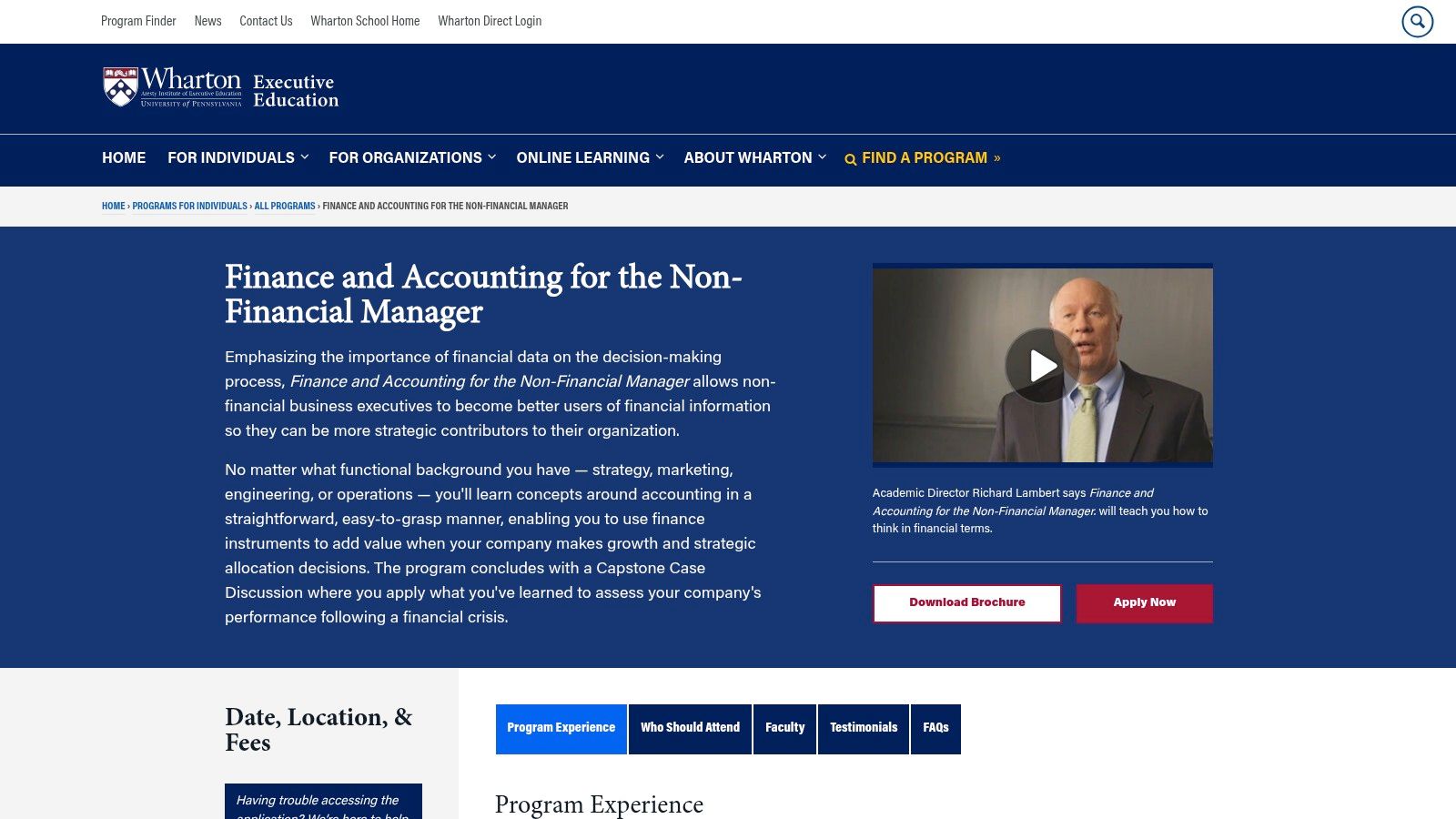
Wharton's Finance and Accounting for the Non-Financial Manager suits firm owners and senior administrators who want an intensive, hands-on experience rather than a long online sequence. The program is delivered in a 5-day executive format, with work involving financial statements, management accounting, and financial risk.
Its value comes from concentration. A managing partner can step away from routine firm operations, work through financial decisions with experienced faculty, and return with a clearer framework for hiring, pricing, marketing investment, and budget control. That makes it more immediately applicable than a course designed mainly for examination preparation.
The cost of immersion
The downside is operational disruption. A full week on campus in Philadelphia means travel, schedule coordination, and the opportunity cost of being away from the firm. Tuition is also positioned at the executive-education level, so this is not an impulse purchase for a curious associate.
Choose Wharton when the learner already owns meaningful financial decisions and needs to improve judgment quickly. It's less suitable for someone who still needs basic accounting instruction or can't obtain clean financial reports from the firm's existing systems.
The program's real test should come after the classroom. Ask the participant to use the material to assess a current firm decision, such as whether a new intake channel can be staffed profitably or whether billing delays are masking an otherwise healthy practice area. If the answer remains “the spreadsheet says yes” without clear assumptions, the course hasn't yet done its job.
4. Stanford Graduate School of Business Finance and Accounting for the Nonfinancial Executive
Stanford Graduate School of Business's Finance and Accounting for the Nonfinancial Executive targets mid-to-senior leaders who make financial decisions without finance titles. The course covers accounting fundamentals, then applies them to finance decisions, and awards a certificate of completion.
For a law firm, that scope suits a COO, managing partner, or operations leader responsible for budgets, performance indicators, staffing capacity, and operational investment. The practical question is whether the learner can use the material to test intake economics, billing performance, matter profitability, and hiring plans. A report reading habit is not financial analysis, even when the report arrives in a very official-looking spreadsheet.
A strong peer-learning option
Stanford's cross-industry cohort adds useful perspective. Legal operations leaders can compare how managers assess capacity, costs, and investment decisions, then adapt those methods to referrals, collections, staffing, and matter selection. The comparison requires judgment because a law firm's revenue cycle and professional obligations differ from a software company's subscription model.
The course combines a strong brand with practitioner-focused teaching. Expect meaningful workload and quantitative difficulty, particularly if the participant lacks clean financial reports or rarely works with budgets. Its main practical drawback is limited price transparency. Prospective participants must request current details, so confirm the cohort calendar, tuition, delivery format, and assessment expectations through Stanford's program page before committing.
Choose Stanford when credibility, peer interaction, and executive-level application matter more than legal-industry specialization. It fits a decision-maker who wants to improve budget and investment judgments. It is a weaker choice for someone seeking detailed instruction on trust accounting or legal billing mechanics.

5. Columbia Business School Executive Education Finance and Accounting for the Nonfinancial Executive
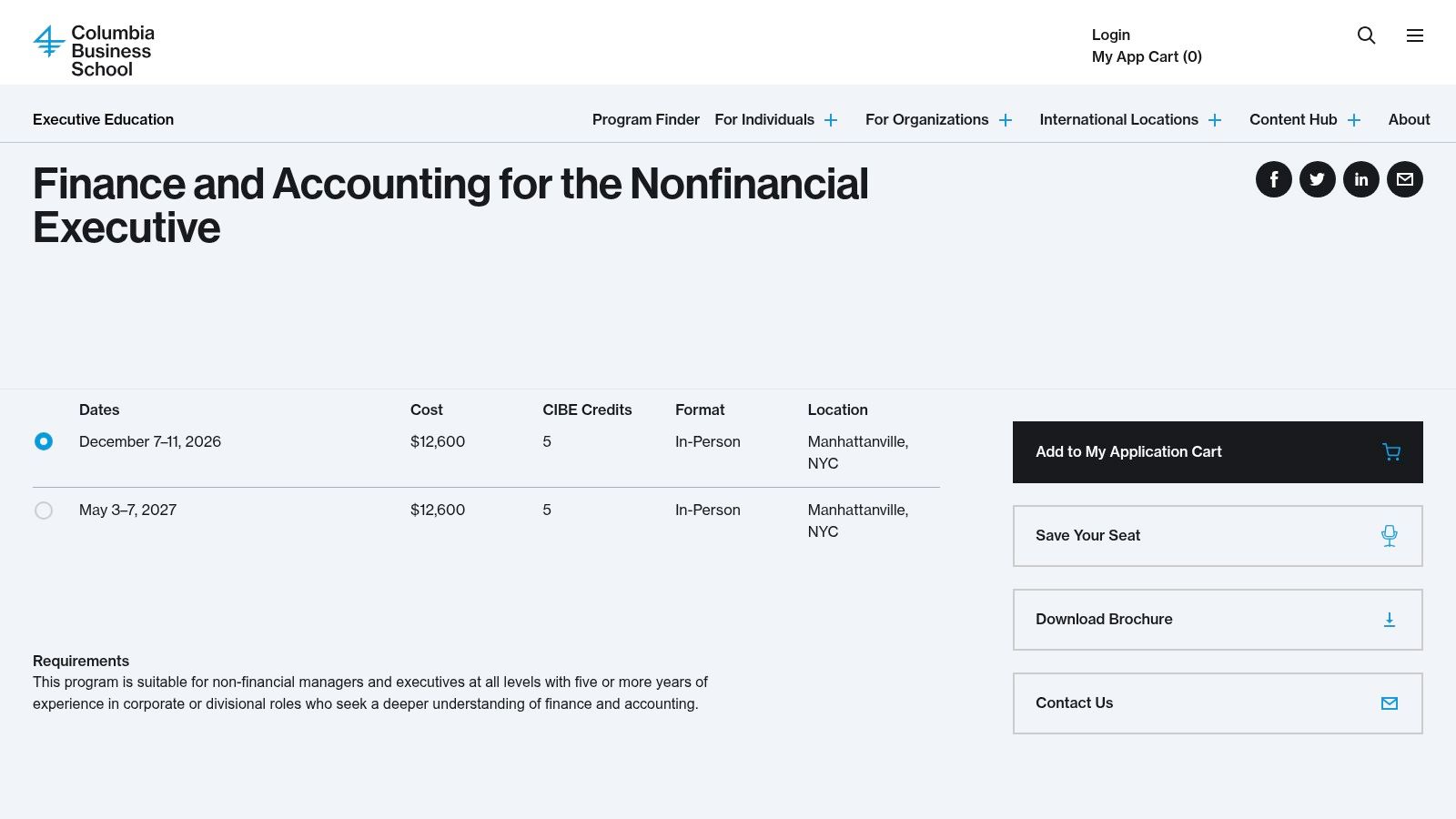
Columbia Business School's Finance and Accounting for the Nonfinancial Executive is another concentrated program for leaders who need to read financial statements, interpret performance metrics, and make better financial decisions. It uses interactive sessions and applied exercises in a 5-day in-person format.
This format works well for a firm owner who has little patience for a course that takes months to complete in fragments. Five focused days can create useful momentum, particularly when the participant brings real questions about intake investment, staffing models, billing processes, and the profitability of different matter types.
Best for concentrated upskilling
Columbia is a sensible selection for leaders who learn through discussion and applied work. Research-active accounting and finance faculty add depth, while the executive setting encourages participants to test assumptions rather than treat financial analysis as a back-office ritual.
The drawbacks are clear. The program requires travel and executive-level tuition, and the primarily in-person format won't suit every firm schedule. A partner who must remain available for every operational issue may not receive enough value from the course if the firm has no coverage plan.
Before attending, gather the firm's current financial questions. Bring a staffing plan, a marketing budget, or a billing report that needs interpretation. The course becomes much more valuable when the participant leaves with a decision framework that the firm can use immediately. Otherwise, the knowledge may join the impressive but underused collection of binders that law firms keep near conference rooms.
6. NYU Stern Executive Education Finance and Accounting for Non-Finance Executives
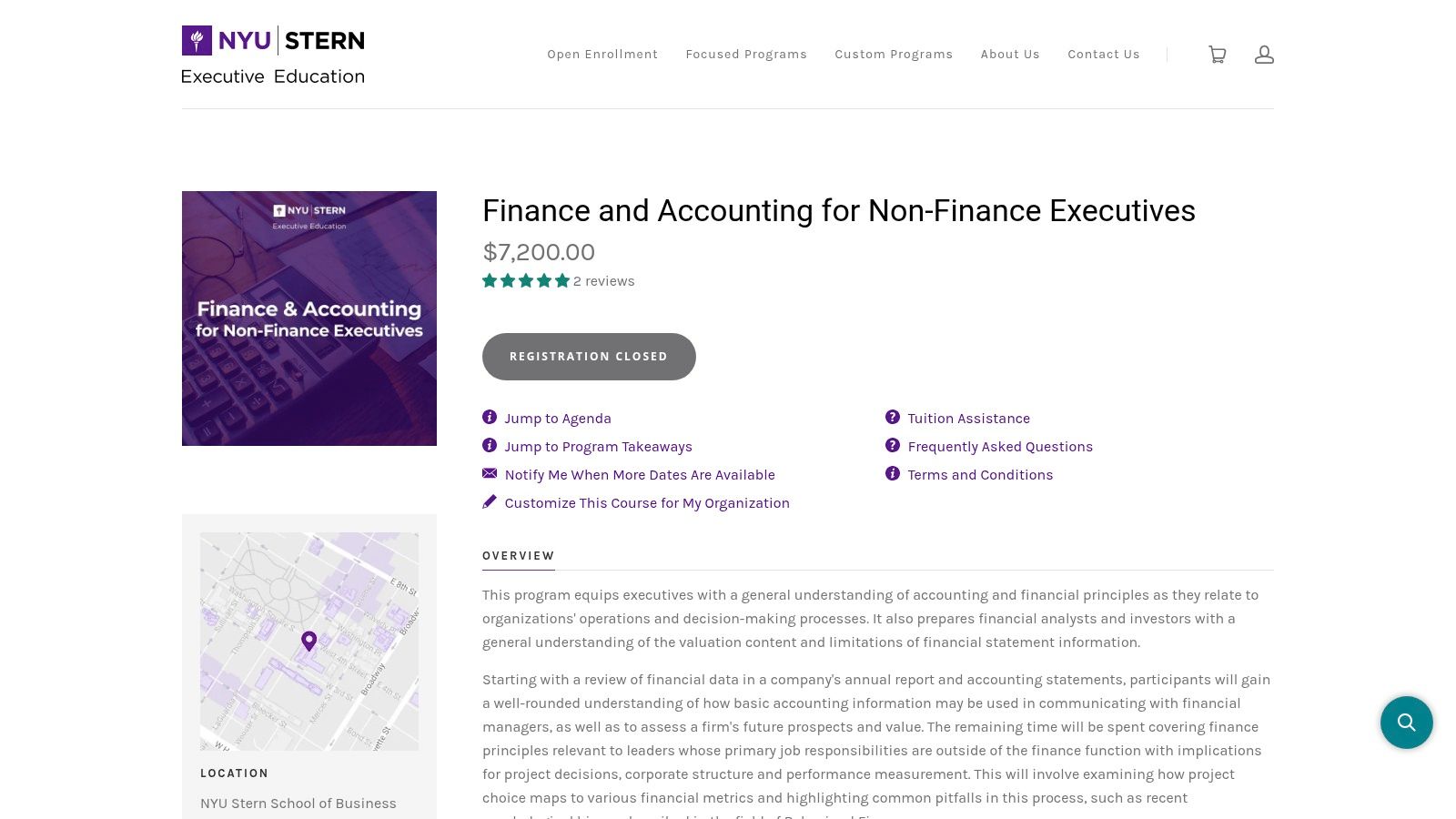
NYU Stern's Finance and Accounting for Non-Finance Executives suits law-firm leaders who make financial decisions without working in finance. The program combines accounting fundamentals with corporate-finance tools and offers online or in-person cohort formats, allowing firms to match delivery with operational demands.
That flexibility matters when a managing partner or legal administrator cannot disappear for a campus week. The course also goes beyond a short introductory webinar, although participants should expect real quantitative work rather than a polite tour of financial vocabulary.
Useful for investment and pricing decisions
Stern is strongest when the question involves an investment. Leaders can apply its concepts to staffing capacity, intake economics, pricing, technology purchases, marketing channels, service expansion, and operational budgets. Each decision depends on assumptions about available people, timing, risk, revenue realization, and the work required to support growth. A shiny new system does not improve a firm if nobody has time to configure or use it.
The course is less direct for leaders whose immediate problems involve billing workflows, trust accounting, or matter-level profitability. Those issues call for legal-administration training with closer attention to firm operations.
NYU Stern's finance reputation makes the program attractive, but the workload will challenge first-time learners. Review the Stern program page for current tuition and schedule details, and confirm the commercial terms before enrollment.
Choose Stern when the leadership team needs a stronger framework for investment, budgeting, and resource-allocation decisions. Choose a specialized legal-finance program when the firm needs to repair billing or measure individual matters. Prestige is useful. Better decisions are the point.
7. Wharton Online Coursera Business and Financial Modeling Specialization
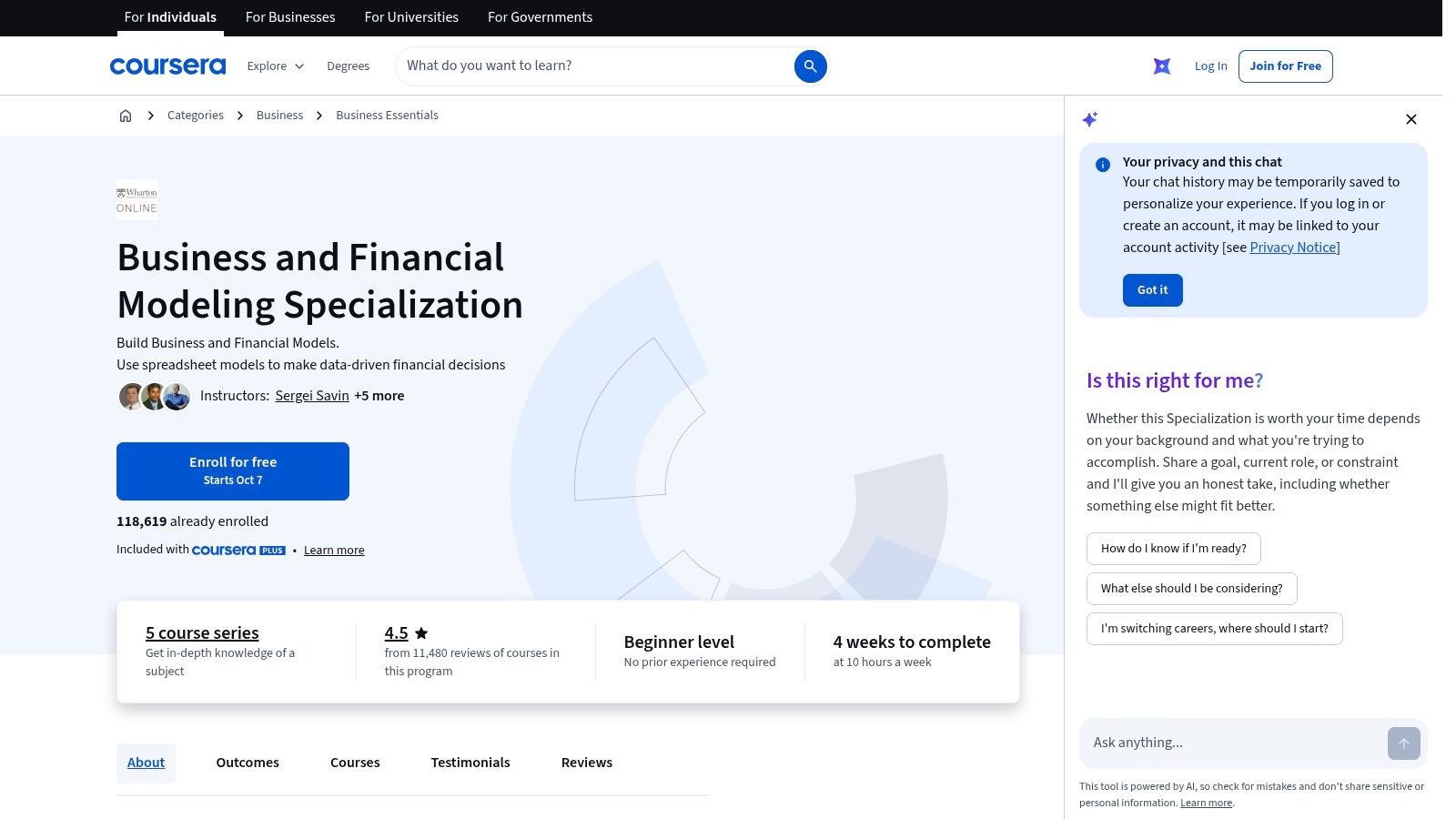
Wharton Online's Business and Financial Modeling Specialization is the practical choice for a firm leader who wants to build models rather than just discuss finance. The Coursera sequence uses spreadsheets to address forecasting, decision-making, risk, and optimization, then applies the learning through a capstone project.
For legal operations, that matters. A spreadsheet model can help a firm test intake volume, response capacity, staffing requirements, case-cost assumptions, and the financial consequences of delayed billing. It can also expose the uncomfortable truth that a firm may be generating more opportunities than its current team can qualify and serve.
Best for quantifying capacity
The self-paced MOOC format is more flexible and generally more accessible than executive education. It also works for non-programmers because the core activity is hands-on spreadsheet modeling. The tradeoff is self-discipline. Nobody will appear at 4:55 p.m. to ask why the model is still sitting untouched beside the cold coffee.
The specialization offers a certificate rather than university credit by default, and it provides less networking than an executive cohort. That makes it a strong capability-building option, but a weaker choice if the credential itself is the primary objective.
Use Attorney Assistant's calculator tools when turning course concepts into practical staffing or intake scenarios. For additional context, this guide to financial model building for business owners can help translate spreadsheet exercises into a repeatable management process.
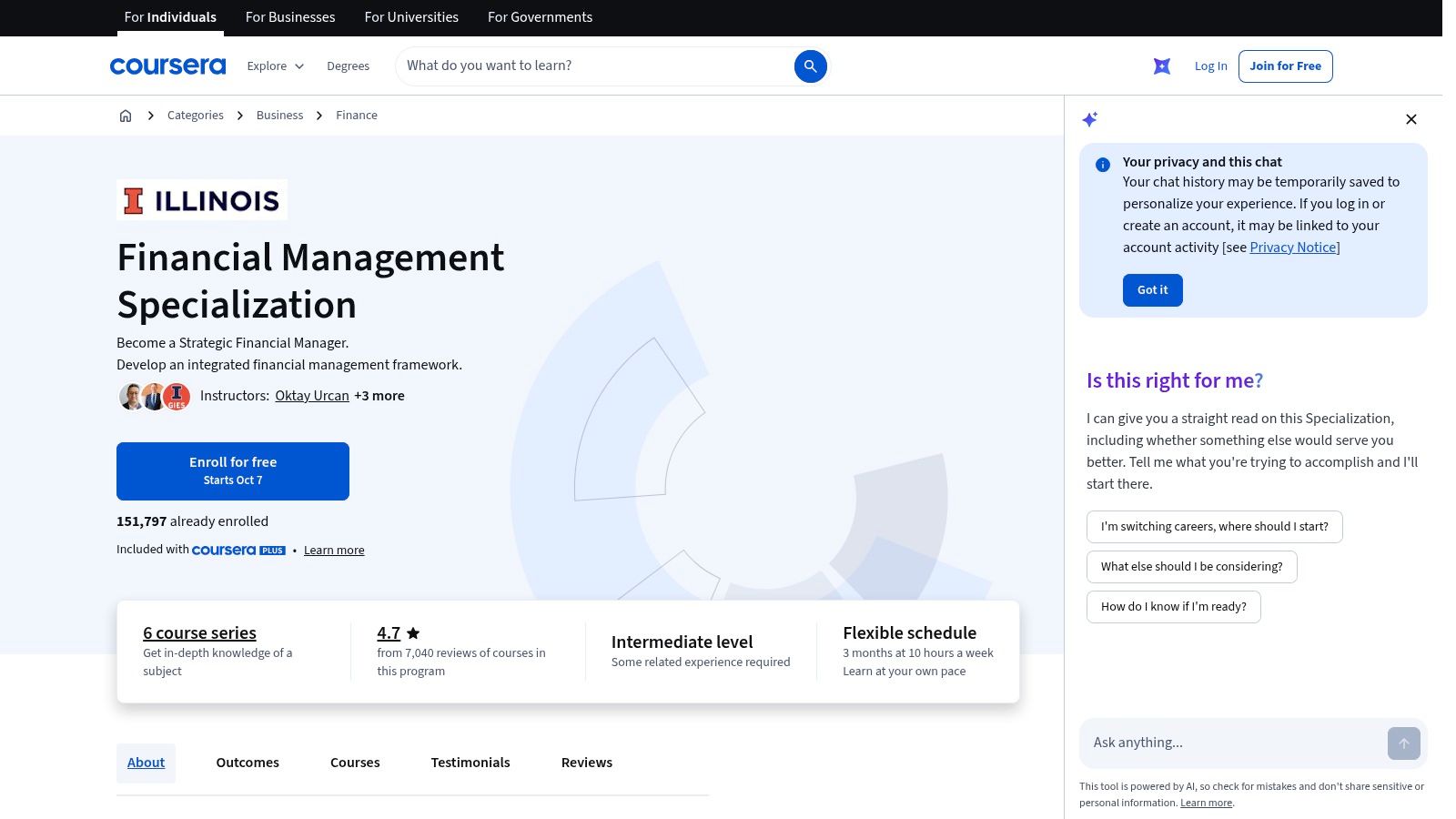
8. University of Illinois Gies Financial Management Specialization
The University of Illinois Gies offers two distinct paths through its Financial Management Specialization. The Coursera option is non-credit and covers accounting, investments, and corporate finance. The separate for-credit Graduate Certificate in Financial Management provides a transcripted credential and can stack toward the iMBA.
This structure makes Gies attractive to two different legal audiences. A practice manager can begin with shorter online learning to improve financial fluency, while an administrator with broader career ambitions can pursue a recognized graduate credential. The progression is clearer than enrolling in a single course with no obvious next step.
Choose the credential path deliberately
The Coursera route is the faster way to develop practical knowledge, but it doesn't appear on a university transcript. The for-credit option requires separate admissions and a greater time commitment. Those aren't minor distinctions, especially when a firm is paying for the training or expecting the learner to maintain daily operations while studying.
The subject mix supports decisions about investments, cash flows, and financial management. It can help a law-firm leader compare staffing alternatives, assess technology spending, and interpret the financial impact of case volume. It won't replace legal-specific instruction on trust accounting or matter workflows.
A good application is to connect each assignment to an existing firm decision. Use one project to examine whether administrative work should remain with attorneys, move to internal staff, or be handled through dedicated support capacity. The course is most valuable when it changes a decision, not merely when it adds another certificate to a professional profile.
9. MITx MicroMasters Program in Finance
MITx's MicroMasters Program in Finance is the most quantitatively demanding option on this list. Its online sequence covers asset pricing, corporate finance, and financial mathematics through multiple courses and a proctored exam.
This course suits analytically strong leaders who want serious finance depth without leaving remote study. It is a poor fit for a partner who only wants to read a profit and loss statement with greater confidence. Defined assessments add structure, and the program may offer a pathway to credit toward selected master's programs, subject to each program's terms.
Use MITx for serious quantitative depth
The payoff is rigor. Completion should strengthen a leader's ability to examine risk, valuation, and financial models beyond the level offered by executive overview courses. That knowledge can support decisions about financing, major operational investments, growth plans, intake economics, and matter profitability.
For a law firm, the practical test is specific. Can the learner use this depth to assess staffing capacity, billing performance, budgeting assumptions, or the return from new technology? If the answer is no, a less mathematical business finance course will probably produce more useful results with less disruption to daily operations.
The workload and mathematical difficulty are substantial. Do not assign MITx merely because a harder credential sounds impressive. Compare the expected value of advanced finance capability with the cost of adding operational capacity, using Attorney Assistant's staffing cost comparison as one input rather than a replacement for the firm's own figures.
Pricing and platform terms can change. Confirm current details through MITx's finance program information before enrolling.

10. Association of Legal Administrators Finance Specialist Certificate
The Association of Legal Administrators Finance Specialist Certificate is the clearest recommendation for a law-firm administrator who wants finance training built around legal operations. The instructor-led program combines FM1 and FM2 over 6 weeks, includes an exam, and uses weekly live online sessions with the same instructor and cohort.
Its subject matter is unusually practical for firms. The curriculum addresses chart of accounts, trust-accounting basics, billing models, budgeting, and key performance indicator tracking. Those topics connect directly to the decisions legal administrators make about collections, staffing ROI, matter profitability, and financial reporting.
The best choice for law-firm specificity
Generic business finance courses explain how companies allocate capital. A legal-administration course can ask a more useful question: why does a firm appear profitable while cash remains trapped in work in progress, receivables, discounts, and write-offs?
That distinction is not theoretical. A 2025 benchmarking survey of 145 law firms found that combined lock-up, meaning work in progress plus debtors, rose from 143 to 146 days, leaving firms waiting nearly five months to convert work into cash. The Law Society's 2025 financial benchmarking survey also reports that 72% of firms experienced increased write-offs in the prior year, 75% expected further increases, and 85% saw greater client demand for financial transparency.
Practical rule: A matter isn't financially healthy simply because the time has been recorded. The firm must understand when and how that work becomes collected cash.
The ALA certificate has a narrower scope than an MBA-style program, and its scheduled cohorts limit flexibility. Choose it when the learner needs immediately relevant law-firm finance rather than broad corporate theory. It's the strongest option here for connecting billing performance, staffing capacity, intake economics, and matter profitability to daily ownership.

Top 10 Business Finance Courses, Comparison
| Program (Format) | Core focus / Unique features ✨ | Target audience 👥 | Legal-ops fit / Value 🏆 | Price & time / Quality 💰★ |
|---|---|---|---|---|
| Harvard Business School Online, Leading with Finance (online) | Case-based finance decision-making; certificate; peer discussion ✨ | Legal-ops managers & non-finance leaders 👥 | Strong for interpreting P&L and strategic intake/staffing decisions 🏆 | 💰Premium; 6–7 weeks; quality ★★★★ |
| Harvard Business School Online, CORe (Credential of Readiness) | Integrated Financial Accounting, Analytics, Economics; graded assignments ✨ | Professionals needing broad business fundamentals 👥 | Great foundational accounting/analytics before specialized finance 🏆 | 💰High time (150+ hrs); cohort schedule; quality ★★★★ |
| Wharton Executive Education, Finance & Accounting (in-person/online) | Immersive 5-day, hands-on with senior faculty; network access ✨ | Senior leaders making hiring/pricing/strategy choices 👥 | Immediate applicability for executive decisions and pricing models 🏆 | 💰Executive tuition + travel; 1 week; quality ★★★★ |
| Stanford GSB, Finance & Accounting for Nonfinancial Exec (certificate) | Accounting→finance decision-making; strong brand & cohort learning ✨ | Mid–senior ops/administrators evaluating budgets & KPIs 👥 | Highly credible for strategic finance literacy; peer learning bonus 🏆 | 💰Variable pricing; cohort timing; quality ★★★★ |
| Columbia Business School Exec Ed, Finance & Accounting (in-person) | 5-day applied sessions with research-active faculty; rapid upskilling ✨ | Firm owners & operations leaders on East Coast 👥 | Fast skill build for implementing intake/staffing models 🏆 | 💰Executive tuition + travel; 5 days; quality ★★★★ |
| NYU Stern Exec Ed, Finance & Accounting (online/in-person) | Accounting essentials + corporate finance; certificate pathways ✨ | Non-finance executives who need deeper corporate-finance tools 👥 | Good depth and option to stack with related Stern programs 🏆 | 💰Price varies; workload substantial; quality ★★★★ |
| Wharton Online (Coursera), Business & Financial Modeling Specialization | Spreadsheet-driven modeling + capstone; practical & MOOC format ✨ | Analysts, ops staff, managers building models & forecasts 👥 | Excellent for quantifying intake funnels, staffing capacity, scenario planning 🏆 | 💰Affordable; self-paced; quality ★★★★ |
| Univ. of Illinois (Gies), Financial Management (Coursera / for-credit) | Non-credit Coursera + for-credit grad certificate; stackable to iMBA ✨ | Learners wanting credential path from MOOC → for-credit 👥 | Flexible path: quick upskill or transcripted graduate credential 🏆 | 💰Coursera = moderate; for-credit = higher; quality ★★★★ |
| MITx MicroMasters in Finance | Rigorous quantitative finance, proctored exam, credit pathways ✨ | Analytically strong leaders seeking deep quantitative credential 👥 | Best for heavy quantitative needs (asset pricing, modeling) but may be overkill 🏆 | 💰High time & rigor; fully online; quality ★★★★★ |
| Association of Legal Administrators, Finance Specialist Certificate | Law‑firm–specific curriculum (trust accounting, billing, KPIs); FM1+FM2 + exam ✨ | Legal administrators, practice finance staff, office managers 👥 | Directly relevant to law‑firm finance, intake ROI, trust accounting compliance 🏆 | 💰Good value; 6-week cohort; quality ★★★★ |
Choose the Course That Matches the Bottleneck
The right business finance course depends on the decision the learner needs to make after completing it.
Choose the ALA Finance Specialist Certificate when the priority is direct law-firm relevance. It is the best fit for legal administrators and operations leaders dealing with billing models, trust-accounting basics, budgeting, KPIs, and matter profitability. It won't provide the broadest corporate-finance education, but it addresses the financial mechanics that determine whether legal work becomes collected revenue.
Choose an executive overview course when the learner needs financial fluency rather than specialist depth. HBS Online Leading with Finance, Wharton, Stanford, Columbia, and NYU Stern all serve variations of this need. HBS is especially suitable for a time-bounded, case-based experience. Wharton, Stanford, and Columbia are better for immersive executive learning, while NYU Stern offers useful delivery flexibility when cohorts permit it.
Choose the Wharton Online modeling specialization when the firm needs spreadsheet-based forecasting. This is the strongest path for testing intake capacity, staffing scenarios, case-volume assumptions, and investment tradeoffs. It suits a hands-on operator who will build and maintain models, not someone collecting credentials for decorative purposes.
Choose HBS Online CORe or the University of Illinois Gies pathway when the foundation is the problem. CORe provides a broad base in financial accounting, business analytics, and economics for managers. Gies offers a progression from non-credit online learning to a for-credit graduate certificate and a possible route toward the iMBA.
Choose MITx when the learner needs substantial quantitative depth. It is the most demanding option and should be treated as a serious academic commitment, not an upgraded version of a finance primer. Leaders comparing executive education with other professional training can also review this resource on tax preparer training programs to see how credential structure and practical application differ across professional education.
Apply the learning to one live decision
Check current schedules, tuition, delivery formats, assessment requirements, cohort expectations, and credential terms directly with each provider. Course details can change, and a program that fits one firm's operating calendar may be impossible for another.
Then choose one live decision and use the course against it. Evaluate staffing capacity, intake follow-up, billing performance, matter profitability, or the amount of attorney time consumed by administrative work. Define the assumptions, identify the data gaps, and assign an owner to the resulting action. A course that produces no operational change is an expensive reading assignment.
Financial fluency may reveal that the firm doesn't have a knowledge problem. It has a capacity problem. If attorneys are spending substantial time on file organization, records, calendars, CRM hygiene, intake, or follow-up, the answer isn't automatically another finance lesson. Staffline provides dedicated, full-time legal support professionals assigned to one firm, while Frontline provides 24/7 live intake for answering, qualifying, following up with, and signing appropriate matters.
Frontline's role is broader than taking messages. Clio's 2019 secret-shopper study found that only 40% of law firms responded to an email inquiry, while 56% of phone calls were answered by a person and 39% went to voicemail. More than half of firms failed to respond to voicemail messages within 72 hours, even though 82% of prospective clients considered timeliness important and 79% expected a response within 24 hours. Clio's study of law-firm responsiveness supports a simple operational conclusion: taking a message is not intake.
Clio's 2024 reporting found that only 40% of firms answered secret-shopper phone calls, down from 56% in 2019. After including returned calls, 48% of firms remained effectively unreachable. Firms using client-facing capabilities such as online intake and related communication tools generated 51% more client leads and reported 52% higher revenues than firms without those capabilities. The association doesn't prove that any particular vendor causes revenue growth, but it does show why a voicemail box isn't a 24/7 intake system. Clio's 2024 Legal Trends reporting provides the operational benchmark.
The best course helps you see the bottleneck. The right workforce then helps you remove it.
Attorney Assistant provides law firms with dedicated Staffline legal support professionals and Frontline 24/7 live intake, covering client qualification, follow-up, case administration, records, billing support, and other repeatable work inside the firm's workflows. Use what you learned here to identify where attorney time, staffing capacity, or intake opportunities are being lost, then visit Attorney Assistant to assess the operational support that fits the gap.
Related Articles

Call Answering Service for Law Firms: What Actually Works
A call answering service for law firms should sign cases, not take messages. Learn pricing models, vendor criteria, and 24/7 intake that converts.

1st Dollar Coverage in Law Firm Retainers: A Practical Guide
Understand 1st dollar coverage in legal and insurance contexts. Learn how it shapes intake, retainer strategy, firm revenue, and risk.

Case Management Aide: A Law Firm Setup Guide
Learn the key roles, setup steps, and workflow tips for a case management aide in your law firm. Boost efficiency and organize cases in 2026.