
The most popular advice about a call screen service is usually to block spam, identify unknown numbers, and keep the phone from disturbing anyone important. That's useful for a consumer. It's incomplete for a law firm.
A legal caller isn't valuable because the number looks legitimate. The caller is valuable when the firm can determine whether the matter fits, capture the necessary facts, route the inquiry correctly, and follow up until the next action happens. Taking a message is not intake. Sending a screened call to an already overloaded paralegal is a missed call with better paperwork.
The operational evidence is uncomfortable. Only 40% of law firms answered the phone in Clio's 2024 secret-shopper study of 500 firms, down from 56% in 2019. When callbacks were included, only 52% ever made contact, leaving 48% effectively unreachable by phone, as reported in this summary of legal client intake statistics. A firm can spend generously on marketing and still hand qualified opportunities to the competitor who answered.
Table of Contents
- Why Most Law Firm Call Screening Fails
- Comparing the Four Main Call Screening Options
- Evaluation Criteria for Legal Call Screen Services
- Handling After-Hours and Compliance-Sensitive Intake
- Integrating Call Screening with Case Workflows and CRM
- The Operational Cost of Poor Call Screening
- Choosing the Right Call Screen Service for Your Firm
Why Most Law Firm Call Screening Fails
Most firms treat call screening as a defensive phone feature. They want fewer robocalls, fewer sales pitches, and fewer interruptions for attorneys. Those are reasonable goals, but they don't answer the commercial question: did the right caller reach the right next step?
A useful legal call screen service should distinguish more than spam from nonspam. It should identify the practice area, jurisdiction, urgency, basic eligibility, conflict-check information, referral source, and the caller's readiness to move forward. The exact questions depend on the firm's acceptance criteria. A personal injury firm and a family law practice shouldn't use the same script just because both happen to own telephones.
Practical rule: A screened call has value only when the firm records a disposition and assigns an action.
A voicemail prompt doesn't qualify a matter. An auto-attendant doesn't notice that a caller has an imminent court date unless someone designed the workflow to ask. A receptionist who writes “potential case, call back” on a yellow pad has created an archaeological artifact, not a pipeline.
The missed-call problem is operational
Firms that missed a call in the Clio-based reporting returned it only about 20% of the time, and the average response time among firms that responded within 30 days was 42 hours, according to this analysis of law firm lead response time. More than half of firms in the 2019 study didn't return voicemail within 72 hours.
Technically, calling someone back four days later is follow-up. It isn't particularly useful follow-up. The lead may have hired another firm, stopped answering unknown numbers, or decided that the firm couldn't be bothered.
The consequences reach beyond intake. Attorneys end up reviewing incomplete messages, staff members chase missing facts, and everyone argues about who was supposed to call the person back. The firm then interprets the resulting chaos as a marketing problem and buys more leads. This is how a phone system becomes a recurring expense with a law degree attached to it.
Comparing the Four Main Call Screening Options
Law firms generally choose among four operating models: an in-house receptionist, an automated auto-attendant, a generic virtual receptionist, or a specialized legal intake team. Each can work in the right context. None should be judged by whether a call technically reaches a human or generates a transcript.
| Screening Option | After-Hours Coverage | Lead Qualification | CRM Integration | Best For |
|---|---|---|---|---|
| In-house receptionist | Usually limited to scheduled shifts | Depends on training and authority | Often manual unless systems are well connected | Firms with steady daytime volume and strong supervision |
| Automated auto-attendant | Available when configured | Basic prompts and routing, limited judgment | Varies by phone platform | Simple routing and spam reduction |
| Generic virtual receptionist | Often available, depending on contract | Basic qualification, usually script-bound | May rely on messages, portals, or integrations | Overflow coverage and straightforward inquiries |
| Specialized 24/7 legal intake team | Built for nights, weekends, and overflow | Practice-specific qualification, follow-up, and handoff | Designed around CRM and case workflows | Firms that need capture, conversion, and continuity |
In-house coverage
An in-house receptionist offers proximity. They can learn the personalities in the office, recognize regular clients, and ask a supervising manager for help. The weakness is capacity. One person can't be fully available for every call, every break, every holiday, and every surge in advertising response. If the receptionist is also handling scheduling, mail, visitors, and administrative work, “available” becomes a generous interpretation.
This model works best when the firm has predictable daytime demand and a documented intake process. It fails when knowledge lives in one employee's head and after-hours calls fall into voicemail.
Automation and generic reception
An auto-attendant is efficient at directing callers to departments. It isn't a substitute for qualification. Pressing a number doesn't reveal whether the caller has a viable matter, whether the deadline is urgent, or whether the person will complete a consultation.
A generic virtual receptionist can improve answer coverage, but many providers are built to take messages across industries. Their staff may handle dental appointments in one conversation and legal inquiries in the next. That can be acceptable for a basic callback request. It isn't enough when the firm needs a structured intake, appropriate escalation, and persistent follow-up.
This comparison of call handling services is useful when separating reception from actual intake. The distinction matters because a message is an event, while intake is a process.
Specialized legal intake
A specialized 24/7 legal intake team is the strongest option when the firm needs qualification, conversion, and workflow handoff rather than coverage alone. Attorney Assistant's Frontline, for example, provides live intake designed to answer, qualify, follow up with, and sign appropriate cases. It includes nights and weekends, English and Español coverage, warm transfers, appointment setting, and call quality assurance.
The recommendation is straightforward. Use automation to reduce nuisance traffic. Use a trained legal intake team when a qualified caller deserves more than a voicemail box and a hopeful internal reminder.
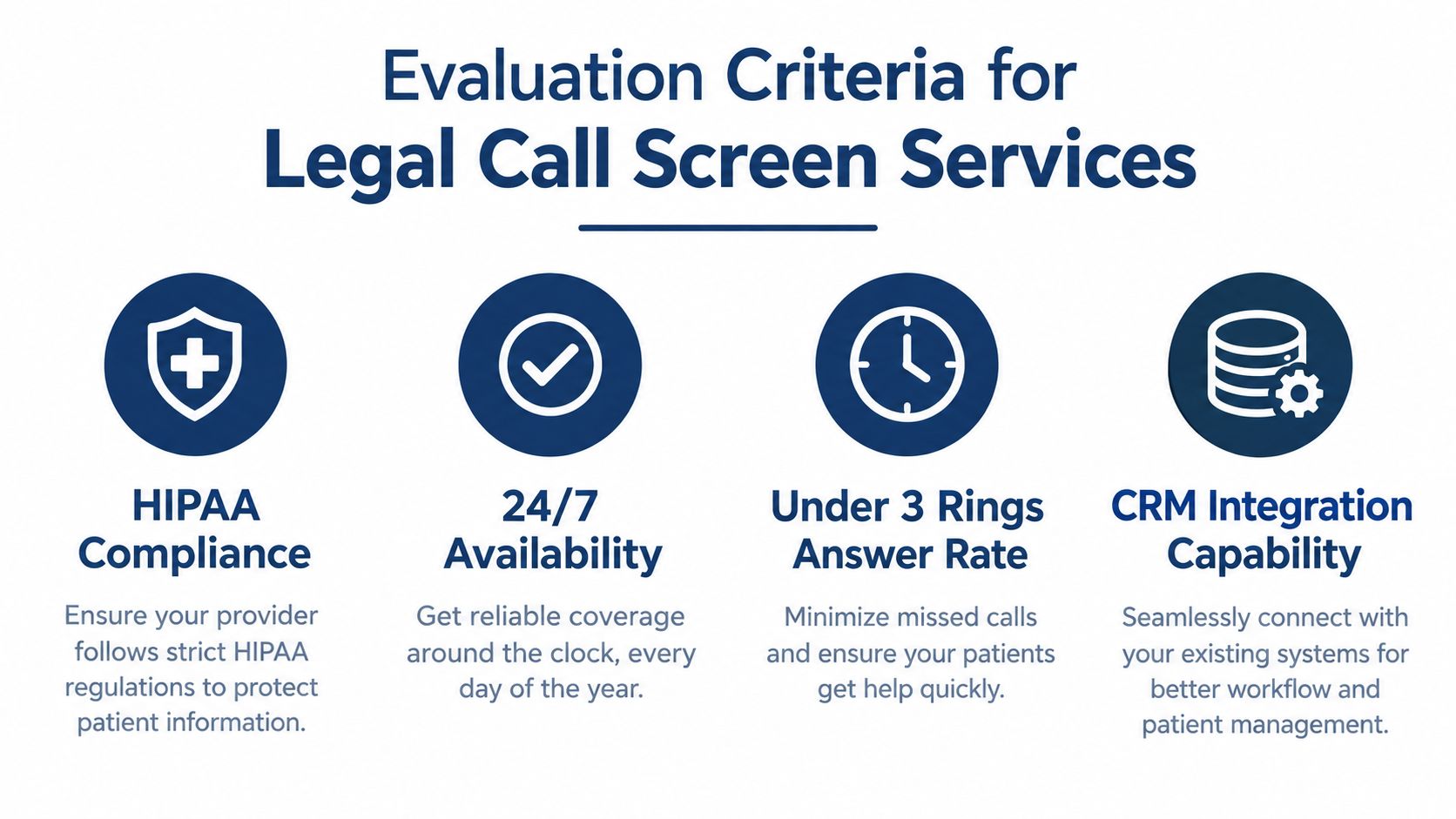
Evaluation Criteria for Legal Call Screen Services
Vendor demonstrations tend to feature polished dashboards and enthusiastic references to AI. Ask a less glamorous question first: what happens to a qualified caller after the call ends?
A practical evaluation should measure the full path from answer to signed matter. One law-firm-focused KPI framework recommends tracking live call answer rate, missed call percentage, call abandonment rate, response time, consultation booking rate, and retained-client rate. It also recommends answering inbound calls in under five minutes during business hours and returning after-hours calls within one hour, as described in this law firm intake KPI framework.
Those measures expose the gap between call activity and business performance. A provider can answer every call and still fail if it books no consultations. A firm can book consultations and still struggle if follow-up stops after one attempt.
Questions that reveal the real product
Independent review frameworks described for 2026 commonly use a weighted composite of roughly 40% features, 30% ease of use, and 30% value, with outcomes tied to call-disposition logs rather than vendor promises, according to this call-screening evaluation framework. The weighting is less important than the discipline behind it. Require evidence of what the system records and what the team does next.
Ask vendors:
- Disposition detail: Can the system record qualified, unqualified, consultation booked, callback required, conflict concern, and retained-client outcomes?
- Caller control: Can staff identify, route, block, and prioritize callers using rules that match the firm's practice areas?
- Workflow automation: Does a qualified call create a CRM record, task, alert, or appointment without rekeying?
- Transcription and review: Can managers inspect transcripts or call summaries for quality assurance and script improvement?
- Follow-up ownership: Who contacts a lead after the first conversation, and how does the system prove that contact occurred?
RingCentral and Dialpad are useful examples of enterprise tools that combine screening with routing rules, administrative controls, transcription, and analytics. Twilio illustrates a different model, an API-first platform valued for programmable screening logic and caller-data-based routing. The right choice depends on whether the firm needs configurable infrastructure or an operating team that performs the intake work.
Handling After-Hours and Compliance-Sensitive Intake
Friday night creates a simple test. A caller reaches a family law firm after an arrest, a personal injury prospect calls after a weekend collision, and a Spanish-speaking prospective client needs help before Monday. The firm doesn't need a cheerful message saying someone will call soon. It needs urgency detection, language support, secure data handling, and a clear handoff.
A generic call center may gather a name and telephone number. That can be better than silence, but it leaves the firm to determine what happened, whether the matter fits, and whether the caller is still available. A specialized legal intake team should follow the firm's criteria, identify urgency, gather structured facts, and route the matter according to the established workflow.
After-hours is a workflow, not a schedule
Recent legal-service materials emphasize 24/7 triage, bilingual intake, encrypted systems, and privilege protocols, showing that buyers need more than routing, as discussed in this legal call answering resource. Those controls need to appear in the operating procedure, not merely in a sales presentation.
For after-hours calls, define:
- Urgency categories: Specify what requires an immediate warm transfer, an on-call attorney alert, or a scheduled callback.
- Language handling: Make English and Español coverage explicit, and document how other language needs are escalated.
- Confidentiality controls: Limit access to sensitive information, establish secure handoffs, and confirm how transcripts and recordings are stored.
- Conflict information: Capture the names needed for the firm's conflict process before promising a consultation or transfer.
- Next-action ownership: Assign a person, queue, or calendar event. “Someone will review it” is not an owner.
Call recording and transcription require particular care. Consent requirements can vary by state and become more complicated when participants are in different jurisdictions. Firms should confirm their policies with qualified counsel and make disclosure and consent part of the call workflow where recording is used.
The hard question is whether the screening process creates false negatives. A caller who sounds vague may still have a viable matter. Attorney-defined criteria and regular script updates based on accepted and rejected calls are more reliable than a static script written once and forgotten.
For a practical look at coverage beyond ordinary business hours, review these after-hours answering services considerations. The operational standard is simple: the caller shouldn't have to understand the firm's staffing problem before receiving a useful next step.
Integrating Call Screening with Case Workflows and CRM
A call screen service is only as good as the data it delivers to the firm. If intake lives primarily inside someone's memory, the firm has built the world's least reliable CRM. Memory is impressive right up until the person carrying it takes a vacation.
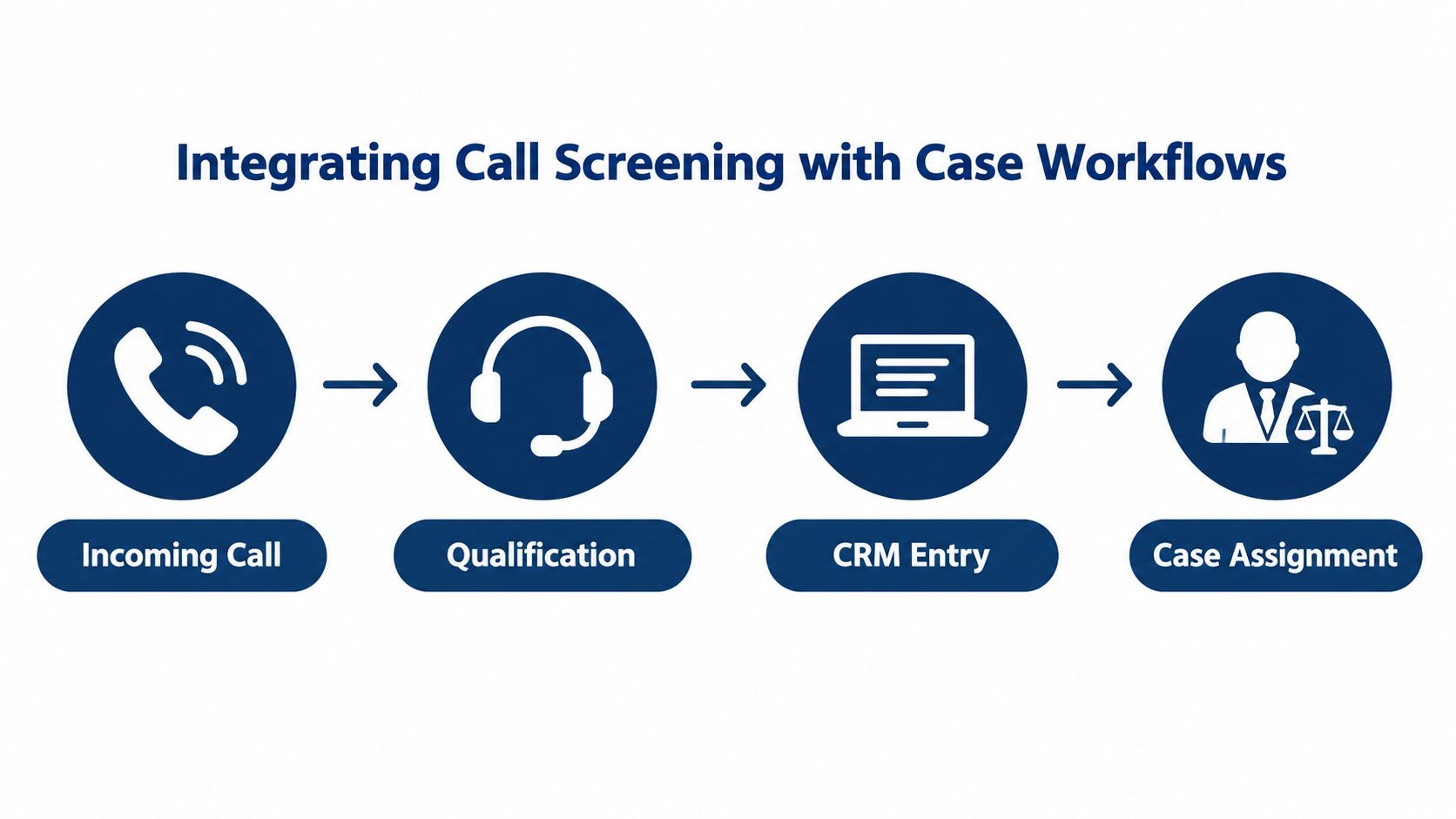
Build the handoff in four stages
First, capture the call as a structured event. Record the caller's contact details, source, practice area, location, urgency, relevant facts, and disposition. Free-text notes have their place, but they shouldn't carry the entire process.
Second, qualify against written criteria. The intake team needs clear rules for acceptable matters, referral matters, conflicts, geographic limits, and escalation. Attorneys should approve the criteria. They shouldn't be expected to reinvent them during every phone call.
Third, create the CRM record automatically or immediately. The entry should include the next action, owner, deadline, and relevant transcript or summary. A spreadsheet can hold information. It doesn't reliably manage accountability unless someone has built a disciplined process around it.
Fourth, assign and monitor the matter. Route urgent inquiries to the on-call attorney, schedule consultations, and place nurture leads into a defined follow-up sequence. Managers should review dispositions and unfinished tasks, not merely count answered calls.
Use your case platform as the system of record. This case management system guide can help firms think through the relationship between intake data, matter workflows, and staff responsibilities.
Prevent the black hole
A qualified lead can still disappear after a perfect call. The usual culprit is a broken handoff, such as a message in a shared inbox, a note in a spreadsheet, or a task assigned to “the team.” Give every lead one owner and one next action.
Review failed handoffs during quality assurance. If callers repeatedly provide information that never reaches the case-management system, fix the integration or the procedure. If staff repeatedly reject matters that later look viable, update the script. Screening should become more accurate through feedback, not fossilize into a script nobody trusts.
The Operational Cost of Poor Call Screening
Poor call screening looks inexpensive because its invoice is often small. Its real cost appears in lost consultations, interrupted attorney days, duplicated staff work, and opportunities that move to another firm without notice.
Clio's press materials report that lawyers spent, on average, 48% of nonbillable time on administrative tasks and 33% on business development, while 41% of law firm respondents said they would use extra time to look for clients, as reported in the second Legal Trends Report press release. A phone process that creates more administrative work is not helping the firm grow. It's adding another small leak to a system already full of them.
Thomson Reuters Institute found that 41% of partners rated reducing hours worked but not billed as “extremely important,” reinforcing that firm leaders are focused on reducing nonbillable work rather than just adding staff, according to this law firm billing write-downs report.
Treat intake as capacity planning
Frontline should capture and convert the opportunity. Staffline should carry the repeatable operational work after the matter enters the firm. That division is more sensible than asking attorneys to answer every call, chase every prospect, open every file, and still maintain a billable practice.
The value isn't limited to the number of calls answered. It includes cleaner records, fewer interruptions, clearer ownership, and a reliable bridge from signed matter to active case support. Frontline signs the case. Staffline carries it.
A firm should audit three things before changing vendors: which calls go unanswered, how long qualified leads wait, and where attorney or staff time disappears after intake. The answers usually identify whether the bottleneck is coverage, qualification, follow-up, CRM discipline, or case administration.
Choosing the Right Call Screen Service for Your Firm
A solo firm with modest daytime volume may start with an auto-attendant and a documented callback process. If callers regularly reach voicemail, the next step is a live receptionist or virtual service that can capture basic information consistently. Don't buy complex routing to compensate for an intake process nobody has defined.
A growing small or mid-sized firm needs more. If the firm handles urgent matters, advertises outside business hours, serves multilingual communities, or struggles to maintain follow-up, choose a specialized legal intake team with 24/7 live coverage, qualification, structured follow-up, CRM handoff, and clear escalation rules. Coverage without conversion is just a more efficient way to collect disappointing messages.
Assess the public-facing experience too. A firm that wins cases but ignores unanswered calls creates a credibility gap, which is why operational phone performance belongs alongside lawyer online reputation management. Reputation isn't repaired by a polished website if the phone still behaves like a locked side door.
The recommendation is practical. Audit missed calls, response time, consultation bookings, and retained-client outcomes. Then select the call screen service that can show how each disposition becomes a next action, not merely how attractive its dashboard looks.
Attorney Assistant provides Frontline, a 24/7 live intake team for answering, qualifying, following up with, and signing appropriate cases, plus Staffline, dedicated full-time legal support professionals who work inside the firm's workflows. Visit Attorney Assistant to evaluate where your intake and case-support capacity is breaking down, and decide whether a co-managed operating team fits the gap.
Related Articles

Live Virtual Receptionists for Law Firms: A Practical Guide
Learn how live virtual receptionists help law firms capture more leads, qualify intake, and operate 24/7 without adding attorney workload.

How to Improve Your Voice for Court and Calls
Learn how to improve your voice for depositions, court, and client calls. Practical vocal techniques and operational fixes to stop losing your voice by 3 PM.
Case Processing Summary: Accelerate Your Law Firm Workflow
Learn how a case processing summary optimizes your law firm workflow, reduces delays, and keeps every case moving toward resolution in 2026.