Client retention step by step for PI law firms

TL;DR:
- Effective client retention in personal injury law relies on disciplined follow-up and structured communication, not just initial outreach. Building the right infrastructure, including dedicated roles, portals, workflows, and feedback mechanisms, is essential for consistent execution. Ongoing engagement, post-settlement contact, and clear metrics ensure firms foster loyalty, encourage referrals, and avoid silent treatment after case closure.
Personal injury law firms spend thousands generating new leads, yet retention depends heavily on disciplined follow-up cadences, not just initial outreach. That means the revenue you are losing is not hiding in your ad budget. It is hiding in your intake process, your follow-up gaps, and the silence that follows a signed retainer. This guide breaks down client retention step by step so your firm can build a repeatable system that converts signed clients into loyal advocates, and turns satisfied clients into your most reliable referral source.
Table of Contents
- What you need to build a retention-first client intake system
- Step-by-step: The PI law firm client retention playbook
- Discipline and cadence: How to avoid intake drop-offs
- Tracking retention: Key metrics PI firms must monitor
- Aftercare: Preventing the “silent firm” effect post-settlement
- Why “client retention” should mean more than just repeat business
- Streamline your firm’s retention: Proven solutions for every step
- Frequently asked questions
Key Takeaways
| Point | Details |
|---|---|
| Immediate response is critical | Contact new PI clients within 24 hours to set the tone for retention. |
| Follow a structured cadence | Scheduled check-ins tied to case milestones prevent drop-off and boost trust. |
| Leverage technology | Portals, e-signatures, and automated touchpoints reduce friction and improve outcomes. |
| Aftercare secures referrals | Stay in touch post-case to unlock referrals and sustain client relationships. |
| Track what matters | Monitor response times, reviews, referrals, and engagement—not just case completions. |
What you need to build a retention-first client intake system
Before you execute any retention playbook, you need the right infrastructure in place. Skipping this step is like building a follow-up schedule with no one assigned to run it.
Here are the core prerequisites every PI firm needs:
- Dedicated intake role or technology. Someone or something must own the first 48 hours after a client signs. This is not the attorney’s job.
- Client communication portal. Portal-enabled transparency reduces communication friction during and after a matter, which directly supports retention.
- Intake workflow templates. Standardized scripts and email sequences remove the guesswork and keep communication consistent across your team.
- Feedback mechanism. A simple post-case survey or check-in call gives you data on where your process breaks down.
The table below maps each retention tool to its function and the role responsible for it:
| Tool or resource | Primary function | Who owns it |
|---|---|---|
| Client portal | Case updates, document access | Intake coordinator |
| E-signature software | Fast, frictionless onboarding | Admin or intake team |
| Online intake forms | Capture complete client data | Intake coordinator |
| Follow-up email sequences | Scheduled touchpoints | Intake or admin role |
| Post-case feedback survey | Identify friction and satisfaction gaps | Firm management |
Technology-enabled intake and communication can measurably improve conversion and revenue outcomes for solo, small, and mid-sized firms. That is not a future-state observation. It is a benchmark reality for firms that have already made the shift.

Understanding intake onboarding essentials is the first move. From there, building out your intake communication strategies gives you the specific scripts and timing your team needs to execute consistently.
When clients are considering choosing a personal injury attorney, responsiveness and clarity are among the top factors. Your intake system either reinforces or undermines that first impression.
Pro Tip: You do not need to build everything at once. Start with one improvement, such as reducing your first response time to under one hour, and layer in additional steps as your team adjusts.
Step-by-step: The PI law firm client retention playbook
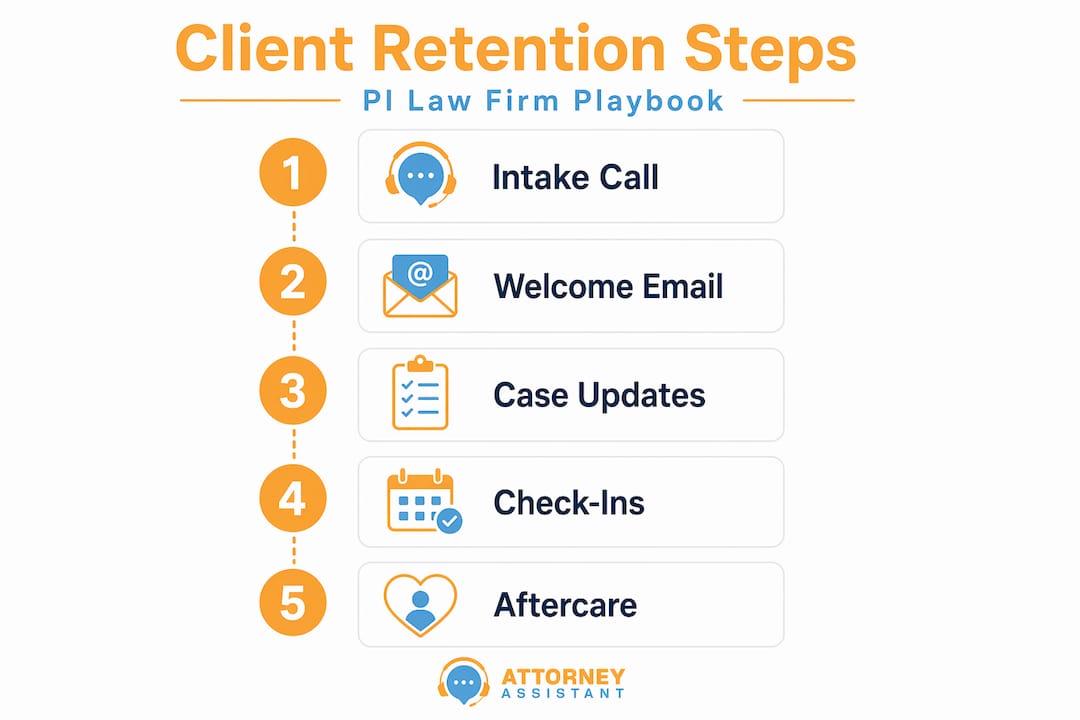
Once your foundation is set, you can execute a structured retention sequence. A PI firm retention system should start immediately after signing and move into scheduled check-ins tied to predictable case milestones.
Here is the full sequence:
- Day-of welcome call. Within hours of signing, a team member calls to introduce themselves, confirm next steps, and set expectations for communication frequency. This call takes five minutes and eliminates the most common early complaint: “I never heard from anyone.”
- Day 2 to 3: Document and portal setup. Get the client into your portal, confirm their login, and upload any initial case documents. This is where e-signature and online forms earn their value.
- Post-medical update check-in. After the client completes their initial medical appointments, follow up to acknowledge that milestone and explain what happens next. Most PI clients are anxious at this stage. A brief call or message goes a long way.
- Monthly touchpoints. A short email or call each month, even when there is no case news, signals that the firm is active and attentive. This is one of the most overlooked client engagement tips in PI practice.
- Post-demand notification. When the demand letter goes out, tell your client. Explain what it means in plain English. Clients who understand the process feel more confident and are far less likely to second-guess their choice of firm.
- Settlement or resolution call. Walk the client through the outcome, the numbers, and the timeline for receiving funds. Do not let this moment happen over email alone.
- 30-day post-close check-in. One month after the case closes, reach out to ask how the client is doing. This is the step most firms skip entirely, and it is the one that generates referrals.
Ongoing client education and personalization, plus structured aftercare, reinforce retention for PI firms specifically. Plain-English communication at every stage is not just good service. It is a retention strategy.
The comparison below shows what the client experience looks like with and without this system:
| Stage | Without a retention system | With a retention system |
|---|---|---|
| Day of signing | No follow-up | Welcome call, portal setup |
| Post-medical | Client calls in, frustrated | Firm reaches out proactively |
| Monthly | Silence | Brief update or check-in message |
| Post-demand | Client hears nothing | Firm explains the process |
| Post-close | No contact | 30-day check-in, referral opportunity |
Mastering legal intake is what separates firms that convert and retain from those that constantly chase new volume. And for clients navigating an injury lawyer search in 2026, the firms that communicate clearly and consistently are the ones that earn five-star reviews and word-of-mouth cases.
Pro Tip: Assign each step to a specific role. The intake coordinator owns Days 1 through 14. The case manager owns monthly touchpoints. The attorney owns the demand and settlement calls. When everyone knows their lane, nothing falls through.
Discipline and cadence: How to avoid intake drop-offs
Knowing the steps is one thing. Following through on them consistently is where most firms fail. The gap between “we have a process” and “we execute the process every time” is where clients quietly lose confidence.
Here is a practical follow-up schedule for new sign-ups:
- Day 1: Welcome call and portal setup (urgent, same day)
- Day 2: Confirmation email with case summary and contact information
- Day 5: Check-in to confirm medical appointments are scheduled
- Day 14: Status update, even if there is nothing new to report
- Monthly: Brief touchpoint tied to case activity or general check-in
Not every client will be ready to engage immediately. Some are still processing the accident, dealing with medical appointments, or simply not phone-friendly. Build in flexibility. If a client does not respond to a call, follow up with a short text or email. The goal is presence, not pressure.
“Retention depends heavily on disciplined intake follow-up cadences and fast response expectations, not just initial outreach.” Lexology
Communication gaps are the single biggest driver of client dissatisfaction in PI cases. A client who does not hear from their firm for three weeks will not wait patiently. They will call other firms, post frustrated reviews, or simply disengage. Disciplined cadence prevents that.
Understanding how intake shapes client experience is foundational here. Pairing that with a clear client communication guide gives your team the structure to execute without burning out or missing touchpoints.
Tracking retention: Key metrics PI firms must monitor
Once your cadence is running, you need to verify it is working. A retention metrics approach for PI firms focuses on measurable relationship outcomes, not just whether clients come back for another case.
The key metrics to track:
- First response time. How quickly does your team respond to a new inquiry or signed client? Under one hour is the benchmark.
- Referral rate. What percentage of closed cases generate a referral? This is your most honest retention signal.
- Reviews per closed case. If you close 20 cases and get one review, your aftercare is missing.
- Email open and reply rates. Low engagement on your touchpoint emails signals the messages are not landing.
- Client portal logins. If clients are not using the portal, they are not feeling informed. That is a friction problem.
| Metric | What it tells you | Target benchmark |
|---|---|---|
| First response time | Speed of intake process | Under 1 hour |
| Referral rate | Quality of client relationship | 20% or higher of closed cases |
| Reviews per closed case | Post-close satisfaction | 1 review per 5 to 10 cases |
| Portal login frequency | Communication effectiveness | At least 1 login per case milestone |
| Email engagement rate | Touchpoint relevance | 35% open rate or higher |
Tracking these numbers monthly gives you a clear picture of where your law firm retention metrics are improving and where process friction is costing you referrals.
Aftercare: Preventing the “silent firm” effect post-settlement
Case closed does not mean relationship closed. This is the most common mistake PI firms make, and it is entirely preventable.
“There is a recurring communication gap risk after settlement: the perception that the firm goes silent can suppress referrals even when the client is satisfied.” Walker Advertising
Clients who had a positive experience will refer friends and family, but only if they remember you. Silence erases that memory faster than you think. Here is a practical aftercare checklist:
- Send a handwritten or personalized thank-you note within one week of case close.
- Add the client to a quarterly newsletter that shares legal tips and firm updates.
- Send a holiday card in November or December with a brief personal note.
- Set a 6-month reminder to check in informally, especially if the client had significant injuries.
- When a referral comes in from a past client, call to thank them personally. That call generates more referrals.
Clients who receive proper post-settlement communication are significantly more likely to recommend their attorney. The investment is minimal. A quarterly newsletter and two check-in calls per year cost almost nothing compared to the value of a single referred case.
Why “client retention” should mean more than just repeat business
Here is the uncomfortable truth most retention guides avoid: in personal injury law, repeat business is the wrong metric to optimize for.
Most PI clients will never need your firm again. That is a good outcome for them. If you are measuring retention by whether clients return for another case, you are measuring the wrong thing entirely. Retention in PI practice is better understood as an outcomes dashboard: referral rate, satisfaction scores, and intake conversion analytics that reveal where friction is costing you cases before they even start.
The firms that build genuine long-term client relationships are not doing it with software alone. They are doing it with staff culture. When your intake coordinator genuinely cares about the person on the other end of the call, that comes through. No CRM can replicate it. Law firm culture and strategy directly influence whether clients feel valued, and that feeling is what drives referrals.
There is also a real risk in overengineering retention. If your quarterly newsletter reads like a mass marketing email, clients will unsubscribe. If your check-in calls feel scripted, they will feel like a sales tactic. Authenticity is not a soft concept here. It is a measurable variable. Clients who feel genuinely remembered refer more. Clients who feel managed do not.
The practical takeaway: invest in retention and loyalty strategies that your team can execute with genuine warmth, not just technical precision. The best retention system in the world fails if the people running it do not believe in it.
Streamline your firm’s retention: Proven solutions for every step
Building a retention system takes structure, consistency, and the right people in the right roles. Most firms already know what they should be doing. The gap is in execution, and that gap costs real money every month.
Attorney Assistant handles intake, follow-up, and administrative workflows so your team can focus on cases instead of chasing down communications. Our intake and reception services ensure every new client is contacted quickly, onboarded properly, and never left waiting. Our lead follow-up solutions keep your pipeline moving without adding to your attorneys’ workload. If you are ready to stop losing clients to slow response times and communication gaps, book a call with us and we will show you exactly where your process is leaking revenue.
Frequently asked questions
How soon should our law firm follow up with new PI clients after signing?
You should initiate a welcome call within 24 hours of signing, then maintain regular check-ins tied to key case milestones. Early contact sets the tone for the entire client relationship.
What are the most important client retention KPIs for PI law firms?
Key metrics include response time, referral rate, reviews per closed case, email engagement, and client portal usage. A retention metrics approach for PI focuses on relationship outcomes, not just repeat cases.
How does a client portal help with retention?
A client portal reduces friction by giving clients transparent access to case updates and documents. Portal-enabled transparency directly supports retention by keeping clients informed without requiring constant attorney involvement.
What is the risk of not following up after case closure?
Neglecting post-closure communication can suppress referrals even when clients are satisfied. The silent firm effect is a well-documented pattern where perceived silence after settlement erodes goodwill and referral behavior.
What if my firm cannot change everything at once?
Start with one improvement, such as cutting your first response time, and build from there. Technology-enabled intake shows measurable gains even when firms implement changes incrementally rather than all at once.
Recommended
Related Articles

The Role of Communication in Client Conversion for Law Firms
Discover the vital role of communication in client conversion for law firms. Boost your client intake with effective strategies and insights.

Case Management Notes: A Law Firm's How-To Guide
Learn how to write case management notes that hold up, with a defensible structure, privilege safeguards, handoff tips, and a smarter way to staff the work.

Medical Records Coordinator: What the Role Actually Does
A medical records coordinator manages records retrieval, summaries, billing, and liens for law firms. Learn duties, KPIs, and when to outsource vs hire.