Master legal intake to boost PI case conversions by 40%

Most personal injury firms believe they need more leads to grow. The real problem is far simpler and more costly: poor intake processes leak revenue from leads already in hand. Firms lose up to $80,000 monthly from slow follow-up, inconsistent screening, and missed after-hours calls. The solution lies not in marketing budgets but in optimizing how you capture, qualify, and convert inquiries. This guide defines legal intake, explains its mechanics, and provides actionable strategies to increase signed retainers by 30% or more through faster response times and smarter workflows.
Table of Contents
- Key takeaways
- What is legal intake and why it matters for personal injury firms
- Core mechanics of an effective personal injury legal intake process
- Best practices for follow-up: timing, channels, and conversion impact
- Navigating intake challenges and balancing human touch with automation
- Boost your firm’s intake success with Attorney Assistant
- What is legal intake? Frequently asked questions
Key Takeaways
| Point | Details |
|---|---|
| Rapid follow up | Faster response times across phone, web forms, chat and text convert more inquiries into signed retainers. |
| Red flag screening | Pre sign screening flags issues like treatment gaps and low insurance limits to avoid unprofitable cases. |
| Structured intake data | Structured data collection ensures readiness for follow up and quicker case evaluation. |
| Revenue lift potential | Improving intake processes can lift signed retainers by thirty percent or more. |
What is legal intake and why it matters for personal injury firms
Legal intake is the systematic process used by law firms to capture and convert potential client inquiries into signed retainers. It begins the moment a lead contacts your firm and continues through consultation, qualification, conflict checking, and retainer signing. For personal injury practices, intake serves as the critical gateway determining which cases enter your pipeline and how many leads slip away to competitors.
Strong intake minimizes lead loss by ensuring every inquiry receives timely, professional attention. It sets clear client expectations about case timelines, fee structures, and next steps. Most importantly, intake directly impacts your conversion rate, the percentage of inquiries that become paying clients. A firm converting 25% of leads versus 40% can see revenue differences exceeding six figures annually, even with identical marketing spend.
Personal injury firms face unique intake challenges due to high inquiry volumes, emotional client states, and complex case evaluation requirements. Prospects often contact multiple firms simultaneously, making speed essential. Clear, scripted processes reduce errors, ensure consistent quality, and allow intake process training to scale effectively across team members.
Key intake components include:
- Inquiry capture across phone, web forms, chat, and text channels
- Initial client information collection and incident details
- Medical treatment history and insurance verification
- Conflict checks against existing clients and opposing parties
- Attorney consultation scheduling and case evaluation
- Retainer agreement execution and file opening
Pro Tip: Track your conversion rate by lead source. If phone inquiries convert at 45% but web forms at 20%, you know where to focus improvement efforts. Most firms discover their follow-up speed on digital leads lags far behind phone handling.
Without systematic intake, firms experience inconsistent client experiences, missed follow-ups, and lost cases to competitors who respond faster. The difference between a 5-minute and 30-minute response time can mean losing a $50,000 case to a firm that simply answered first.
Core mechanics of an effective personal injury legal intake process
Intake forms typically collect client identification, accident details, injury descriptions, medical treatment history, insurance information, witness contacts, and available evidence. A thorough intake call usually requires 10-20 minutes, balancing completeness against client patience. Rushing through critical questions creates gaps that delay case evaluation, while excessive detail exhausts prospects before they commit.

Structured data collection ensures case readiness and efficient follow-up. Essential intake elements include:
| Data Category | Key Information | Purpose |
|---|---|---|
| Client Identity | Name, contact info, SSN, DOB | Conflict checks and file setup |
| Incident Details | Date, location, parties involved, police report | Statute of limitations and liability |
| Injuries | Type, severity, ongoing treatment | Case value estimation |
| Medical History | Prior injuries, pre-existing conditions | Red flag identification |
| Insurance | Policy limits, coverage types, claim numbers | Recovery potential assessment |
| Evidence | Photos, witnesses, documentation | Case strength evaluation |
Pre-sign screening filters viable cases before consuming attorney time. Intake specialists identify red flags like treatment gaps exceeding 90 days, inconsistent accident narratives, prior injuries to the same body part, or insurance limits below $25,000. These indicators help firms avoid unprofitable cases that drain resources without adequate recovery potential.
Post-sign tasks convert signed clients into active files. This phase includes:
- HIPAA authorization forms for medical records requests
- Representation letters to insurance carriers and medical providers
- Insurance policy verification and limits confirmation
- Medical treatment coordination and lien negotiations
- Evidence preservation letters to relevant parties
- Client portal access and case management system setup
Good intake teams include legal intake specialists who manage complexities and client care. These professionals combine legal knowledge with customer service skills, handling emotional clients while gathering accurate information. They understand personal injury case evaluation criteria and can pre-qualify leads effectively, ensuring attorneys review only cases meeting firm standards.
Pro Tip: Create intake checklists for common case types like car accidents, slip and falls, or medical malpractice. Standardized forms reduce missed questions and training time for new staff. Your intake department objectives should include both conversion metrics and data quality standards.
Structured intake processes reduce errors that cause case delays or missed deadlines. When every team member follows the same protocol, clients receive consistent experiences regardless of who answers their call. This consistency builds trust and professionalism, differentiating your firm from competitors with ad hoc approaches.
Best practices for follow-up: timing, channels, and conversion impact
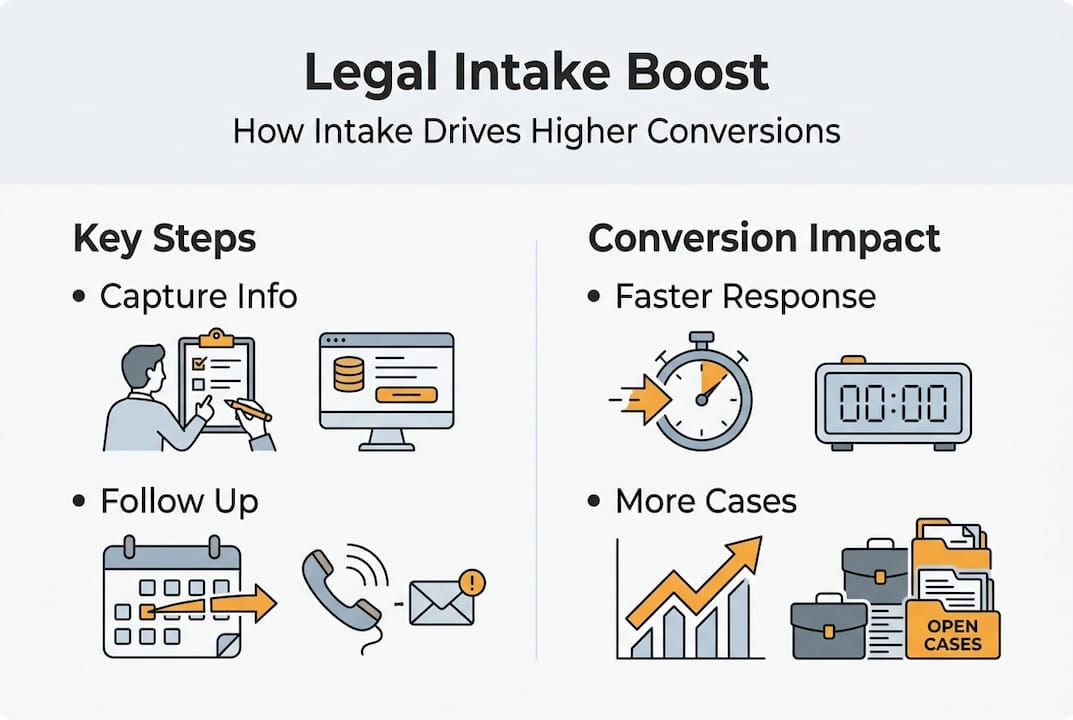
Multi-channel cadences with 3-8 touches over 48-72 hours and under 5-minute response times can increase conversion by up to 40% and yield 300-391% lifts. Speed matters because prospects contact multiple firms simultaneously. The first firm to respond professionally often wins the case, even if competitors offer better terms later. Every minute of delay reduces your conversion probability exponentially.
Immediate response, defined as contact within 5 minutes, boosts conversions almost 4 times compared to 30-minute delays. This speed advantage compounds when combined with multi-channel outreach. A prospect who misses your call might respond to a text, while another prefers email. Using coordinated sequences across channels maximizes engagement without annoying contacts.
Effective follow-up sequences typically include:
- Initial contact attempt within 5 minutes of inquiry
- Follow-up text message within 15 minutes if no answer
- Second call attempt 2-4 hours later
- Email with case evaluation information within 24 hours
- Third call attempt on day 2
- Final outreach on day 3 before marking lead cold
Automated reminders reduce unsigned leads and drop-off. Many prospects express interest but delay signing retainers due to busy schedules or decision paralysis. Automated systems send appointment reminders, retainer follow-ups, and document requests without manual staff effort. This automation prevents leads from going cold while freeing intake specialists to focus on live conversations.
| Follow-up Speed | Conversion Rate | Revenue Impact |
|---|---|---|
| Under 5 minutes | 35-45% | Baseline |
| 5-30 minutes | 20-30% | 30% revenue loss |
| 30-60 minutes | 10-20% | 55% revenue loss |
| Over 1 hour | 5-15% | 70% revenue loss |
Scripts create urgency and professionalism, improving results. Well-crafted scripts guide intake specialists through qualification questions while maintaining conversational tone. They ensure consistent messaging about fee structures, case timelines, and next steps. Scripts also help newer staff handle objections and difficult questions confidently, reducing training time and improving quality.
Tracking missed calls and lead loss areas informs continuous improvement. Most firms discover 40-60% of inquiries arrive outside business hours. Without after-hours coverage, these leads go to competitors. Call tracking reveals which marketing sources generate highest-quality leads versus tire-kickers, allowing smarter budget allocation. Review intake follow-up scripts regularly to identify language that resonates versus phrases that create friction.
Pro Tip: Implement a lead response dashboard showing average response time, conversion rate by channel, and follow-up completion percentage. Public visibility creates healthy competition among intake staff and quickly identifies process breakdowns. Firms using these dashboards typically see 20-30% conversion improvements within 90 days. Understanding intake specialist benefits helps justify investment in dedicated follow-up resources.
Navigating intake challenges and balancing human touch with automation
Common red flags require careful screening to avoid unprofitable cases. Prior injuries to the same body part complicate causation arguments and reduce settlement values. Inconsistent accident narratives suggest credibility problems that juries will notice. Treatment gaps exceeding 60-90 days allow insurance adjusters to argue injuries resolved or were not serious. Low policy limits below $25,000-50,000 may not justify case costs, especially with significant medical bills or permanent injuries requiring expert testimony.
Additional warning signs include:
- Pre-existing conditions affecting the same body systems
- Delayed initial medical treatment beyond 72 hours without explanation
- Client shopping multiple firms with identical stories
- Unrealistic settlement expectations or litigation demands
- Incomplete or missing police reports in liability disputes
- Uncooperative or hostile communication during intake
After-hours and overflow leads require flexible intake solutions. AI cuts admin time 30-40% and boosts conversions 35-50%, but human intake specialists excel in nuanced personal injury cases and empathy. The optimal approach combines both: AI handles initial capture, basic qualification, and appointment scheduling, while humans manage complex screening, build rapport, and close retainers.
Forty percent or more of inquiries arrive outside standard business hours. Evening and weekend leads often come from prospects researching options after work or following recent accidents. Without coverage, these high-intent leads go directly to competitors. Solutions include answering services, dedicated after-hours staff, or AI chatbots that capture information and schedule callbacks.
Poor intake causes costly problems beyond lost cases. Bad signups, cases accepted despite red flags, consume attorney time through investigation and case development before firms realize the file lacks merit. These cases tie up resources better spent on strong matters. Mid-size personal injury firms with weak intake processes lose $80,000-120,000 monthly in combined lost cases and bad signups.
Balancing automation and human touch requires strategic role division:
- Use AI for initial inquiry capture and basic information gathering
- Route qualified leads to human specialists for detailed screening
- Automate appointment reminders and document requests
- Reserve attorney time for consultation with pre-qualified prospects
- Implement human quality checks on AI-processed leads
- Monitor conversion rates by intake method to optimize mix
Regular audits detect weak points and optimize processes continuously. Monthly reviews should examine conversion rates by lead source, average response times, common objections, and reasons for declined cases. Call recording analysis identifies training opportunities and script improvements. Successful firms treat intake as an evolving system requiring constant refinement, not a set-it-and-forget-it process. Learning about benefits of intake specialists and traits of great specialists helps firms build stronger teams capable of handling complex screening while maintaining client rapport.
Boost your firm’s intake success with Attorney Assistant
Most personal injury firms lose cases not from bad marketing but from intake execution gaps. Attorney Assistant provides expert intake support tailored specifically to PI practices, combining AI-powered efficiency with high-touch human specialists who understand case evaluation nuances. Our solutions reduce administrative burden by up to 40% while improving client experience through faster response times and consistent follow-up.
Our intake solutions handle the complete process from initial inquiry through retainer signing, ensuring no lead slips away due to slow follow-up or after-hours gaps. Virtual specialists manage overflow and evening calls, while our proven scripts and training frameworks help your team convert more inquiries into signed cases. Join our virtual webinar to see how firms increase signed retainers by 30-50% through optimized intake workflows. Explore our intake reception services to discover how dedicated support transforms your conversion rates and firm profitability.
What is legal intake? Frequently asked questions
What is the typical time required for a legal intake call?
Most personal injury intake calls require 10-20 minutes to gather essential information including accident details, injuries, treatment history, and insurance coverage. Complex cases like medical malpractice or multi-vehicle accidents may need 25-30 minutes. Rushing through intake creates information gaps that delay case evaluation, while excessive length exhausts prospects before commitment.
How soon should firms follow up on new leads?
Firms should contact new leads within 5 minutes of inquiry to maximize conversion rates. Response times under 5 minutes achieve conversion rates 300-400% higher than 30-minute delays. After initial contact, implement a 3-8 touch sequence over 48-72 hours using calls, texts, and emails to engage prospects who missed the first attempt.
Can AI replace human intake specialists?
AI excels at initial capture, basic qualification, and administrative tasks, reducing workload by 30-40%. However, human specialists remain essential for nuanced personal injury case evaluation, building client rapport, and handling emotional prospects. The optimal approach combines AI efficiency with human empathy, using technology for routine tasks while reserving specialists for complex screening and relationship building. Learn more about the legal intake specialist role to understand this balance.
What are common intake mistakes that reduce conversions?
Slow response times, inconsistent follow-up, lack of multi-channel outreach, poor qualification leading to bad signups, and inadequate after-hours coverage are the most damaging mistakes. Many firms also fail to track conversion metrics by lead source, preventing data-driven improvements. Scripting gaps allow inconsistent messaging that confuses prospects or misses closing opportunities.
How to handle after-hours intake effectively?
Implement dedicated after-hours answering services, AI chatbots for initial capture and appointment scheduling, or rotating on-call intake specialists for evening and weekend coverage. Over 40% of inquiries arrive outside standard business hours, making after-hours solutions essential for competitive firms. Automated systems should capture contact information, basic case details, and schedule next-day callbacks to prevent lead loss to 24/7 competitors.
Recommended
Related Articles

How to enhance law firm response time for client conversion
Learn proven strategies to enhance law firm response time and convert more leads into signed cases through CRM integration, automation, and staff training.

Law Firm Support Staff: Structure Smart, Operate Smooth, Achieve More
Law firm support staff play a central role in how a law office runs each day. While attorneys handle legal strategy and case decisions, it’s usually the support team keeping everything organized behind the scenes. They manage documents, keep schedules straight, and talk to clients so attorneys can focus on practicing law. Most firms run on a mix of legal support staff, administrators, and assistants who handle the daily flow of work. They prep files, track deadlines, answer client questions, and help attorneys stay on top of cases. When those roles are clearly defined, the whole law firm management structure works better. And as more firms look for smarter ways to operate, how you organize your law firm staff matters more than ever. This guide breaks down the key support roles and how they fit into a modern firm. What Is Law Firm Support Staff? Walk into any well-run law firm and look past the attorneys. The people rushing around with files, answering phones, juggling calendars, herding clients, and keeping the whole operation running are your law firm support staff. Paralegals, legal assistants, billing specialists, receptionists, and document managers all fall into this group. They make sure deadlines do not get missed, clients do not get ignored, and attorneys do not waste time searching for files or wondering when a hearing is scheduled. They handle the daily chaos so lawyers can focus on practicing law. Good support staff are hard to find, and when you have the right team in place, the entire firm runs the way it should. What Is a Legal Support Staff Structure? A legal support staff structure is simply how a firm organizes its non-lawyer team. It determines who answers to whom, who handles what tasks, and how work like case management, billing, client calls, and tech support actually gets done. Get the structure right, and everything flows. Get it wrong, and you end up with confused staff, missed deadlines, and attorneys wasting time on things they should not have to worry about. Most firms tend to land in one of three basic setups. 1. Centralized Structure Support staff are organized into firm-wide teams. One paralegal group might serve the entire firm. A single billing team handles all invoices. This approach makes it easier to cover absences and lets people focus on what they do best. 2. Decentralized Structure Staff are assigned directly to specific attorneys or practice groups. This builds closer working relationships and more personalized support. The downside is you have to watch for burnout or bottlenecks when someone gets overloaded. 3. Hybrid Structure A blend of in-house employees working alongside remote or offshore team members. This gives firms flexibility to scale up quickly, access specialized skills, and control costs. Some firms use it to cover overnight work, like having offshore staff review documents after hours while local teams handle client calls during the day. Each setup comes with tradeoffs. Most firms mix and match based on their size, their workload, and simply how they prefer to operate. What Roles Make Up a Typical Law Firm Support Staff Structure? A typical law firm support staff structure includes several key roles that work together to keep the firm running while lawyers focus on legal work. These roles cover case support, administration, finance, client interaction, and technology, and they shift depending on firm size and how things are set up. 1. Core Case-Support Roles Paralegals and Legal Assistants They handle legal research, draft documents, manage discovery, and maintain case files. In many firms today, they also handle client communication and keep cases moving day to day. Document and Litigation Support Specialists These people manage electronic filing systems, coordinate document production, and maintain case databases. When trial prep starts, they handle exhibits and presentation materials. 2. Administrative and Office Roles Administrative and Legal Assistants They manage lawyer calendars, schedule meetings, handle correspondence, and are often the first point of contact for clients. They keep daily operations from falling apart. Office and Practice Managers They oversee daily operations and supervise other support staff. In smaller firms, they might handle finance and HR too. In larger firms, they focus more on strategy and efficiency. Office Juniors and Clerks Entry-level staff handling filing, photocopying, data entry, and basic document prep. It is where many people start before moving up. 3. Finance, Front-Desk, and Technical Roles Billing and Accounts Staff They track time, prepare invoices, manage trust accounts, and handle collections. They keep the financial side straight so lawyers do not have to. Receptionists and Front-Desk Staff They greet clients, answer calls, and handle initial intake. They set the tone for how clients experience the firm from the first moment they walk in or call. IT and Operations Staff They maintain systems, handle security, and keep case management software running. When technology breaks, they fix it. 4. Specialized or Larger-Firm Roles Professional Support Lawyers Experienced attorneys who focus on research and training rather than direct client work. Knowledge Management Professionals They maintain databases of precedents and internal guides so staff can work more efficiently. HR, Marketing, and Business Development Teams They handle recruitment, training, firm culture, client relations, and growth efforts. Every firm puts its own spin on these roles based on size, practice areas, and how support staff are organized. Together, these are the people who keep a law firm functional, productive, and focused on clients. Why Is a Strong Law Firm Management Structure Important? A strong law firm management structure just makes everything easier. It sounds like corporate talk, but really it just means everyone knows what they are supposed to do, who they answer to, and how decisions actually get made. When that is clear, work does not fall through the cracks, support staff can actually do their jobs, attorneys stop putting out fires all day, and clients get better service. When it's strong: Tasks are clearly owned, reducing confusion and inefficiency. Deadlines are met with backup coverage in place. Attorneys focus on legal work, not administrative tasks. Workflows are consistent, errors are minimized, and clients have a smooth experience. The firm can grow and adapt because the system is stable and proactive. When it's weak: Tasks bounce between staff members because no one owns them, creating confusion and inefficiency. Deadlines are missed when the responsible person is unavailable and no backup exists. Attorneys spend time on admin, filing, or billing instead of high-value legal work. Workflows are inconsistent, errors increase, and client experience suffers. Firms struggle to grow or adapt because the system is fragile and reactive. What Are the Trends Reshaping Legal Support Staff? The way firms use support staff looks nothing like it did a decade ago. The old model of one assistant per lawyer is fading, and firms are figuring out smarter ways to get work done without simply adding more bodies. 1. Centralized Teams More firms are moving away from one-to-one assignments and building firm-wide support teams instead. Paralegals, assistants, and billing staff work as a group, covering for each other and sharing the load. When someone is out or things get busy, work keeps moving and nothing falls through the cracks. 2. Technology and AI AI tools now handle a lot of the grunt work. Document review, contract checks, and basic research get done faster with software, which means support staff spend less time on repetitive tasks and more time on work that actually matters. The role shifts from doing the work to managing the work and checking what the tools produce. 3. Fewer Support Staff per Lawyer Because of better systems, firms can run leaner without sacrificing quality. The old one-to-one model is giving way to ratios like one support person for every three or four lawyers. Costs stay under control and lawyers still get the help they need. 4. Remote and Flexible Work Support staff do not have to sit in the office anymore. Remote and hybrid arrangements let firms hire from anywhere and give employees the flexibility they want. Cloud-based systems make it easy for people to collaborate whether they are down the hall or across the country. 5. Client Expectations Clients expect faster responses, clearer bills, and predictable costs. That pressure flows straight down to support staff. They have to be organized, responsive, and on top of things. Flat fees and alternative billing models also mean firms have to work efficiently, which changes how support teams are structured. 6. Evolving Roles Paralegals and assistants are doing more than administrative work these days. They handle client communication, oversee technology, and take on strategic tasks. They are not just helpers anymore. They are essential to keeping the firm running. 7. Smarter Organization Firms are getting intentional about structure. Clear workflows, defined responsibilities, and the right technology make sure nothing gets missed. That kind of setup lets firms grow and adapt without everything falling apart when something changes. Why Virtual Legal Staff Fits Modern Firms Virtual legal support just makes sense for how firms operate today. It gives you flexibility, scales up or down when you need it, and costs a lot less than bringing someone in-house. Attorneys get to focus on the work that actually matters, caseload spikes do not wreck your team, and it plays nicely with remote work and AI tools. 1. Cost Savings You skip the big expenses. No office space to find, no equipment to buy, no full-time benefits to carry. You pay for the hours you actually need. That keeps overhead down and payroll under control even when things slow down. Revenue per employee tends to look better too. 2. Scalability and Flexibility Caseloads go up and down. Virtual staff let you ride those waves without over-hiring or burning people out. Cloud tools make it easy to bring in a paralegal, an admin, or someone with a niche skill from anywhere. Bilingual intake, litigation research, whatever you need. Geography does not limit you anymore. 3. Improved Productivity Attorneys get back hours they used to lose to scheduling, billing, or basic research. Virtual teams can also cover different time zones, so work keeps moving after your in-house people log off. Clients stay happy, and your core team does not get run into the ground. 4. Better Client Service Clients respond to faster turnaround and steady communication. Virtual staff can help deliver both. Sensitive information still gets handled securely, and the quality does not drop just because someone works remotely. If anything, availability goes up and risk stays low. How Attorney Assistant Supports Your Virtual Law Firm Staffing Attorney Assistant places virtual staff with law firms who know how legal work flows. These are not general virtual assistants. They handle the administrative and legal support tasks that keep a remote or hybrid firm running. Think of them as an extension of your team, just without the desk space or the payroll taxes. 1. Delegated Tasks Your attorneys stop wasting time on stuff that does not require a law degree. Client intake, scheduling, follow-ups, billing, research. The vetted assistants take it all on. The Intake360 team covers calls 24/7, nurtures leads, and provides relief when things get busy or someone calls in sick. Your people stay focused on billable work. 2. Onboarding Process It starts with a conversation about what your firm needs. Then they hand pick someone who fits and train them on your workflows and systems. No awkward ramp up period. They show up ready to go from day one. Scaling up or down is simple because you are not hiring or firing. You just adjust. 3. Efficiency Gains Firms run smoother when the right people handle the right tasks. Bottlenecks clear out. Attorneys get back to practicing law. The ratios work better too. You get professional, trained support that aligns with how modern firms operate, without stacking up non-billable hours or throwing off your staff to lawyer balance. How Can Virtual Staff Strengthen Your Law Firm's Management Structure? Virtual legal support does more than check off tasks. When you actually build them into how your firm operates, remote staff can tighten things up, improve accountability, and keep work flowing no matter who is where. 1. Defined Roles and Ownership Every task lands with someone specific. Nothing floats around waiting for someone to notice it. That matters even more when half your team is remote. 2. Centralized Coordination Managers can see what is moving and what is stalled across the whole firm. They catch bottlenecks before things back up and keep work pushing forward. 3. Streamlined Workflows When processes are written down, everyone follows the same steps. Does not matter if someone works in your office, from home, or across an ocean. 4. Scalable Oversight New virtual team members plug in without causing chaos. They follow the same systems as everyone else, so adding help does not create confusion. 5. Consistent Client Experience Clients get the same response, the same quality, the same attention from every person on your team. They do not care where someone sits. 6. Supports Strategic Planning Leadership can actually focus on growth and technology and training. Operations run predictably, so you are not always putting out fires. Virtual staff stop being just extra hands when you drop them into a real structure. They become part of a system where everyone knows their role and work gets done. Transform Your Law Firm with Smart Support Structure and Virtual Staff Running a law firm means managing cases, clients, calendars, and paperwork. For most attorneys, the breaking point comes when they realize they cannot do it all alone. That is where the right support structure changes things. How you organize your law firm support staff determines whether your firm runs smoothly or deals with constant disruptions. Clear roles, smart workflows, and the flexibility to scale up keep everything on track. Virtual staff who know legal work have become a practical piece of that puzzle. Attorney Assistant places experienced virtual staff who integrate with your team. Reach out and see how they elevate your firm’s operations. Frequently Asked Questions What is support staff in a law firm? Support staff are the people in a law firm who are not lawyers but help everything run well. They handle the daily office tasks so the lawyers can focus on their cases. These workers include paralegals, receptionists, office managers, and IT staff who keep things working. What is an assistant in a law firm called? An assistant in a law firm is usually called a legal assistant or a legal administrative assistant. This person helps lawyers by answering phones, scheduling meetings, and organizing papers. Some firms use other names like practice assistant or litigation assistant depending on the job.
Applications for Lawyers Working Smarter in a Digital Legal World
Running a law firm today is nothing like it was ten years ago. Reputation can’t do all the work on its own. Clients expect fast responses, easy communication, and systems that keep the office running without constant interruptions. That is where applications for lawyers step in as practical tools that make daily legal work more manageable. Legal apps help organize files, track deadlines, stay in touch with clients, and handle routine tasks. A well-chosen law app gives clear insight into priorities and more time to focus on the work that drives the firm forward. What to Look for When Choosing Apps for Your Law Firm Picking the wrong app is easy. There are a lot out there, and most look good in a demo. But the wrong tools just get in the way. They slow down your team and cost more than they save. Good apps should fit how you work and give you back time. 1. Ease of Use Some apps look great but are a headache to use every day. If your team needs to call IT every time they open it, that app is costing you money. Simple tools cut down on mistakes. People actually use them. Things that matter: Can someone figure it out in five minutes? Does it need training just to do basic stuff? Is the support team helpful when something goes wrong? 2. Fewer Apps, Better Results Adding a new app for every problem gets messy fast. Soon you have ten logins, five invoices, and a confused team. Fewer tools mean less to manage and less to pay for. What to think about: Can one platform handle case management, billing, and workflow? Does the pricing make sense for your size? (Most run $39 to $99 per user.) Does this tool solve something real or just add another tab to someone’s browser? 3. Teamwork That Works If your team can’t share files easily or see updates in real time, you’re working blind. Good apps make collaboration feel easy. Bad ones create confusion and delays. Look for: Real-time access from anywhere. Tools that work with Microsoft 365 or whatever you already use. Client portals so communication stays in one place. 4. Security and Compliance Client information is sensitive. If something leaks, it can create real legal trouble. The lawyer apps you bring in need to take this seriously. Things to check: Does the app meet HIPAA, GDPR, or state bar rules? Is data encrypted and access limited to the right people? Can you see who did what and when? 5. Integration with What You Already Use An app that won’t talk to your billing software or calendar creates extra work. You end up entering things twice. That’s where mistakes happen. Good apps connect to what you already have. Ask about: Whether it works with your billing system and calendar. Testing it out before committing. 6. Growing Without Breaking the Bank Your firm will change over time. You want lawyer apps that can grow with you without surprise price jumps. Keep an eye on: Pricing that lets you move up as you grow. No hidden fees. Whether the tool still makes sense six months from now. What Types of Apps Should Law Firms Consider? You don’t need flashy gimmicks to run a successful firm. What matters are apps that solve the problems you deal with every day. Here are five categories that help. Case management apps built to handle everything in one place. Communication apps to keep you and your clients in touch. Timekeeping apps made for tracking hours and deadlines. Dictation apps so you can stop typing so much. Productivity apps that help your team stay on top of things. Some of these help any business, and some are built specifically for law firms. They help you stay on top of things without adding more clutter. Best Applications for Lawyers for Modern Law Firm Operations Phones and laptops are part of the job. But not all technology makes work easier. The right apps help you move cases forward, respond to clients faster, and manage tasks without all the paperwork. Below is a list of apps that support real legal work. Some are built for law firms. Others just fit well into a legal practice. They all make daily work more organized and less of a hassle. 1. Practice Management Clio Clio is cloud-based software that lets you run your firm from anywhere. You can access client information, track billable time, manage cases, and add new contacts on your phone or laptop. It connects with more than 250 other legal apps, so billing, document management, and client communication all live in one place. Many firms use it as the central hub for their daily operations. Fastcase Fastcase gives you access to a large mobile law library at no cost. You can look up case law, read opinions, and research legal questions from anywhere without expensive database subscriptions. It integrates with Clio to automatically track time spent on research, so those hours don’t slip through the cracks. For attorneys who need quick answers on the go, it’s a practical research tool. 2. Time-Tracking Apps TimeSolv Some firms piece together separate apps for billing, expenses, and accounting. TimeSolv wraps it all into one place. It’s built for legal work, so it handles trust accounting and invoicing the way law firms need. The whole thing lives in the cloud, which means you can check numbers or run reports from home or on the road without digging through files at the office. Toggl Toggl keeps things simple. You click a button when you start working, click it again when you’re done, and it logs the time. The free version gives you enough to get started, and the Chrome extension makes it easy to track as you bounce between email, research, and documents. Later, you can run reports to see where the day actually went. It plays nicely with about a hundred other apps, so you don’t have to rearrange your whole setup just to use it. 3. Document Review and Annotation iAnnotate Documents come at you from all directions. Clients email them. Courts post them. Opposing counsel sends them through portals. iAnnotate pulls everything together from Dropbox, Google Drive, and other places so you have one spot to find what you need. You can markup files on your phone, tablet, or computer, and the changes show up everywhere. It handles client materials without security issues, which matters more than it used to. GoodReader If you deal with PDFs all day, GoodReader is worth a look. You can redline language, highlight sections, and drop comments right on the page without converting files or printing anything out. It links to Dropbox, so briefs and discovery documents stay organized instead of floating around in email attachments. When a partner sends you a 200-page brief at 9pm, it opens fast and lets you get to work. 4. Cloud Storage OneDrive If your firm already pays for Microsoft Office, OneDrive comes with it. You open files from your phone or laptop, and they look the same as they do at your desk. Sharing a document with a client takes a few clicks, and you control whether they can edit or just view. Everything stays backed up without thinking about it. Dropbox Dropbox just works. You drop files into a folder, and they show up on your computer, phone, and the web. Need to send something to opposing counsel? Right click, copy link, paste in email. They can’t mess with the original file, and you don’t have to worry about attachment size limits. Google Drive Google Drive is for firms that collaborate. Two people can look at the same document at the same time and see each other’s changes as they happen. No more emailing drafts back and forth or wondering if you’re looking at the latest version. Everything lives in your browser, so there’s no software to update or manage. 5. Note-Taking Apps Evernote You take notes everywhere. In meetings, at court, on your phone between calls. Evernote puts all of it in one place. The search actually works, even on scanned documents and business cards. If you use Clio, it cleans up scanned files and turns cards into contacts without typing anything. Pull up whatever you need from your phone or laptop, and it’s there. Microsoft OneNote OneNote is just a bunch of digital notebooks. You make one for each case, add sections for research or client meetings, and start typing. It works with Outlook and Word so you can drop emails or draft language in without copying and pasting. Record audio during a meeting, and it sits right next to your notes. Otter.ai Otter sits in meetings and depositions and writes everything down. You talk, and it types. Later you search for whatever the client said about deadlines or what the witness admitted. Add notes or highlight parts while you review. You actually watch the room instead of your notepad. 6. Calendar and Scheduling Apps Google Calendar You probably already have it if you use Gmail. Drop in appointments, set reminders so you don’t miss deadlines, and share your calendar with staff so they know where you are. When someone emails you, Google spots dates and asks if you want to create an event. It runs on your phone and laptop, so changes show up everywhere. Microsoft Outlook Calendar and Bookings Outlook Calendar lives inside the email you’re already using. Someone emails about a meeting, you click and pick a time without leaving the message. The Bookings piece lets clients see when you’re free and grab a slot themselves. It sorts out time zones, so you don’t show up an hour early or late. Calendly Calendly cuts out the email chain where you say Tuesday at 10; they say how about Wednesday, you say Wednesday works but not until after 2. You set your available times, send a link, and they pick what works for them. It checks your calendar so nobody double books. Handles time zones automatically so a client in another state doesn’t accidentally schedule at 5am your time. 7. Communication and Video Skype Skype has been around long enough that most people already have it. You can call clients on video from your laptop, send quick messages instead of formal emails, or ring someone in another country without running up a phone bill. It works on phones and computers, so you can take a call from wherever you are. Slack Email chains get long, and things fall through the cracks. Slack puts conversations in one place where you can actually follow them. You set up channels for different cases or topics, share files without attaching them to messages, and jump on a quick video call when email back -and-forth stops making sense. Remote staff stay looped in because everything lives in the app instead of someone’s inbox. 8. Project Management Tools Trello Trello shows you everything that’s sitting on someone’s desk. Each case or task gets its own card, and you move cards across the board as work progresses. Draft a motion, move it to reviewing. Get notes back, move it to revisions. File it, move it to done. Everyone on the team sees where things stand without asking for updates. It’s simple enough that you don’t need training to use it. Notion Notion puts case notes, task lists, firm policies, and draft documents in one place. You set it up however makes sense for your firm. Everything is searchable, so you’re not digging through old emails for something you wrote months ago. An optional AI piece summarizes meeting notes or pulls information from Slack and Google Docs. Some firms find it saves time hunting down scattered information. 9. Legal Research and Automation Zapier You do the same things over and over. Email attachments get saved to Drive. New client forms mean typing the same info twice. Zapier handles that thing automatically in the background. The free plan covers basics, and paid plans start around $20. Feedly You need to know what’s happening in your practice areas but don’t have time to check twenty websites. Feedly pulls court rulings, industry news, and updates into one feed. You organize by topic and skim what matters. It turns legal research into just reading what shows up. 10. Password Management and Security 1Password You have passwords for court filings, client portals, banking, and a dozen other sites. 1Password creates strong passwords for every account and locks them in an encrypted vault. You only remember one master password, and the app fills in the rest on your phone, laptop, or tablet. Personal plans run $36 a year, and there’s a free trial to see if it works for you. Utilize the Right App for Attorneys in Your Firm The right applications for lawyers help your team stay on top of cases, communicate with clients, and handle daily work without the extra stress. Start small. Pick an app for attorneys that actually fits how your firm runs and add more as you go. If managing all this tech becomes its own job, Attorney Assistant connects you with virtual assistants who already know these tools. They get everything running, show your team the ropes, and sort out any issues along the way. Ready to stop wrestling with these legal apps? Give us a call. Frequently Asked Questions What applications do lawyers use? Lawyers use apps to manage cases, do legal research, handle documents, and bill clients. Most firms rely on practice management tools to keep everything organized in one place. They also use tools for research, e-signatures, payments, and virtual meetings. What apps are good for law? Clio is a solid choice because it handles your calendar, billing, and client paperwork without jumping between different programs. For research, Westlaw is the go-to app to quickly find the legal answers you need. And when it comes to money, LawPay is built specifically to handle legal payments and keep client funds separate and safe. What is the 80/20 rule for lawyers? It means that most of your results come from just a small part of your work, like 80% of your income coming from 20% of your clients. So instead of saying yes to everything, focus your energy on the few clients and cases that actually make you money. It also means you should hand off small busywork to others, so you have time for the big stuff that really matters.