AI in law firm intake: 35% higher conversion rates

TL;DR:
- AI can significantly increase personal injury law firm conversion rates and qualified leads.
- Automation of routine tasks and 24/7 inquiry handling improve efficiency and client engagement.
- Proper implementation requires clear workflows, human oversight, and adherence to compliance and ethical standards.
Personal injury law firms are sitting on a conversion crisis they cannot see. Empirical benchmarks show AI lifts conversion rates from 10% to 35%, delivers 280% more qualified leads, and slashes intake time by over 60%, yet most firms are still relying on voicemail, spreadsheets, and staff who are stretched too thin. The result is a pipeline that leaks revenue at every stage. This guide breaks down exactly how AI transforms intake for small and mid-sized PI firms, what the technology can and cannot do, and how to roll it out without the guesswork.
Table of Contents
- How AI transforms law firm intake: From bottleneck to pipeline
- Inside the AI toolbox: Key features, benchmarks, and workflows
- Limits and risks: Where AI intake shines—and where it fails
- Getting started: Practical rollout steps for small and mid-sized PI firms
- Why most firms miss out: The uncommon truth about AI intake success
- Supercharge your intake: How Attorney Assistant can help
- Frequently asked questions
Key Takeaways
| Point | Details |
|---|---|
| Massive efficiency gains | AI-powered intake can more than double qualified leads and cut intake time by over 60 percent. |
| Routine vs high-value cases | AI excels at screening routine injury leads but humans are essential for complex or emotional cases. |
| Compliance first | Firms must avoid generic consumer AI for intake and prioritize enterprise solutions with built-in compliance features. |
| Hybrid intake works | Combining AI with human oversight delivers the best results and protects both client trust and firm reputation. |
How AI transforms law firm intake: From bottleneck to pipeline
For most PI firms, intake is where promising leads quietly die. A potential client calls after hours, nobody answers, and by morning they have already signed with a competitor. AI-driven intake solves this at the root level by keeping your pipeline active around the clock.
AI automates initial client screening, data collection, lead qualification, and follow-up using chatbots, voice agents, and intelligent forms designed to handle high-volume inquiries 24 hours a day, 7 days a week. This is not a future capability. Firms are deploying these tools right now and seeing measurable results within weeks.
Here is what changes immediately when AI enters your intake workflow:
- Calls answered at 2 a.m. without adding staff
- Case facts captured automatically during the first contact
- Duplicate leads flagged before they waste attorney time
- Instant follow-up triggered for every new inquiry, regardless of volume
- Data pushed directly to systems like Clio or Litify without manual entry
The downstream effect is significant. When you eliminate manual data entry and human error from the front of your pipeline, your staff can focus on what actually closes cases. Understanding AI in law firms more broadly reveals that intake is consistently the highest-leverage starting point for automation.
Stat to know: PI firms implementing AI have seen qualified leads jump by 280% while cutting the time from first contact to signed retainer by more than half.
The firms benefiting most are not the largest ones. They are the ones who recognized that their intake process, not their marketing budget, was the actual growth constraint. Tracking intake trends for case conversion confirms this pattern across firm sizes and markets.
Pro Tip: Deploy AI for routine screening and follow-up first. Reserve your human intake specialists for cases involving serious injuries, emotional distress, or complex liability, where empathy and judgment matter most.
Inside the AI toolbox: Key features, benchmarks, and workflows
Having established the strategic shift, let’s zoom in on what AI can actually do for your intake today. The modern AI intake stack is more capable than most firm owners realize, and far more practical than the hype suggests.
Core components of a mature AI intake system include adaptive chatbots that adjust questions based on prior answers, voice recognition that transcribes and analyzes calls in real time, dynamic questioning flows that branch based on case type, automated lead scoring, and direct CRM integration. These are not experimental features. They are table stakes for personal injury AI intake in 2026.
AI analyzes intake calls and transcripts for case-specific details, sorts leads by value and urgency, generates attorney-ready summaries, and flags high-value cases for immediate human review. This removes hours of manual review from your staff’s week.

Here is what benchmark data shows across PI firms using AI:
| Metric | Without AI | With AI |
|---|---|---|
| Conversion rate | 10% | Up to 35% |
| Qualified leads | Baseline | +280% |
| Intake time per lead | 90 minutes | 35 minutes |
| Response time | 24 to 48 hours | Under 90 seconds |
| 24/7 coverage | Rarely | Always |
The workflow looks like this in practice: AI screens the new lead, captures all relevant case facts, scores the lead by potential value, and delivers a clean summary to the attorney before any human has picked up the phone. Reviewing intake best practices alongside this data makes it clear why firms that skip this step are leaving revenue on the table.
Top four tasks AI handles automatically:
- Screening: Filters out non-qualifying cases before they consume staff time
- Transcription: Captures and organizes case facts from every call
- Lead qualification: Scores each inquiry by case type, injury severity, and timeline
- Instant follow-up: Sends acknowledgment and next steps within seconds of contact
Understanding AI intake specialist roles alongside automation shows that the goal is not to replace your team. It is to give them better information faster so they can do more with it.
‘Firms using AI saw response times drop from 24 hours to 90 seconds.’ That single metric explains why competing firms are winning clients before you even know they called.
Limits and risks: Where AI intake shines—and where it fails
While the AI toolbox is robust, it has important boundaries that every firm owner should know. Ignoring these is how firms create liability, lose trust, and damage their reputation with their best potential clients.
AI handles roughly 97% of routine PI intake efficiently. The top 3% of cases, typically those involving catastrophic injuries, grief, or complex multi-party liability, need human empathy that AI simply cannot replicate. A system that misses a pause in someone’s voice, or fails to recognize that a caller is in emotional shock, can cost you a seven-figure case.
| Dimension | AI strength | Human strength |
|---|---|---|
| Speed | Responds in under 90 seconds | Minutes to hours |
| Scale | Handles unlimited simultaneous inquiries | Limited by headcount |
| Accuracy | Consistent data capture | Subject to fatigue |
| Empathy | None | Essential for trauma cases |
| Nuance | Weak on tone and subtext | Strong contextual reading |
| Complex judgment | Rule-based only | Adaptive reasoning |
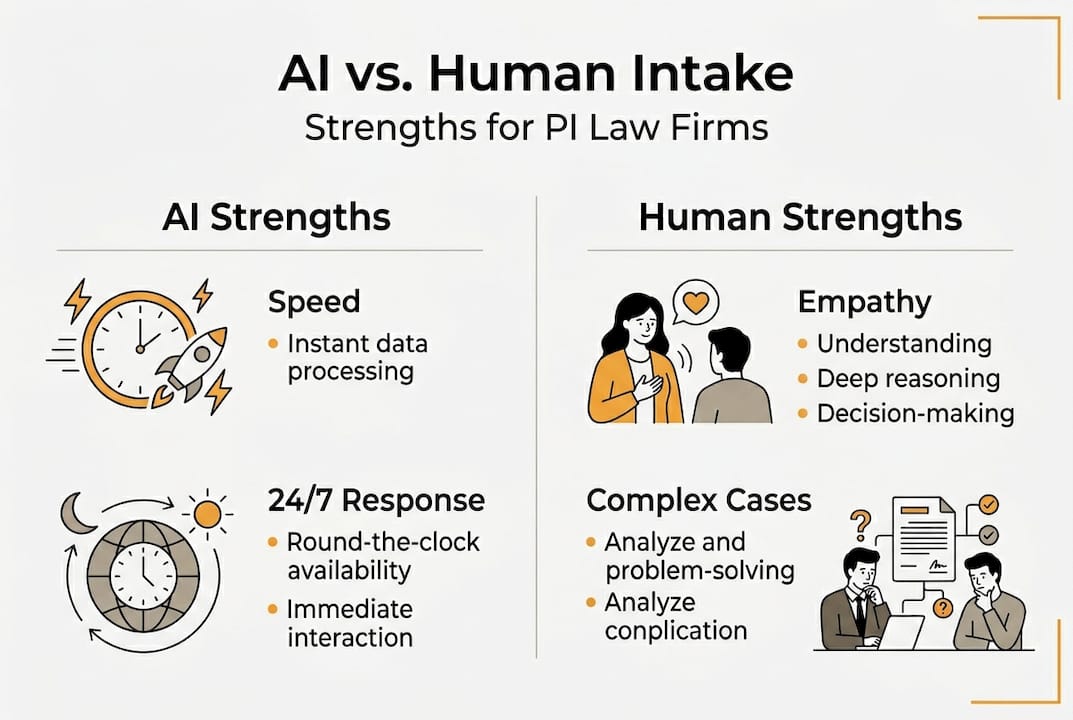
Beyond client experience, there are real compliance risks. Privilege waiver becomes a genuine concern when sensitive client information is entered into consumer AI tools like ChatGPT. Unauthorized practice of law concerns, algorithmic bias, and AI hallucinations that generate inaccurate case summaries are all documented risks. Good client intake communication strategies already account for tone and trust. AI cannot replace that judgment layer.
Key controls every firm must implement:
- Use AI exclusively for routine screening and data collection
- Require human review for every flagged high-value or emotionally complex case
- Update your intake disclaimers regularly to reflect AI involvement
Reviewing AI intake compliance advice before rollout is not optional. It is the difference between a scalable system and a liability.
Pro Tip: Never run client intake through public AI tools. Use only enterprise-grade platforms that maintain privilege protections, provide audit trails, and are built specifically for legal workflows.
Getting started: Practical rollout steps for small and mid-sized PI firms
Knowing both the capabilities and limits, here’s how to put AI into action in your firm today. The good news is that you do not need a large tech budget or a dedicated IT team to see results fast.
The biggest ROI jump comes from automating lead qualification and follow-up first. These two steps have the highest failure rate in manual intake and the fastest measurable return when automated. Starting with AI for routine screening and 24/7 coverage is the most reliable path to early wins for small and mid-sized PI firms.
Roll out in four clear stages:
- Identify your intake pain points by mapping where leads currently stall or drop off
- Test AI on routine incoming calls with a defined script and escalation trigger
- Train your team on exception protocols so they know exactly when to take over
- Monitor metrics weekly and adjust thresholds based on real conversion data
The intake process works best when AI filters the volume and humans handle the value. Keep your top 3% of complex leads in human hands from the first contact.
Metrics worth tracking from day one:
- Conversion rate lift from baseline
- Average time saved per lead
- Client satisfaction scores on intake experience
- Error rate on captured case data
- Escalation rate from AI to human review
Adaptive intake flows with lead scoring and CRM integration, measured through ROI metrics, are what separate firms that merely adopt AI from those that profit from it. Governance, clear prompts, and regular audits for ethics are not bureaucratic extras. They are how you protect the system you build. A solid implementation guided by AI-enabled optimization principles ensures your investment compounds over time rather than creating new operational headaches.
Why most firms miss out: The uncommon truth about AI intake success
Here is what most AI guides for law firms will not tell you: the technology is rarely the problem. The firms that buy sophisticated intake tools and see no improvement almost always made the same mistake. They treated AI as a replacement for process instead of an accelerator for it.
The practices seeing 3x to 5x ROI from AI intake share one thing in common. They built strict escalation paths before they deployed a single chatbot. They knew exactly which cases would go to a human and why. They did not figure that out after launch.
The best-performing firms also audit their AI output every week. They review flagged cases, catch errors before they compound, and continuously train staff on how to handle exceptions. AI in law firms works when people stay in the loop, not when they step away from it entirely.
Treat AI as an accelerator for superior client service, not a substitute for it. The firms winning with this technology are not the ones with the fanciest tools. They are the ones who built the right habits around realistic, compliant, human-centered workflows.
Supercharge your intake: How Attorney Assistant can help
Translating these insights into practice starts with choosing the right AI intake partner.
Attorney Assistant is built specifically to help small and mid-sized PI firms stop losing revenue from leads they already have. Our AI-powered intake and reception solutions keep your pipeline active around the clock, respond to inquiries in seconds, and route high-value cases to your team before a competitor gets there.
We also offer lead follow-up services designed to re-engage cold leads and recover signed cases that would otherwise disappear. If you want to audit your current workflow before committing to anything, our free law firm tools give you a practical starting point with no pressure. The firms converting the most leads are the ones that moved first. Let us show you exactly how to get there.
Frequently asked questions
What intake tasks can AI automate for my law firm?
AI handles screening, data collection, lead qualification, initial follow-up, and scheduling automatically, freeing your staff to focus on cases that require real judgment and relationship-building.
Does AI improve law firm client conversion rates?
Yes. Conversion rates rise from 10% to 35% for PI firms using AI intake, along with a documented 280% increase in qualified leads compared to traditional manual intake.
Are there any risks to using AI in legal intake?
Privilege waiver, unauthorized practice concerns, AI hallucinations, and lost empathy for high-value emotional cases are all real risks that require enterprise tools, clear disclaimers, and human oversight to manage properly.
What’s the best way for small and mid-sized PI firms to implement AI intake?
Start with routine screening and 24/7 inquiry capture, build a hybrid model that keeps complex and high-value cases with human intake staff, and track conversion lift and time saved from week one.
Recommended
- Boost case conversion: Legal intake trends shaping 2026 | Attorney Assistant
- Legal assistants in PI intake: boost conversions fast | Attorney Assistant
- Optimize law firm intake and convert 80% more leads | Attorney Assistant
- Law firm client intake best practices: boost conversions | Attorney Assistant
Related Articles

Top law firm growth tips: boost intake efficiency
Discover proven law firm growth tips to boost case intake, streamline follow-up, and maximize marketing ROI for personal injury firms in 2026.

Client retention for law firms: Boost loyalty and profits
Learn how personal injury law firms can boost client retention, increase profits by up to 95%, and build lasting loyalty with proven strategies for 2026.

Your Firm Works. It Just Shouldn’t Be This Hard.
From the outside, your law firm looks exactly like it’s supposed to.