Optimize law firm intake and convert 80% more leads

TL;DR:
- Effective follow-up and structured intake processes significantly increase lead conversion rates.
- Tracking micro-conversions helps identify bottlenecks and improve intake scripts without extra marketing spend.
- Rapid response and consistent multi-channel follow-up are crucial to prevent revenue loss from missed leads.
Every personal injury firm has a lead problem, but not the one you think. The real issue is not lead volume. It is what happens after a prospect contacts your firm. Slow responses, inconsistent follow-up, and unstructured intake processes quietly drain revenue every single month. Research shows that an optimal intake process built on multi-channel outreach, empathy-first scripting, and micro-conversion tracking significantly boosts conversion rates. This guide walks you through a step-by-step framework to fix your intake, tighten your follow-up, and turn more of the leads you already have into signed cases.
Table of Contents
- Define your growth goals and requirements
- Build a high-converting multi-channel intake process
- Optimize lead follow-up and recovery
- Avoid mistakes: Case screening and lead quality pitfalls
- Most firms underestimate micro-conversion tracking
- Supercharge your firm’s intake and lead management
- Frequently asked questions
Key Takeaways
| Point | Details |
|---|---|
| Define clear growth metrics | Set realistic targets and track intake and follow-up micro-conversions for smarter scaling. |
| Build multi-channel intake | Use phone, SMS, email, and prompt empathy-based scripts to convert prospects efficiently. |
| Optimize lead follow-up | Implement rigorous follow-up schedules and manage after-hours leads to prevent lost revenue. |
| Screen for lead quality | Avoid low-value cases by thorough screening for red flags and understanding lead exclusivity. |
| Monitor intake steps | Track and analyze every stage of your intake pipeline to drive lasting growth and profitability. |
Define your growth goals and requirements
Before you redesign anything, you need a clear picture of where your firm stands financially and operationally. Growth without a baseline is just guessing.
Small to mid-sized PI firms typically operate with profit margins averaging 30 to 55%, and scaling to 100 cases per month can require up to 14 intake staff alongside a tech stack costing $500 to $2,000 per month. Those numbers matter because they define what your intake process needs to support. You cannot build a scalable system without understanding the load it must carry.
Here are the key requirements for scaling your firm sustainably:
- Multi-channel lead sources: phone, SMS, web forms, live chat, and paid referrals
- A CRM with intake automation: to track every lead from first contact to signed retainer
- Defined staffing ratios: typically one intake specialist per 8 to 10 active leads per day
- Clear SLAs for response time: two minutes for paid ads, five minutes for organic inquiries
- Regular intake audits: monthly reviews of conversion rates at each stage
- Marketing investment benchmarks: most growing PI firms allocate 7 to 12% of gross revenue to lead generation
Here is a practical overview of what scaling phases typically look like:
| Growth phase | Monthly cases | Intake staff | Tech investment |
|---|---|---|---|
| Early stage | 10 to 25 | 1 to 2 | $500/mo |
| Growth stage | 25 to 60 | 3 to 6 | $500 to $1,200/mo |
| Scale stage | 60 to 100+ | 7 to 14 | $1,200 to $2,000/mo |
These ranges are not arbitrary. They reflect the real operational demands of law firm growth strategies that actually hold up under pressure. Firms that skip the staffing math end up with bottlenecks that kill conversion rates before marketing even gets a chance to help.
Pro Tip: Before hiring more staff or spending more on ads, start tracking intake micro-conversions. Measure how many leads move from first contact to qualification, from qualification to document review, and from review to signed retainer. You will find the leak fast.
Aligning your intake processes for law firms with realistic benchmarks is the foundation everything else builds on. Get this right first.
Build a high-converting multi-channel intake process
Once you know your requirements, the next step is building an intake process that reliably moves prospects from first contact to signed client. Speed and consistency are everything here.
Different lead channels perform very differently, and your intake approach needs to match each one:
| Lead channel | Average response window | Conversion potential | Follow-up method |
|---|---|---|---|
| Inbound phone | Immediate | Highest | Live answer + SMS |
| Web form | Under 2 minutes | High | SMS + email + call |
| Paid social/PPC | Under 2 minutes | High | Call + SMS sequence |
| Referral | Same day | Very high | Personal call |
| Organic search | Under 5 minutes | Moderate to high | Email + call |
Building a process that works across all of these channels requires structure. Here is a proven sequence:
- Capture every lead immediately: Use live answering, web form auto-responders, and SMS triggers so no inquiry goes unacknowledged.
- Apply empathy-first scripting: The first 30 seconds of any intake call sets the tone. Train your team to acknowledge the prospect’s situation before asking qualifying questions.
- Screen for case viability: Ask about liability, injury severity, medical treatment, and insurance coverage early. This protects your firm’s time and filters out low-value cases.
- Set internal SLAs: Multi-channel follow-up with seven or more contacts over two weeks is the standard for maximizing conversions. Build that cadence into your CRM.
- Track every micro-conversion: Log when a lead answers, qualifies, submits documents, and signs. Each step is a data point.
- Review and refine weekly: Use your CRM data to identify where leads drop off and test adjustments.
“80% of conversions occur between the 5th and 12th contact.” Most firms give up after two attempts and wonder why their conversion rate is low.
Pro Tip: Track each micro-conversion in your CRM as a separate pipeline stage. When you can see that 40% of leads drop off after the first call but before document submission, you know exactly where to focus your scripting and follow-up improvements.
For a deeper look at client intake best practices and how to boost client intake conversion, these resources break down the tactical details that make a real difference.
Optimize lead follow-up and recovery
A strong intake process only works if your follow-up matches it. Most firms lose leads not during the first call but in the days that follow.

After-hours and overflow leads account for 35 to 42% of all inbound inquiries, yet 67% of firms fail to respond to them in a timely manner. That gap is where revenue disappears. Missed calls alone cost PI firms an average of $250,000 in annual revenue. That is not a rounding error. That is a staffing salary, a marketing budget, or a year of technology investment.
Here are the best practices for follow-up timing and recovery:
- Respond within two minutes for any paid ad or PPC lead. Every minute of delay cuts conversion probability significantly.
- Use SMS as your first follow-up channel after a missed call. Text open rates far exceed email.
- Build a seven-touch sequence across phone, SMS, and email over 14 days for every unresponsive lead.
- Flag leads as “lost” only after 12 attempts across multiple channels and time windows.
- Run monthly lead recovery campaigns: Pull all leads marked inactive in the past 90 days and restart a shorter outreach sequence.
- Use after-hours coverage: Whether through a live answering service or an AI-assisted intake tool, every after-hours lead deserves a real response.
The client communication strategies that work best combine automation with a human touch. Automated SMS gets the conversation started. A real person closes it.
Pro Tip: Schedule a lead recovery campaign every 30 days. Pull every lead that went cold in the previous month and send a simple, empathetic re-engagement message. You will consistently recover 5 to 15% of those leads into active conversations.
For more on lead management tips that reduce drop-off and increase signed cases, the fundamentals are simpler than most firms expect. Consistency beats sophistication every time.
Avoid mistakes: Case screening and lead quality pitfalls
With your follow-up system in place, the next risk area is what you do with the leads you do reach. Not every prospect is a good case, and signing the wrong ones costs you more than passing on them.
Common red flags your intake team must screen for:
- Pre-existing injuries: If the prospect has documented prior injuries to the same body area, liability becomes complex and case value drops significantly.
- No medical treatment: Prospects who have not sought medical care within days of an incident are difficult to build a damages case around.
- Already represented: If a prospect is working with another attorney, your intake team needs to identify this immediately and handle the conversation carefully.
- Uninsured or underinsured at-fault parties: These cases can drag on without meaningful recovery. Know your firm’s appetite for them.
- Inconsistent facts: If the story changes during the intake call, document it and flag it for attorney review before proceeding.
After-hours and overflow spikes also create screening risks. When your team is stretched thin, quality control slips. Leads get qualified too quickly or not at all.
Shared leads versus exclusive leads also deserve attention. Shared leads are sold to multiple firms simultaneously, which means your speed and scripting matter even more. Exclusive leads cost more but arrive without competition. Neither is inherently better. The right choice depends on your intake team’s capacity and your cost-per-signed-case target.
“Missed calls result in $250,000 average firm loss annually.” That number assumes you are only losing the call, not accounting for the referrals and repeat business that never materialize from those lost clients.
Understanding the intake specialist benefits of having a dedicated screener versus relying on a generalist receptionist is one of the highest-leverage decisions a growing PI firm can make.
Most firms underestimate micro-conversion tracking
Here is the uncomfortable truth: most PI firms obsess over case volume and marketing spend while completely ignoring the granular data sitting inside their own intake pipeline. That is backwards.
Micro-conversions are the individual steps a lead takes before signing a retainer: answering a call, completing a qualification screen, submitting documents, attending a consultation. Each of these steps has a conversion rate. And most firms have no idea what those rates are.
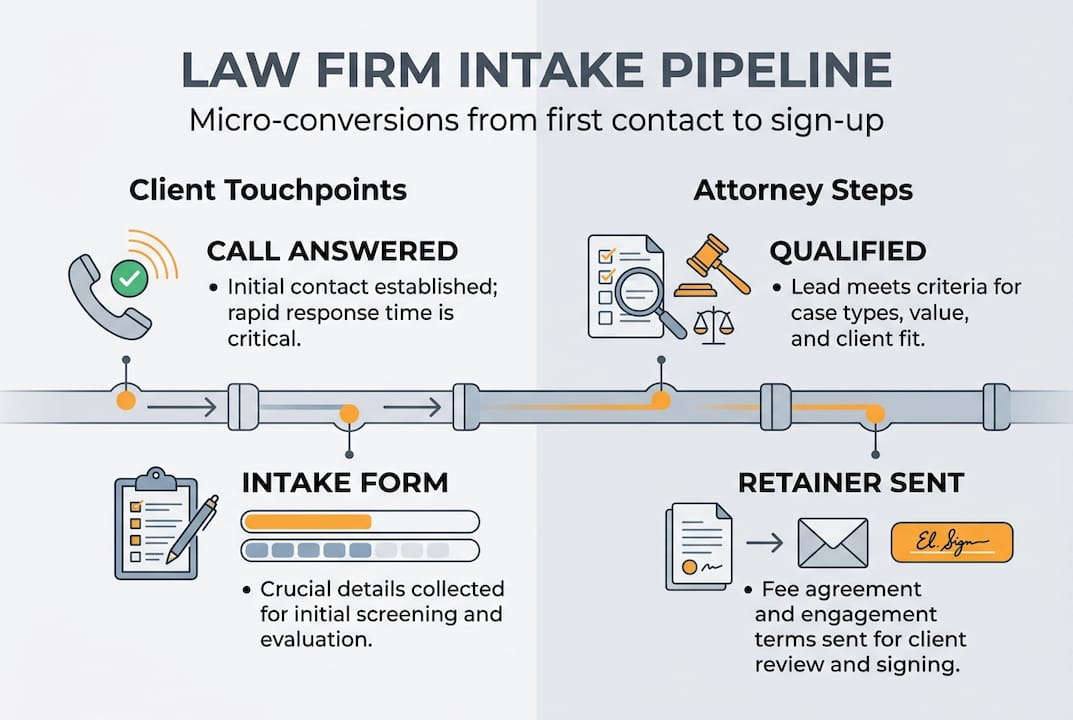
When you track them, the math becomes obvious. If 60% of leads answer the first call but only 20% complete qualification, your scripting is the problem, not your lead source. Fixing that one step could double your signed cases without spending a single additional dollar on marketing.
Firms that build dashboards around these metrics and review them monthly consistently outperform peers who only track top-line case volume. The growth strategies that actually move the needle are almost always found inside the intake funnel, not outside it.
Pro Tip: Set up a simple dashboard in your CRM with five stages: contacted, qualified, documents received, attorney reviewed, and retainer signed. Review conversion rates between each stage every month. The drop-off point will tell you exactly where to invest your energy.
Supercharge your firm’s intake and lead management
You now have the framework. The harder part is execution, especially when your team is already stretched managing active cases, client calls, and daily operations.
Attorney Assistant is built specifically for PI firms that want to stop leaking revenue from the leads they already have. Our lead follow-up services ensure every prospect gets a timely, consistent response regardless of when they reach out. Our 24/7 intake services handle after-hours and overflow leads so your firm never misses a signed case because of a staffing gap. You can also explore our free intake tools to start optimizing your process today without any commitment.
Frequently asked questions
What is the best follow-up cadence for law firm leads?
The most effective cadence is 7+ multi-channel contacts over two weeks, with the majority of conversions occurring between the 5th and 12th attempt. Stopping early is the single most common reason firms lose convertible leads.
How quickly should intake respond to new leads?
Best practice is to respond within two minutes for paid ads and five minutes for organic leads. Even a 10-minute delay can cut your connection rate significantly.
What intake tech stack is typical for small PI firms?
Firms usually invest $500 to $2,000 per month in CRM and intake platforms, with costs scaling as case volume and staff size increase.
Which red flags should intake screen for?
Key red flags include pre-existing injuries, lack of medical treatment after the incident, and prospects who are already represented by another attorney.
How much revenue is lost from missed calls?
Missed calls cost PI firms an average of $250,000 annually, making consistent after-hours coverage and rapid follow-up essential for protecting your firm’s revenue.
Recommended
Related Articles

Legal assistants in PI intake: boost conversions fast
Discover how legal assistants drive intake efficiency, improve case conversion, and reduce attorney overload at personal injury law firms.

Lead leakage in law firms: capture more PI cases
Learn what lead leakage costs PI law firms and get actionable strategies to capture more personal injury cases through faster, smarter intake.

Effective law firm intake process: boost client conversion
Learn how to optimize your personal injury law firm's intake process to convert more leads, improve efficiency, and stop losing cases to slow or inconsistent intake.