Law firm lead management: convert more clients in 2026

Every personal injury law firm has experienced it: a promising lead calls, fills out a form, or sends a message, and then nothing happens. No one follows up fast enough. The intake process stalls. The potential client signs with a competitor. That single missed opportunity might represent tens of thousands of dollars in lost revenue. The frustrating truth is that most firms do not have a lead generation problem. They have a lead conversion problem. This guide walks you through a practical, evidence-backed system for capturing, managing, and converting more legal leads into signed cases.
Table of Contents
- Understanding the lead management challenge for law firms
- Preparing your law firm for effective lead management
- Capturing and generating qualified legal leads
- Optimizing intake workflows and lead response
- Verifying results and avoiding intake pitfalls
- Take your lead management further with Attorney Assistant
- Frequently asked questions
Key Takeaways
| Point | Details |
|---|---|
| Prompt responses matter | Law firms that follow up within 30 minutes can see up to 35% more conversions. |
| Blend tech and human touch | AI tools boost efficiency but must be balanced with human empathy for client trust. |
| Diversify lead sources | Combine sustainable channels like SEO and referrals with quicker paid options for steady growth. |
| Measure and improve | Regularly track conversion rates, lead sources, and follow-up times to continuously boost results. |
Understanding the lead management challenge for law firms
Personal injury law is one of the most competitive legal markets in the country. Firms spend heavily on advertising, referral networks, and SEO, yet many still struggle to convert the leads they already receive. The problem is rarely a shortage of inquiries. It is almost always a breakdown somewhere between first contact and signed engagement.
Lead management in a legal context covers every step of that journey:
- Initial inquiry capture: Phone calls, web forms, live chat, and social media messages
- Qualification: Determining whether the lead fits your practice area and case criteria
- Follow-up: Reaching back out consistently until you get a decision
- Intake: Gathering the information needed to open a case file
- Conversion: Getting the engagement letter signed
Each of these steps is a potential leak point. A slow response at step one can kill the deal before step two even begins. Inconsistent follow-up at step three means leads go cold. Poor intake scripts at step four create confusion and drop-offs.
Strong intake processes alone can boost conversion by 15-35%, which means the biggest gains for most firms are hiding inside their existing lead flow, not in buying more leads.
Understanding lead nurturing in legal marketing is the first step toward fixing these leaks. Once you see where leads are falling out of your pipeline, you can start plugging the gaps systematically.
Preparing your law firm for effective lead management
Before you can improve conversion, you need the right infrastructure in place. Think of this as building the foundation before adding floors. Without the right tools and roles, even the best strategy will fall apart under real-world pressure.
Here are the core essentials every firm needs:
- CRM system: A client relationship management tool that tracks every lead, their status, and all communication history
- Intake scripts: Structured conversation guides that help staff qualify leads consistently and professionally
- Trained intake staff: People who understand both the legal context and the human side of a potential client’s situation
- AI-assisted platforms: Tools that handle after-hours inquiries, automate follow-up reminders, and reduce manual workload
| Tool | Key feature | Role in lead management |
|---|---|---|
| CRM system | Lead tracking and pipeline visibility | Prevents leads from falling through the cracks |
| Intake scripts | Consistent qualification questions | Ensures every lead is evaluated the same way |
| Trained intake staff | Empathy and legal knowledge | Builds trust and gathers accurate case information |
| AI intake platform | 24/7 availability and automation | Captures leads outside business hours |
| Follow-up scheduler | Automated reminders and sequences | Keeps leads warm without manual effort |
Understanding why intake specialists matter can help you make the right hiring decisions early. Setting clear intake department goals gives your team a measurable target to work toward.
In-house lead generation through SEO or referrals can deliver a 25-45% conversion rate and is more sustainable over time than buying leads. That makes your intake infrastructure even more valuable, because it is the engine that turns those organic leads into signed clients.

Pro Tip: Assign one person or team as the clear owner of intake. Ambiguity about who handles new leads is the single biggest driver of slow response times and dropped follow-ups.
Capturing and generating qualified legal leads
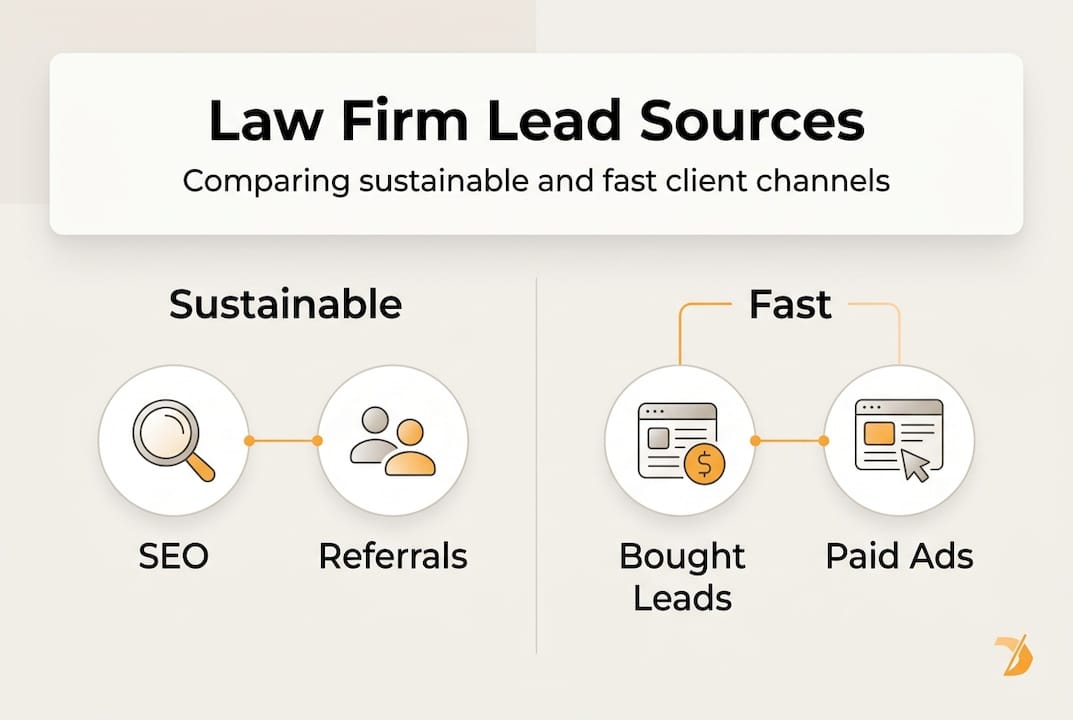
Not all lead sources are created equal. Some deliver volume fast but at a steep cost. Others take time to build but pay off consistently over the long run. Smart firms use a mix of both.
Buying leads (retainer or signed cases): You pay a vendor for pre-qualified leads or even signed cases. This is fast but expensive, and quality varies widely depending on the vendor.
Paid advertising (PPC and LSA): Google Pay-Per-Click and Local Services Ads can put your firm in front of people actively searching for legal help. PPC and LSA can cost $70-250 per click, which adds up quickly, but results are immediate.
SEO and referrals: Organic search and word-of-mouth referrals take longer to build but deliver leads with higher intent and lower cost per acquisition over time.
| Lead source | Estimated ROI | Complexity | Vendor dependency |
|---|---|---|---|
| Bought leads | Moderate, variable | Low | High |
| PPC/LSA ads | High short-term, costly | Medium | Medium |
| SEO | High long-term | High | Low |
| Referrals | Very high | Low | Low |
For more detail on building a sustainable pipeline, explore generating high-quality leads and see real SEO lead results from firms that have made the shift.
Pro Tip: Do not rely on a single lead source. Pair at least one sustainable channel like SEO or referrals with one faster channel like PPC or bought leads. This protects your pipeline if one source dries up.
Optimizing intake workflows and lead response
This is where most firms either win or lose. You can have a great lead source and a solid CRM, but if your intake workflow is slow or inconsistent, you will keep losing cases you should be winning.
Here is a step-by-step framework for handling every new lead:
- Receive and log the lead immediately. Every inquiry, regardless of channel, gets entered into your CRM within minutes of arrival. No exceptions.
- Qualify the lead within 30 minutes. Call, text, or email the prospect. Ask the key qualifying questions from your intake script.
- Document the outcome. Log whether the lead is qualified, not a fit, or needs more follow-up. Update the CRM status.
- Schedule follow-up automatically. If you did not reach them, set a follow-up reminder for within a few hours. Do not wait until the next day.
- Follow up at least three times. Most leads do not convert on the first contact. Persistence, done respectfully, dramatically increases conversion.
- Hand off to the attorney. Once qualified, move the lead to the attorney or case manager for the next step in the engagement process.
AI intake can offer four times the coverage and up to 90% cost efficiency compared to fully manual intake, but human empathy and oversight remain crucial, especially for personal injury clients who are often in distress.
Common intake mistakes to avoid:
- Letting calls go to voicemail without a fast callback system
- Using generic scripts that do not address personal injury-specific concerns
- Failing to log leads in the CRM in real time
- Treating follow-up as optional rather than mandatory
- Handing off leads to attorneys before they are properly qualified
Learn what qualities of effective intake specialists look like in practice, and understand the broader role of legal intake specialists in a high-performing firm. If you want to see what a fully built system looks like, explore modern intake solutions designed specifically for law firms.
Pro Tip: Set a firm-wide rule: every new inquiry gets a response within 30 minutes, and every lead gets at least three follow-up attempts before being marked as lost. This one rule alone can meaningfully move your conversion numbers.
Verifying results and avoiding intake pitfalls
Building a great intake system is not a one-time project. It requires ongoing measurement and adjustment. If you are not tracking results, you cannot know what is working or where leads are slipping away.
Key metrics to monitor every week:
- Lead-to-consultation conversion rate: What percentage of inquiries become scheduled consultations?
- Consultation-to-signed rate: How many consultations result in a signed engagement?
- Average response time: How long does it take your team to make first contact after a new inquiry arrives?
- Follow-up completion rate: Are your team members actually completing all scheduled follow-up attempts?
- Lead source ROI: Which channels are delivering the best return relative to their cost?
Spotting bottlenecks requires looking at where leads stop moving. If your lead-to-consultation rate is strong but your consultation-to-signed rate is weak, the problem is in your attorney’s pitch or your engagement process, not your intake. If response time is slow, the problem is staffing or workflow, not scripts.
Here is a simple troubleshooting sequence when conversion drops:
- Pull your CRM data and identify at which stage leads are dropping out.
- Listen to recorded intake calls or review chat transcripts from that period.
- Check whether follow-up sequences were completed or skipped.
- Interview your intake staff to surface any process confusion or tool issues.
- Adjust scripts, staffing, or automation rules based on what you find, then retest.
Blending human values with system efficiency is what separates firms that grow consistently from those that plateau, regardless of how much they spend on lead generation.
Review lead nurturing results to benchmark your performance, and use proven intake script resources to keep your team’s conversations sharp and consistent.
Take your lead management further with Attorney Assistant
You now have a clear picture of what effective lead management looks like, from infrastructure and lead sourcing to intake workflows and performance tracking. The next step is putting it all into practice without adding more chaos to your team’s day.
Attorney Assistant is built specifically for personal injury law firms that want to stop losing cases to slow response times and inconsistent intake. Our intake management platform gives your firm the tools, workflows, and human-plus-AI coverage needed to respond faster, follow up consistently, and convert more leads into signed cases. If you want to see exactly how it works for firms like yours, join our next lead management webinar and walk away with a plan you can implement immediately.
Frequently asked questions
What is lead management in a law firm?
Lead management in a law firm is the process of capturing, tracking, and converting potential clients from their initial inquiry to signed engagement. It covers every touchpoint between a prospect’s first contact and the moment they become a client.
What are the best sources for law firm leads?
SEO and referrals offer a 25-45% conversion rate and are more sustainable long-term, while paid ads like PPC and LSA deliver faster results at a higher cost per click.
How fast should law firms respond to new leads?
Firms should respond within 30 minutes of a new inquiry. Faster, consistent follow-up can increase conversion by up to 35%, and each lead should receive at least three follow-up attempts before being marked as lost.
Can AI fully replace human intake specialists?
No. AI intake provides 4x coverage and significant cost efficiency, but personal injury clients often need human empathy and judgment that AI alone cannot replicate. The best results come from combining both.
Recommended
Related Articles

What Is Lead Follow-Up for Law Firms: 2026 Guide
Discover what is lead follow-up for law firms in 2026. Learn effective strategies to convert prospects and boost your case retention.

Inbound Calls Management for Law Firms: 2026 Guide
Discover what is inbound calls management for law firms. Learn strategies to convert leads, improve client retention, and optimize operations.

Lead Management Best Practices for Law Firms in 2026
Discover effective lead management best practices for law firms in 2026. Improve client conversion and maximize your marketing spend.