Lead leakage in law firms: capture more PI cases

TL;DR:
- Up to 60% of personal injury leads are missed outside regular business hours, costing firms significant revenue.
- Common causes of lead leakage include delayed responses, poor intake processes, and handoff failures.
- Implementing faster response systems and dedicated after-hours coverage can significantly reduce lead loss.
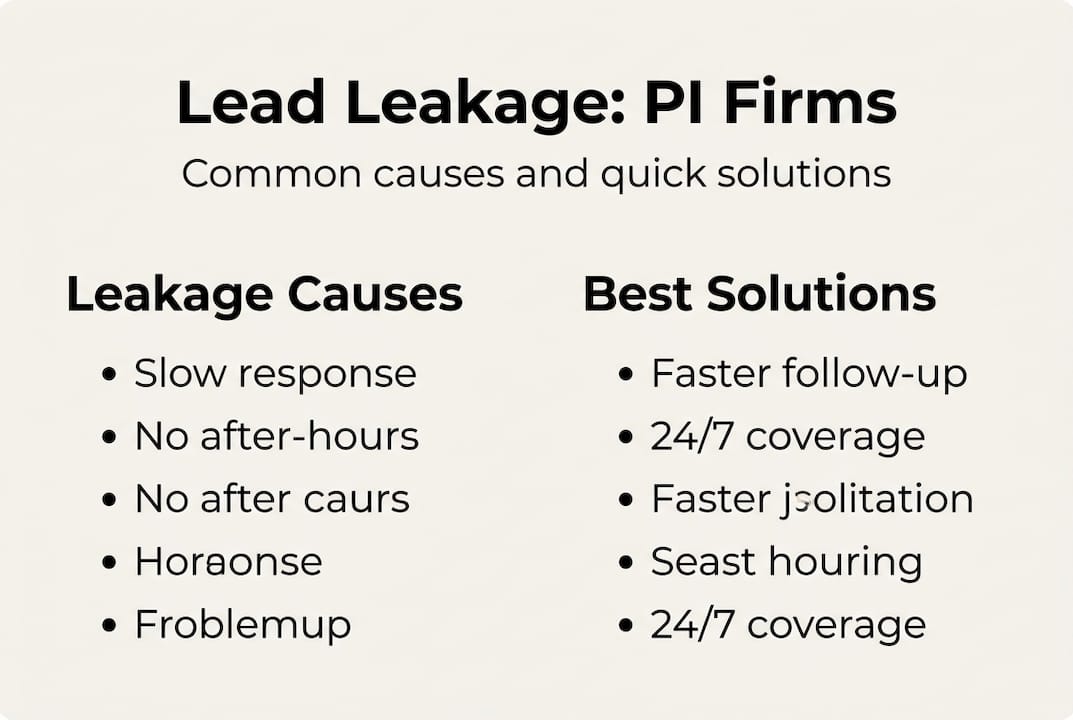
You are probably spending thousands of dollars every month on marketing to bring personal injury leads through the door. But here’s the uncomfortable reality: a large portion of those leads are slipping away before anyone at your firm even speaks to them. Up to 60% of PI inquiries arrive after hours, on weekends, or during moments when your intake process simply cannot keep up. And in a market where speed is everything, that gap between inquiry and response is costing you signed cases, not just missed calls.
Table of Contents
- Defining lead leakage in law firms
- What causes lead leakage in PI law firm intake?
- The cost of lead leakage: Data and impact on revenue
- How to prevent lead leakage: Actionable solutions for PI firms
- A hard truth about lead leakage most firms ignore
- Close the gaps: How Attorney Assistant helps eliminate lead leakage
- Frequently asked questions
Key Takeaways
| Point | Details |
|---|---|
| Lead leakage definition | Lead leakage is when potential client inquiries are missed or mishandled, resulting in lost cases for your law firm. |
| Main causes | Slow intake, poor follow-up, and lack of after-hours coverage drive most lead losses in PI firms. |
| Financial impact | Even small improvements in intake can result in major revenue gains and market share boosts. |
| Prevention steps | Prioritize faster responses, dedicated intake resources, and auditing to prevent revenue loss. |
Defining lead leakage in law firms
With the stakes clear, let’s agree on exactly what lead leakage means for your firm.
Lead leakage is the process by which potentially valuable case inquiries fail to convert because they were missed, mishandled, or ignored somewhere in your intake pipeline. It is not always dramatic. Sometimes it is a voicemail that sat unanswered for 18 hours. Sometimes it is a web form that never triggered a callback. Sometimes it is a receptionist who screened out a caller too quickly because the case sounded complicated.
For personal injury firms specifically, the vulnerability is acute. You operate in a high-volume, high-competition environment where after-hours leads make up 40 to 60% of all inquiries. That means a huge portion of your potential clients are reaching out when no one qualified is available to respond. And if your competitor picks up that call first, you have almost certainly lost that client for good.
“78% of personal injury cases go with the first law firm to respond.” That single statistic should change how you think about intake forever.
Understanding client intake best practices starts with recognizing the specific moments where leads fall through the cracks. Here are the most common lead leakage scenarios in PI firms:
- Missed after-hours calls: A potential client calls at 9 PM after an accident. No one answers, no callback system exists, and by morning they have hired someone else.
- Slow follow-up on web inquiries: A form submission sits in an inbox for 24 hours. The lead has already moved on.
- Incomplete intake screening: A staff member skips key questions, the case is incorrectly triaged, and a viable lead gets dropped.
- Data entry errors and handoff failures: A lead’s contact information is recorded incorrectly, or the handoff between intake and attorney is never completed, leaving the prospect in limbo.
Each of these scenarios represents a real case, and real revenue, that your firm will never recover.
What causes lead leakage in PI law firm intake?
Now that lead leakage is defined, it is vital to uncover exactly how and why it shows up in your PI intake pipeline.
The root causes of lead leakage are rarely mysterious. They are almost always structural. Your firm has gaps in coverage, gaps in training, or gaps in technology, and leads fall into those gaps every single day.
Delayed response is the single biggest driver. Improving response time is not just a courtesy issue, it is a conversion issue. Studies consistently show that leads contacted within five minutes of inquiry are dramatically more likely to convert than those contacted even 30 minutes later. Most PI firms are nowhere near that benchmark.

Night and weekend inquiries compound the problem. If your intake process stops when your staff goes home, you are essentially turning off your pipeline for a third of the week. Poor intake risks bad case signups or lost leads entirely, which means the cost cuts both ways: you either sign bad cases or you lose good ones.
Weak documentation and handoff failures are also major culprits. When intake information is captured inconsistently, or when the transition from intake staff to attorney is informal, details get lost. A lead who felt heard during their first call suddenly feels forgotten when no one follows up with accurate information.
Here is where leakage tends to accelerate inside the pipeline:
- Intake handoffs with no confirmation step: The lead is transferred but no one verifies the handoff was completed.
- Tech gaps between CRM and phone systems: Calls are not logged, and follow-up reminders never trigger.
- Undertrained staff handling complex cases: A caller with a prior injury or a treatment gap gets screened out instead of escalated.
- No follow-up cadence for non-converting leads: If someone does not sign on the first call, they are often never contacted again.
Building an effective intake process means closing each of these gaps systematically, not just patching one at a time.
Pro Tip: Assign a dedicated intake specialist specifically for after-hours and weekend calls. This one change alone can recover a significant portion of the leads your firm is currently losing to competitors who do answer.
Strong intake communication strategies also matter here. How your team speaks to a potential client in the first 90 seconds shapes whether that person stays on the line or hangs up and calls the next firm on their list.
The cost of lead leakage: Data and impact on revenue
Having seen the causes, it is time to quantify the damage lead leakage does to your growth and bottom line.
Most PI firm owners think about marketing spend in terms of cost per lead. But they rarely calculate the cost of the leads they already paid for and then lost. That is where the real financial damage lives.
Consider a typical five-attorney PI firm receiving 80 inbound inquiries per month. If even 25% of those leads are lost to leakage, that is 20 potential cases gone every month. At an average case value of $15,000, that is $300,000 in potential revenue disappearing monthly, or $3.6 million annually, from leads you already paid to acquire.
| Metric | Monthly estimate | Annual estimate |
|---|---|---|
| Total inbound inquiries | 80 | 960 |
| Leads lost to leakage (25%) | 20 | 240 |
| Average PI case value | $15,000 | $15,000 |
| Revenue lost to leakage | $300,000 | $3,600,000 |
| Potential gain from 15% leakage fix | $45,000 | $540,000 |
Those numbers are conservative. And they do not account for referrals those clients would have sent your way.
Firms often spend 3x more trying to generate new leads than it would cost to fix the intake gaps that are draining their existing pipeline.
78% of PI cases go to the first firm that responds. That means your intake speed is not just an operational metric, it is your primary competitive advantage. Improving lead management strategies by even modest margins can shift your new case volume meaningfully. A 15% reduction in leakage for that same firm translates to three additional signed cases per month. At scale, that compounds fast.
How to prevent lead leakage: Actionable solutions for PI firms
Awareness alone does not plug revenue leaks. Let’s get tactical with concrete prevention steps.
The good news is that most lead leakage is preventable. The fixes are not complicated, but they do require commitment and consistency. Here is a prioritized action plan:
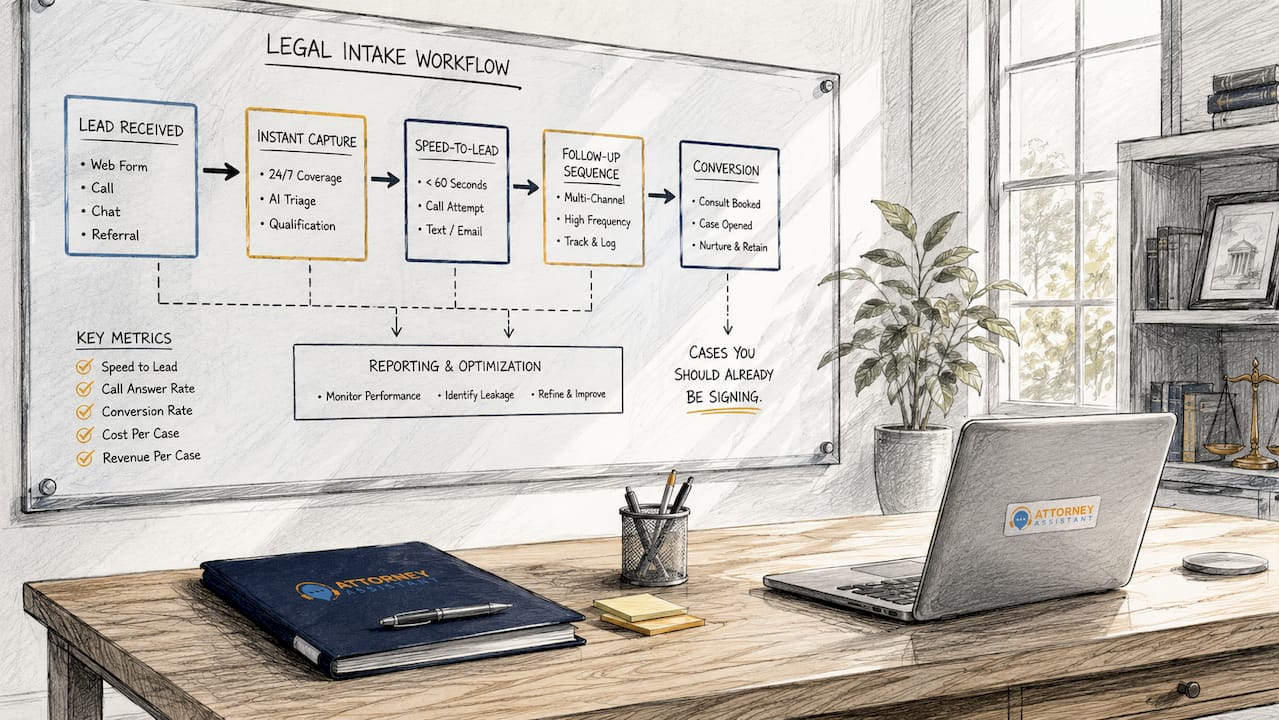
- Cut your response time to under five minutes. Set up automated text and email acknowledgments the moment a lead comes in, so the prospect knows they have been heard even before a human calls back.
- Install after-hours intake coverage. Whether through a trained intake specialist, a virtual receptionist, or a legal answering service, your pipeline should never go dark.
- Standardize your intake screening questions. Every intake call should follow the same script, covering case viability, timeline, injuries, and prior claims. Consistency prevents both bad signups and dropped leads.
- Run daily lead audits. Every morning, someone on your team should review every inquiry from the previous 24 hours and confirm that each one received a follow-up.
- Build a multi-touch follow-up sequence. If a lead does not convert on the first contact, they should receive a structured series of calls, texts, and emails over the following week.
High-volume after-hours leads and fierce competition mean your intake must be both rigorous and relentlessly responsive. Here is how your coverage options compare:
| Feature | In-house staff | Intake specialists | Third-party answering service |
|---|---|---|---|
| After-hours coverage | Limited | Yes | Yes |
| Case screening quality | Variable | High | Low to moderate |
| Cost per month | High | Moderate | Low |
| Conversion rate impact | Moderate | High | Low to moderate |
| Consistency | Variable | High | Variable |
The data points clearly toward dedicated intake specialists as the highest-ROI option for PI firms serious about boosting PI case conversions.
Pro Tip: Before increasing your ad budget, calculate what a 20% reduction in lead leakage would mean for your revenue. For most PI firms, fixing intake delivers a higher return than buying more leads.
A hard truth about lead leakage most firms ignore
Now that the frameworks are clear, here is a perspective you will not find in most intake guides.
Most law firm owners treat lead leakage as an operations problem. They assume it is a staffing issue, a technology gap, or a workflow inefficiency. Fix the process, plug the hole, move on. But the firms that consistently outperform their competitors understand something deeper: intake is not a back-office function. It is your primary growth lever.
The best PI firms we have observed do not obsess over their marketing spend. They obsess over what happens the moment a lead touches their firm. They track every inquiry, including the ones that seemed too complicated or too risky. They treat after-hours calls and red-flag scenarios, prior injuries, inconsistent narratives, treatment gaps, as signals to refine their process, not reasons to discard a lead.
Here is the insight most guides skip: the “messy” leads, the ones your intake team finds hardest to handle, are often the cases your competitors are also mishandling. That is exactly where your competitive advantage lives. Investing in legal intake specialist expertise to handle complex cases is not a cost. It is a market positioning decision.
Close the gaps: How Attorney Assistant helps eliminate lead leakage
Ready to stop leaking revenue? Here is how you can act today.
At Attorney Assistant, we built our entire platform around the specific intake and follow-up challenges that PI law firms face every day. We know that your leads do not keep business hours, and that a slow or inconsistent response means a lost case.
Our intake solutions are designed to capture every inquiry, qualify it properly, and move it through your pipeline without gaps or delays. Our lead follow-up services ensure that no potential client falls through the cracks after the first contact. From 24/7 coverage to analytics dashboards that show you exactly where your leakage is happening, we give PI firms the infrastructure to convert more of the leads they already have. Book a call and let us show you what your firm is leaving on the table.
Frequently asked questions
What is lead leakage in a law firm?
Lead leakage is when law firms lose potential cases because inquiries are missed or mishandled, often due to gaps in their intake process that prevent timely follow-up.
How common is lead leakage in personal injury firms?
It is extremely common. 40 to 60% of PI inquiries arrive after hours, and most cases go to the first firm that responds, making coverage gaps especially costly.
What are the top causes of lead leakage in law firms?
The main causes are slow follow-up, no after-hours coverage, poor intake screening, and information lost during handoffs between intake staff and attorneys.
How can law firms stop lead leakage?
Firms can reduce leakage by speeding up response time, adding after-hours intake coverage, running daily lead audits, and using specialized intake staff trained for PI case screening.
Recommended
- Free PI Intake Audit — Find Where Your Firm Is Losing Cases | Attorney Assistant
- Law firm engagement: convert more leads in 2026 | Attorney Assistant
- Free Tools for Law Firms | Attorney Assistant
- Law firm lead management: convert more clients in 2026 | Attorney Assistant
- Seo for Legal Firms: Boost Your Client Intake with Proven SEO Strategies
Related Articles

What Is Lead Leakage? A Law Firm Guide
Discover what is lead leakage in law firms. Learn how to prevent losing qualified leads and boost your revenue today!
How to Increase Case Conversions for PI Attorneys
Discover how to increase case conversions for PI attorneys through optimized intake and follow-up strategies that turn leads into clients.

Lead Conversion Workflow for Law Firms: 2026 Guide
Discover effective lead conversion workflow strategies for law firms. Boost your client retention and increase revenue with our 2026 guide.