Effective law firm intake process: boost client conversion

TL;DR:
- An efficient intake process is critical for converting leads into clients and maximizing revenue.
- Speed, empathy, and automation significantly improve client engagement and intake success.
- Investing in specialized training and 24/7 coverage enhances lead capture and client satisfaction.
The intake process at your personal injury law firm is not just answering phones and collecting names. It is a structured, strategic sequence of steps that determines whether a potential client signs with you or calls your competitor. Many firms treat intake as basic admin work, but the reality is that intake is where revenue is either captured or permanently lost. Firms that invest in a disciplined intake system convert more leads, satisfy more clients, and run leaner operations. This article walks you through every stage of the intake process and gives you practical strategies to improve conversion and efficiency starting today.
Table of Contents
- Why intake matters for personal injury law firms
- The step-by-step intake process explained
- Best practices for intake conversion and efficiency
- Training and technology: building a high-performing intake team
- What most law firm owners miss about intake
- Improve your intake today with proven tools and services
- Frequently asked questions
Key Takeaways
| Point | Details |
|---|---|
| Intake drives conversions | A precise intake process is the starting point for winning more personal injury clients. |
| Structure and speed matter | Using standardized scripts and responding within minutes dramatically increases lead conversion. |
| Tech and talent enhance results | Combining digital tools with well-trained specialists yields the best balance of efficiency and accuracy. |
| Empathy is essential | Empathetic scripts and human nuance set your firm apart in a competitive marketplace. |
Why intake matters for personal injury law firms
Personal injury clients are not shopping for a commodity. They are scared, in pain, and often confused about their rights. They make decisions fast. Research shows that potential clients decide within minutes of first contact whether they trust a firm enough to move forward. If your intake process is slow, cold, or disorganized, they move on. That decision costs you a case worth thousands of dollars in contingency fees.
The stakes are uniquely high in PI law for several reasons:
- Statute of limitations pressure: Clients often call late in the window, meaning delays in intake can literally kill the case before it starts.
- Comparative negligence screening: You need to assess fault percentages early. Taking a case where your client is 80% at fault is a financial trap.
- Conflict checks: Representing a client who is adverse to a current client is an ethical violation. Intake is where you catch this.
- Insurance coverage verification: Knowing upfront whether there is a viable defendant with coverage determines case viability.
- Emotional sensitivity: PI clients are often in crisis. How your intake team handles that first call shapes the entire client relationship.
“The intake process is the firm’s first and most powerful opportunity to demonstrate competence, empathy, and trustworthiness to a potential client.”
From a business perspective, intake best practices show that a unified digital intake system can save over 1,300 admin hours per year. That is not a marginal improvement. That is the equivalent of freeing up a full-time employee to focus on higher-value work. When intake is efficient, your attorneys spend more time on cases and less time chasing down missing information or correcting data errors.
Poor intake also creates compliance risk. Missing a conflict check or failing to document a client’s reported injuries accurately can expose your firm to malpractice claims. Intake is not just a sales function. It is a legal and operational safeguard.
The step-by-step intake process explained
Understanding the full intake sequence helps you identify where your firm is losing leads and where improvements will have the biggest impact. According to a detailed intake process overview, PI intake typically involves 4 to 6 structured steps from first contact to signed retainer.
The six core stages
- Initial contact: This is the moment of truth. Whether the lead comes in by phone, web form, or live chat, speed and empathy are everything. A warm, confident greeting sets the tone. A hold message or voicemail kills momentum.
- Information gathering: Your intake specialist collects structured data using a script or digital form. This includes incident details, injuries, insurance information, witness names, and the date of the incident. Standardized fields prevent gaps.
- Conflict check: Before going further, the firm checks whether the potential client or adverse party conflicts with any existing client relationships. This is non-negotiable.
- Case screening: The specialist or attorney reviews liability, identifies red flags, and determines whether the case meets the firm’s criteria for representation. This is where comparative negligence, coverage, and damages are assessed.
- Attorney review: The attorney does a deeper evaluation of legal viability, potential damages, and strategic fit. This may involve a brief call or a full consultation.
- Retainer signing and onboarding: The client signs the retainer agreement, receives a welcome packet, and has expectations clearly set for next steps and communication.
| Stage | Key output | Common failure point |
|---|---|---|
| Initial contact | Lead captured | Slow response or cold tone |
| Information gathering | Complete case profile | Missing fields, no script |
| Conflict check | Cleared for representation | Skipped or delayed |
| Case screening | Accept or decline decision | Inconsistent criteria |
| Attorney review | Legal viability confirmed | Bottleneck, no SLA |
| Retainer and onboarding | Signed client | Slow document delivery |
A well-trained legal intake specialist can manage steps one through four independently, freeing attorneys to focus on review and strategy. Using structured intake scripts ensures consistency across every call, regardless of who answers.
Pro Tip: Set a maximum time limit for each intake stage. If case screening takes more than 24 hours, you are likely losing leads to faster competitors. Build internal SLAs and track them weekly.
Best practices for intake conversion and efficiency
Knowing the steps is one thing. Executing them in a way that consistently converts leads into signed clients is another. Here are the strategies that make the biggest difference.

Speed-to-lead is your single biggest lever. Studies consistently show that responding to a new lead within five minutes dramatically increases the chance of conversion compared to responding even 30 minutes later. PI clients are often calling multiple firms at once. The first firm to respond with warmth and competence wins. Use automated acknowledgment messages to confirm receipt instantly, then follow up with a live call as fast as possible. Faster response time is not just a nice-to-have. It is a competitive advantage.
Empathy-first scripting converts better than legal jargon. Your intake team should lead with acknowledgment before asking questions. Phrases like “I’m so sorry this happened to you” and “We’re here to help you understand your options” build trust immediately. Clients who feel heard are far more likely to stay on the call and complete the intake process.
Digital CRM integration eliminates data loss. When intake data flows directly into your case management system, nothing falls through the cracks. You can track where every lead is in the pipeline, set follow-up reminders, and measure conversion rates by source. Empathy-first scripts combined with CRM tools deliver superior conversion rates and measurable time savings.
Statistic: Firms using unified digital intake systems save over 1,300 admin hours per year, freeing staff for higher-value work.
24/7 coverage closes the gap your competitors leave open. Most PI leads call outside of business hours, on evenings and weekends, right after an accident. If your firm goes to voicemail at 7 p.m. on a Friday, that lead is gone by Monday morning. Outsourced intake services or AI-assisted answering ensure every call is captured and every lead gets an immediate response.
Multi-channel follow-up maximizes contact rates. Do not rely on a single phone call. Use a sequence of phone, text, and email touchpoints over the first 48 hours. Many leads do not answer the first call but respond to a text. Boosting PI case conversions requires persistence across multiple channels, not just one attempt.
- Respond to new leads within 5 minutes
- Use empathy-first language in every first contact
- Standardize intake fields in your CRM
- Provide 24/7 coverage via outsourcing or AI
- Follow up by phone, text, and email in the first 48 hours
Training and technology: building a high-performing intake team
The best intake process in the world fails if the people running it are not trained properly. And even the best-trained team will underperform without the right technology supporting them.
Your intake specialists need PI-specific knowledge. They should understand the basics of negligence, how comparative fault affects case value, what the statute of limitations is in your state, and what types of injuries and accidents your firm handles. This knowledge lets them screen cases accurately and speak credibly with potential clients. A specialist who sounds uncertain about whether a case qualifies will lose the client’s confidence immediately.
Empathy is a skill, not a personality trait. It can be taught and practiced. Role-playing difficult calls, reviewing recorded conversations, and giving structured feedback builds empathy skills over time. Scripts are a starting point, but real conversation requires listening, adapting, and responding to what the client is actually saying.
AI tools accelerate screening without replacing judgment. AI pre-qualifies leads effectively for basic criteria, but human review is essential for nuanced PI matters where facts are ambiguous or emotional context matters. Use AI to handle initial data capture and basic screening, then route qualified leads to a trained specialist for the human conversation.
Pro Tip: Record and review intake calls monthly. You will identify patterns in where leads drop off, which specialists convert best, and what language works. This data is more valuable than any generic training program.
Ongoing training keeps your team sharp. Laws change, your firm’s case criteria evolve, and client communication norms shift. Build a quarterly training cadence that covers legal updates, technology changes, and client interaction skills. Firms that hire dedicated intake specialists and invest in their development consistently outperform firms that treat intake as a rotating duty for whoever is available.
Compliance is not optional. Intake teams must follow proper conflict check protocols, handle sensitive client data securely, and document everything accurately. Gaps in compliance create liability. Build checklists and audit your intake records regularly to catch errors before they become problems. Explore intake solutions that include built-in compliance tracking.
- Train specialists on PI basics: negligence, statute of limitations, case criteria
- Practice empathy through role-play and call review
- Use AI for initial screening, humans for nuanced conversations
- Run quarterly training updates on legal and technology changes
- Audit intake records for compliance and accuracy
What most law firm owners miss about intake
Here is the uncomfortable truth: most practice owners treat intake as an administrative function when it is actually one of the highest-leverage strategic investments in the firm. They hire the cheapest person available, hand them a basic script, and wonder why conversion rates are flat.
The firms that consistently outperform their competitors on client acquisition are not spending more on advertising. They are converting a higher percentage of the leads they already have. A 20% improvement in intake conversion can outperform a 50% increase in marketing spend, because every converted lead is pure margin with no additional acquisition cost.
Training on empathy and PI basics transforms conversion rates in ways that scripts alone never will. We have seen firms make small changes, like adding a 30-second empathy acknowledgment at the start of every call and implementing a 5-minute callback SLA, and watch their signed case rate jump significantly within 90 days.
Intake is also where client satisfaction is built or broken. A client who felt heard and respected during intake refers friends and family. A client who felt rushed or confused during intake becomes a negative review. Your intake department goals should include client satisfaction metrics, not just conversion rates. When you measure both, you build a firm that grows through reputation as well as marketing.
Improve your intake today with proven tools and services
You now have a clear picture of what a high-performing intake process looks like and where most firms fall short. The next step is putting it into practice.
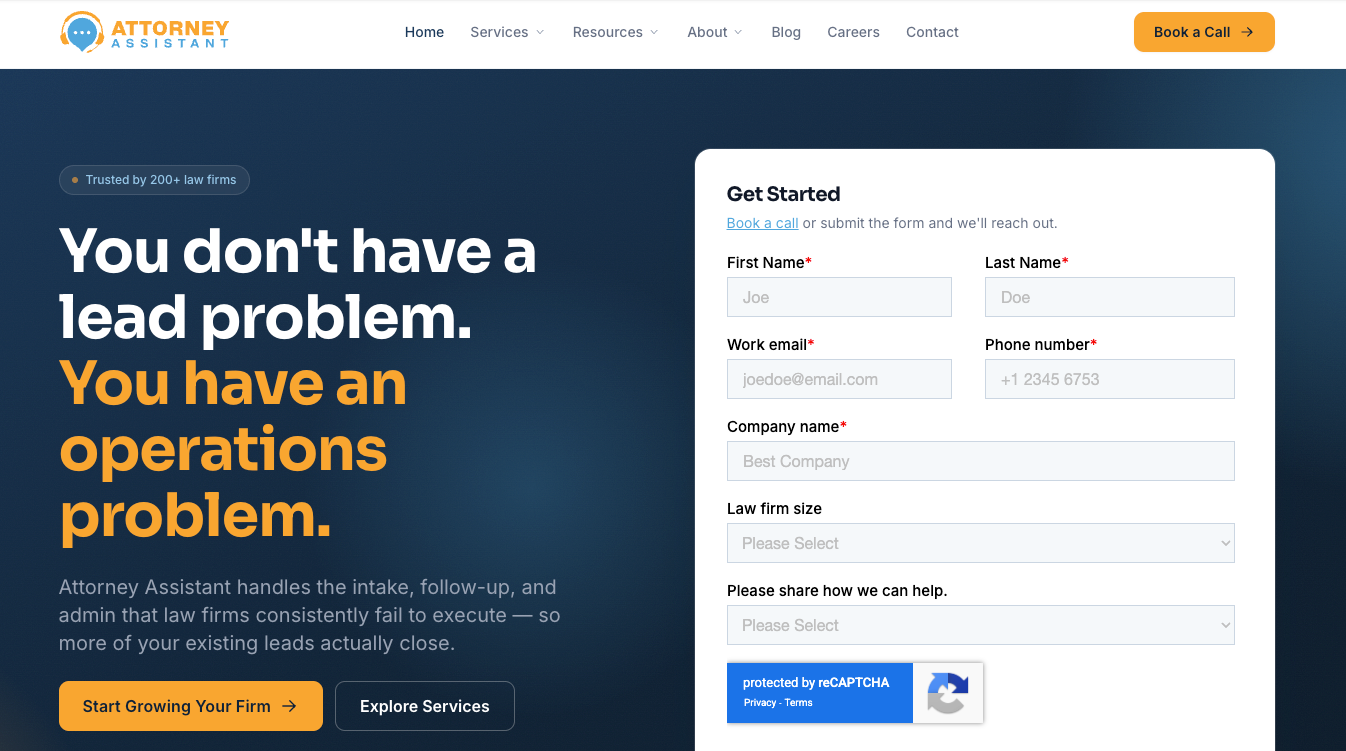
Attorney Assistant is built specifically for personal injury law firms that want to stop losing leads to slow response times and inconsistent intake. Our intake solutions cover everything from 24/7 live intake coverage to AI-assisted lead screening and CRM integration. You can also explore our full suite of law firm tools to automate follow-up and track every lead through your pipeline. If you want to see how lead follow-up services can recover leads you thought were lost, we can show you exactly how it works for firms like yours.
Frequently asked questions
What are the most common intake mistakes law firms make?
Most firms respond too slowly, fail to lead with empathy, or skip conflict checks during busy periods. Speed-to-lead and empathy are the two factors that most directly determine whether a potential client signs or walks.
How can technology improve the intake process?
AI and digital CRMs automate initial screening, reduce data entry errors, and ensure every lead gets a timely follow-up. Unified digital intake saves over 1,300 admin hours annually, giving your team more capacity for high-value work.
What should personal injury intake specialists know?
They need a working understanding of negligence, your state’s statute of limitations, and the case types your firm accepts, combined with empathy training to handle distressed callers. Specialists with PI basics and empathy script training consistently outperform generalist staff.
Is 24/7 intake coverage important?
Absolutely. The majority of PI leads call outside standard business hours, often right after an accident. 24/7 coverage via outsourcing or AI ensures no lead goes unanswered and your firm stays competitive around the clock.
Recommended
Related Articles

Boost client intake: top communication strategies for law firms
Learn how PI law firms can boost client intake conversions with faster response times, multi-channel follow-up, and empathy-driven intake scripts.

Law firm engagement: convert more leads in 2026
Learn how PI law firms can improve engagement, reduce missed leads, and convert more clients with faster intake and empathetic follow-up strategies.

Law firm lead management: convert more clients in 2026
Learn how personal injury law firms can improve lead management, speed up intake, and convert more leads into signed cases with proven, practical strategies.