Law firm engagement: convert more leads in 2026

Personal injury law firms spend thousands every month on marketing, yet a staggering number of those leads never convert. Not because the leads are bad, but because the firm was too slow, too cold, or simply unavailable when a potential client reached out. After-hours leads account for 42% of inquiries at law firms, which means nearly half your pipeline is arriving when your staff has already gone home. Engagement is not just a customer service concept. For PI firms, it is the difference between a signed case and a prospect who called your competitor next.
Table of Contents
- What does engagement mean for law firms?
- The high cost of poor engagement: lost leads and revenue
- Balancing speed and empathy: AI vs. human touch
- After-hours engagement: the overlooked opportunity
- Why engagement is the real competitive advantage for PI law firms
- Take your engagement to the next level with Attorney Assistant
- Frequently asked questions
Key Takeaways
| Point | Details |
|---|---|
| Engagement drives conversion | Quick, empathetic responses directly boost lead conversion in PI law firms. |
| Poor intake costs big | Missed or mishandled leads can drain $80-120k monthly from your firm. |
| AI and empathy are complementary | Combining technology speed with human empathy provides optimal client intake results. |
| After-hours matters most | 42% of leads come outside business hours, requiring reliable follow-up. |
| Empathy training yields real ROI | Intake specialists trained in empathy drive more reviews and referrals, outpacing competitors. |
What does engagement mean for law firms?
Engagement is one of those words that gets used loosely, but in the context of a personal injury law firm, it has a very specific meaning. It is not just answering the phone. It is the full experience a potential client has from the moment they first contact your firm to the moment they sign a retainer.
True engagement includes three core elements:
- Responsiveness: How fast you reply to calls, texts, web forms, and messages
- Empathy: How well your team understands and acknowledges the emotional state of someone who just experienced an accident or injury
- Clarity: How clearly you communicate next steps, timelines, and what the client can expect
PI clients are not shopping for a product. They are scared, in pain, and often confused about their legal rights. That emotional context makes engagement far more important in personal injury than in almost any other practice area.
“The way a firm treats a potential client in the first five minutes sets the tone for the entire relationship. Empathy is not soft. It is a business strategy.”
Empathy training for intake specialists has been shown to directly boost reviews and referrals for PI law firms. That is not a coincidence. When someone feels heard during a stressful moment, they remember it. They tell their friends. They leave five-star reviews.
The intake specialist role is often the first human touchpoint a lead experiences. If that person is undertrained, distracted, or reading from a rigid script, the emotional connection breaks down immediately. Engagement starts there, and it either builds trust or destroys it.
For firms with 5 to 50 employees, this is especially critical. You do not have the luxury of a large client services department. Every intake interaction carries enormous weight, and the quality of that interaction directly determines your conversion rate.
The high cost of poor engagement: lost leads and revenue
Let us be direct. Poor engagement is not just a missed opportunity. It is a financial leak that compounds over time.
When a lead calls your firm and gets voicemail, or reaches someone who sounds distracted and reads from a checklist, that lead does not wait. They call the next firm on their list. Personal injury clients are often contacting multiple attorneys simultaneously, especially in competitive markets.

| Scenario | Engaged firm | Unengaged firm |
|---|---|---|
| Response time | Under 5 minutes | 2 to 24 hours |
| Intake quality | Empathetic, structured | Rushed, scripted |
| Lead conversion rate | 35 to 50% | 10 to 20% |
| Client referral rate | High | Low |
| Monthly revenue impact | Positive growth | Stagnant or declining |
The numbers get worse when you factor in unqualified leads. Bad signups can cost firms $80 to 120k per month in wasted resources, including staff time, follow-up costs, and case management overhead. Proper qualification during intake is not just about filtering. It is about protecting your firm’s capacity.
Pro Tip: Track your lead-to-signed-case conversion rate monthly. If it is below 30%, your engagement process is the first place to look, not your marketing budget.
Firms that invest in lead management strategies consistently outperform those that treat intake as an administrative task. The data from response time case studies is clear: speed and empathy together create a compounding advantage that is very hard for competitors to replicate.
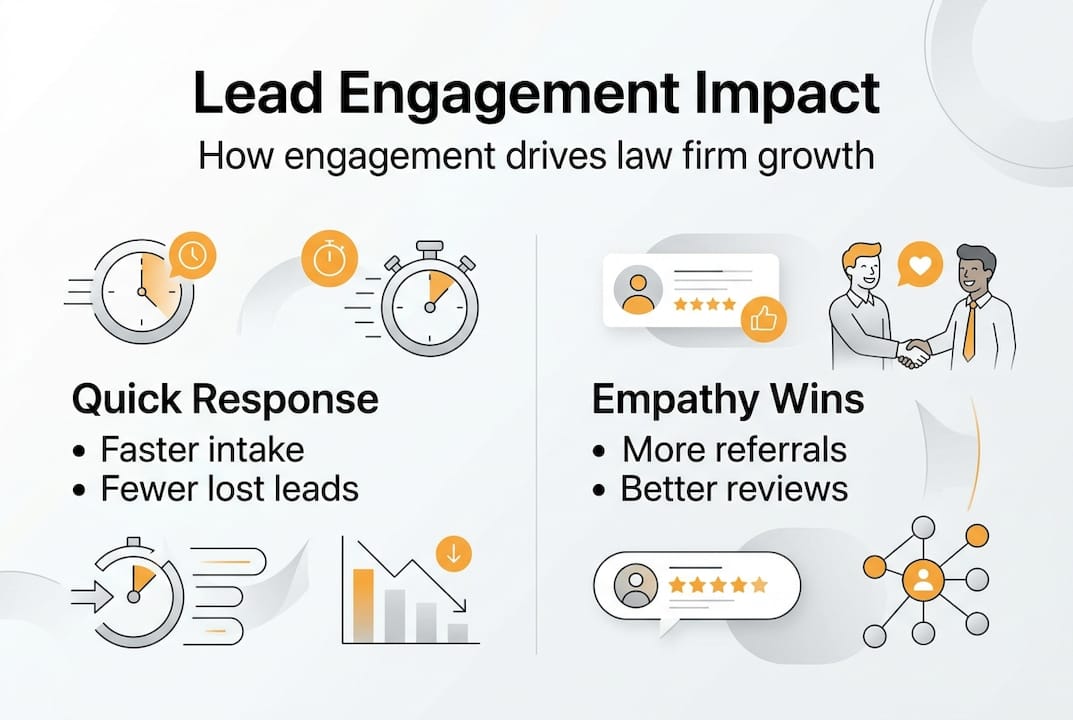
The real cost of poor engagement is invisible on most balance sheets. You never see the cases you lost. You only see the ones you signed. That blind spot is exactly why so many firms keep pouring money into ads while their intake process quietly bleeds revenue.
Balancing speed and empathy: AI vs. human touch
One of the most common mistakes PI firms make is treating speed and empathy as competing priorities. They are not. The best intake systems deliver both, and the way to achieve that is through a smart hybrid model.
AI in intake processes has matured significantly. Automated tools can now handle initial contact, collect basic case information, screen for eligibility, and route leads to the right team member. This happens in seconds, not minutes, which is critical when a prospect is filling out forms at midnight.
But here is what AI cannot do: it cannot sit with someone who just lost a family member in a truck accident and make them feel like a real person is fighting for them. PI clients are emotional and need trust, and while AI handles speed well, complex cases require a human connection to close.
The best approach looks like this:
- AI handles: Initial form capture, eligibility screening, appointment scheduling, after-hours acknowledgment messages
- Humans handle: Emotional intake conversations, case qualification calls, follow-up with warm leads, retainer signing
| Task | Best handled by | Why |
|---|---|---|
| First response | AI | Speed, availability |
| Case screening | AI | Consistency, accuracy |
| Emotional intake | Human | Empathy, trust-building |
| Complex follow-up | Human | Nuance, relationship |
| Retainer conversion | Human | Persuasion, connection |
Technology and client satisfaction are not in conflict when you design your intake workflow intentionally. The firms that struggle are those who either rely entirely on automation or refuse to adopt any technology at all. The middle path, where AI creates speed and humans create trust, is where conversion rates climb.
After-hours engagement: the overlooked opportunity
If there is one area where most PI firms leave money on the table, it is after-hours intake. The assumption is that serious clients will call back during business hours. That assumption is wrong and expensive.
After-hours engagement captures 42% of leads that would otherwise go missed. These are real people, often in crisis, reaching out at the moment they feel ready to take action. That moment does not always happen between 9 and 5.
Here is how to build a reliable after-hours intake system:
- Deploy an AI chat or intake bot on your website to capture lead information and send an immediate acknowledgment at any hour
- Set up automated text responses for missed calls, confirming that someone will follow up within a specific timeframe
- Partner with a legal answering service that specializes in PI intake so real humans handle urgent calls after hours
- Create a clear escalation protocol so your team knows which after-hours leads require same-night follow-up versus next-morning contact
- Review after-hours lead data monthly to identify patterns, such as peak inquiry times, and adjust staffing or automation accordingly
Pro Tip: Firms that respond to after-hours leads within 10 minutes, even with an automated message, are significantly more likely to convert than those who wait until the next business day. Speed signals professionalism and care.
The firms that have mastered boosting PI case conversions all share one trait: they treat after-hours leads with the same urgency as daytime calls. Your competitors who close their phones at 5 PM are handing you a competitive advantage every single evening.
Why engagement is the real competitive advantage for PI law firms
Here is something most law firm consultants will not tell you: you probably do not need more leads. You need to stop losing the ones you already have.
The PI market is crowded. Advertising costs are rising. But the firms that consistently grow are not always the ones with the biggest ad budgets. They are the ones that pick up the phone, respond with genuine care, and follow up when others do not.
Empathy training boosts referrals and reviews, making it one of the most undervalued tools in PI firm growth. Yet most firms spend 10 times more on Google Ads than they do on training their intake team. That is a misalignment that costs real money.
Engagement is not a soft skill. It is a revenue strategy. When a client feels genuinely supported from the first call, they refer their friends, they leave reviews, and they do not ghost you before signing. That flywheel effect is worth more than any paid campaign.
Investing in your intake specialist expertise is one of the highest-return decisions a PI firm owner can make. The firms that figure this out early build a reputation that marketing dollars simply cannot buy.
Take your engagement to the next level with Attorney Assistant
If you recognize your firm in any of these scenarios, whether it is missed after-hours calls, slow follow-up, or inconsistent intake quality, you are not alone. Most PI firms are leaking revenue from leads they already paid to acquire.
At Attorney Assistant, we handle the intake, follow-up, and administrative workflows that keep leads from slipping through the cracks. Our lead follow-up services ensure no prospect goes cold, and our 24/7 intake solutions mean your firm is always available, even when your team is not. Want to see exactly how this works for firms like yours? Join our webinar on engagement and walk away with a clear action plan to convert more leads starting this week.
Frequently asked questions
What does law firm engagement look like in daily operations?
Engagement means responding quickly and empathetically to every lead, with intake specialists trained to handle the emotional needs of PI clients. Empathy training boosts reviews and referrals, making it a core daily practice, not a one-time initiative.
Why are after-hours responses critical for PI law firms?
Almost half of new client leads arrive outside business hours, and failing to respond means losing those prospects to faster competitors. After-hours leads represent 42% of total firm inquiries, making round-the-clock coverage a direct revenue decision.
How can AI improve intake without sacrificing empathy?
Use AI for initial screening, data capture, and after-hours acknowledgment, then hand off complex or emotional cases to trained intake specialists. AI handles speed effectively, but human staff build the trust that actually closes cases.
What is the financial risk of not qualifying leads properly?
Firms can lose between $80,000 and $120,000 monthly when unqualified leads consume staff time and fail to convert into signed cases. Qualification avoids significant financial loss and protects your team’s capacity for the cases that actually matter.
Recommended
- Law firm lead management: convert more clients in 2026 | Attorney Assistant
- Lead nurturing for lawyers: increase client conversion | Attorney Assistant
- Virtual Webinar - Attorney Assistant
- How We Generated - Attorney Assistant
- LinkedIn Marketing Benefits 2026: 80% B2B Leads & 2x CVR - Kawaak
- Why website design impacts leads: 2026 guide for service firms
Related Articles

Inbound Calls Management for Law Firms: 2026 Guide
Discover what is inbound calls management for law firms. Learn strategies to convert leads, improve client retention, and optimize operations.

Lead Management Best Practices for Law Firms in 2026
Discover effective lead management best practices for law firms in 2026. Improve client conversion and maximize your marketing spend.

How to Reduce Intake Errors at Your Law Firm
Learn how to reduce intake errors at your law firm. Discover steps and tools to enhance client data accuracy and streamline your processes.