Lead nurturing for lawyers: increase client conversion

Most law firms pour money into generating leads and then watch those leads go cold. The real problem is not the number of leads coming in. It is what happens after the first contact. One firm increased qualified leads 280% and signed cases 121% simply by improving how they nurtured prospects through intake and follow-up. That result is not an outlier. It is what happens when firms stop treating lead nurturing as an afterthought and start treating it as a core business function. This article breaks down exactly what lead nurturing means for law firms, why the data behind it is impossible to ignore, and how you can build a system that converts more of the leads you already have.
Table of Contents
- Defining lead nurturing for lawyers
- Why lead nurturing matters: Evidence and impact
- Key components of an effective lead nurturing system
- Comparing lead nurturing methods: Manual vs automated
- How to implement lead nurturing in your firm
- Next steps: Support and solutions for lead nurturing success
- Frequently asked questions
Key Takeaways
| Point | Details |
|---|---|
| Lead nurturing delivers high ROI | Firms that nurture leads boost signings and see dramatic conversion rate increases. |
| Automation scales engagement | Automated follow-up reduces ad costs and enables consistent, timely responses. |
| Personalized communication matters | Tailored outreach builds trust and guides prospects to choose your firm. |
| Step-by-step implementation | Successful nurturing systems start with intake, segmentation, ongoing communication, and continual improvement. |
Defining lead nurturing for lawyers
Lead nurturing is not just sending a follow-up email after a consultation. It is a structured, ongoing process of building trust with a prospect from the moment they first contact your firm until they are ready to sign. It spans multiple channels, including email, phone, text, and automated messaging, and it is designed to meet prospects where they are emotionally and practically.
Many firms confuse activity with strategy. Sending one email or leaving one voicemail is activity. Lead nurturing is a deliberate sequence of personalized touchpoints that educates prospects, addresses their concerns, and keeps your firm top of mind. Firms that invest in legal lead nurturing strategies consistently outperform those that rely on a single point of contact.
Here is how lead nurturing differs from basic follow-up:
- Basic follow-up: One or two calls after initial contact, generic voicemail, no tracking of response
- Lead nurturing: Segmented outreach based on case type, automated email sequences, personalized text messages, scheduled check-ins, and documented engagement history
- Basic follow-up: Stops when the prospect does not respond immediately
- Lead nurturing: Continues with value-driven content until the prospect opts out or signs
- Basic follow-up: Treats all leads the same regardless of urgency or case type
- Lead nurturing: Prioritizes high-value leads and tailors messaging to each prospect’s situation
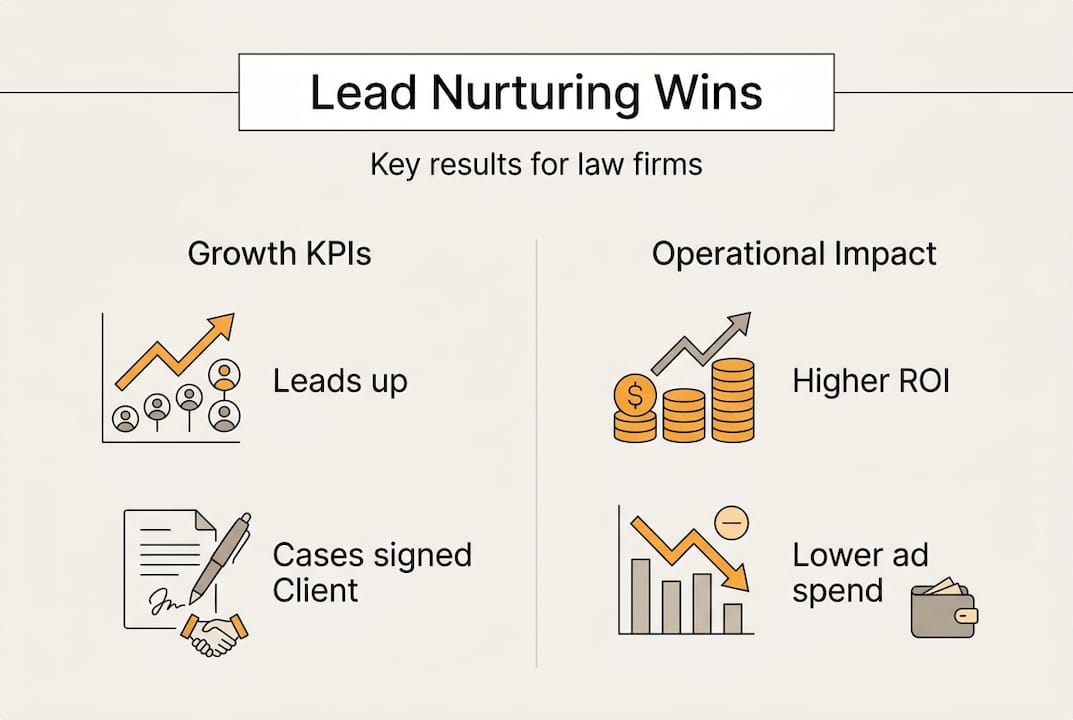
The difference is not just operational. It is financial. Signed cases increased 121% in firms that made this shift.
Why lead nurturing matters: Evidence and impact
The numbers make a compelling case. Firms that implement structured nurturing systems see results that go far beyond marginal improvements. The data points to transformational outcomes across lead volume, conversion rates, and marketing efficiency.
Consider what automation-driven nurturing has produced across documented case studies: an 18% lift in conversion rates, a 40% reduction in ad spend, and a 7x increase in clients for one firm using HubSpot nurturing workflows. These are not theoretical projections. They are real outcomes from firms that committed to a system.
“One firm increased qualified leads by 280% and signed cases by 121% after implementing AI-powered intake and nurturing. Another multiplied its client base 7x through structured automation.”
Here is a summary of documented outcomes:
| Metric | Outcome |
|---|---|
| Qualified lead growth | 280% increase |
| Signed cases | 121% increase |
| Client volume growth | 7x via HubSpot nurturing |
| Conversion rate lift | 18% improvement |
| Ad spend reduction | 40% decrease |
These results reinforce what the best-performing firms already know: you do not need more leads if you are converting the ones you have. Reviewing lead nurturing best practices and understanding how generating high-quality legal leads connects to nurturing gives you a complete picture of the revenue opportunity sitting in your pipeline right now.
Key components of an effective lead nurturing system
Building a nurturing system that actually works requires more than good intentions. It requires specific components working together in sequence. Here is what every high-performing system includes:
- Fast initial intake response. Speed matters more than most firms realize. The first firm to respond to a prospect often wins the case. Hiring intake specialists ensures someone is always ready to engage a new lead without delay.
- Lead segmentation. Not every lead is equal. Segment by case type, urgency, and qualification status so your team focuses energy where it counts. Understanding legal intake specialist benefits helps you structure this process correctly from the start.
- Automated and personalized communications. Use automation to send timely, relevant messages without burdening your staff. Personalization means referencing the prospect’s specific situation, not just their name.
- Defined follow-up sequences. Every lead should enter a documented sequence with clear timelines. Setting intake department goals gives your team measurable targets and accountability.
- Response tracking and monitoring. Know who opened your emails, who responded to texts, and who went silent. Use that data to adjust your approach in real time.
Pro Tip: Generic messaging kills conversions. A personal injury prospect and a family law prospect have completely different fears and questions. Write separate nurturing sequences for each practice area and watch your response rates climb.
Firms that increased signed cases 121% did not do it with one tactic. They built a system where every component reinforced the next.
Comparing lead nurturing methods: Manual vs automated
Once you understand what a nurturing system needs, you have to decide how to run it. Manual and automated approaches each have a place, but they are not equally effective at scale.
| Factor | Manual nurturing | Automated nurturing |
|---|---|---|
| Cost | Lower upfront, higher labor cost | Higher setup cost, lower ongoing cost |
| Consistency | Depends on staff availability | Consistent 24/7 delivery |
| Personalization | High touch, deeply personal | Personalized at scale with templates |
| Speed of follow-up | Limited by staff hours | Instant response capability |
| Scalability | Difficult to scale | Scales without adding headcount |
| Tracking | Manual logging, error-prone | Automated reporting and analytics |
Manual nurturing works well for high-value cases where a personal phone call from an attorney or senior staff member makes a real difference. Automated nurturing handles volume, consistency, and speed in ways no human team can match alone.

The strongest firms combine both. They use automation to handle initial outreach, reminders, and educational content, while reserving personal calls for qualified prospects who are close to signing. Understanding legal intake specialist roles helps you define where human touchpoints add the most value. Pairing that with well-crafted intake scripts for lawyers ensures every conversation moves the prospect forward.
Key advantages of automation:
- Responds to leads instantly, even at 2 a.m.
- Sends follow-up sequences without staff intervention
- Tracks every interaction automatically
Key limitations of manual-only nurturing:
- Inconsistent when staff are busy or unavailable
- Difficult to maintain across high lead volumes
- No built-in tracking without extra administrative effort
Firms using AI-powered intake and nurturing saw a 40% reduction in ad spend because they stopped wasting money chasing new leads when their existing pipeline was underserved.
How to implement lead nurturing in your firm
Knowing what to build is one thing. Actually building it is another. Here is a practical sequence to get your nurturing system running without overwhelming your team.
- Audit your current intake process. Map every step from first contact to signed retainer. Identify where leads drop off and how long each stage takes. Most firms discover they are losing prospects between the first call and the second touchpoint.
- Set clear follow-up protocols. Define exactly who contacts each lead, when, and through which channel. Ambiguity in this step is where most nurturing efforts fail.
- Choose your technology platform. Select a CRM or intake automation tool that supports email, text, and call tracking. Client intake automation tools built for law firms reduce setup time and integrate with your existing workflow.
- Build your communication sequences. Write emails and text messages for each stage of the nurturing process. Keep them short, relevant, and specific to the prospect’s case type.
- Monitor performance and adjust. Track open rates, response rates, and conversion rates weekly. Use that data to refine your sequences. Access lead nurturing guides to benchmark your results against proven frameworks.
Pro Tip: Do not wait until your system is perfect to launch it. A basic automated follow-up sequence running today will outperform a perfect system that is still being planned next quarter. Start simple, then optimize.
Firms that committed to this process saw conversion rates rise 18% while simultaneously cutting ad spend. That combination means more revenue from the same or smaller marketing budget.
Next steps: Support and solutions for lead nurturing success
You now have a clear picture of what lead nurturing is, why it works, and how to build it. The next step is putting it into motion without adding chaos to your firm’s operations.
Attorney Assistant handles the intake, follow-up, and administrative workflows that most firms struggle to maintain consistently. Our automated intake solutions are built specifically for law firms that want to respond faster, convert more leads, and reduce the internal pressure on their staff. If you want to see how other firms have applied these strategies, our lead nurturing webinars walk through real examples and proven frameworks. Ready to see what this looks like for your firm? Schedule a call and we will map out a nurturing strategy tailored to your practice area and lead volume.
Frequently asked questions
How does lead nurturing improve client conversion for law firms?
Lead nurturing keeps your firm in front of prospects through consistent, personalized contact across multiple channels, so when they are ready to hire, your firm is the obvious choice. Firms using structured nurturing have seen signed cases increase 121% compared to basic follow-up approaches.
What tools are best for automating lead nurturing in law firms?
CRM platforms with built-in email, text, and call tracking are the most effective tools for law firm nurturing automation. Automation-driven systems have produced an 18% conversion lift and a 40% reduction in ad spend for documented firm case studies.
How is lead nurturing different from basic follow-up?
Basic follow-up is a single touchpoint with no structure or personalization. Lead nurturing is a multi-stage, segmented strategy that educates prospects and builds trust over time. Firms that made this shift saw qualified leads grow 280% without increasing their marketing budget.
Can small law firms benefit from lead nurturing automation?
Absolutely. Automation allows small firms to maintain consistent follow-up across every lead without hiring additional staff. Conversion rates improved 18% in firms that implemented automated nurturing, regardless of firm size.
Recommended
- The Power of Lead Nurturing in Legal Marketing - Attorney Assistant
- Intake Specialist for Your Law Firm
- How We Generated - Attorney Assistant
- Effective Strategies and Techniques for Generating High-Quality Legal Marketing Leads - Attorney Assistant
- How to Communicate with Legal Counsel as an Employee
Related Articles

Law firm lead management: convert more clients in 2026
Learn how personal injury law firms can improve lead management, speed up intake, and convert more leads into signed cases with proven, practical strategies.

Law firm client intake best practices: boost conversions
Discover proven client intake best practices for personal injury law firms. Reduce admin backlog, improve response speed, and convert more leads into signed cases.

What is law firm chaos? Identify, fix, and streamline
Learn what law firm chaos is, why it costs PI firms 15-40% in lost conversions, and how to fix intake and operations for good.