What is law firm chaos? Identify, fix, and streamline

Most personal injury law firm owners assume that a busy, chaotic office is just the price of success. It isn’t. Operational disorder in a law firm is not a badge of hustle. It’s a revenue leak. When intake calls go unanswered, follow-ups fall through the cracks, and staff scramble to find files, you’re not just stressed. You’re losing signed cases to competitors who simply respond faster. This guide breaks down what law firm chaos actually is, why PI firms are especially vulnerable, and exactly what you can do to fix it.
Table of Contents
- Defining law firm chaos
- How chaos hurts your law firm’s bottom line
- The root causes of chaos in PI law firms
- Spotting and measuring chaos: Symptoms checklist
- Proven solutions: Turning chaos into streamlined operations
- Avoiding common pitfalls: What most firms overlook
- Streamline your firm and never look back
- Frequently asked questions
Key Takeaways
| Point | Details |
|---|---|
| Law firm chaos defined | It’s avoidable disorganization that directly impacts firm success and client satisfaction. |
| Business costs | Operational chaos leads to lost revenue, staff burnout, and compliance risks. |
| Root causes | Manual processes and informal intake systems are key sources of chaos, especially in PI firms. |
| Clear solutions | Automating intake and follow-ups rapidly boosts conversions and reduces chaos. |
| Sustainable change | Ongoing attention to workflows and technology keeps chaos from returning. |
Defining law firm chaos
Law firm chaos is not just a messy desk or a hectic Monday morning. It’s a persistent state of organizational disorder that affects how your firm captures leads, serves clients, and manages daily operations. Think of it as the gap between how your firm should run and how it actually runs on any given day.
According to a practice management analysis, law firm chaos means operational disorder like scattered files and inefficient communication that compounds over time. Left unaddressed, it quietly erodes your firm’s ability to convert leads and retain clients.
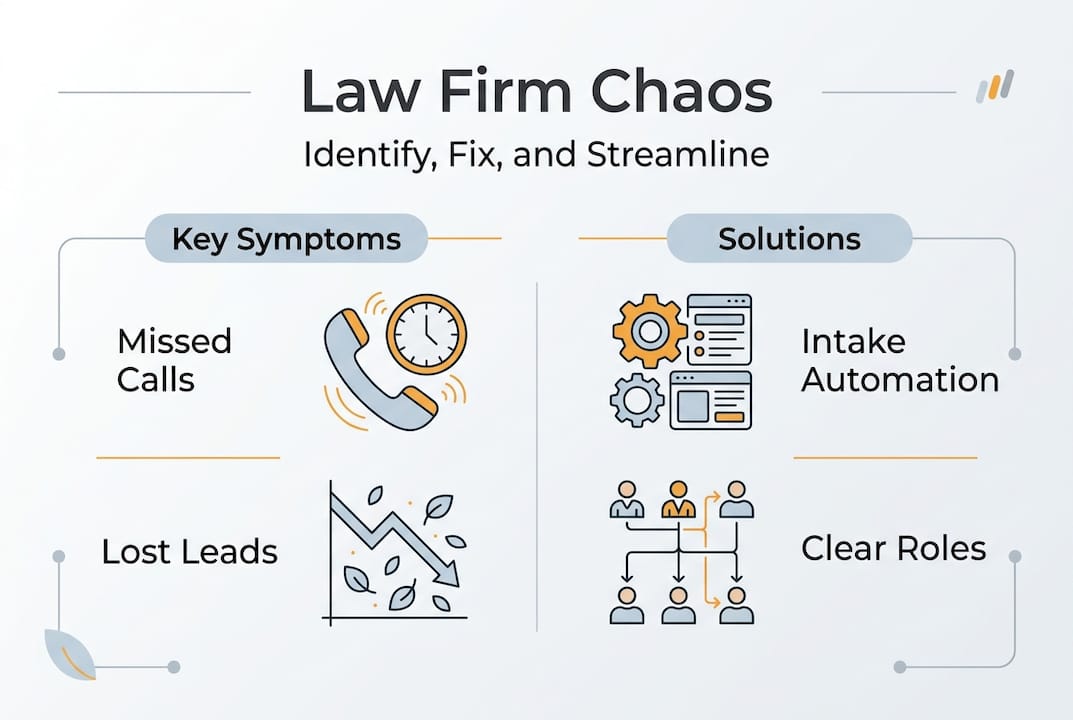
Common symptoms include:
- Missed client follow-up calls or emails
- Files stored in multiple locations with no clear system
- Billing errors and delayed invoices
- Staff unsure who owns which task
- Deadlines tracked in personal notebooks instead of shared systems
“Chaos in a law firm is rarely dramatic. It shows up as small, repeated failures that add up to serious business damage.”
For personal injury firms specifically, the problem is amplified. PI practices deal with high-velocity inbound leads, often from people in urgent situations. When your intake process is disorganized, those leads don’t wait. They call the next firm on their list. Investing in transforming firm efficiency and adopting digital tools for law firms are two of the fastest ways to close that gap.
How chaos hurts your law firm’s bottom line
Chaos is not just an operational inconvenience. It has a direct, measurable cost. Every missed call, every slow response, and every dropped follow-up represents a potential case that walked out the door.
Here’s where the damage shows up most:
- Lost leads: Potential clients who don’t hear back within minutes often sign with another firm. Speed is a competitive advantage in PI law.
- Revenue leakage: Billing errors, unbilled time, and rework from unclear processes drain thousands of dollars per month.
- Staff burnout: When roles are unclear and processes are broken, your team spends energy on confusion instead of casework. Turnover follows.
- Compliance risk: Sloppy intake and documentation practices increase the risk of bar association complaints and malpractice exposure.
The financial upside of fixing this is significant. Improving intake processes can increase conversions by 15 to 40 percent without spending a single dollar more on marketing. That’s not a small number. For a firm signing 10 cases a month, a 25 percent improvement means 2 to 3 additional signed cases every month.
Understanding the role of PI intake specialists and the importance of intake roles is a critical first step. Pairing that with clear intake department goals gives your team a measurable target to work toward.
The root causes of chaos in PI law firms
Chaos doesn’t appear out of nowhere. It builds gradually from specific, fixable problems. The most common triggers in PI firms are:
- Manual intake processes: Phone calls logged on sticky notes, intake forms emailed back and forth, no centralized tracking.
- Scattered spreadsheets: Multiple team members maintaining separate trackers that never sync.
- Unclear staff roles: Everyone assumes someone else is following up. Nobody does.
- No automation: Every reminder, every follow-up, and every status update requires a human to initiate it.
- Communication silos: Attorneys, paralegals, and intake staff operating in separate systems with no shared visibility.
As research confirms, chaos often results from overreliance on spreadsheets and manual processes that were never designed to scale. What worked when your firm had five cases a month breaks down completely at fifty.

Comparing manual vs digital processes side by side often reveals just how much time and money is being lost. For a deeper look at tools available in 2026, the legal tech resources page is a solid starting point.
Pro Tip: Before buying any new software, spend one week documenting every task your intake team performs manually. That list becomes your automation roadmap.
Spotting and measuring chaos: Symptoms checklist
Once you understand the root causes, the next step is diagnosing your firm’s specific situation. Use the table below to score your firm on the most common chaos indicators.
| Chaos symptom | Present? | Severity (1 to 5) |
|---|---|---|
| Missed or delayed client follow-ups | Yes / No | |
| Billing errors or unbilled time | Yes / No | |
| Lost or misrouted leads | Yes / No | |
| Unclear task ownership | Yes / No | |
| Repeated data entry across systems | Yes / No | |
| Overdue deadlines discovered late | Yes / No | |
| Staff asking the same questions repeatedly | Yes / No |
Score each symptom from 1 (minor) to 5 (severe). A total score above 20 signals that chaos is actively costing your firm money and cases. Share this table with your team and review it together. You’ll often find that staff have been aware of these problems for months but assumed leadership already knew.
As practice management experts note, disorganization and manual systems make chaos easy to overlook until it becomes a crisis. The five most common red flags to watch for are:
- Forgotten follow-ups with no accountability trail
- Repeated errors in the same process week after week
- No single person responsible for lead tracking
- Bottlenecks that only one staff member can resolve
- Client complaints about communication or responsiveness
For additional self-assessment tools, the chaos management guides library offers practical frameworks built specifically for law firms.
Proven solutions: Turning chaos into streamlined operations
Diagnosing chaos is only useful if you act on it. Here’s a step-by-step framework for moving from disorder to a firm that runs predictably.
- Audit your intake process first. Map every step from first contact to signed retainer. Identify where leads fall through.
- Document your core processes. Write down how things should work, not just how they currently do. This becomes your operations manual.
- Assign clear ownership. Every task and every stage of the client journey needs one named person responsible for it.
- Automate follow-up. Use tools that trigger reminders, send status updates, and flag overdue tasks without requiring manual input.
- Review and iterate. Set a monthly review to check your chaos score and adjust processes based on what’s still breaking.
The comparison below shows why automation matters:
| Process | Manual | Automated |
|---|---|---|
| Lead response time | Hours to days | Minutes |
| Follow-up consistency | Depends on staff | 100% consistent |
| Data accuracy | Prone to errors | Standardized |
| Scalability | Breaks under volume | Scales easily |
| Staff time required | High | Low |
Intake automation and workflow reorganization can rapidly reduce chaos and increase conversion rates. The firms that see the fastest results start with their most repetitive daily task and automate it completely before moving on.
For practical guidance, the intake process tips and intake process improvement resources walk through real implementation steps. Pairing those with the right technology for operations makes the transition faster and more sustainable.
Pro Tip: Pick the single most repetitive task your intake team does every day and automate it this week. One win builds momentum for the rest.
Avoiding common pitfalls: What most firms overlook
Fixing chaos sounds straightforward. In practice, most firms stumble in predictable ways. Knowing these pitfalls in advance saves you months of wasted effort.
- Treating symptoms instead of causes. Adding a new checklist to a broken process doesn’t fix the process. It just adds steps.
- Keeping legacy software out of loyalty. Old systems that staff have worked around for years are often the core problem, not the solution.
- Skipping staff input. The people doing the work daily know exactly where the bottlenecks are. Ignoring them means missing your best insights.
- Implementing too many changes at once. Firms that overhaul everything simultaneously create new chaos while trying to fix the old kind.
Consider a common scenario: a PI firm invests in a new case management platform but keeps its manual intake process unchanged. Six months later, the firm still loses leads at the same rate. The software didn’t fail. The intake process was never fixed.
“Firms that skip intake upgrades or leave manual systems in place see chaos return quickly, regardless of other improvements made.”
The intake process mistakes resource covers the most common errors PI firms make during this transition and how to avoid them.
Streamline your firm and never look back
You now have a clear picture of what law firm chaos is, where it comes from, and how to fix it. The next step is putting that knowledge into action with the right support behind you.
Attorney Assistant was built specifically for PI firms that are tired of losing cases to slow response times and inconsistent intake. We handle intake, follow-up, and administrative workflows so your team can focus on winning cases instead of chasing paperwork. Whether you’re ready to overhaul your intake process or just want to see what’s possible, the intake solutions page walks through exactly how we help. You can also join our automation webinar to see live examples of how firms like yours have cut chaos and increased signed cases within weeks.
Frequently asked questions
What are the early warning signs of law firm chaos?
Missed client follow-ups, billing errors, and unclear task ownership are the most common early signals. These small failures tend to compound quickly if not addressed.
How can intake automation reduce law firm chaos?
Intake automation standardizes how leads are captured and followed up, ensuring no inquiry slips through. Firms that fix their intake process see conversion improvements of 15 to 40 percent without increasing their marketing budget.
Is chaos more common in personal injury law firms?
Yes. PI firms handle high volumes of inbound leads from people in urgent situations, which means disorganized intake has an outsized impact on revenue compared to other practice areas.
Which manual processes contribute most to chaos?
Manual intake logging, spreadsheet-based lead tracking, and non-centralized communication are the primary culprits. As practice management research shows, overreliance on manual processes is the most consistent trigger of firm-wide disorder.
What is the quickest way to reduce chaos?
Audit your intake and follow-up process first, then automate the most repetitive steps. Intake automation delivers measurable results faster than any other single operational change.
Recommended
Related Articles

Law firm lead management: convert more clients in 2026
Learn how personal injury law firms can improve lead management, speed up intake, and convert more leads into signed cases with proven, practical strategies.

Law firm client intake best practices: boost conversions
Discover proven client intake best practices for personal injury law firms. Reduce admin backlog, improve response speed, and convert more leads into signed cases.

Lead nurturing for lawyers: increase client conversion
Learn how law firms use lead nurturing to increase client conversion rates, reduce ad spend, and sign more cases from existing leads.