Legal assistants in PI intake: boost conversions fast

TL;DR:
- Legal assistants play a strategic role in initial client screening and case viability assessment.
- Effective intake processes increase conversion rates, reduce attorney workload, and capture more leads.
- Treating intake as a profit center with trained staff and technology boosts firm growth and client satisfaction.
Intake is where personal injury cases are won or lost, and most firm owners don’t realize it until they’re already bleeding revenue. The legal assistant sitting at the front of your intake process isn’t just filling out forms. They’re making judgment calls, building client trust, and filtering leads that determine whether your attorneys spend time on winnable cases. Legal assistants handle initial client interviews, gather incident details, medical records, and insurance information, and assess case viability before a single attorney gets involved. This article breaks down exactly how that works and what it means for your firm’s bottom line.
Table of Contents
- Defining the legal assistant’s role in intake
- How legal assistants drive intake efficiency and reduce attorney overload
- Key intake tasks: From information gathering to case viability assessment
- Impact of legal assistants on conversion rates and workflows: Firm-level benefits
- Why most PI firms underestimate intake legal assistants and how to rethink your team
- Upgrade your intake team for higher conversions
- Frequently asked questions
Key Takeaways
| Point | Details |
|---|---|
| Intake is strategic | Legal assistants shape the first client interaction and influence case outcomes, making intake a high-impact function. |
| Boost efficiency and conversion | Legal assistants filter leads, streamline information collection, and raise firm-wide conversion rates for PI cases. |
| Workflow innovation | Virtual staffing and CRM integration empower legal assistants to deliver 24/7 coverage and cut attorney overload. |
| Investment pays off | Firms investing in dedicated intake legal assistants see measurable gains in new client acquisition and operational productivity. |
Defining the legal assistant’s role in intake
Most people picture a legal assistant scheduling appointments or filing paperwork. That picture is incomplete, and for PI firms, it’s costing real money. Legal assistants in intake are doing work that directly shapes case outcomes before litigation even begins.
Paralegals and intake specialists handle initial client interviews, collect incident details, injuries, medical records, and insurance information, and assess case viability during intake. That’s not admin work. That’s strategic filtering that protects attorney time and improves your acceptance rate.
Here’s what a legal assistant actually owns during intake:
- First contact with the potential client, setting the tone for the entire relationship
- Structured interviews to capture incident facts, liability indicators, and injury severity
- Medical record and insurance documentation requests to support early case evaluation
- Initial viability screening to flag strong cases and identify red flags before attorney review
- Case file creation and data entry into your practice management system
This is meaningfully different from general administrative support. A receptionist routes calls. A legal assistant evaluates what’s on those calls and decides what moves forward. That distinction matters enormously when you’re trying to build an effective intake process that converts leads into signed cases consistently.
The role also varies by firm size. At smaller PI firms, one legal assistant may handle the full intake workflow. At mid-sized firms, you might have dedicated intake specialists who focus exclusively on first contact and screening. Either way, the function is the same: qualify leads, gather facts, and prepare cases for attorney review.
Pro Tip: Build standardized intake procedure templates for your legal assistants. When every interview follows the same structure, you reduce missed information, speed up case review, and make it easier to train new staff. Understanding why you should hire an intake specialist starts with recognizing how much structured intake work already exists in your firm.
How legal assistants drive intake efficiency and reduce attorney overload
Attorneys are expensive. Every minute they spend on a call with a low-value lead or chasing down missing documentation is a minute they’re not working on billable case strategy. Legal assistants solve this problem at the source.

For small and mid-sized PI firms, intake legal assistants boost efficiency by owning first impressions, filtering low-value leads, enabling 24/7 coverage through virtual solutions, and improving workflows with CRM integration. That’s a complete operational shift, not just a staffing convenience.
Here’s what that looks like in practice:
- Lead filtering: Legal assistants screen out calls that don’t meet your firm’s case criteria before they ever reach an attorney
- First impressions: A trained intake specialist communicates professionalism and empathy, which directly influences whether a prospect signs with your firm or calls the next number on their list
- 24/7 coverage: Virtual legal assistants can handle intake outside business hours, capturing leads that would otherwise go unanswered
- CRM integration: When intake data flows directly into your case management system, follow-ups are automated, nothing falls through the cracks, and your attorneys walk into reviews with complete information
The personal injury specialization space is competitive. Prospects who call multiple firms sign with whoever responds fastest and makes them feel heard. A legal assistant who picks up within minutes and conducts a thorough, empathetic intake interview wins that client before your competitors even return the call.
Pro Tip: Integrate your intake workflow with a CRM from day one. When legal assistants log information directly into a shared system, follow-up reminders are automated, documentation is centralized, and your team spends less time on manual coordination. Firms that want to boost PI case conversions consistently invest in this kind of infrastructure.
The legal intake specialist role is also scalable. As your firm grows, you can add intake capacity without adding attorney hours, which is how mid-sized firms compete with larger ones.
Key intake tasks: From information gathering to case viability assessment
Let’s get specific. Here’s the step-by-step workflow a legal assistant follows during a standard PI intake call.
- Initial contact and rapport building: Greet the prospect, confirm availability to talk, and establish a calm, professional tone
- Incident overview: Collect the basic facts of the accident or injury, including date, location, and circumstances
- Injury and medical status: Ask about injuries sustained, current treatment, and whether the prospect has seen a doctor
- Insurance and liability details: Identify all relevant insurance policies, at-fault parties, and any prior claims
- Documentation checklist: Request police reports, medical records, photos, and any correspondence with insurance companies
- Red flag screening: Identify issues like contributory negligence, expired statutes of limitations, or prior injuries to the same body part
- Case viability summary: Prepare a brief summary for attorney review, flagging strong cases and noting concerns
Legal assistants gather incident details, injuries, and insurance info while identifying red flags and potential risks early. That early detection is what separates firms with clean case pipelines from firms drowning in poor-fit clients.
Here’s a quick reference for common intake data points and their purpose:
| Data point | Why it matters |
|---|---|
| Date and location of incident | Establishes jurisdiction and statute of limitations |
| Injury description | Indicates case value and medical documentation needs |
| Insurance carrier and policy | Determines coverage and potential recovery |
| Prior injuries or claims | Flags credibility or causation issues |
| Treating physician | Confirms medical documentation trail |
For cases involving accident case details like slip and falls, the intake checklist gets even more specific, requiring property ownership records, incident reports, and witness statements.
“Thorough intake isn’t about collecting data. It’s about building the foundation every strong case rests on. Miss something at intake, and you’re chasing it for months.”
Review your core intake tasks and compare them against intake best practices to identify gaps in your current workflow.
Impact of legal assistants on conversion rates and workflows: Firm-level benefits
The difference between firms with dedicated intake legal assistants and those without shows up fast in conversion data, lead response times, and attorney satisfaction.
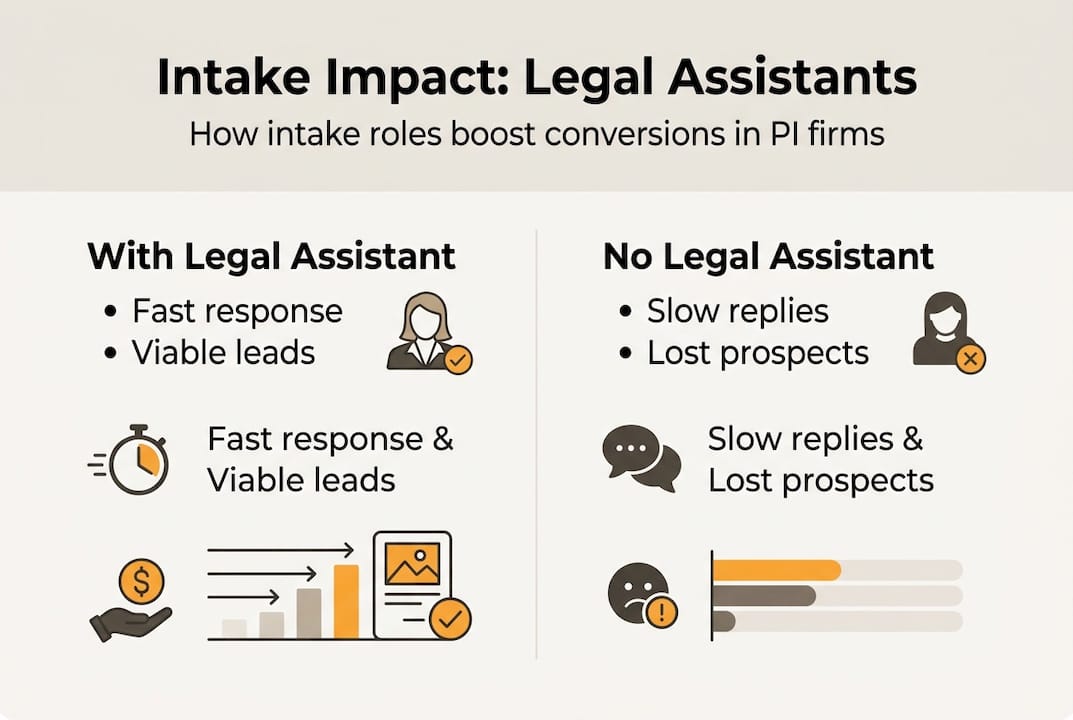
| Metric | Firms without dedicated intake | Firms with dedicated intake |
|---|---|---|
| Lead response time | Hours to days | Minutes to 1 hour |
| Case acceptance rate | Inconsistent, often low | Higher and more predictable |
| Attorney time on intake | High, pulling from case work | Minimal, focused on vetted cases |
| Lost leads from missed calls | Frequent | Rare with virtual coverage |
| Documentation completeness | Variable | Standardized and consistent |
Legal assistants are key to scaling case conversion without attorney overload and support CRM-driven efficiency. That’s not a soft benefit. That’s a structural advantage that compounds over time as your firm grows.
Here are the signs your firm needs to invest more in intake support:
- Attorneys are still taking first calls from unscreened prospects
- Follow-up is inconsistent and leads go cold before anyone circles back
- Intake data is scattered across emails, sticky notes, and spreadsheets
- You’re losing cases to competitors who respond faster
- Conversion rates are flat despite steady lead volume
If two or more of those sound familiar, your intake function is the bottleneck, not your marketing. The path to boost client conversion runs directly through how your legal assistants are structured, trained, and supported.
Firms that invest in dedicated intake roles also report lower staff turnover among attorneys, because attorneys aren’t burned out fielding unqualified calls. That’s a retention benefit most firm owners don’t factor into the ROI calculation. Reviewing the intake impact data makes the case clearly.
Why most PI firms underestimate intake legal assistants and how to rethink your team
Here’s the uncomfortable truth: most PI firm owners treat intake as overhead. They hire the cheapest person available, give them a script, and wonder why conversion rates stagnate. The firms that grow consistently do something different. They treat intake as a revenue-generating function and staff it accordingly.
Legal assistants aren’t support staff. They’re the first point of contact between your firm and a potential client who is scared, injured, and making a fast decision about who to trust. That moment is worth real money. A poorly handled intake call doesn’t just lose one case. It loses the referrals that case would have generated.
The firms we’ve seen scale fastest didn’t just add marketing spend. They fixed effective intake conversion first. They hired trained intake specialists, built structured workflows, and integrated technology so nothing slipped through. Revenue followed.
Pro Tip: Reframe intake as a profit center in your next team meeting. Track conversion rates, response times, and lead quality scores the same way you track case outcomes. When your legal assistants know their work is measured and valued, performance improves.
Upgrade your intake team for higher conversions
If this article made one thing clear, it’s that your intake function is either working for you or quietly costing you cases every week. The good news is that fixing it doesn’t require a full firm overhaul.
At Attorney Assistant, we specialize in exactly this. Our Intake 360 service gives PI firms trained intake specialists who handle first contact, lead screening, and follow-up so your attorneys stay focused on cases. Explore our intake optimization tools to see how technology and trained staff work together to close the gaps in your current process. And if you want to see the full picture before committing, join our virtual intake webinar to learn how firms like yours are converting more leads without adding attorney hours.
Frequently asked questions
What specific information do legal assistants collect during intake at PI firms?
Legal assistants gather incident details, medical records, insurance information, and injury facts to assess whether a case meets the firm’s acceptance criteria.
How do legal assistants improve case conversion rates for PI firms?
By filtering low-value leads and owning first impressions, legal assistants ensure that higher conversions follow from faster, more consistent, and better-qualified intake interactions.
What operational advantages come from virtual intake legal assistants?
Virtual intake legal assistants provide 24/7 coverage and workflow improvements, faster response times, and seamless CRM integration that reduces manual follow-up and missed leads.
Why is intake more than an admin task at personal injury firms?
Intake involves critical first contact, trust-building, and early case vetting, all of which directly impact conversion rates and long-term firm growth.
Recommended
Related Articles

Lead leakage in law firms: capture more PI cases
Learn what lead leakage costs PI law firms and get actionable strategies to capture more personal injury cases through faster, smarter intake.

Effective law firm intake process: boost client conversion
Learn how to optimize your personal injury law firm's intake process to convert more leads, improve efficiency, and stop losing cases to slow or inconsistent intake.

Boost client intake: top communication strategies for law firms
Learn how PI law firms can boost client intake conversions with faster response times, multi-channel follow-up, and empathy-driven intake scripts.