How intake shapes successful client onboarding

TL;DR:
- A well-structured intake process builds trust, converts more leads, and prevents client loss.
- Automating and optimizing intake forms reduces delays, errors, and increases client conversion rates.
- Leadership ownership and consistent review of intake are crucial for law firm growth and client satisfaction.
Your intake process is either your firm’s strongest asset or its biggest blind spot. Most personal injury law firms pour money into advertising and referral networks, then lose potential clients in the first 10 minutes of contact because the intake process is slow, disorganized, or cold. Intake, meaning the structured first contact and initial data gathering with a prospective client, is not a clerical formality. It is the moment where a stranger decides whether to trust your firm with one of the most stressful events of their life. Get it right, and you convert more leads into signed cases. Get it wrong, and your marketing budget is quietly funding someone else’s growth.
Table of Contents
- What is legal intake and why does it matter?
- How intake impacts each stage of client onboarding
- Key components of an effective intake process
- Best practices for optimizing intake efficiency
- Measuring the impact of intake improvements
- Why most law firms underestimate intake’s power and how to lead the change
- Streamline your intake with Attorney Assistant
- Frequently asked questions
Key Takeaways
| Point | Details |
|---|---|
| Intake sets onboarding success | The intake process establishes the first impression and smooths every subsequent step in client onboarding. |
| Optimize for higher conversions | Streamlined, tech-enabled intake turns more inquiries into signed cases for personal injury firms. |
| Measure, review, and refine | Track intake metrics and continually improve to maximize ROI and client satisfaction. |
| Combine tech with personal touch | Balancing digital tools with skilled intake staff yields the best onboarding outcomes. |
| Firm leadership drives results | When firm owners prioritize intake, long-term onboarding and business growth improve dramatically. |
What is legal intake and why does it matter?
Legal intake is the structured process of collecting information from a prospective client during first contact. It includes gathering case details, qualifying the lead, capturing contact information, and assessing whether the case is a good fit for your firm. Think of it as the bridge between “someone heard of you” and “someone signed with you.”
A lot of firms treat intake as purely administrative. One of the most common misconceptions is that intake is “just paperwork.” Another is that any staff member can handle it without specialized training. Both assumptions cost firms real money. As structured intake procedures directly shape the client experience, a poorly managed intake does not just annoy prospects. It signals disorganization and erodes trust before your attorneys have spoken a single word.
The stakes are high. A missed call, a 48-hour callback delay, or a confusing intake form can send a viable personal injury client straight to a competitor. Reputation damage is also real. Clients who feel dismissed at intake rarely give second chances, and they do talk.
Here is what weak intake actually costs your firm:
- Lost leads from slow response times or missed after-hours calls
- Poor case fit when unqualified leads slip through without proper screening
- Incomplete files that delay case opening and frustrate attorneys
- Negative first impressions that reduce referrals and online review scores
- Staff burnout from inconsistent or manual processes that waste time
Pro Tip: Stop thinking of intake as admin work. It is client service. The moment someone calls or submits a form, they are evaluating your firm. The person who handles intake is, in effect, your firm’s first impression and your primary conversion tool.
Your client intake communication strategies matter as much as your legal credentials when it comes to winning a client’s trust on that first contact.
How intake impacts each stage of client onboarding
Intake does not happen in a vacuum. It feeds every downstream phase of client onboarding. Onboarding, in this context, means the full process of transitioning an accepted prospect into an active, welcomed client with an open case file. When intake is strong, onboarding flows. When intake is weak, every stage after it struggles.
A well-structured intake process shapes the client journey from the first call all the way through case assignment and beyond. Here is how the sequential flow typically looks in a personal injury firm:
- Inquiry received — Call, web form, or live chat captures initial contact.
- Qualification — Staff determines if the case fits your practice areas and minimum thresholds.
- Information capture — Incident details, medical status, insurance information, and liability questions are gathered.
- Documentation and e-signature — Retainer agreements and release forms are sent and signed.
- Case assignment — The file moves to an attorney or paralegal team for review and activation.
- Onboarding welcome — Client is formally welcomed, expectations are set, and communication protocols are established.
Breakdowns most often happen at steps 3 and 4. Incomplete information capture means attorneys get files they cannot work with. Slow e-signature collection creates lag that frustrates clients and delays billable work. Effective intake management for onboarding closes these gaps before they become habits.

Here is a quick view of key handoffs and where things typically go wrong:
| Intake stage | Onboarding handoff | Common breakdown |
|---|---|---|
| Lead qualification | Case screening by attorney | Vague or missing case details |
| Information capture | File creation | Incomplete forms, missing dates |
| E-signature collection | Retainer activation | Slow delivery, no follow-up |
| Scheduling | Case assignment | Unconfirmed appointments |
| Welcome communication | Relationship building | No client-facing update after sign |
Pro Tip: Set internal benchmarks for each stage. For example, aim for qualification within one hour, document delivery within four hours, and e-signature collection within 24 hours. Benchmarks make bottlenecks visible so you can fix them fast.
Key components of an effective intake process
Not all intake processes are equal. High-performing firms share specific structural elements that make their intake fast, accurate, and client-friendly. If your current process is missing any of these, you likely have conversion leaking somewhere in your pipeline.
Well-designed intake forms are one of the clearest differentiators between firms that convert well and firms that struggle. The best forms balance thoroughness with simplicity. They ask the right questions in the right order without overwhelming someone who just experienced a traumatic accident.
Here are the essential components of effective legal intake:
- Clear, structured intake forms that guide the client through each question logically
- Empathetic opening scripts for phone intake that acknowledge the client’s situation before diving into questions
- Case qualification criteria built into the intake flow so staff can confidently screen leads
- Data validation fields that prevent incomplete submissions
- Automated e-signature collection integrated directly into the intake workflow
- Centralized data storage so any team member can access complete client records instantly
Stat callout: Firms that use streamlined, user-friendly intake forms consistently report higher client conversion rates compared to those relying on manual, paper-based intake. Reducing friction in the form experience directly correlates to fewer abandoned inquiries and faster case open times.
Here is how traditional intake compares to a modern optimized approach:
| Feature | Traditional intake | Modern optimized intake |
|---|---|---|
| Form delivery | Paper or PDF email | Mobile-friendly digital forms |
| Completion time | 2 to 5 days | Same day, often within hours |
| Data accuracy | Manual entry, error-prone | Validated fields, auto-populated |
| E-signature | Printed and faxed or mailed | Integrated digital signature |
| Client experience | Fragmented and slow | Smooth and guided |
| Staff time required | High | Reduced by automation |
The contrast is stark. If your intake still relies on faxed retainer agreements or manually typed notes, you are not just slower than your competitors. You are signaling to clients that your firm may not be the organized, attentive advocate they need.
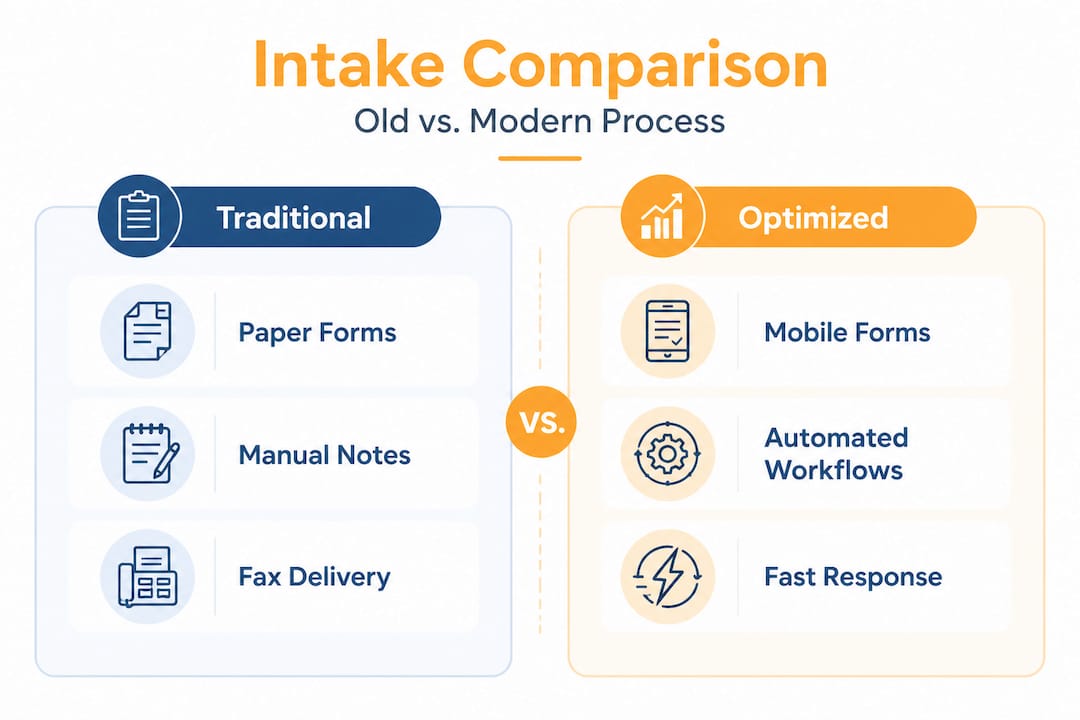
Supporting automating legal intake with the right technology does not mean removing the human element. It means freeing your team to focus on the parts of intake that require real empathy and judgment.
Best practices for optimizing intake efficiency
Knowing what good intake looks like is only useful if you act on it. Here are specific, practical improvements that personal injury firms can implement without overhauling everything at once.
The digital evolution in legal services has created real expectations among clients. People expect speed, clarity, and convenience from their first contact with any service provider, and law firms are no exception. Meeting that expectation requires deliberate process design, not just good intentions.
“The firms that grow fastest are not always the ones with the best attorneys. They are the ones with the most consistent, responsive intake. When a firm can respond to a lead within minutes and guide them through the process smoothly, the attorney rarely has to compete for the case at all.” — Legal operations consultant insight on technology-driven intake
Here is an actionable checklist to boost your intake speed and accuracy:
- Digitize all intake fields. Replace paper forms and email attachments with a secure, mobile-friendly digital intake system.
- Automate initial scheduling. Use calendar integrations so prospective clients can self-schedule consultations immediately after submitting their inquiry.
- Set up automated lead follow-up. Configure text and email sequences to respond to new inquiries within minutes, even outside of business hours.
- Centralize all data capture. Use a single platform or CRM where every intake entry is stored, searchable, and visible to authorized team members.
- Train intake staff with scripts and role-playing. Cover both the technical process and the empathetic communication skills required for sensitive personal injury conversations.
- Build in escalation protocols. Define when an intake specialist should transfer a call or flag a case for attorney review.
Explore your legal intake automation options carefully. The best tools integrate with your existing case management software so data flows without duplication. For firms focused on boosting PI case conversions, automation is often the single highest-return investment available.
Pro Tip: Pull your intake data once a month and look at where prospects are dropping off. Are inquiries being submitted but not followed up? Are forms being started but not completed? Monthly review turns intake from a passive function into a managed, improving system.
Measuring the impact of intake improvements
You cannot manage what you do not measure. Firms that invest in intake improvements often feel the results intuitively through smoother operations and more signed cases, but the business case becomes undeniable when you put numbers to it.
The connection between strong intake and measurable case outcomes is clear. PI case conversion data consistently shows that firms with structured, responsive intake processes sign significantly more cases from the same volume of leads. That means your marketing budget goes further without spending an extra dollar.
Key metrics to track for intake performance include:
- Lead-to-conversion rate — What percentage of inquiries become signed clients?
- Time to first response — How quickly does your team contact a new lead?
- Time to case open — How long does it take from first contact to an active case file?
- Form completion rate — What share of started intake forms are actually submitted?
- Client satisfaction score — Collected via brief post-intake surveys or follow-up calls
Simple before-and-after comparisons are often the most compelling way to demonstrate ROI internally. Track these numbers for 60 days before a process change, implement the improvement, then track for another 60 days. The delta is your ROI.
| Metric | Before optimization | After optimization |
|---|---|---|
| Lead-to-conversion rate | 18% | 34% |
| Average time to first response | 4.2 hours | 11 minutes |
| Time to case open | 6 days | 1.5 days |
| Form completion rate | 52% | 81% |
| Client satisfaction (out of 10) | 6.4 | 8.7 |
These are realistic improvements that firms achieve when they treat intake as a managed process rather than an afterthought. Setting intake department goals and tracking them monthly keeps your team accountable and your leadership informed.
Why most law firms underestimate intake’s power and how to lead the change
Here is the uncomfortable truth: most law firm owners know their intake is not great. They hear the complaints. They see the slow response times. They know the forms are clunky. But they keep pushing intake improvements to “later” because it feels less urgent than winning a big case or landing a new marketing contract.
That is exactly backwards. Marketing brings leads to your door. Intake decides whether they walk in or walk away. If your intake process loses 30% of qualified leads through slow follow-up and poor form UX, no amount of ad spend will fix that.
What separates the firms that grow consistently is not just better advertising or better attorneys. It is leadership that owns the intake function. In most firms, intake is delegated entirely to a receptionist or junior admin with no documented process, no benchmarks, and no regular review. That is not a staffing problem. It is a leadership choice.
Rethinking intake management as a strategic function means assigning ownership, building accountability, and reviewing it with the same seriousness you give to case outcomes. It means understanding that a one-minute improvement in response time or a 10% increase in form completion translates directly to revenue.
Intake also shapes firm culture in ways that are easy to overlook. When intake is chaotic, staff stress increases, errors multiply, and clients feel it from day one. When intake is structured and supported, your team is more confident, your clients feel heard, and your attorneys get cleaner files to work with. That is a compounding advantage that shows up in referrals, reviews, and retention over time.
The firms that win this decade will treat intake not as a cost center, but as a competitive weapon.
Streamline your intake with Attorney Assistant
Attorney Assistant was built specifically for personal injury firms that are tired of losing good cases to slow follow-up and disorganized intake. If the process improvements in this article feel overwhelming to implement alone, that is exactly the problem we solve.
From digital intake setup and workflow automation to staff training and ongoing process audits, our team handles the operational side so your attorneys can focus on the legal side. Firms working with us see faster response times, higher conversion rates, and a measurable reduction in internal chaos. Explore our streamlined intake solutions to see what a fully supported intake function looks like in practice. You can also access our free intake optimization tools to start identifying and closing the gaps in your current process today.
Frequently asked questions
How does intake differ from client onboarding?
Intake is the initial data gathering and qualification step that determines whether someone becomes a client. Onboarding involves the formal process of welcoming accepted clients, setting up their case file, and establishing ongoing communication.
What’s the top metric to track for intake process success?
Client conversion rate is the most important metric because it directly shows how effectively your intake converts inquiries into signed cases and revenue.
Can technology replace a human intake specialist?
Technology can automate scheduling, form delivery, and follow-up, but a skilled intake specialist remains essential for empathetic conversations and nuanced case qualification that software cannot replicate.
How fast should law firms follow up with new client leads?
Following up within 5 to 15 minutes is the gold standard, as fast lead response dramatically improves both conversion rates and the client’s initial perception of your firm.
What intake improvements yield the fastest ROI?
Digitizing intake forms and automating lead follow-up produce the quickest returns because they directly reduce drop-off at the earliest and most critical stage of your client acquisition pipeline.
Recommended
- What is intake management? Streamline law firm client onboarding | Attorney Assistant
- How to organize your law firm intake team for peak efficiency | Attorney Assistant
- Intake Specialist for Your Law Firm
- Client Communication Guide: Boost Law Firm Intake | Attorney Assistant
- Onboarding Process | Dope SEO - Cannabiz Marketing Solutions
- Onboarding im Gesundheitsbereich: Bindung und Effizienz stärken | TheraComplete
Related Articles

Law firm onboarding checklist: streamline intake and efficiency
Revamp your client intake with our comprehensive onboarding checklist for law firms. Boost efficiency and win more cases today!

Avoid critical legal intake mistakes: real examples
Discover real examples of legal intake mistakes that cost law firms thousands. Learn to identify and fix these errors to boost conversions!

What is intake management? Streamline law firm client onboarding
Discover what intake management is and how it boosts client onboarding in law firms, ensuring more leads convert into signed clients.