Law firm onboarding checklist: streamline intake and efficiency

TL;DR:
- An organized onboarding checklist improves client trust and reduces revenue loss in personal injury law.
- Regularly measuring KPIs and iterating processes ensures efficient, consistent client intake.
- Automating repetitive tasks enhances speed, accuracy, and scalability of the onboarding process.
Disorganized client onboarding is one of the most overlooked revenue killers in personal injury law. When a potential client reaches out, every hour of delay, every missed document request, and every unclear next step chips away at their confidence in your firm. The result is signed cases that should have been yours going to a competitor who simply responded faster and more professionally. A structured onboarding checklist solves this by standardizing intake, conflict checks, documentation, communication, and performance tracking into a repeatable system your entire team can follow and measure.
Table of Contents
- How to set up your law firm onboarding checklist
- Core items on your onboarding checklist
- Automation vs. manual process: Choosing the right approach
- Checklist benchmarks: Measuring and improving onboarding performance
- Industry perspective: The real secret to efficient law firm onboarding
- See how your firm can implement a smarter onboarding checklist
- Frequently asked questions
Key Takeaways
| Point | Details |
|---|---|
| Time-box critical steps | Set deadlines for conflict checks and document collection to speed up client intake. |
| Measure with KPIs | Track performance with specific onboarding metrics for ongoing process improvement. |
| Combine automation and review | Automation boosts consistency, but manual review ensures continuous enhancement. |
| Checklist is never static | Update your onboarding checklist regularly to reflect new insights and changing needs. |
How to set up your law firm onboarding checklist
Now that you know what this checklist will solve, let’s look at what must go into an effective onboarding process.
A strong onboarding checklist is not just a to-do list. It is a structured framework that defines who does what, when it happens, and how you measure success. Before you build yours, you need to understand the five core criteria every effective checklist must address.
The five core criteria for your checklist:
- Intake: Capture every lead’s contact details, case type, accident date, and injury description during the first contact.
- Conflict check: Screen for conflicts of interest quickly and systematically before any representation is confirmed.
- Document collection: Identify which records you need, police reports, medical records, insurance information, and assign clear deadlines for gathering them.
- Communication touchpoints: Define when clients hear from you, what information you share, and through which channel.
- KPIs (key performance indicators): Establish measurable goals, like days to matter activation or intake completion rate, so you can evaluate and improve your process over time.
Good onboarding also needs time-boxing, which means assigning a maximum time limit to each step so nothing sits in limbo. Law Firm Onboarding Best Practices recommends time-boxing conflict screening with an initial check within 24 hours and a final resolution within 72 hours, and setting tangible outcomes for the first 30 days. These benchmarks create accountability across your team and signal to clients that your firm operates with precision.

If you are building your process from scratch, start by exploring free onboarding tools that can help you draft templates and automate repeating tasks. You can also reference a step-by-step law firm setup guide to make sure your onboarding fits within a broader operational structure.
Pro Tip: Assign a named team member to be responsible for each checklist step. When accountability is shared by everyone, it is actually owned by no one. Designate ownership, and review completion timelines weekly during your first few months to spot bottlenecks before they become habits.
Core items on your onboarding checklist
With the main criteria set, here is a step-by-step template you can adapt for your firm.
This checklist is designed for personal injury practices but applies broadly to any plaintiff-side firm. Each step builds on the one before it, so skipping or reordering them creates downstream problems.
-
Initial client intake and contact details. Collect the prospective client’s full name, phone number, email, preferred contact method, incident date, injury description, and opposing party’s insurance carrier if known. Do this during the first call or form submission, not afterward.
-
Conflict check within 24 to 72 hours. Run the client’s name, the opposing party, and any related entities through your conflict database before confirming representation. Document the result regardless of whether a conflict exists.
-
Send the welcome packet and engagement letter. Once the conflict check clears, send a professionally written welcome packet that explains your process, sets expectations for communication frequency, and includes your engagement letter with a clear signature deadline.
-
Gather key documents and information. Request all relevant records immediately: accident reports, medical records, photos, witness contact information, and prior treatment history. Provide a checklist to the client so they know exactly what to gather.
-
Set up your communication cadence and schedule the first update. Define how often the client will hear from your firm, weekly, biweekly, or at case milestones, and send the first substantive update within the first seven days of signing.
-
Monitor KPIs and track completion rates. Log the date each step was completed and compare it against your benchmarks. Track how long it takes from initial contact to active matter status.
As Law Firm Onboarding Best Practices notes, onboarding must deliver a tangible outcome within the first 30 days. For personal injury firms, that outcome is a fully activated matter with signed representation, collected documents, and an established communication plan.
“Onboarding done right is not about speed alone. It is about making every client feel like they are your firm’s only priority in the first 30 days.”
Pro Tip: Build template letters and canned email responses for your welcome packet, document request, and first update. When your team is not drafting from scratch each time, response speed increases and quality stays consistent. Explore role-specific onboarding guides to build templates that match your intake team’s actual workflow.
Automation vs. manual process: Choosing the right approach
Next, consider which approach, automation or manual, serves your firm’s goals and workflow best.
Many small and mid-sized personal injury firms still rely on manual onboarding, which means staff-driven phone calls, paper forms, and individually sent emails. There is nothing wrong with manual processes when done consistently. But when caseload grows, inconsistencies multiply. Tasks get duplicated, deadlines get missed, and clients slip through cracks.
According to reporting on client onboarding in law firms, onboarding can become slow, fragmented, and manual when firms treat it as a task list rather than a structured journey. That fragmentation costs firms both signed cases and client trust.
Here is a side-by-side comparison to help you decide which approach fits your firm right now:
| Factor | Automation | Manual |
|---|---|---|
| Consistency | High, same process every time | Variable, depends on individual staff |
| Speed | Fast, triggered immediately | Slower, depends on availability |
| Flexibility | Lower, harder to customize | Higher, easy to adapt case by case |
| Error risk | Low once set up correctly | Higher, especially under volume pressure |
| Best for | High-volume, repeating workflows | Complex or sensitive cases |
| Cost | Initial setup investment | Ongoing staff time |
Signs your firm should seriously consider automating:
- Your intake volume has grown but your team size has not.
- Clients frequently call to ask where things stand because updates are inconsistent.
- You are seeing KPIs decline month over month, such as longer time-to-matter or lower completion rates.
- Staff regularly duplicate tasks because there is no clear handoff system.
- Your conflict check process relies on a single person’s memory or an informal spreadsheet.
If several of those describe your firm, it is time to automate legal intake rather than simply hire more staff to manage a broken process.
“Redesigning onboarding as a structured journey, not just a task list, is what separates firms that scale from firms that stall.”
The firms that get this right tend to use automation for repeating, predictable touchpoints like welcome emails, document request reminders, and follow-up sequences while keeping manual oversight for nuanced case decisions and sensitive client conversations. That hybrid model is often the most practical starting point for small to mid-sized firms.
Checklist benchmarks: Measuring and improving onboarding performance
To ensure your onboarding process delivers results, use benchmarks and regular performance checks.
You cannot improve what you do not measure. KPIs give your onboarding checklist teeth. Without them, you are making qualitative guesses about whether your process is working. With them, you have data to guide specific improvements.
The most important onboarding KPIs for personal injury firms:
- Time-to-matter activation: How many days from initial contact to an active, signed matter? Target under seven business days for straightforward cases.
- Intake completion rate: What percentage of intake forms are fully completed before the conflict check? A low rate signals either a confusing intake process or insufficient follow-up.
- Conflict check turnaround: Is the initial check happening within 24 hours? Is the final resolution landing within 72 hours?
- Document collection rate at 14 days: What percentage of requested documents have you received by day 14 of a new matter? Low numbers here often mean your document request letter needs to be clearer or more urgent in tone.
- Client satisfaction at onboarding: A simple one to three question survey sent at the end of onboarding tells you how the experience landed from the client’s perspective.
Here is a reference table to benchmark your firm’s performance:
| KPI | Target benchmark | Warning threshold |
|---|---|---|
| Initial conflict check | Within 24 hours | Over 48 hours |
| Final conflict resolution | Within 72 hours | Over 5 business days |
| Matter activation | Within 7 business days | Over 14 business days |
| Intake form completion | 95% or higher | Below 80% |
| Document collection at day 14 | 75% of requested docs | Below 50% |
| Client satisfaction score | 4 out of 5 or higher | Below 3.5 out of 5 |
As Law Firm Onboarding Best Practices emphasizes, your checklist must define onboarding KPIs and set regular measurement loops to actually drive improvement rather than just track data passively.
The practical step after defining your KPIs is to build a simple monthly review meeting with your intake team. Walk through the numbers, identify where the process broke down in the past 30 days, and make one specific adjustment. Over six months, those incremental changes compound into a dramatically more efficient system. You can use resources on optimizing law firm intake and improving law firm response time to inform what changes are most impactful.
Pro Tip: Do not wait for a quarterly review to fix problems you can already see. If intake completion rates drop sharply in a single week, find out why immediately. One broken link in a digital form, one staff member on vacation without coverage, or one unclear instruction to clients can tank a metric fast. Monthly reviews catch trends. Weekly check-ins catch fires.
Industry perspective: The real secret to efficient law firm onboarding
With your checklist and KPIs set, now consider what actually separates high-performing firms from the rest.
Here is the uncomfortable truth: most law firms that build an onboarding checklist treat it as a finished product. They spend hours designing the perfect intake form, draft a polished welcome packet, assign steps to their team, and then walk away assuming the system will run itself. Twelve months later, they are surprised to find conversion rates are flat and clients still complain about communication gaps.
The checklist was never the problem. The failure to iterate on it was.
The firms that consistently outperform their peers on intake conversion do not have better checklists. They have better feedback loops. They ask clients what was confusing about the intake process. They ask their staff what steps create the most friction. They treat onboarding as something alive, something that gets smarter every month based on real data and real experience.
That is a meaningful mindset shift. Most owners see onboarding as operational infrastructure, necessary but not strategic. But client experience during those first 30 days directly influences how vigorously a client refers your firm to friends and family. It shapes whether they respond promptly to your document requests or drag their feet. It determines whether they feel like a valued partner in their own case or a file number.
As industry reporting confirms, onboarding as a journey, not simply a checklist of isolated tasks, is what actually delivers long-term value to both the firm and the client. High-performing firms link their onboarding performance to client communication strategies that extend well beyond the first week, ensuring that the trust built during intake carries through the entire case lifecycle.
The real competitive edge is not having a checklist. Every firm has some version of one. The edge is having a team that reviews it, challenges it, and improves it regularly. Static processes create stagnant results. Iterative ones create growth.
See how your firm can implement a smarter onboarding checklist
If you want to put these steps into action with less stress and more impact, here’s where to begin.
Attorney Assistant is built specifically for personal injury firms that are tired of losing cases to slow follow-up and inconsistent intake. We handle the workflows you cannot afford to let slip, from first contact to signed matter and beyond.
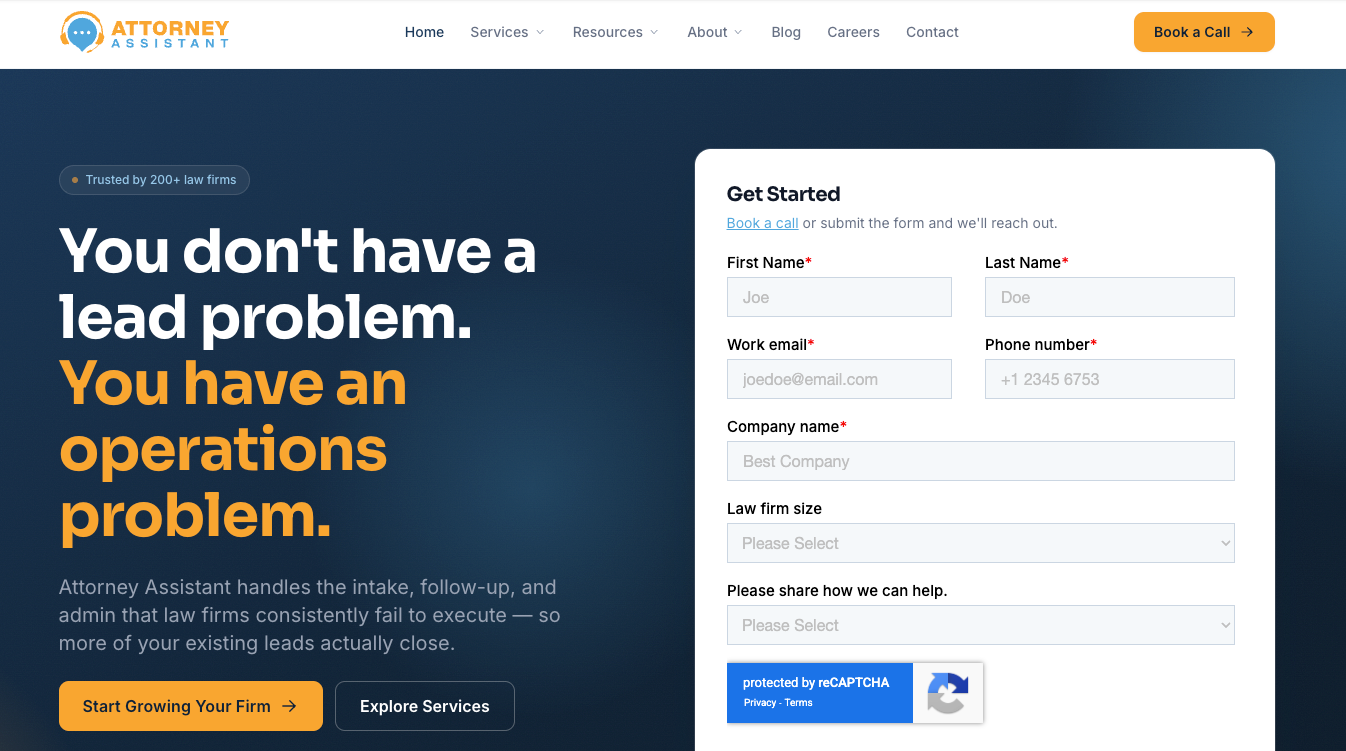
Whether you need templates to get started quickly or full hands-on support for your intake and follow-up process, we have practical solutions ready. Our intake management solutions cover every step on your checklist, with built-in measurement and accountability so nothing gets missed. You can also access free law firm tools today to begin building a faster, more consistent onboarding experience without a major overhaul.
Frequently asked questions
What is the first step on a law firm onboarding checklist?
The initial client intake and conflict check are always the first steps to ensure eligibility and compliance. The initial conflict screen should begin within 24 hours of first contact.
How quickly should conflict checks be completed during onboarding?
Conflict screening should be initiated within 24 hours and resolved within 72 hours for most matters. Meeting these time-boxed conflict benchmarks keeps your compliance tight and your onboarding moving.
What KPIs should law firms track during onboarding?
Key KPIs include time-to-matter activation, checklist completion rates, and client satisfaction at onboarding. Your checklist should define measurable KPIs from the start so improvement is data-driven, not guesswork.
Should we automate our onboarding process?
Automation is best if your firm faces repeated delays, heavy intake volume, or needs standardized communication across all new clients. When onboarding becomes fragmented or manual processes create bottlenecks, automation resolves the pain at the source.
How often should we review our checklist?
Monthly reviews tied to KPIs and team input are best for continuous improvement. Your checklist should have built-in improvement loops so your process gets smarter over time rather than staying frozen.
Recommended
Related Articles

Avoid critical legal intake mistakes: real examples
Discover real examples of legal intake mistakes that cost law firms thousands. Learn to identify and fix these errors to boost conversions!

How to organize your law firm intake team for peak efficiency
Learn how to organize your intake team effectively to boost conversions and profitability. Streamline processes and capture leads efficiently!

What is intake management? Streamline law firm client onboarding
Discover what intake management is and how it boosts client onboarding in law firms, ensuring more leads convert into signed clients.