How to Improve Your Voice for Court and Calls
At 3 p.m., your voice has usually filed its own motion to withdraw. You've handled calls, argued a hearing, explained the same process to several prospective clients, and now every sentence comes out sounding like you've been gargling gravel. The firm still needs answers, of course. The calendar has no sympathy.
Learning how to improve your voice for court and calls requires two fixes at once. You need better physical technique, including breath support, pacing, resonance, and recovery. You also need to stop spending your vocal capacity on work that trained legal staff can handle, especially repetitive intake and follow-up.
Table of Contents
- Why Your Voice Gives Out Before the Workday Ends
- The Physical Mechanics of Projection and Pacing
- Quick Exercises and Environmental Adjustments
- The Operational Fix for Vocal Fatigue
- Adapting Your Voice for Remote and In-Court Settings
- Protecting Your Capacity to Practice Law
Why Your Voice Gives Out Before the Workday Ends
Voice fatigue is common, and it isn't limited to singers or stage performers. The National Institute on Deafness and Other Communication Disorders estimates that 17.9 million adults in the United States report voice problems. The American Speech-Language-Hearing Association says about 1 in 13 adults experiences a voice problem each year, while only about 10% seek treatment. The issue affects working adults, teachers, performers, older people, and legal professionals who spend their days persuading, negotiating, questioning, and answering.
Law practice creates an unusually efficient voice-fatigue machine. Courtrooms can be dry and acoustically awkward. Depositions demand sustained concentration and clear projection. Video calls encourage shallow breathing and stiff posture. Then there's the phone, where an attorney may spend hours conducting initial intake, returning missed calls, chasing records, and explaining basic next steps that could have been handled by someone else.
The practical diagnosis: A tired voice may reflect poor technique, excessive workload, or both.
A lawyer who reaches the afternoon with a strained voice often treats the problem as inevitable. It isn't. The physical side improves with deliberate training, hydration, vocal breaks, and reduced strain. Resources on professional voice training techniques can help professionals build a more efficient speaking pattern instead of just trying to speak louder.
The operational side deserves equal attention. If your intake process depends on attorneys answering every call between hearings, the voice problem is partly a staffing problem. A useful review of how law firms stay responsive without burning out should lead to an uncomfortable question: which calls require legal judgment, and which calls merely require a reliable process?
Your attorneys went to law school to practice law. Ideally, they should occasionally get to do that.
The Physical Mechanics of Projection and Pacing
Strong projection doesn't begin in the throat. It begins with steady breath support, a relaxed upper body, and enough resonance that your voice carries without forcing volume.
Start with this sequence before a hearing or extended call:
- Sit or stand with your ribs able to expand. Let your shoulders stay quiet.
- Breathe low and slowly, allowing the abdomen and lower ribs to move.
- Speak on the outgoing breath rather than squeezing sound from the throat.
- Keep your jaw loose and your tongue mobile.
- Aim your sound forward, toward the listener, instead of pushing it upward into the neck.
You don't need a theatrical “courtroom voice.” You need an efficient one. When breath pressure does the work, the vocal folds don't have to absorb every bit of force. Resonance in the chest, mouth, and facial area can make speech sound fuller without turning every objection into a public-address announcement.
Articulation matters as much as volume. Open your mouth enough to finish consonants. Attorneys often compress words when stressed, particularly at the ends of sentences. That forces listeners to work harder and tempts the speaker to repeat or raise the volume. Clear consonants reduce both problems.
Pacing is the other frequent offender. Lawyers rush when a judge is waiting, a client is anxious, or the next call is already blinking. Deliberate pauses improve comprehension and give your voice small recovery periods.
Use the pause as a tool, not an apology. A short silence before an important point makes the point easier to hear and makes you sound more deliberate.
Try pausing after a question, before a key fact, and at the end of a sentence. Record a short explanation of a legal concept and listen for three things: shallow breaths, disappearing word endings, and sentences that run together. Those recordings are often more candid than a colleague who enjoys remaining employed.
Quick Exercises and Environmental Adjustments
You don't need a forty-five-minute vocal ritual before a deposition. You need a short routine you'll actually perform before the first question, not a beautifully designed plan abandoned beside the coffee machine.
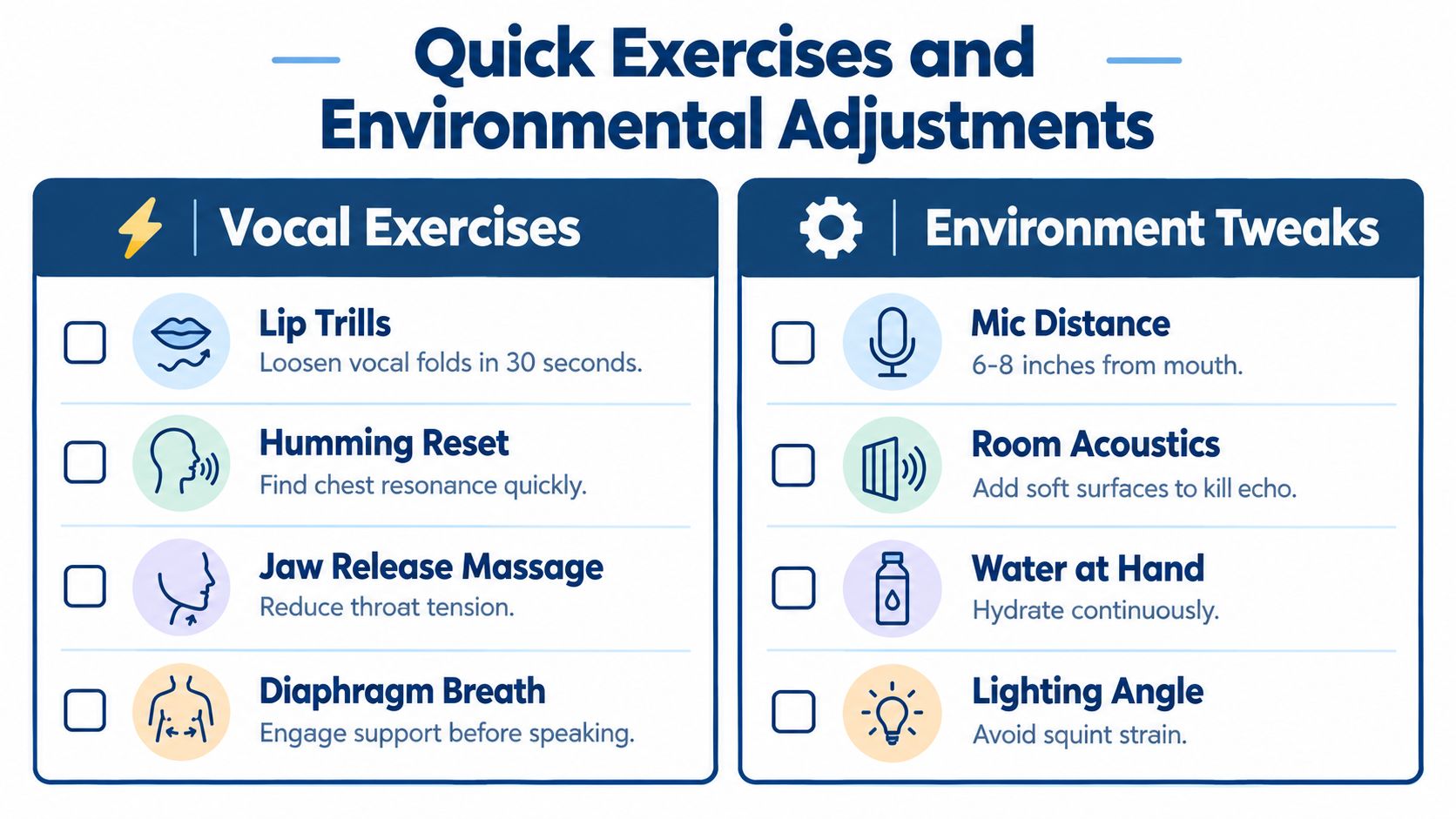
Begin with gentle semi-occluded vocal tract exercises. Straw phonation, lip trills, and humming narrow the airflow slightly and encourage efficient vibration without demanding force. The clinical literature has moved these exercises well beyond folk wisdom. In one study of vocal function exercises, participants showed significantly increased maximum phonation time after 6 weeks, with gains still present at 1-month follow-up. A related study found that greater home-practice dosage produced greater improvement in maximum phonation time. The findings appear in this clinical review of vocal function exercises.
A practical pre-call routine looks like this:
- Lip trills: Use gentle vibration to loosen the voice without pushing.
- Humming: Find a forward, easy resonance at a comfortable pitch.
- Straw phonation: Make light sound through a straw, stopping if you feel discomfort.
- Jaw release: Massage the jaw and let the tongue rest rather than bracing it.
- Breath reset: Take several low, unforced breaths before speaking.
For additional ideas, this guide to warm-ups and breathing techniques offers a useful starting point, even if your performance venue is a deposition room rather than a concert hall.
Your environment can either protect the work or subtly sabotage it. Keep water within reach. Reduce echo with soft surfaces where possible. Position a microphone consistently and speak toward it instead of compensating for poor placement by increasing volume.
Don't whisper when your voice feels tired. Medical guidance recommends vocal breaks, avoiding whispering, and using the voice gently rather than relying on prolonged complete silence. Aggressive throat clearing is also a poor recovery strategy. Sip water, swallow, or use a gentle cough instead of repeatedly scraping the throat.
A humidifier may help in a dry workspace, but it won't compensate for a schedule that requires nonstop calls. Hydration, quieter rooms, microphones, and fewer conversations held over background noise all matter. So does reducing the number of calls assigned to the person whose voice is already failing.
The Operational Fix for Vocal Fatigue
Some vocal fatigue is a technique problem. A significant amount is a capacity problem wearing a throat problem as a disguise.
If an attorney spends hours on initial intake, follows up with old inquiries, requests medical records, and manages routine scheduling, the firm is using its most expensive and least available resource as a telephone queue. That arrangement is especially wasteful when response speed matters. Hennessey Digital's 2025 law-firm study found a median response time of 13 minutes, with 25% of firms responding in under 5 minutes, 56% responding within an hour, and 39% taking more than 2 hours or not responding at all. The figures are reported in the 2025 lead form response time study.
The point isn't that every call must be answered by an attorney. The point is that every viable inquiry needs a defined owner, a qualification process, and structured follow-up. A lead who waits until an attorney finishes court may become a lead who chooses another firm. Technically, calling someone back four days later is follow-up. It is not particularly useful follow-up.
| Metric | Attorney Handling Intake | Dedicated Intake Team |
|---|---|---|
| Availability | Limited by hearings, meetings, and legal work | Coverage can be assigned across the firm's intake schedule |
| Voice demand | Repetitive calls consume attorney vocal capacity | Attorneys handle the conversations requiring legal judgment |
| Follow-up | Often interrupted or delayed | Structured outreach can continue after the initial contact |
| Process consistency | Depends on individual habits | Uses defined qualification, routing, and documentation steps |
| Operational result | Legal work competes with intake work | Frontline intake supports the legal team instead of displacing it |
A dedicated intake function isn't an excuse to abandon judgment. It is a way to reserve judgment for the people qualified to exercise it. Frontline intake should answer, qualify, follow up, route appropriate matters, and document the interaction. It shouldn't merely take a message and place the lead in a digital drawer.
Attorneys also lose vocal energy to case-support work. Staffline, for example, provides dedicated full-time legal support professionals who work inside one firm's systems and can assist with case management, records and bill retrieval, lien reduction, file opening, calendars, inboxes, CRM hygiene, intake, and administration. That model is different from asking a shared assistant to remember your process between several unrelated firms.
For attorneys trying to reduce physical strain from repetitive computer and phone work, tools and guidance on avoiding RSI using voice command tools may help with workflow design. But software can't repair an ownership gap. Your CRM cannot follow up with a lead if nobody puts the lead in the CRM.
A practical review of live answering services for law firms should focus less on whether someone picks up and more on what happens next. Does the team qualify the opportunity, follow up persistently, communicate in English and Español when needed, and provide quality assurance? Taking a message is not intake.
Adapting Your Voice for Remote and In-Court Settings
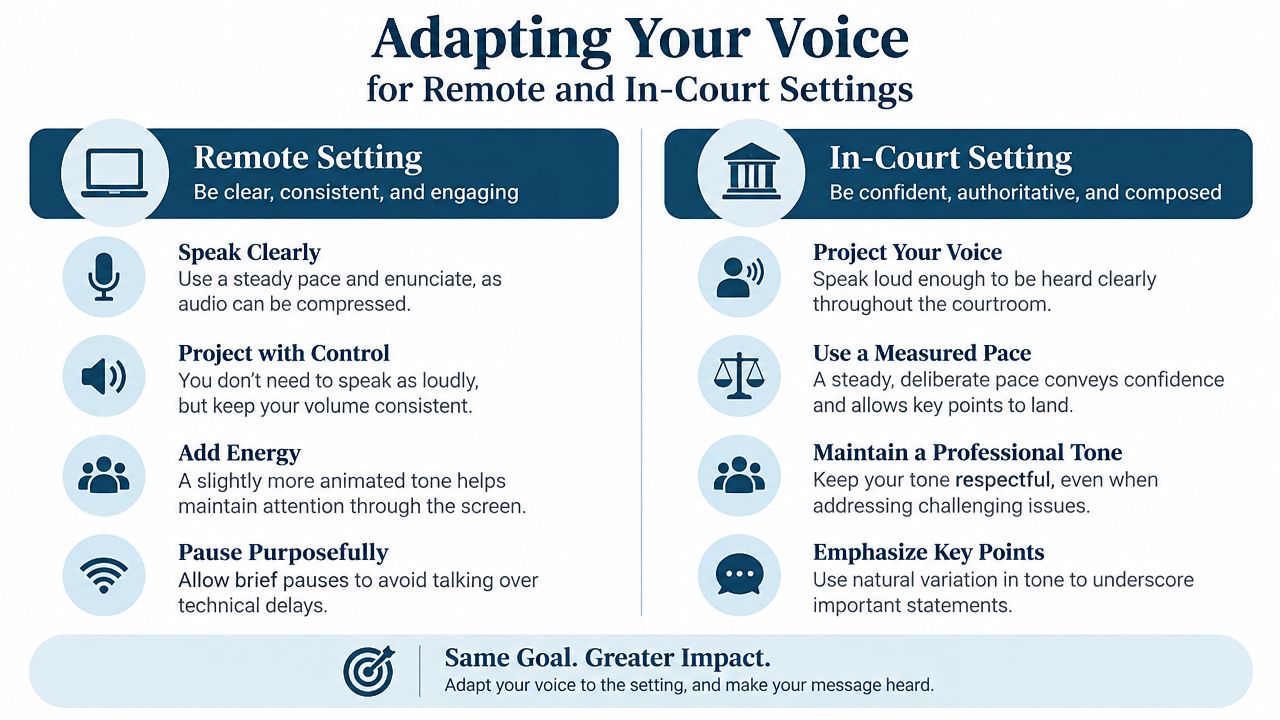
The same voice behaves differently in a courtroom and on a video call. Treating both environments identically is how people end up shouting at a laptop or speaking to a jury as though everyone is sitting inside their collar.
In the courtroom
Project from breath support rather than volume. Face the jury or judge when making the point, but keep your head stable enough that your voice doesn't disappear whenever you turn toward an exhibit. Use clean consonants, measured phrasing, and pauses before important questions.
Large rooms reward clarity, not force. If the room has poor acoustics, ask for a microphone adjustment rather than compensating by tightening your throat. When opposing counsel interrupts, don't answer the interruption with a louder voice. Pause, let the court control the exchange, and resume at a controlled pace.
Your authority comes from control. A rushed attorney sounds as though the schedule is in charge. The schedule already has enough power.
On remote hearings and calls
A laptop microphone changes the equation. Speak toward the microphone, keep a consistent distance, and test how close you can get before low frequencies become muddy. Exaggerate articulation slightly because video compression and small speakers remove some of the detail listeners would receive in person.
Remote settings also magnify posture. A collapsed chest restricts breathing, while a rigid neck encourages throat tension. Put both feet on the floor, keep the screen near eye level, and take a quiet breath before answering instead of beginning every response on a depleted breath.
A remote call also makes operational delegation more valuable. If your calendar contains routine intake calls, follow-up calls, and status requests alongside depositions and hearings, your voice has no protected recovery periods. Route conversations according to complexity. Let a trained intake professional handle qualification and scheduling. Reserve attorney calls for analysis, advice, negotiation, and advocacy.
The distinction is simple:
- Courtroom speaking requires room-filling clarity, controlled projection, and composure during interruptions.
- Remote speaking requires microphone discipline, precise articulation, stable posture, and protection from vocal overuse between hearings.
- Phone intake requires consistency and responsiveness, but it doesn't automatically require an attorney.
Protecting Your Capacity to Practice Law
A durable voice standard is straightforward:
- Support the breath: Speak on a steady exhale instead of squeezing sound from your throat.
- Pace the argument: Use pauses to improve comprehension and reduce continuous vocal load.
- Warm up gently: Use humming, lip trills, or straw phonation before demanding speaking.
- Recover intelligently: Take vocal breaks, avoid whispering, and use the voice gently rather than forcing total silence.
- Fix the workload: Remove repetitive intake, follow-up, scheduling, and administrative calls from the attorney's daily queue.
Voice care becomes much easier when the schedule stops requiring one person to perform every role. If an attorney is handling a hearing, returning inquiries, chasing records, and answering routine status calls, no exercise can create additional hours or vocal cords.
A firm should audit its call log and calendar for work that doesn't require legal judgment. Then assign each category to a clear owner, define the handoff, and measure whether the work is completed. If you suspect the issue is structural, review why not answering the phone costs law firms opportunities and examine where calls are being lost.
Your voice is a professional instrument, but it is also a capacity signal. Protect it physically, then stop spending it on tasks someone else can perform reliably.
Attorney Assistant provides dedicated legal support staff through Staffline and 24/7 live intake through Frontline, including qualification, follow-up, routing, and case-signing support rather than simple message taking. Visit Attorney Assistant to evaluate where intake and administrative calls are draining your attorneys' time, capacity, and voice.
Related Articles

Litigation Support Services: What Law Firms Need to Know
Discover how litigation support services streamline discovery, reduce costs, and improve case outcomes. Learn what to look for in a provider.

Preferred Method of Contact for Law Firm Intake
Discover how to capture and use the preferred method of contact in legal intake to improve conversions, ensure compliance, and streamline law firm operations.

White Glove Support for Law Firms
Discover how white glove support transforms law firm intake and operations. Learn the metrics, staffing models, and workflows that actually sign cases.