Intake Qualification Questions That Stop Lead Leakage
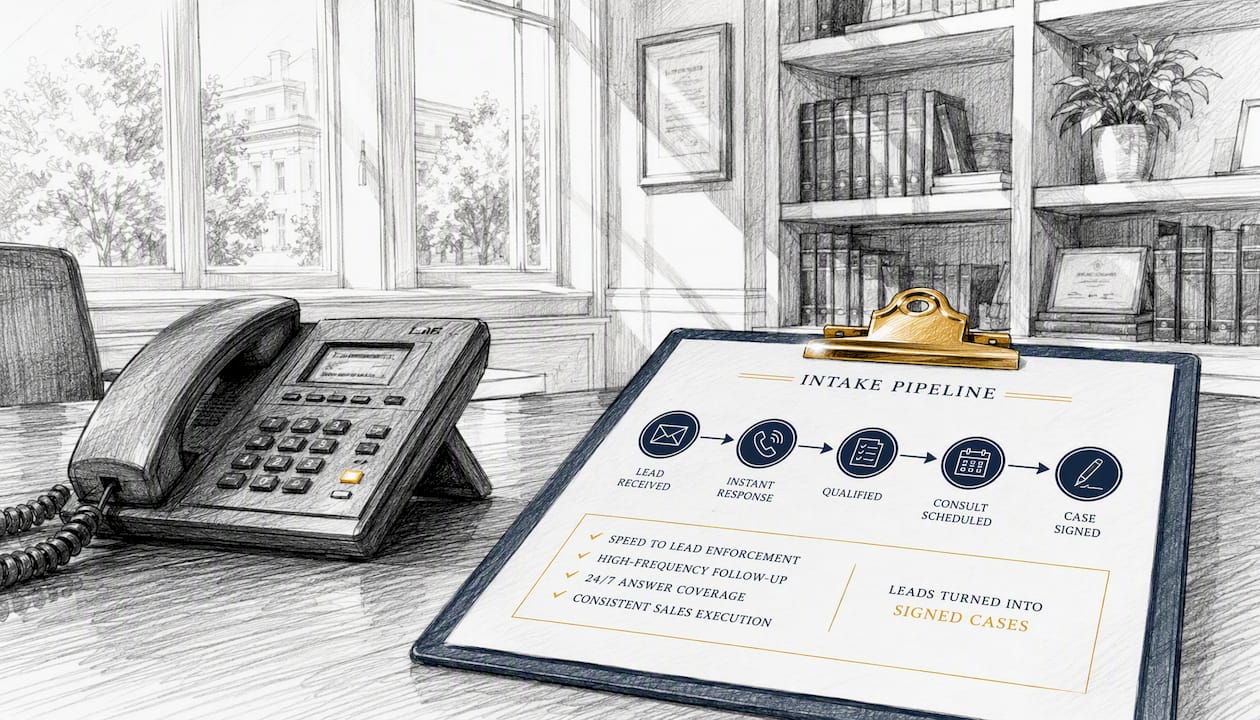
On the first call, capture five things before anything else: full contact information, the date of the incident, the nature of the injury, whether the caller has received medical treatment, and the state where the incident occurred. That sequence, done in the first 90 seconds, tells you whether the statute of limitations is a live threat and whether the case has triage value. The single next step: if the incident date puts you within six months of the SOL deadline, or if the injury is catastrophic, route immediately to an attorney review queue — do not let it sit in a general inbox.
Three operational rules to enforce before the call ends:
- Respond within minutes, not hours. A lead that goes to voicemail at 2 PM on a Tuesday is often gone by 3 PM.
- Assign one person to triage every new matter before the end of the business day.
- Log all five fields in your CRM before the call closes — incomplete records are the root cause of most missed follow-ups.
Key Takeaways
Structured intake qualification questions, enforced SLAs, and a triage scoring system are the three operational levers that convert more leads into signed cases without increasing marketing spend.
| Point | Details |
|---|---|
| Capture the incident date first | The date determines SOL urgency and must be a required CRM field before the call closes. |
| Use a triage score | Rate urgency, viability, and solvency 1–3 each; route any score of 7+ to priority attorney review. |
| Enforce 24/7 coverage | An AI-plus-human hybrid prevents after-hours lead loss and queues urgent flags for morning review. |
| Train for empathy and probing | Structured follow-up questions uncover case value that a rigid checklist misses. |
| Attorney Assistant fills the gap | 24/7 intake, speed-to-lead enforcement, and retainer signing close the conversion gap for PI firms. |
Table of Contents
- Why do intake qualification questions matter for PI firms?
- Who should ask qualification questions, and when?
- What are the core intake qualification questions for a personal-injury lead?
- How do you structure the intake conversation without a rigid script?
- What red flags should trigger special handling during qualification?
- How do you score, triage, and document intake answers?
- Copy-paste intake form and quick checklist
- How do you implement intake improvements in 30, 60, and 90 days?
- What Attorney Assistant sees most often in intake operations
- Attorney Assistant closes the intake gaps that cost firms cases
- Sources
- FAQ
Why do intake qualification questions matter for PI firms?
Faster, structured intake increases signed-case conversion and saves attorney time. That is the operational reality, and intake quality directly affects revenue in ways most firms underestimate until they audit their own numbers.
The problem is not lead volume. Most personal-injury and contingency-fee firms spend real money on marketing, then lose a significant share of those leads at the intake stage through missed calls, slow callbacks, and incomplete data capture. According to Law, firms without a dedicated intake department are effectively wasting their marketing budget — every dollar spent acquiring a lead that never gets properly qualified is a dollar with no return.
Three trust signals that separate high-converting firms from the rest:
- 24/7 coverage or an immediate AI answer so no call goes to voicemail after hours.
- Attorney review of every high-urgency or SOL-risk lead before the consultation is scheduled.
- Call recordings used for QA and training, not just compliance.
Who should ask qualification questions, and when?
Dedicated intake staff should capture structured facts on first contact. Attorneys review high-urgency or SOL-risk leads before the consultation is booked. That division of labor is what keeps attorneys billing instead of triaging cold calls.
The roles that need to be defined clearly:
- Front-line intake specialist: answers every call, captures the five core fields, and flags red flags in real time.
- Intake manager: reviews daily logs, monitors SLA compliance, and runs weekly call-record QA sessions.
- Attorney triage reviewer: receives a one-paragraph intake summary for any lead flagged as SOL-urgent, catastrophic injury, or high-value.
- After-hours responder: an AI-plus-human hybrid that captures structured data overnight and queues SOL or catastrophic-injury flags for attorney review first thing in the morning.
Recommended SLAs: a live answer or AI response within minutes of the initial call, a first human callback within two hours for standard leads, and same-day attorney triage for any SOL or urgent flag. Dedicated intake staffing and 24/7 response are the two levers that most directly reduce lead leakage.
What are the core intake qualification questions for a personal-injury lead?
Use this ordered flow: incident basics first, then injury and treatment, then liability and evidence, then insurance and representation, then jurisdiction and SOL, then damages and expectations, then conflicts. This sequence lets intake determine SOL urgency and case value within a brief call lasting just a few minutes.
Incident basics
- What is your full name, phone number, and best email?
- When did the incident occur? (Exact date, if known.)
- Where did it happen? (City and state.)
- What type of incident was it? (Car accident, slip and fall, dog bite, etc.)
- Who do you believe was at fault, and why?
Injury and treatment
- What injuries did you sustain?
- Have you received medical treatment? If yes, where and when?
- Are you still receiving treatment, or have you been discharged?
- Have you missed work or lost income because of your injuries?
Liability and evidence
- Was a police report filed? Do you have the report number?
- Were there any witnesses? Do you have their contact information?
- Do you have photos or video of the scene, vehicle damage, or injuries?
- Have you given a recorded statement to any insurance company?
Insurance and representation
- Do you have health insurance, auto insurance, or both?
- Has any insurance company contacted you about the claim?
- Are you currently represented by another attorney on this matter?
Jurisdiction, SOL, and damages
- In which state did the incident occur?
- Have you filed any prior claims related to this incident?
- What outcome are you hoping for? (Compensation for medical bills, lost wages, pain and suffering?)
Pro Tip: When asking about the incident date, follow up with: “And just to confirm, has it been less than two years since that date?” Many callers do not know what a statute of limitations is. Framing it as a simple yes/no question surfaces the urgency without alarming them.
For liability probes, avoid yes/no questions. Use open prompts: “Tell me more about what happened right before the impact” or “Walk me through what you saw when you arrived at the scene.” These elicit details a rigid checklist misses entirely.
How do you structure the intake conversation without a rigid script?
Use a three-phase structure: open, probe, close. Name the phases in your training materials so staff understand the goal of each.
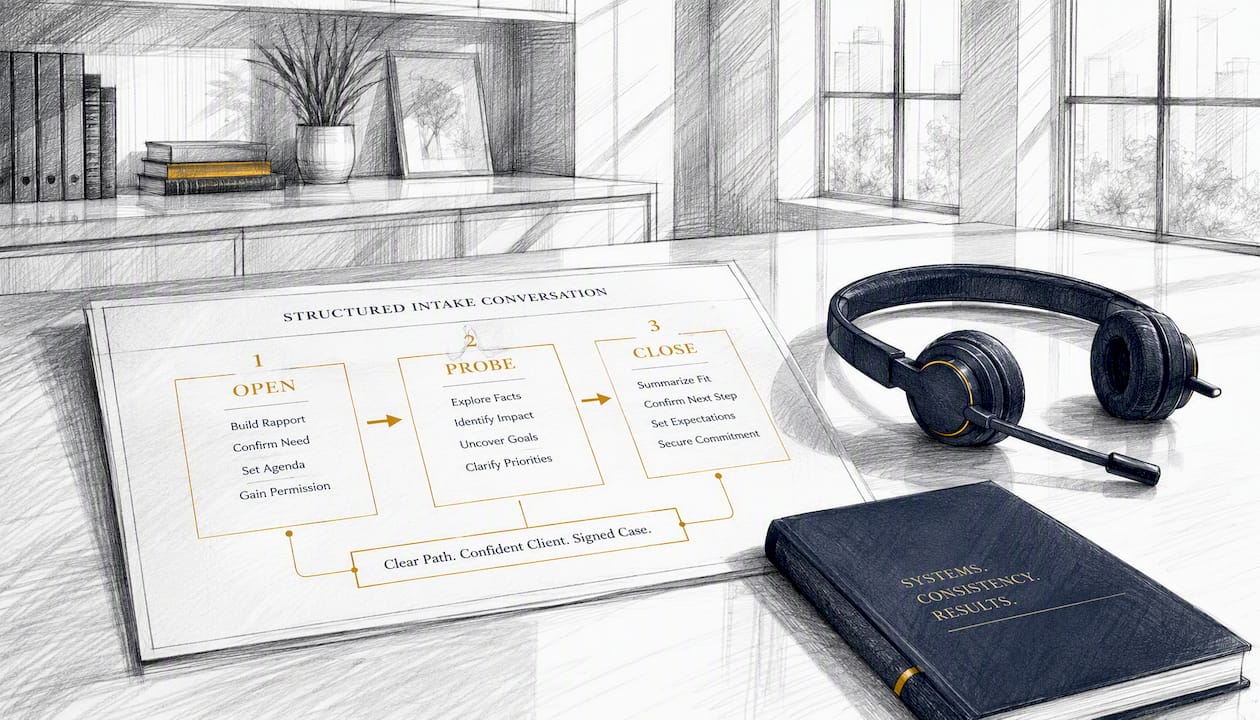
Open (0–90 seconds): Confirm contact info, acknowledge why the caller is reaching out, and set a warm tone. “I want to make sure we capture everything so our team can review your situation properly.”
Probe (90 seconds to 6 minutes): Work through the question categories above in order. When a red flag surfaces (recorded statement, prior representation, SOL risk), note it and keep moving — do not stop the call to deliberate.
Close (final 60 seconds): Confirm next steps, give a realistic timeline for follow-up, and tell the caller exactly who will contact them and when.
Pro Tip: Use silence deliberately. After a caller answers a liability question, pause for two seconds before moving on. Most callers will fill the silence with the detail that actually matters — the detail they were not sure was relevant.
The rule for scripting: structure, not script. Give intake staff a question order and a list of required fields. Do not give them word-for-word lines. Callers hear a script and disengage. Empathy plus structured probing converts more leads than a checklist read aloud.
What red flags should trigger special handling during qualification?
These are the auto-flags that move a lead to a special handling path or referral — not a standard queue.
- SOL expired or within 60 days: Route immediately to attorney review. Do not schedule a standard consultation.
- Client already represented: Politely confirm, document, and close. Do not collect further case details.
- Prior recorded statement to insurer: Flag for attorney review before any further intake. This materially affects case value.
- Government-entity defendant: Shorter notice deadlines apply. Flag as urgent and note the entity name.
- Clear fraud indicators: Inconsistent story, prior claims on the same injury, or implausible timeline. Document and escalate to the intake manager.
- Minor without a guardian present: Do not proceed. Request a parent or legal guardian call back.
- Out-of-jurisdiction incident: Confirm whether the firm handles that state. If not, refer to a network contact and document the referral.
Missing police reports and gaps in medical treatment are also common viability risks — note them in the CRM and flag for attorney review rather than auto-rejecting.
How do you score, triage, and document intake answers?
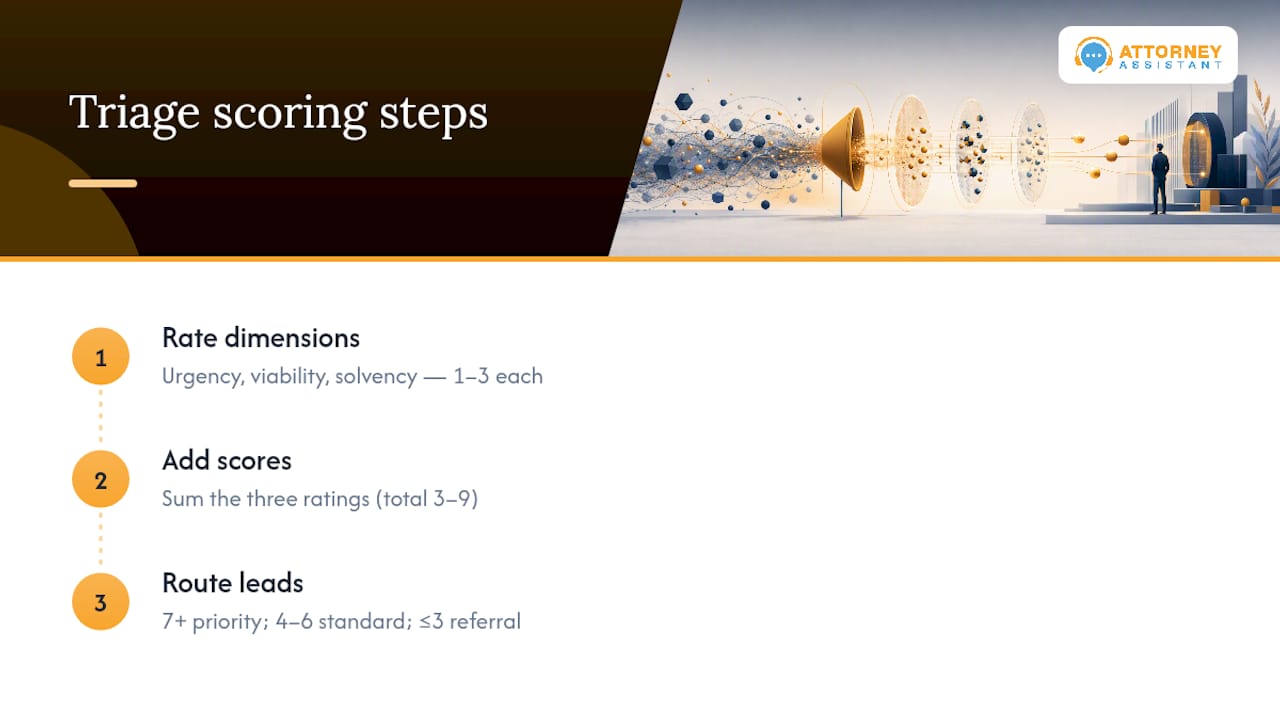
A simple triage score routes leads into the right queue: rate urgency (1–3), viability (1–3), and solvency (1–3), then add the three numbers. A score of 7 or above goes to priority attorney review. A score of 4–6 goes to standard follow-up. A score of 3 or below is a referral or decline.
Required CRM fields
Every call should produce a one-paragraph intake summary in the CRM: incident date and type, injury and treatment status, liability notes, insurance status, SOL flag, and triage score. Attorneys should receive this summary before the consultation, not during it. Call recordings back up the written notes and are the primary tool for QA — reviewing recordings weekly catches missed fields and coaching opportunities before they become patterns.
Copy-paste intake form and quick checklist
Drop this form into your CRM or website and start capturing the required fields today. Pre-qualification forms that branch by practice area and front-load the incident date and location filter out unqualified consultations before attorney time is spent.
Intake form fields
Call checklist for every intake rep
- Confirm contact info in the first 60 seconds.
- Ask incident date and calculate SOL exposure before moving on.
- Complete all injury and treatment fields.
- Ask about recorded statements and prior representation.
- Assign triage score before ending the call.
- Log all fields in CRM and write the one-paragraph summary.
- Notify the intake manager of any score 7+ or red flag.
Pro Tip: Use conditional branching in your intake form: if the incident date is more than the applicable SOL period ago, the form should surface a warning field automatically. Most CRMs support this with basic logic rules — you do not need custom software.
For medical record retrieval tied to intake, Attorney Assistant’s medical records workflow handles the downstream documentation so intake staff stay focused on qualification.
How do you implement intake improvements in 30, 60, and 90 days?
A 30/60/90 plan is the fastest path from leaking intake to a reliable conversion system.
Days 1–30 (immediate triage fixes):
- Define the four intake roles above and assign names to each.
- Implement the triage scoring formula in your CRM.
- Set SLA alerts for any lead that has not received a callback within two hours.
- Start recording all intake calls if you are not already.
Days 31–60 (QA and training):
- Run weekly 30-minute call-record reviews with intake staff.
- Score each reviewed call against the required CRM fields.
- Add empathy training: role-play the open and probe phases with a focus on trauma-sensitive language.
- Track conversion rate from first contact to signed retainer as your primary metric.
Days 61–90 (SLA and score optimization):
- Review triage score accuracy: are priority leads actually converting at a higher rate?
- Adjust SOL urgency thresholds based on your state’s specific deadlines.
- Evaluate after-hours coverage gaps and implement an AI-plus-human hybrid for nights and weekends.
Pro Tip: Track the gap between first contact and signed retainer, not just the number of consultations booked. A firm that books 40 consultations and signs 10 has a different problem than one that books 20 and signs 15.
Attorney Assistant provides 24/7 intake coverage, speed-to-lead enforcement, and retainer signing support so firms close the gap without rebuilding their internal team from scratch. The AI-plus-human hybrid model captures structured data immediately and routes SOL or catastrophic-injury flags to attorney review during business hours.
What Attorney Assistant sees most often in intake operations
The single most common failure is not a missing question. It is a missing date. A caller reaches out, the intake rep captures the injury and the insurance information, and nobody asks when the incident happened. The case looks viable. It gets scheduled for a consultation. The attorney sits down, asks the date, and discovers the SOL expired three weeks ago.
That is a $100,000 case that walked in the door and walked back out because one field was skipped. The fix is not complicated: make the incident date a required field with a hard stop in your CRM. The form cannot advance without it. The call cannot close without it logged.
What changes operationally when firms enforce this: the triage score becomes meaningful, attorney time stops going to dead-end consultations, and intake staff develop the habit of treating the date as the first real question, not an afterthought.
Attorney Assistant closes the intake gaps that cost firms cases
Most firms that contact Attorney Assistant are not short on leads. They are short on the operational infrastructure to convert the leads they already have. Missed calls after 5 PM, leads that sit in a CRM for 48 hours without a callback, retainer agreements that never get sent — these are revenue losses, not marketing problems.
Attorney Assistant provides 24/7 intake coverage through an AI-plus-human hybrid, enforces speed-to-lead SLAs, manages attorney triage workflows, and handles retainer signing and CRM hygiene.
If your intake is leaking cases, book a call and we will show you exactly where the gaps are.
Sources
FAQ
What are the most important intake qualification questions for a PI firm?
Capture incident date, injury type, medical treatment status, at-fault party, and state of occurrence on every first call. These five fields determine SOL urgency and case viability before any attorney time is spent.
How quickly should a law firm respond to a new intake lead?
Response should happen within minutes of the initial contact. Leads that wait more than a few hours convert at significantly lower rates, and after-hours leads require 24/7 coverage to avoid being lost entirely.
When should an attorney review an intake lead directly?
Any lead with an SOL deadline within six months, a catastrophic injury, a government-entity defendant, or a fraud indicator should go to attorney review before a consultation is scheduled, not after.
How do you score and triage personal injury intake leads?
Rate urgency, viability, and solvency each on a 1–3 scale and add the scores. A total of 7 or above goes to priority attorney review; 4–6 goes to standard follow-up; 3 or below is a referral or decline.
When does outsourcing intake to a service like Attorney Assistant make sense?
Attorney Assistant provides 24/7 coverage and enforces the SLAs most small firms cannot staff internally.
Recommended
Related Articles

White Glove Support for Law Firms
Discover how white glove support transforms law firm intake and operations. Learn the metrics, staffing models, and workflows that actually sign cases.

10 Business Finance Course Options for Law Firms
Compare 10 business finance course options by level, format, workload, and law-firm relevance, then choose the right fit for your role and goals.
10 Good VoIP App Options for Law Firms in 2026
Compare 10 good VoIP app options for small and mid-sized law firms, including security, integrations, pricing, mobile use, and desk-phone readiness.