The Medical Record Retrieval Process: A Litigation Guide
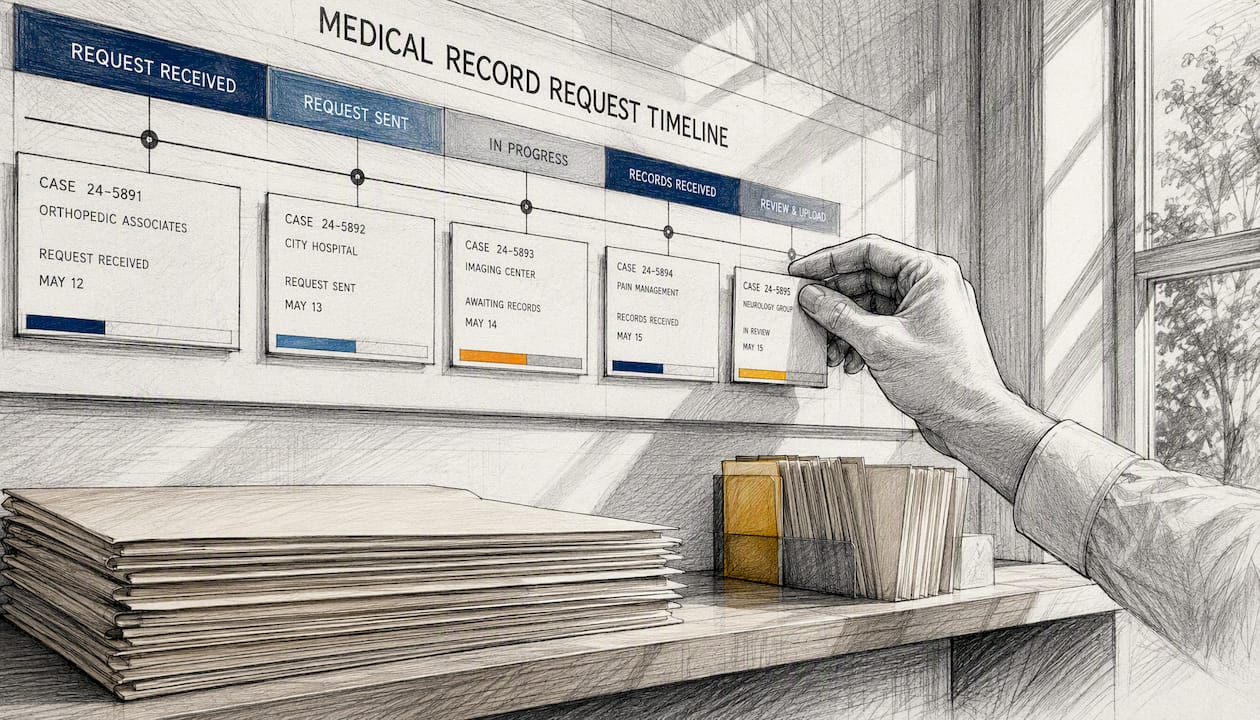
The medical record retrieval process is the sequence of legal authorizations, provider outreach, tracking, and quality control required to obtain court-ready health records for litigation. When a record is needed fast, the quickest defensible route is a properly executed HIPAA authorization signed by the patient. If the patient is unavailable or uncooperative, a subpoena or court order under 45 CFR §164.512(e) is the alternative path.
Every request must clear three legal steps before a provider will release anything:
- Identify all treating providers and confirm which entity actually holds the records (the hospital system, an EHR vendor, a third-party imaging archive).
- Secure the correct legal authority — a valid patient authorization under §164.508, a subpoena with proper notice, or a court order.
- Submit a provider-compliant request package that matches the custodian’s specific release-of-information (ROI) requirements, including scope, format preference, and fee estimate request.
Pro Tip: Before sending any request, verify the authorization’s expiration date and confirm the patient’s full legal name matches the provider’s records exactly. Name mismatches and expired authorizations are the two most common reasons a request is rejected before it is even reviewed.
Key Takeaways
The medical record retrieval process succeeds or fails at intake: firms that assign ownership, verify authorizations before submission, and track follow-up on a defined cadence consistently avoid the delays that cost cases.
| Point | Details |
|---|---|
| Secure the correct authority first | Choose patient authorization, subpoena with notice, or court order before preparing any request package. |
| HIPAA gives 30 days, reality gives more | Providers often take 45–90 days; build a 60-day buffer for large hospital systems into every discovery plan. |
| Verify before you send | Name mismatches and expired authorizations are the leading causes of first-contact rejection. |
| Track and escalate on a schedule | Confirm receipt by day 3–5, escalate at day 10, contact the privacy officer at day 20. |
| Attorney Assistant reduces bottlenecks | Attorney Assistant handles retrieval coordination, QC, and court-ready packet delivery for personal injury firms. |
Table of Contents
- Why medical records are central to your litigation strategy
- What legal authority actually lets you get the records?
- How to request records step by step
- How long does retrieval actually take?
- Common retrieval problems and how to fix them
- Should you manage retrieval in-house or use a vendor?
- What retrieval costs and how to control it
- Copy-ready checklists for your intake file
- Why retrieval discipline is the real issue
- How Attorney Assistant handles retrieval for your firm
- Sources
- FAQ
Why medical records are central to your litigation strategy
Records are not background material. They are the evidentiary spine of most civil litigation. A treating physician’s notes establish the mechanism of injury, the timeline of treatment, and the causal link between the defendant’s conduct and the plaintiff’s harm. Without them, damages are speculative and liability is contested.
The record types that matter vary by case type. In a motor vehicle personal injury matter, the emergency department records, imaging studies, and physical therapy notes document the acute injury and the recovery arc. In a medical malpractice case, the operative notes, nursing assessments, and informed-consent documentation often determine whether the standard of care was met. In a workers’ compensation claim, pre-employment physicals, occupational health records, and pharmacy logs become critical when the defense argues a pre-existing condition. For a detailed breakdown of what records to prioritize in personal injury matters, medical records in PI cases is a useful practitioner reference.
The record categories every litigation team should expect to request:
- Hospital and clinic charts (admission notes, discharge summaries, physician orders, nursing notes)
- Diagnostic imaging (X-rays, MRIs, CT scans, and the radiologist’s read)
- Billing and coding records (itemized bills, EOBs, ICD codes that confirm diagnoses)
- Therapy notes (physical, occupational, speech, and behavioral health)
- Pharmacy records (prescription history, dosage changes, refill patterns)
- Specialist and referral records (orthopedics, neurology, pain management)
Pulling these early, before the defense does, lets you control the narrative. Waiting until discovery deadlines loom is where firms lose time they cannot recover.
What legal authority actually lets you get the records?
The U.S. framework gives you four paths to records, and choosing the wrong one wastes weeks.
Patient authorization is the fastest and most flexible route. Under 45 CFR §164.508, a covered entity must honor a valid written authorization. The authorization must contain these core elements:
- A specific description of the information to be disclosed (date ranges, record types)
- The name or class of persons authorized to disclose
- The name or class of persons authorized to receive the information
- The purpose of the disclosure
- An expiration date or expiration event
- The patient’s signature and date
- A statement that the patient may revoke the authorization
Covered entities must retain signed authorizations for six years from the date of creation or last effective date.
Subpoena without a court order triggers §164.512(e), which requires either (a) satisfactory assurances that the requesting party notified the patient and gave them an opportunity to object, or (b) satisfactory assurances that the parties sought a qualified protective order. Providers who receive a bare subpoena without these assurances can and do refuse to produce.
Court order is the cleanest path when a patient is uncooperative. A court order under §164.512(e)(1)(i) permits disclosure without additional notice requirements, though providers may still require a certified copy.
Patient right-of-access under 45 CFR §164.524 lets the patient request their own records and provide them to counsel. This is slower in practice but useful when a provider disputes the authorization’s validity.
State law adds another layer. California’s Confidentiality of Medical Information Act, Washington’s Health Care Information Act, and Rhode Island’s Health Care Confidentiality Act each impose notice requirements that go beyond HIPAA’s federal floor. State-by-state turnaround and notice rules vary significantly, and ignoring them is a common source of avoidable delay.
Sensitive categories require separate authority. Psychotherapy notes under 45 CFR §164.508(a)(2) require a separate authorization from general medical records. Substance use disorder records governed by 42 CFR Part 2 require a court order or a specific Part 2-compliant consent form. HIV/AIDS records, genetic information, and mental health records often carry additional state-level protections. Check the applicable state statute before sending a general authorization for these categories.
How to request records step by step
The workflow below applies to any litigation matter. Assign ownership at each step so nothing stalls between desks.
-
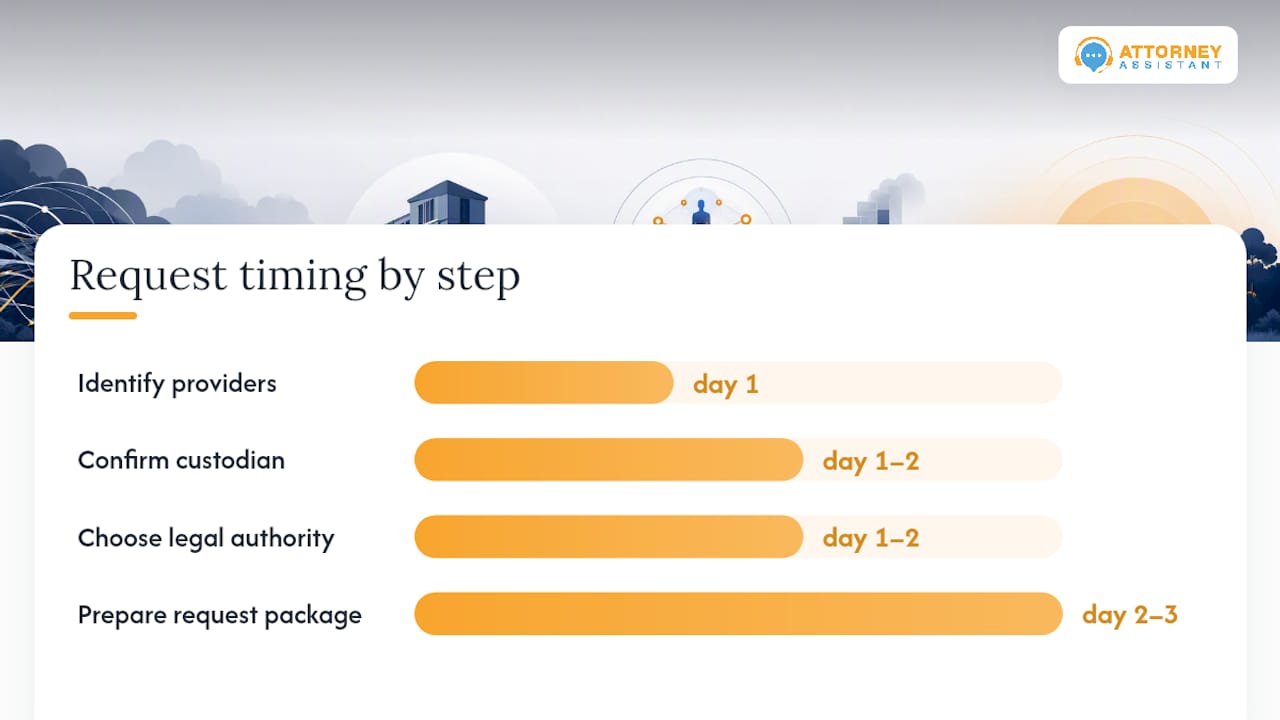
Identify all treating providers (paralegal, day 1). Pull the client’s intake form, prior records, and insurance EOBs. List every provider by name, address, and NPI. Confirm whether the provider uses a third-party ROI vendor such as Ciox Health or MRO Corp, because the request goes to the vendor, not the hospital’s medical records department.
-
Confirm the records custodian (paralegal, day 1–2). Call the provider’s ROI department. Ask whether records are held in-house, by a third-party vendor, or archived off-site. Get the correct mailing address, fax number, and any portal submission instructions.
-
Choose the correct legal authority (attorney, day 1–2). Patient authorization for cooperative clients. Subpoena with notice or qualified protective order for contested matters. Court order when the patient is unavailable or opposing counsel is involved.
-
Prepare the request package (paralegal or litigation support, day 2–3). The package should include: firm letterhead with matter number, patient’s full legal name and date of birth, Social Security number (last four digits minimum), the enclosed signed HIPAA authorization or certified subpoena, a precise description of records requested (date ranges, record types), preferred delivery format (searchable PDF via secure portal), a written fee estimate request, and a certification demand if records will be used at trial. Practitioner-ready sample request language is available from attorney-facing guides and worth adapting to your firm’s letterhead.
-
Submit through the correct channel (paralegal, day 3). Fax, certified mail, or portal submission per the custodian’s instructions. Keep a timestamped confirmation for every submission.
-
Track and follow up (paralegal or retrieval coordinator, ongoing). Confirm receipt within 3–5 business days. Escalate at day 10 if no acknowledgment. Escalate to the provider’s privacy officer at day 20 if still no production. Document every contact in the case management system.
-
Receive and quality-control (litigation support, upon receipt). Verify the records match the requested date range and record types. Check for missing pages, illegible entries, or redactions that appear improper. Flag gaps immediately and send a deficiency letter within 48 hours.
-
Index, Bates-stamp, and organize (litigation support). Assign Bates numbers, create a production index by provider and date range, and upload to the case file. If a protective order governs the records, mark them accordingly.
-
Produce to opposing counsel or use in discovery (attorney). Confirm any applicable protective order language before production.
Pro Tip: When a request comes back deficient, do not restart from scratch. Send a targeted deficiency letter citing the specific missing records by date range and record type, attach a fresh authorization if the original has expired, and reference the original submission date. This preserves your timeline and avoids triggering a new 30-day clock at the provider.
How long does retrieval actually take?
HIPAA sets a 30-day baseline response window, with one permitted 30-day extension if the provider notifies the requester in writing. That statutory clock rarely matches operational reality. Industry reporting documents retrieval timelines expanding to 45–90 days for many providers, and 68% of surveyed firms reported delays tied to record retrieval.
| Provider Type | Typical Turnaround | Notes |
|---|---|---|
| Large hospital system | 30–60 days | Often routes through a third-party ROI vendor |
| Community clinic or private practice | 30 days | Faster when records are in-house |
| Imaging center | 7–21 days | Depends on archive format and volume |
| Pharmacy | 7 days | Usually straightforward; chain pharmacies have centralized systems |
| Retrieval vendor (structured workflow) | 15 days | Vendor-reported average; facility-dependent |
Factors that push timelines past the statutory window:
- Authorization deficiencies (expired date, name mismatch, missing elements)
- Provider routing to the wrong department (billing vs. ROI vs. HIM)
- EHR migrations or system transitions at the provider
- State notice requirements that require waiting periods before production
- High-volume periods at large hospital systems
- Records held by a third-party archive with its own access procedures
- Incomplete provider identification at intake (missing NPI, wrong address)
Build a minimum 60-day buffer into any discovery plan that depends on records from a large hospital system. For imaging centers and pharmacies, 30 days is usually sufficient.
Common retrieval problems and how to fix them
Retrieval delays are predictable. The same problems appear across cases and providers. Here is what to do when they surface.
-
Incomplete or expired authorization: Prepare a corrected authorization immediately. Do not wait for the provider to contact you. Send the corrected version with a cover letter referencing the original submission date and requesting expedited processing.
-
Request routed to the wrong department: Call the provider directly. Ask for the Health Information Management (HIM) or ROI department by name. Get a direct fax number or portal link and resubmit.
-
Excessive fee demands: Providers may charge reasonable, cost-based fees under HIPAA. Request an itemized fee schedule in writing. If the fee appears excessive, dispute it in writing and cite the applicable state fee schedule. Many states cap per-page fees.
-
Redactions that appear improper: Document the redacted sections and send a written objection identifying the specific pages and the legal basis for your objection. If the provider maintains the redaction, escalate to a motion to compel.
-
Missing records or gaps in the chart: Send a deficiency letter within 48 hours of receipt. Specify the missing date ranges and record types. Ask the provider to certify in writing whether the missing records exist or were destroyed.
-
Provider claims records are destroyed: Request a written certification of destruction with the date and method. If the destruction appears to have occurred after litigation was reasonably anticipated, preserve the certification and consult with the supervising attorney about spoliation arguments.
-
Inconsistent EHR identifiers: Patients treated across multiple facilities in the same health system may have different medical record numbers. Confirm the correct MRN for each facility before submitting.
-
Repeated vendor failures: If a retrieval vendor misses SLA targets on multiple matters, document the failures and escalate to the vendor’s account manager. If the pattern continues, reassign the matters.
Should you manage retrieval in-house or use a vendor?
The honest answer depends on your caseload volume, staffing depth, and how predictable your discovery deadlines are.
In-house retrieval works when your firm handles a low volume of matters, your paralegal staff has dedicated bandwidth, and your cases involve a small number of providers per matter. The advantages are direct control over the process and no vendor markup. The disadvantages are that it does not scale, staff turnover disrupts institutional knowledge, and tracking across dozens of simultaneous requests is genuinely difficult without a dedicated system.
A retrieval vendor or operations partner makes sense when caseload volume exceeds what your staff can track reliably, when matters involve multiple providers across different states, or when discovery deadlines are tight and you cannot afford a stalled request. Law firm-facing retrieval guides consistently note that firms outsource as caseloads scale because internal workflows fail to keep pace.
Best practices for efficient retrieval from established health information groups emphasize verified authorizations, provider-specific templates, portal tracking, and QC review as the core disciplines that reduce rejections and missing pages. Whether you do this in-house or through a vendor, those four disciplines are non-negotiable.
When evaluating a vendor, require answers to these questions:
- What is your SLA turnaround target by provider type?
- Are you HIPAA-compliant with a signed BAA, and do you carry SOC 2 or equivalent third-party certification?
- How do you handle chain of custody and Bates-stamping?
- What does your QC process look like on receipt?
- How is pricing structured (per-page, per-matter, flat fee)?
- Do you maintain audit logs for every request and delivery?
- Do you offer portal or API access for status tracking?
Attorney Assistant handles retrieval coordination, QC, and secure delivery for law firms that need predictable outcomes without adding headcount. The service covers intake enforcement, authorization preparation, provider follow-up, and production-ready record packets, including chronologies and lien verification. For firms managing high-volume personal injury caseloads, that combination of retrieval and summarization in one workflow removes a significant operational bottleneck. More detail on the service is at Attorney Assistant’s medical record retrieval page.
What retrieval costs and how to control it
Under HIPAA, providers may charge fees that are reasonable and cost-based. They cannot profit from disclosure. In practice, fee structures vary widely by provider type and state.
Typical fee types you will encounter:
- Per-page copying fees (paper or electronic): many states cap these; Florida, for example, sets specific per-page limits for paper and electronic copies
- Electronic preparation fees: charged for retrieving and formatting records from an EHR system
- Imaging and radiology fees: separate from chart fees; often charged per study or per CD/disc
- Certification fees: charged when records must be certified for admissibility
- Shipping and handling: applies to physical media; avoidable with electronic delivery
- Retrieval vendor fees: per-matter or per-page charges from third-party ROI vendors
Cost-control strategies that work in practice:
- Narrow the date range. Request only the records relevant to the injury period. A blanket “all records” request generates unnecessary volume and higher fees.
- Use phased productions. Request the most critical records first (ED visit, initial treatment) and follow up for the full chart once you confirm the matter will proceed.
- Specify electronic delivery. Searchable PDF via secure portal eliminates per-page paper copying fees and speeds delivery.
- Request a written fee estimate before production. Providers must honor reasonable fee requests. Getting the estimate in writing lets you dispute overcharges with documentation.
- Dispute excessive invoices promptly. Send a written dispute citing the applicable state fee schedule within 30 days of receipt. Waiting longer weakens your position.
For Florida-specific fee guidance and request procedures, state-level practice guides provide the applicable caps and procedural requirements.
Copy-ready checklists for your intake file
Drop these into your case management system at intake. They are designed for paralegals and litigation support staff.
HIPAA authorization core elements checklist
- [ ] Patient’s full legal name (as it appears in provider records)
- [ ] Date of birth and Social Security number (last four digits minimum)
- [ ] Specific description of records requested (record types and date ranges)
- [ ] Name of the covered entity authorized to disclose
- [ ] Name and address of the person or firm authorized to receive
- [ ] Purpose of the disclosure (“litigation” or “at the direction of the individual”)
- [ ] Expiration date or expiration event (e.g., “one year from signature” or “resolution of litigation”)
- [ ] Patient signature and date
- [ ] Statement of right to revoke
- [ ] For psychotherapy notes: separate authorization on a standalone form
- [ ] For Part 2 SUD records: Part 2-compliant consent or court order
Intake checklist for paralegals
- [ ] All treating providers identified and listed with NPI and address
- [ ] ROI department or third-party vendor confirmed for each provider
- [ ] Correct legal authority selected (authorization, subpoena, or court order)
- [ ] Request package prepared with all required elements
- [ ] Submission method confirmed (fax, mail, portal)
- [ ] Submission timestamp recorded in case management system
- [ ] Follow-up calendar entries set (day 3–5, day 10, day 20)
- [ ] Fee estimate requested in writing
For additional intake process guidance, personal injury case intake tips covers the upstream steps that affect whether retrieval starts on time.
Production index format
Structure your production index with these columns: Provider Name | Date Range Requested | Record Types | Date Received | Bates Range | Custodian Notes | Protective Order Status. Log every production as it arrives. Gaps in the Bates range are your first signal that pages are missing.
Why retrieval discipline is the real issue
Most firms treat medical record retrieval as a clerical task. It is not. It is a project-critical workflow with legal deadlines, compliance requirements, and direct consequences for case value.
The pattern that causes discovery failures is predictable: retrieval starts late because no one owned it at intake, the authorization has a deficiency that sits unnoticed for two weeks, the follow-up never happens because the paralegal is managing 40 other matters, and suddenly a settlement conference is three weeks away with records still outstanding. That sequence is not bad luck. It is an operational gap.
Fix it with three structural changes. First, assign a single point of contact for retrieval on every matter at intake, not after the first status conference. Second, enforce intake templates so every authorization goes out complete the first time. Third, track provider performance over time. If a specific hospital system or ROI vendor consistently misses 30-day windows, you need to know that before you build a discovery schedule around them.
Firms that treat retrieval as a tracked operational metric, with assigned ownership and escalation rules, consistently outperform those that treat it as a background task. The operational case for treating retrieval as a bottleneck is well-documented. The fix is not more staff. It is better process.
How Attorney Assistant handles retrieval for your firm
Attorney Assistant delivers end-to-end medical record retrieval coordination for personal injury and contingency-fee law firms. The service covers authorization preparation, provider outreach, follow-up tracking, QC on receipt, Bates-stamping, and secure delivery of court-ready record packets, including medical chronologies and lien verification.
The service aims to improve production timelines by ensuring requests are complete, reducing rejections through authorization verification, and delivering court-ready, indexed record packets that facilitate attorney review.
If your firm is managing a high-volume personal injury caseload and retrieval is creating bottlenecks, book a call to see how Attorney Assistant fits into your current workflow. The conversation takes 30 minutes and focuses on your specific operational gaps, not a generic product demo.
Sources
- HIPAA Privacy Regulations Uses and Disclosures For Which an Authorization or Opportunity to Agree or Object is Not Required: Judicial and Administrative Proceedings - 164.512(e)
- How to Retrieve Medical Records for Litigation: A Complete Guide (2025) | Record Retrieval Solutions
- How Attorneys Request Medical Records: Step-by-Step Guide, HIPAA Requirements, and a Sample Letter
This article is general information, not a substitute for advice from a qualified lawyer. Consult a qualified legal professional about your own circumstances before acting on anything here.
FAQ
What is the medical record retrieval process?
The medical record retrieval process is the sequence of legal authorizations, provider outreach, tracking, and quality control required to obtain health records for litigation. It begins with identifying treating providers and ends with indexed, court-ready records delivered to the case file.
How long does it take to retrieve medical records?
HIPAA requires providers to respond within 30 days, with one permitted 30-day extension. In practice, large hospital systems often take 45–90 days; imaging centers and pharmacies typically produce within 7–21 days.
What are the required steps for releasing medical records?
A provider must receive a valid legal authority (patient authorization, subpoena with notice or qualified protective order, or court order), verify the request meets HIPAA and applicable state requirements, and then produce the records within the statutory window.
What should a HIPAA authorization include for litigation?
A valid authorization under 45 CFR §164.508 must identify the records to be disclosed, name the disclosing and receiving parties, state the purpose, include an expiration date, and carry the patient’s signature. Psychotherapy notes and Part 2 substance use disorder records require separate authorization.
When should a law firm use a retrieval service instead of managing records in-house?
When caseload volume exceeds what staff can track reliably, when matters span multiple providers across different states, or when discovery deadlines are tight, a retrieval service provides the structured workflow and follow-up discipline that in-house teams struggle to maintain at scale.
Recommended
Related Articles

White Glove Support for Law Firms
Discover how white glove support transforms law firm intake and operations. Learn the metrics, staffing models, and workflows that actually sign cases.

10 Business Finance Course Options for Law Firms
Compare 10 business finance course options by level, format, workload, and law-firm relevance, then choose the right fit for your role and goals.

10 Good VoIP App Options for Law Firms in 2026
Compare 10 good VoIP app options for small and mid-sized law firms, including security, integrations, pricing, mobile use, and desk-phone readiness.