A medical records coordinator is a case-velocity owner who tracks authorizations, deadlines, record completeness, billing, and liens, not a person who requests files. The closest U.S. occupational benchmark, medical records specialist, had a median annual wage of $50,250 in May 2024, with projected employment growth of 7% from 2024 through 2034 and about 14,200 openings per year during that decade.
The popular advice to “just request the records” misses the work that determines whether those records can support a case. A file can be received and still be partial, misindexed, tied to the wrong date range, or missing the bill that makes the treatment costs legible. In a personal-injury practice, the coordinator's real output isn't a stack of PDFs. It's a complete, traceable record set that reaches the right person in time to move the matter forward.
The Bureau of Labor Statistics describes medical records specialists as responsible for compiling, processing, maintaining, and securing patient records, checking accuracy, assigning clinical classification codes, and protecting sensitive information. Its benchmark is broader than the job title “medical records coordinator,” but it makes one point clear: this is health-information work, not generic clerical support. The wage and labor-market projections above are drawn from the BLS occupational profile for medical records specialists.
Table of Contents
- Why a Medical Records Coordinator Is Not a File Requester
- Core Duties That Actually Run the Function
- How the Role Fits Inside a Law Firm Workflow
- KPIs That Tell You Whether the Role Is Working
- When to Hire Internally, When to Outsource, and When to Do Neither
- Lien Management and Compliance Controls the Coordinator Owns
- Building the Role So It Actually Pays for Itself
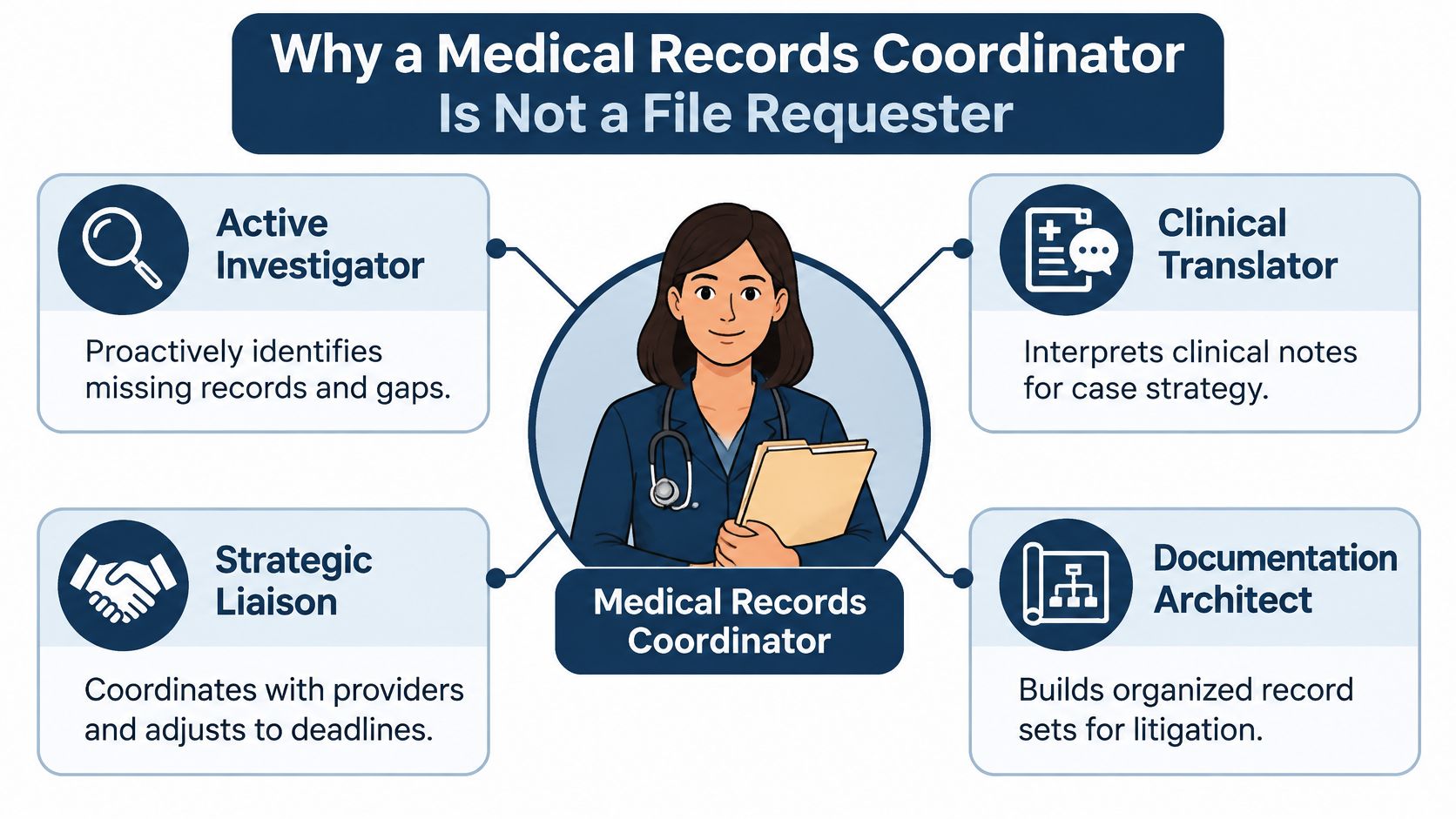
Why a Medical Records Coordinator Is Not a File Requester
A request sent is not a record set received, and a record set received is not necessarily a complete file. Treating those as the same milestone is how records backlogs become permanent fixtures in a firm's case-management system. The coordinator should own the distance between “requested” and “ready for attorney review,” including the follow-up and escalation needed to close that gap.
The risk isn't theoretical. A 2025 VA Office of Inspector General review found that records had been uploaded for only 82% of nearly 3 million completed community-care consults. Another 535,095 consults had no records uploaded to the electronic health record. That review concerns VA community care, not law-firm performance, but it illustrates why an electronic system or a completed appointment doesn't guarantee that the documentation is available. The VA OIG review of community-care records supports a practical distinction: “records received” is a status; completeness is a finding that needs to be checked.
What completeness looks like in practice
A defensible longitudinal file should match the patient and authorized date range, account for the providers involved, and include the components the case needs. Depending on the matter, that may mean clinical notes, imaging, laboratory reports, itemized billing, and records from specialists or facilities that don't share the same portal. A coordinator flags what's missing, documents the follow-up, and makes the limits of a partial production visible before anyone treats it as complete.
The work has changed as care records moved from paper into digital systems. Any-EHR adoption among U.S. office-based physicians rose from 42% in 2008 to 95% in 2024, while certified EHR adoption reached 91% in 2024. Electronic access can make retrieval faster, but it doesn't make records complete, correctly indexed, or consistent across provider systems. The national office-based physician EHR adoption series shows why the role now requires navigating digital workflows as well as chasing paper.
For a practical overview of the provider-side retrieval process, firms can also consult this guide to obtain medical records quickly. The firm's own operating standards should go further by assigning someone responsibility for completeness, deadlines, and escalation. A records management program is useful only if it clarifies who owns each of those decisions.
Core Duties That Actually Run the Function
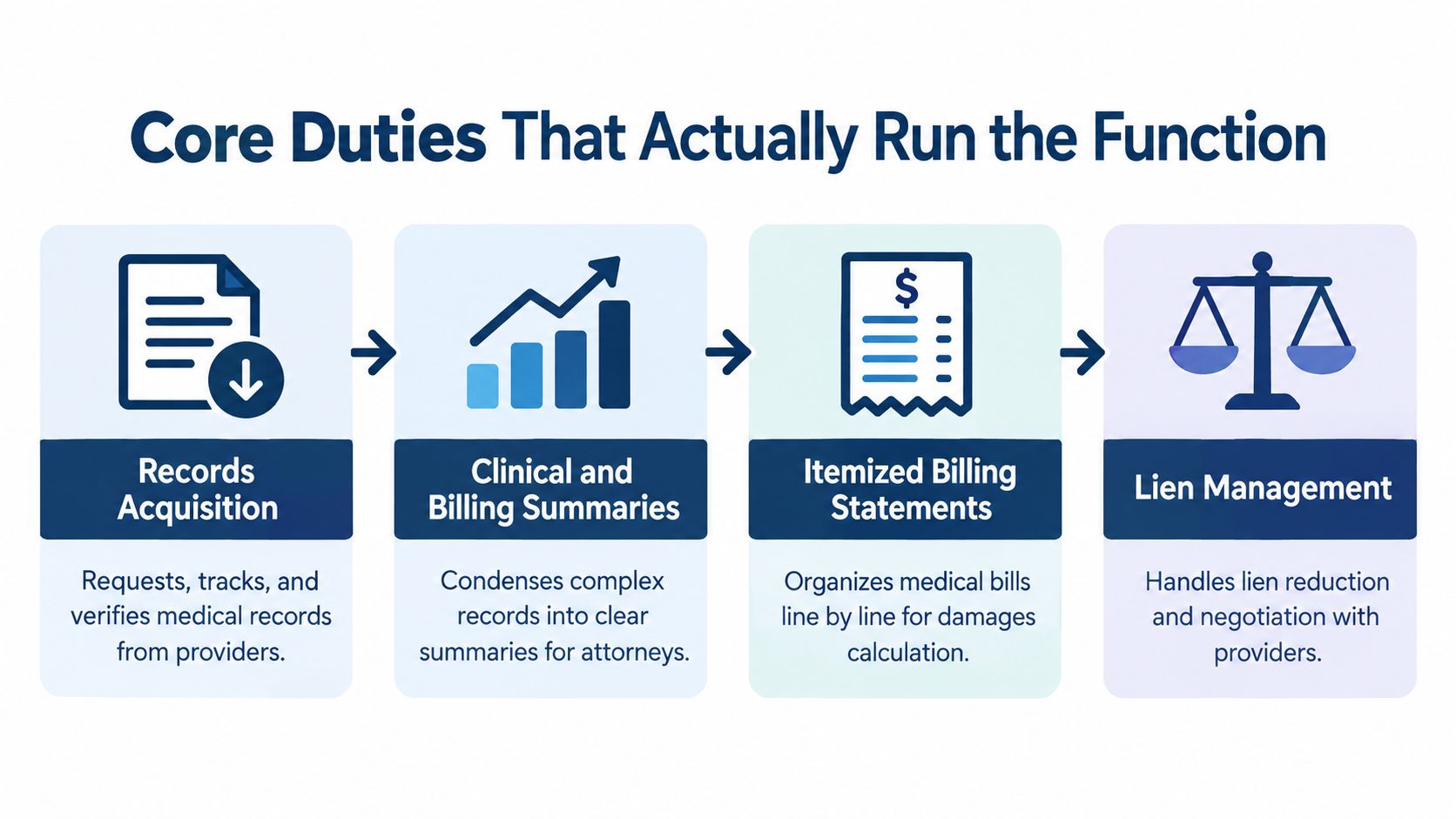
A medical records coordinator's work is easiest to understand as a connected workflow. Each request begins with a need, passes through checks and follow-up, then becomes an organized output for case staff and attorneys. If the coordinator stops at sending authorizations, the firm still has to do the work that makes the production useful.
Acquisition and summaries
Acquisition starts with a reliable request log. The coordinator records the patient and provider, authorization status, date range, request date, applicable deadline, follow-up history, and whether the production has arrived. When it does, the coordinator checks identity, dates, and expected components before changing the status to complete. A request sent through a portal still needs a person to notice when the portal has returned only a discharge summary and not the underlying treatment records.
A summary then turns a large file into a working case document. It should help the attorney and case manager identify treatment sequence, providers, gaps, and records that deserve closer review, without pretending to replace the source documents or legal analysis. The firm can use a step-by-step guide to acquiring medical records to standardize the retrieval stage, then define how summaries are reviewed and filed.
Billing and liens
Itemized billing deserves its own reconciliation. A statement should be organized so staff can connect charges to dates of service and related records, spot gaps or apparent duplication, and identify questions for follow-up. Clinical notes and bills serve different purposes; storing them together without a clear distinction makes damages review slower, not simpler.
Lien work begins with an inventory, not a settlement-week scramble. Track potential claims from providers, health insurers, Medicare, Medicaid, and ERISA plans, and keep each claim connected to its source correspondence and status. The coordinator's job is to surface outstanding balances and deadlines for the right legal decision-maker, not to treat every balance as automatically valid or resolved. A request-only role may keep files moving in a narrow sense, but summaries, billing organization, and lien tracking are what make the records function useful to case preparation and resolution.
How the Role Fits Inside a Law Firm Workflow
A coordinator works best as part of the matter pipeline, not as a remote inbox that staff remember to check when a demand is nearly ready. At intake, the team needs to capture provider names, prior treatment information, and any known gaps. If intake never flags an earlier provider, the coordinator can only request the records the firm knows to ask for.

Once the matter is open, the coordinator and case manager need a shared view of what has arrived, what remains outstanding, and what is blocking chronology or damages work. If no one prepares usable summaries, case managers may rebuild timelines from raw PDFs. That's labor-intensive, and it can delay the point when an attorney can assess whether the file is ready for a demand package. A useful guide to bodily injury claims can help orient staff to the broader claim process, but the firm still needs clear internal handoffs.
Make ownership visible at every handoff
An operating workflow should answer a few direct questions:
- Who owns the request? One person should be accountable for the next follow-up, rather than leaving it in a shared inbox where everybody assumes somebody else has it.
- Who reviews completeness? Someone should compare the production with the expected providers, dates, and record types before it becomes a case-preparation input.
- Who decides readiness? The coordinator can surface gaps and status; the attorney decides whether the evidence supports the next legal step.
- Who watches liens through resolution? The person tracking the claim should carry its status into the settlement workflow, not hand over an undocumented list at the end.
The coordinator should work inside the firm's matter-management system, with a defined docket and a place in regular file reviews. That arrangement gives case managers and attorneys a shared view of blockers without requiring them to become the records department. If a production is incomplete, the team can decide whether to escalate, proceed with a limitation, or wait for a specific document. The key is that the decision is informed and documented, rather than discovered when someone asks why the demand is still sitting in draft.
KPIs That Tell You Whether the Role Is Working
“Requests sent” and “records received” are activity counts. They don't show whether the firm is getting accurate, complete records in time to use them. A useful scorecard pairs timeliness with quality and makes delays visible by request type, provider, and case need.
A 2025 UT Health San Antonio review of 22,358 record requests found that 388 requests, or 1.7%, exceeded applicable state or federal deadlines, and 103, or 0.5%, exceeded the federal deadline. In its accuracy review, incorrect or missing dates appeared in 9 of 49 patient records examined, or 18%. The review is a healthcare-system example, not a law-firm benchmark, but it demonstrates why deadline tracking and field-level validation need separate controls. See the UT Health San Antonio HIPAA record-release process report.
Build a scorecard that shows the exceptions
Industry HIM guidance identifies process measures that translate well to legal operations: correction or re-release errors, turnaround time by request type, escalation for ambiguity or errors, and requester satisfaction. The HIM process-measure guidance offers a useful starting point. For a firm, add measures that show whether the records work is supporting case progress:
| Measure | What it reveals |
|---|---|
| Deadline compliance | Whether requests are released within the shortest applicable deadline, with extensions and notices documented where relevant. |
| Accuracy and re-release exceptions | Whether wrong-patient, wrong-date, or incomplete productions are being caught before they cause downstream problems. |
| Request aging by facility and record type | Which providers or production types are holding up files. A single average can hide the one delayed imaging set the attorney needs. |
| Escalation and resolution | Whether ambiguous requests, missing components, and provider delays are being actively addressed. |
| Lien inventory completeness | Whether potential claims are identified and tracked before settlement discussions. |
| Demand-package readiness | Whether the file's records, bills, summaries, and known gaps are assembled for attorney review. |
Don't set a target just to make a dashboard look decisive. First establish what the firm can reliably measure, then identify the exceptions and root causes. A coordinator who reports only volume gives management no early warning when an authorization is rejected, a provider sends an incomplete production, or a correction has to be requested.
When to Hire Internally, When to Outsource, and When to Do Neither
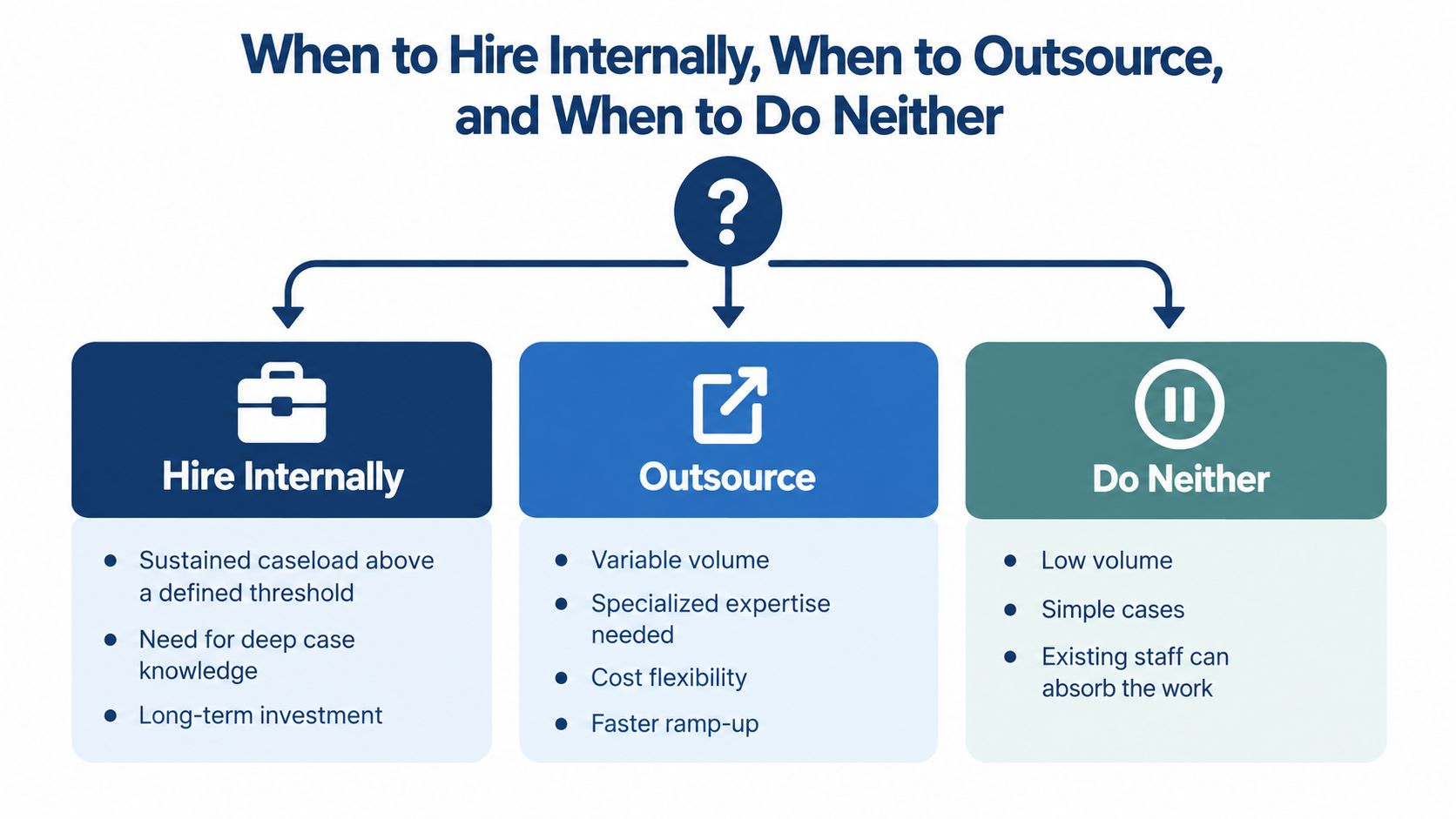
The choice between an internal hire and outside support depends less on the job title than on the shape of the work. Consider whether records volume is sustained, whether lien issues are complex, how much firm-specific judgment the workflow requires, and whether someone has time to supervise the role. A full-time employee brings continuity and close access to the team. Dedicated support can add capacity without making the firm carry a role that its matter volume can't consistently fill.
An internal hire may fit when the workload is stable, provider relationships and case histories require close familiarity, and attorneys and case managers can give the coordinator clear priorities. The trade-off is that salary is only part of the cost: the firm also needs to recruit, onboard, train, supervise, and cover the work when the person is unavailable. An internal role can become a poor investment if records duties compete with unrelated admin until neither gets done well.
Dedicated support may fit when volume fluctuates, cases involve providers across jurisdictions, or the firm needs a defined records function before a full-time in-house position makes sense. It still requires access, training, clear ownership, and routine review. Outsourcing without those basics is just a shared inbox with a different address.
| Signal | Points to Internal Hire | Points to Dedicated Support |
|---|---|---|
| Workload pattern | Records work is steady and the role can stay focused. | Workload varies or needs to scale with active matters. |
| Case familiarity | Deep day-to-day proximity and institutional knowledge matter. | The firm can document its process and train support into it. |
| Provider mix | A concentrated provider network rewards ongoing local familiarity. | Multi-state or changing provider workflows call for flexible capacity. |
| Management readiness | A supervisor can set priorities and review performance. | Co-managed support helps add structure, provided the firm assigns an internal owner. |
| Current bottleneck | The records queue itself is the constraint. | The firm needs extra hands for defined records and case-support tasks. |
Sometimes neither option is right yet. If the firm has low records volume, simple matters, and staff who can absorb the work without delaying other duties, a new role may add unnecessary management overhead. If records are consistently requested late because intake misses provider information or case managers don't maintain matter data, adding a coordinator won't repair the upstream process. Fix the handoff first.
Lien Management and Compliance Controls the Coordinator Owns
Lien work becomes expensive when the firm treats it as a task that begins at settlement. The coordinator should help build and maintain the inventory from the point the matter is opened, track correspondence, flag uncertain claims, and keep resolution status visible to the attorney. The coordinator supports the workflow; legal decisions about a claim's validity, strategy, or negotiation remain with the responsible legal professional.
Medicare conditional payments need active follow-through. The Centers for Medicare & Medicaid Services instructs the beneficiary or attorney to notify the Benefits Coordination & Recovery Center when a settlement, judgment, award, or other payment occurs, so related claims paid since the previous notice can be identified. After CMS issues a Conditional Payment Notice, the recipient has 30 days to respond. If no response arrives within that period, CMS may issue a demand for repayment without a proportionate reduction for attorney fees or costs. The CMS Medicare recovery process explains why a lien tracker needs a response deadline, owner, and documented review, not merely a payoff request.
Keep jurisdiction and claim type in view
A single national checklist can miss local rules. In California, ordinary paper copies may be charged at no more than $0.25 per page, and records copied from microfilm at no more than $0.50 per page, in addition to reasonable clerical costs. Certain written requests by a patient, representative, or qualifying nonprofit legal-services employee must be transmitted within 30 days. The California Health and Safety Code provision on patient records gives coordinators a concrete reason to track jurisdiction and fee category, rather than treating every invoice as a routine per-page charge.
The coordinator should also distinguish Medicare from Medicaid, ERISA plans, workers' compensation claims, and provider balances. Each can involve different documents, decision-makers, and follow-up. The operational control is a current inventory showing the source, claimed amount, correspondence, status, next action, and responsible reviewer. For a practical discussion of how firms approach negotiating medical lien amounts, the key takeaway is that the work needs a paper trail and an owner before settlement. A medical lien management workflow can help a firm keep those steps organized without confusing a coordinator's tracking role with legal advice.
Building the Role So It Actually Pays for Itself
A coordinator's job description won't fix an unclear workflow. Give the person access to the case-management system, records portals, authorization templates, correspondence, and the firm's tracking tools. Define who can approve requests, who reviews sensitive or ambiguous issues, and where an attorney should find the status of a file. If the coordinator has to reconstruct the matter from email threads, the firm has made basic recordkeeping a scavenger hunt.
Start training with authorization and identity checks, then move through request logging, provider follow-up, completeness review, summaries, billing organization, and lien tracking. The coordinator should learn the firm's matter stages and escalation rules, while the firm should learn what information the role needs at intake. Don't judge success by whether someone can send a fax. Judge whether the team can see what is missing, why it is missing, and who owns the next action.
A useful operating test: Can an attorney or case manager open a matter and quickly see the outstanding records, the next deadline, the last follow-up, and any unresolved lien issue?
Keep reporting light enough that the coordinator can do the work being reported. A regular review with case management can surface aging requests and incomplete files; a separate check-in with the attorney or operations lead can address exceptions that need a decision. Audit the role periodically: Are records requests starting promptly after intake? Are partial productions being labeled clearly? Are billing and liens tracked separately from clinical records? Is the coordinator being pulled into unrelated admin so often that the core function is slipping?
If those answers are unclear, fix the scope before adding another task or another hire. Attorney Assistant provides trained, dedicated full-time legal support through Staffline, including records and case-support work, and co-manages performance within a firm's workflows. Visit Attorney Assistant to assess whether dedicated support could help your firm build more reliable records capacity and give attorneys more room for legal work.
Related Articles

Medical Records Request: A Practical Guide for Law Firms
Run a clean medical records request with HIPAA-compliant steps, sample language, timelines, fees, and follow-up tactics built for law firm operations.

Litigation Support Services: What Law Firms Need to Know
Discover how litigation support services streamline discovery, reduce costs, and improve case outcomes. Learn what to look for in a provider.

Preferred Method of Contact for Law Firm Intake
Discover how to capture and use the preferred method of contact in legal intake to improve conversions, ensure compliance, and streamline law firm operations.