Your receptionist is checking in a client, the phone is ringing, and someone at the door would like to discuss your office's windows. The windows aren't why anyone came to work. A nice no soliciting sign should make your policy clear without making clients, delivery drivers, or invited visitors wonder whether they're also unwelcome.
Start with a polite refusal, make it readable, and give staff a calm response for anyone who ignores it. The sign doesn't need to win an argument. Ideally, there won't be one.
Table of Contents
- Ready-to-Use Nice No Soliciting Sign Wording
- What the Law Says Before You Order a Sign
- Design Rules That Keep the Message Readable
- Materials and Mounting That Survive Weather
- Where to Mount It and What to Do When Ignored
- Printable Templates and a One-Week Rollout
Ready-to-Use Nice No Soliciting Sign Wording
A short, polite line is the best default. Start with the friendly version below unless you need to address a particular problem, such as repeated knocking or sales representatives walking straight into reception.
Courtesy belongs around the boundary, not instead of it. A sign that merely thanks people for respecting your privacy leaves them to decide what that means. Some will decide it permits a brief presentation.
Ready-to-use wording by tone
| Tone | Sign wording | Best for |
|---|---|---|
| Friendly | Thank you for stopping by. We are not accepting sales visits. | Family homes and quiet neighborhoods |
| Direct | No soliciting. Please do not knock. | Streets with frequent canvassers |
| Dry humor | We already have a dog, and he has no interest in your gutters. | Light-hearted households that want a smile |
| Legal precision | No soliciting, sales, donations or petitions. Deliveries and invited guests are welcome. | HOAs and visitors who are hard to classify |
| Office | Thank you for visiting. Solicitation is by appointment only. | Law offices and business reception desks |
| Bilingual | No soliciting. No vendedores, por favor. Gracias. | Multilingual households |
The humorous version is decoration first and a boundary second. Pair it with a prominent NO SOLICITING heading if you want people to understand the policy without interpreting the dog's purchasing preferences.
The legal-precision version names the activities you don't welcome. That makes your preference clearer, but it doesn't establish that every listed activity can be prohibited or enforced identically.
Keep the right visitors welcome
A Florida appellate decision distinguished notice against sales, contribution requests, and similar activity from a notice excluding ordinary visitors; the sign didn't withdraw the usual implied permission to approach and knock.
That's why No Visitors, No Trespassing, and No Soliciting aren't interchangeable. For a law office, a broad refusal of visitors can also send exactly the wrong message to a prospective client.
Doorway test: Read the sign aloud at the entrance. Would a delivery driver still know they're welcome?
Choose the office version only if you accept scheduled sales visits. If you don't, replace the appointment language with a straightforward statement that sales visits aren't accepted.
What the Law Says Before You Order a Sign
A sign can communicate a clear boundary and still have different legal force from one municipality to the next. Before ordering a permanent panel, check the rules for the property's address, property type, and the activity you want to discourage.
Posting a preference and creating enforceable notice aren't always the same thing. A polished sign cannot replace a local ordinance, property rule, or required wording.
Where sign rules differ
KSL's review of solicitation rules examined 100 Utah city codes. The review found that most required salespeople to check and obey posted signs, while at least one had no specific compliance requirement.
| Jurisdiction or source | Requirement or finding | What it means for your sign |
|---|---|---|
| Florida state law | A visible sign identifying a dwelling as private property where commercial solicitation is prohibited | Check the statute's wording and residential scope before ordering |
| Utah city codes reviewed by KSL | Most require door-to-door salespeople to check and obey posted signs; at least one has no specific compliance rule | Read your own city's code |
These examples are not a national sign standard. A rule about a dwelling may not apply to a commercial law-office entrance. Check the rule's scope before treating your sign as legal notice.
Make the checks in this order
- Find the local ordinance. Search your city or county code for solicitation, commercial canvassing, permits, and posted notice.
- Read the property rules. Check the HOA covenant, condominium policy, or building signage requirements.
- Get landlord approval in writing. Confirm the location and mounting method before drilling into rented property.
- Match the required wording. Keep any mandatory notice language intact. A friendlier sentence may not meet the rule.
Read the definition of solicitation, not only the penalty provision. Political canvassing, religious outreach, charitable requests, and commercial sales may be treated differently. Listing them together on a sign does not necessarily give them the same legal status.
If the distinction is unclear, ask the municipal office which provision applies and which department handles complaints. In a shared office building, confirm whether the tenant or property manager controls the entrance.
This is practical information, not legal advice. Attorney Assistant isn't a law firm. A local attorney or municipal office can help confirm which rules apply to a specific address. Even attorneys deserve an afternoon without researching their own porch.
Design Rules That Keep the Message Readable
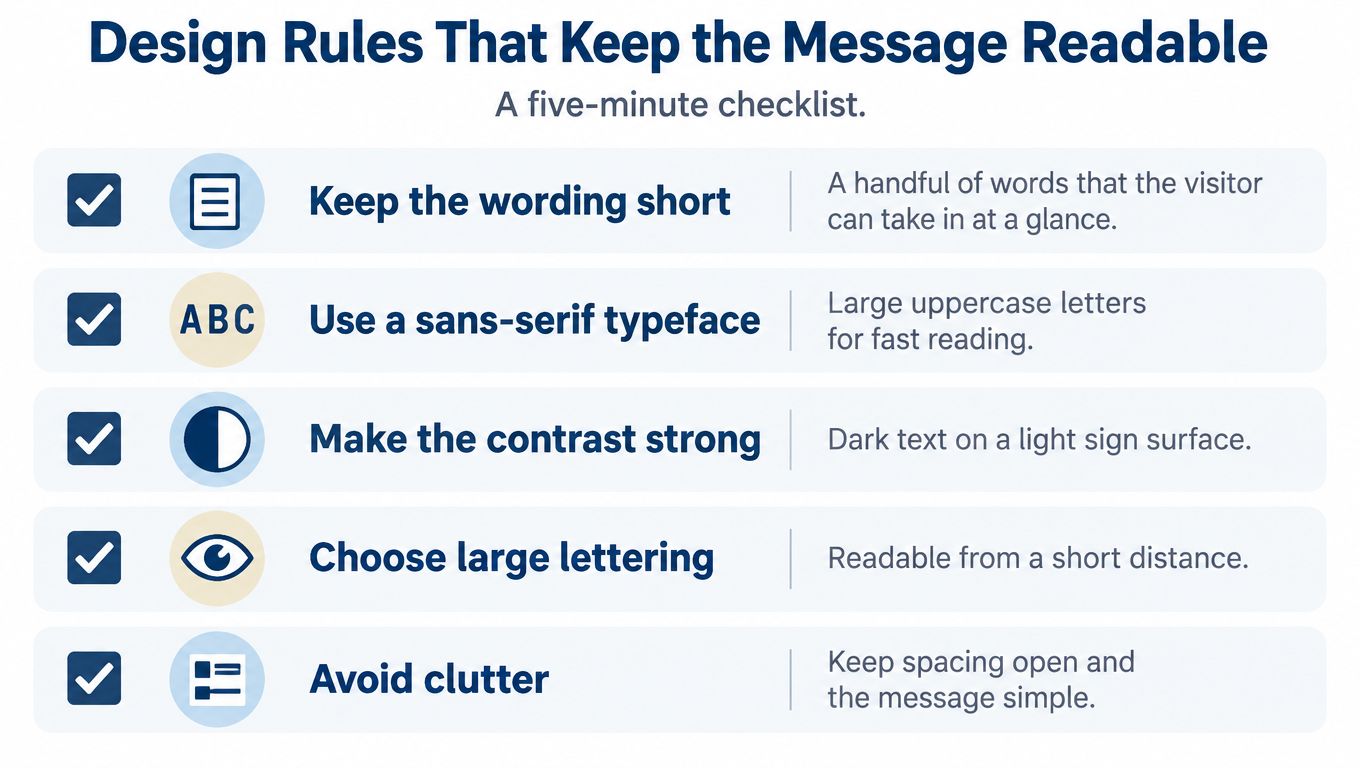
Run this five-minute readability check before approving the artwork. A restrained design is useful here: visitors should notice the policy, not admire your commitment to decorative script.
- Keep the wording short. Put the refusal first so visitors don't need to read a paragraph to identify the boundary.
- Choose a sans-serif typeface. Use large uppercase lettering for the main message, with enough space between characters.
- Make contrast strong. Black on white or white on deep navy separates the lettering from its background.
- Specify a matte finish. A non-glare surface helps keep sunlight from obscuring the words.
- Remove visual interference. Skip patterned backgrounds, thin strokes, and condensed fonts that become difficult to distinguish at an angle.
- Use the normal sightline. Position the message roughly at adult eye level without hiding it behind planters or porch decorations.
- Check the lighting. Illuminate a dark entrance so the notice remains usable after daylight fades.
- Keep the border simple. A plain outline can separate the message from its surroundings without competing with it.
Separate accessibility from decoration
The U.S. Access Board's sign guidance supports non-glare finishes, strong light-dark contrast, and readable character forms. Its tactile-sign requirements concern particular sign categories, including permanent room identification, rather than automatically applying to every exterior solicitation placard.
Adding Braille doesn't by itself establish ADA compliance. Consider it as an accessibility feature where useful, while separately checking which requirements apply to the actual installation.
For visual ideas that coordinate with an entrance, you can compare metal address sign design options from Farmhouse World. Borrow the clean spacing and contrast, not a decorative treatment that makes the prohibition harder to read.
A sign that matches your building beautifully but can't be read from the approach is primarily a building accessory.
Stand on the sidewalk, then follow the route a visitor takes. Check the sign straight on and at an angle, with the door open and closed. If you can't take in the main message at a glance, revise the design before blaming the reader.
Materials and Mounting That Survive Weather
Exterior-grade aluminum is a practical starting point for a permanent entrance sign. Aluminum composite can also work, particularly where you want a rigid panel without committing to a heavier installation.
The words won't determine the replacement schedule. The substrate, printing system, exposure, and mounting will.
Outdoor sign material and expected lifespan
AlphaGraphics' outdoor-material guidance describes properly engineered aluminum signs lasting roughly 10 to 15 years, compared with about 5 to 8 years for standard printed aluminum-composite panels.
| Sign material | Typical outdoor life | Best use |
|---|---|---|
| Engineered exterior aluminum | About 10 to 15 years | Front entrances and exposed doors |
| Printed aluminum composite panel | About 5 to 8 years | Sheltered entrances or budget installs |
| Outdoor banner vinyl | Substantially shorter, no firm figure | Temporary notices only |
Treat those as material-selection guidance, not a warranty. Ultraviolet exposure fades graphics and weakens some plastics and adhesives; temperature swings cause expansion and contraction. Moisture and freeze-thaw conditions can lift edges, separate layers, or compromise fasteners.
Specify the whole installation
- Choose exterior-rated components. Ask for exterior-grade aluminum or aluminum composite with UV-stable graphics and an appropriate UV-protective laminate.
- Use suitable hardware. Specify corrosion-resistant or stainless fasteners matched to the mounting surface.
- Secure the panel mechanically. Don't rely solely on adhesive on textured masonry or a wind-exposed door.
- Inspect the finished sign. Put an annual check on the maintenance calendar for fading, peeling, loose hardware, and reduced contrast.
- Replace unreadable notices. Don't wait until visitors have to guess what the missing letters were.
For a temporary layout trial, The Print Warehouse Ltd's Correx signs for business promotions provide another board format to consider. Don't assume a temporary promotional board has the lifespan of engineered exterior aluminum.
The table compares material longevity only. Landlord approval, historic-district restrictions, and municipal installation rules still need separate checks before you mount anything.
Where to Mount It and What to Do When Ignored
Place the sign where visitors can see it before reaching the door. The front entrance, gate, or beginning of the walkway is the useful decision point, not an interior wall behind reception.
Walk the actual approach rather than assessing the location from inside. Landscaping, a screen door, reflections, and an open gate can all conceal a notice that looks perfectly obvious from your desk.
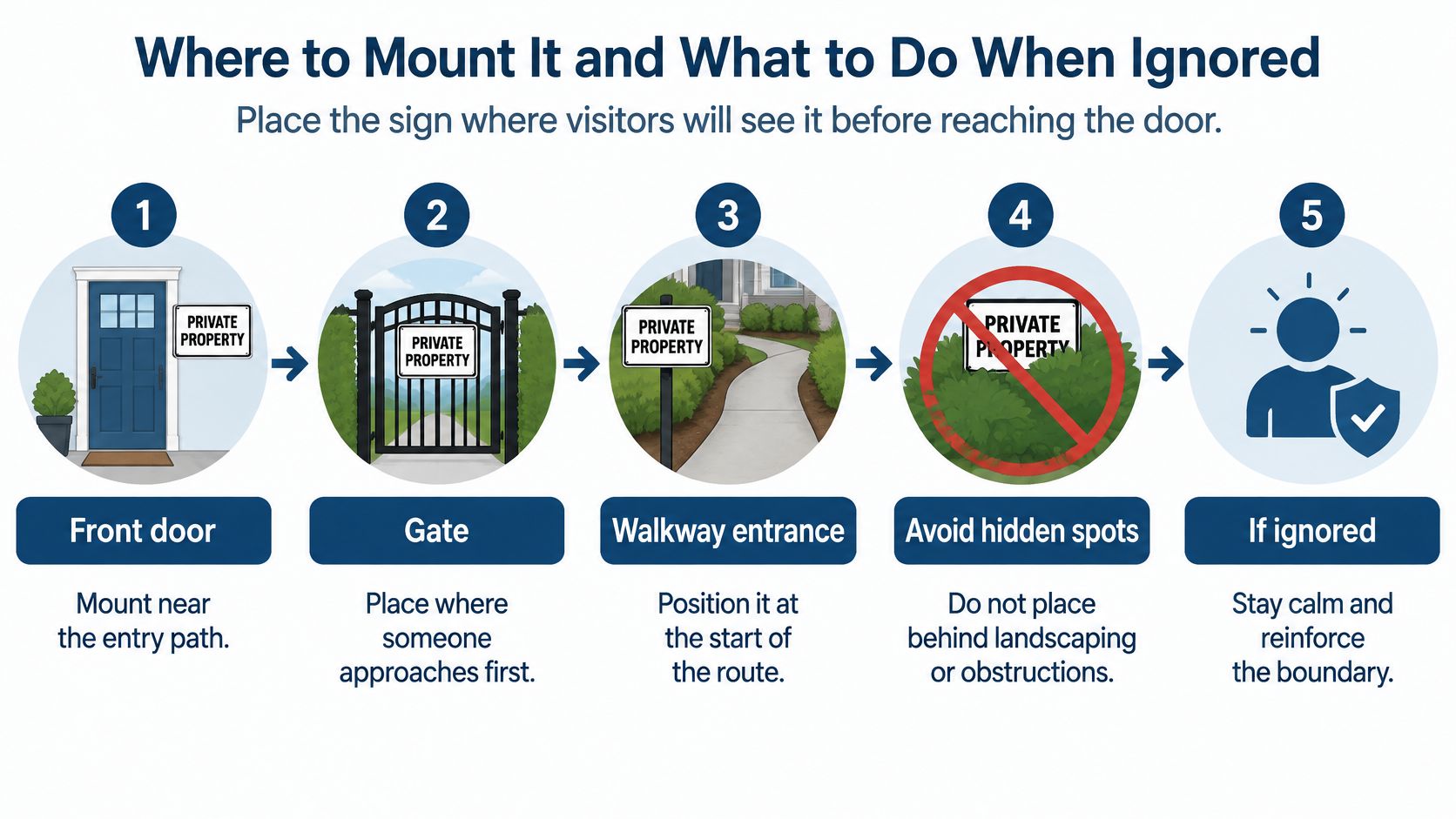
Florida's commercial-solicitation statute makes visibility from the approach part of its residential notice requirements. As a practical matter, an obscured notice also leaves your staff explaining a policy the visitor never had a reasonable opportunity to read.
Use a calm escalation protocol
- Stay behind the door if needed. You don't have to open it to deliver a refusal when doing so feels unsafe.
- Document what you can safely observe. Record the date, time, description, company name, and any permit information shown; don't pursue someone to complete the record.
- Make a clear request to leave. Keep your voice calm and avoid debating the product, the sign, or the visitor's interpretation of either.
- Use the local non-emergency channel for persistent conduct. Follow the reporting route named by your municipality where applicable.
- Reserve emergency services for threats or immediate danger. Prioritize safety over finishing the conversation.
For reception staff, a usable refusal is:
We don't accept unscheduled sales visits. Please leave the premises. Thank you.
Know whether your local process treats an ignored sign as an ordinance issue or requires a separate warning to leave. Don't tell staff that every unwanted visitor is automatically trespassing.
Make the boundary accessible
For apartments and gated communities, identify who can authorize signs in shared areas. For multilingual households, use language visitors can understand; where disability-related needs affect communication, consider an intercom, doorbell instruction, or other accessible contact method.
At a law office, designate who handles a persistent visitor so the receptionist isn't left improvising an enforcement policy beside a waiting client. Concise language and an accessible location are more useful than sarcasm followed by a threat nobody has checked.
Printable Templates and a One-Week Rollout
A sign can be polite, readable, and still leave room for an argument if its wording promises more than local rules allow. Treat these copy-ready starting points as practical drafts, not proof of legal compliance. Before printing, check any local lettering requirements and property rules. Use a matte finish, and make the page larger if the full message will not fit legibly. Smaller type is a poor trade for a sign nobody can read from the approach.
For an 8.5-by-11-inch layout with one-inch lettering, treat those dimensions as a design choice based on the residential specification discussed earlier, not a rule for every property. A longer message may need a larger panel or a separate notice.
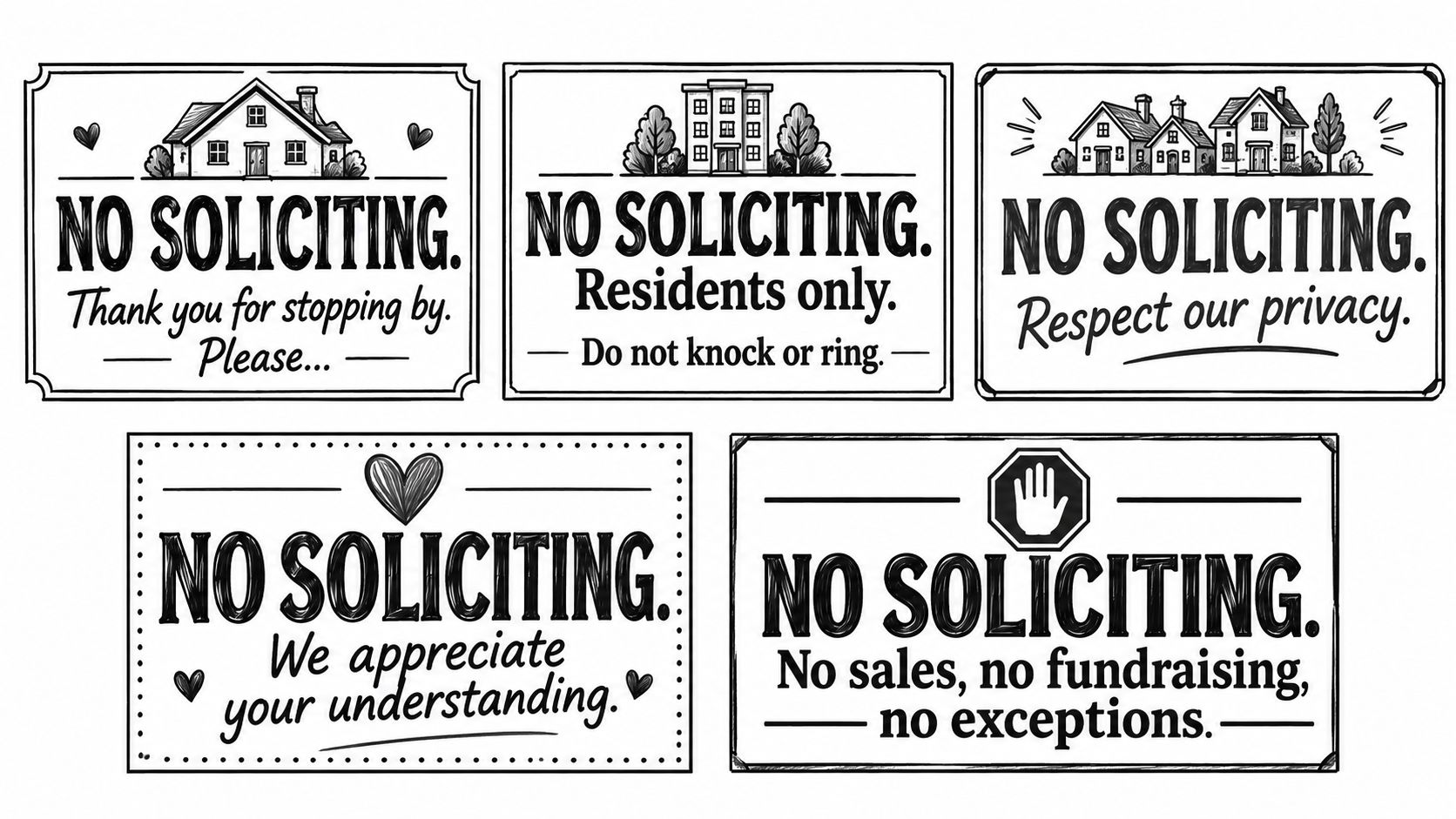
Standard house
NO SOLICITING.
Thank you for stopping by.
Please do not knock.
Deliveries and invited guests are welcome.
Use this at a home entrance when you want to discourage sales visits without turning away expected guests or deliveries. Check local requirements, and add any required private-property language before printing. A courteous line does not replace wording the local rule requires.
Apartment or condo building
NO SOLICITING.
Sales, donations and petitions are not welcome in this building.
Residents and their guests thank you.
This notice speaks for a shared building, so get management approval before posting it. Add the building name if it helps visitors identify where the rule applies. Confirm how local rules treat each listed activity, since a broad phrase may cover conduct the property does not intend to prohibit.
Gated community
NO SOLICITING.
Please contact the gate for resident access.
Solicitors must follow community rules.
Use this wording only if the gate has a real contact process. Add the telephone number or intercom instruction visitors need, then ask management to confirm that the notice matches the community's access policy and local requirements. A direction to contact the gate is useful only if someone can respond.
Bilingual home
NO SOLICITING / NO VENDEDORES.
Thank you for visiting.
Gracias.
This short version addresses sales visits without crowding the sign with parallel paragraphs. Check that both languages convey the boundary you intend, and keep any locally required wording. A translation should not be assumed to replace required text.
Law office reception
NO SOLICITING.
Thank you for visiting.
Solicitation is by appointment only.
Please check in at the front desk.
Use this where reception can check appointments and direct legitimate visitors. Add office hours separately if needed, and make sure the appointment policy matches what staff are expected to allow. A sign cannot make exceptions for staff; the reception process has to do that.
Put it into practice this week
- Choose the tone. Match the wording to the property and the interruptions you want to prevent.
- Clear the requirements. Check city code, property covenants, and landlord approval before ordering or printing.
- Print, mount, and test. Choose exterior-grade material outdoors, place the sign in the approach sightline, and read it from the sidewalk.
- Assign maintenance. Record installation and inspection dates, and name the person responsible for the annual check.
At a law office, reception still needs a process for visitors who ignore the sign. Give staff an appointment-checking procedure, a refusal script, and a named escalation contact. A confident clipboard is not a reason to send every visitor to a managing partner.
Staffline provides a dedicated legal support professional for reception administration, scheduling, and related work within the firm's systems. Virtual support can handle operational tasks, but it does not physically replace an on-site safety presence. Frontline provides live intake after hours, including lead qualification and follow-up. Keep that route clear for potential clients, even when reception turns away an unscheduled sales visit.
A good sign sets a courteous boundary; a consistent office process makes it usable. Attorney Assistant provides dedicated legal support staff and live intake to help firms build operational capacity. Firms can explore Attorney Assistant's Staffline and Frontline services for reception, staffing, and intake support.
Related Articles
Virtual Front Desk for Law Firms: What It Really Does
Learn what a virtual front desk does for law firms, how it compares to in-house reception, and how to roll one out without risking client confidentiality.

Virtual Case Manager Role, Duties, and Fit
See what a virtual case manager owns in records, discovery, liens, and file admin, plus metrics and when virtual beats hiring in-house.

Free Google Phone Number for Business: What Actually Works
Free Google phone number for business covers one user. Here is how to set one up, where it breaks for intake, and when to upgrade.