What Is Intake Analytics for Law Firms

TL;DR:
- Most law firms mistakenly believe their intake issues stem from low lead volume, but the real problem lies in failing to act on existing prospects. Intake analytics reveals that missed follow-ups and slow responses silently reduce conversion rates, emphasizing the importance of structured data and workflows. Effective use of intake data requires clear contracts, proper form design, and automated actions to improve client conversion and revenue.
Most law firms believe their intake problem is a lead volume problem. It rarely is. What is intake analytics and why does it matter? Because the answer reveals that most firms are losing revenue not from a shortage of prospects but from a failure to act on the ones they already have. Missed calls, slow follow-up, and inconsistent intake processes silently erode conversion rates every week. Intake analytics is the system that makes those failures visible and gives you a clear path to fix them before another case walks out the door.
Table of Contents
- Key takeaways
- What intake analytics actually means for law firms
- Why intake analytics fails in most law firms
- How to use intake analytics to drive conversions
- Comparing intake analytics tools and approaches
- Strategic steps to improve your intake analytics
- My honest take on where firms go wrong
- How Attorneyassistant helps firms turn intake data into signed cases
- FAQ
Key takeaways
| Point | Details |
|---|---|
| Intake analytics is not just counting leads | It measures quality, timing, conversion bottlenecks, and follow-up gaps to drive real decisions. |
| Data quality starts with form design | Structured intake fields prevent inaccurate reporting and enable reliable segmentation across cases. |
| Speed to first contact is everything | Lead score value drops sharply beyond 72 hours, making response time a direct revenue variable. |
| The intake contract prevents silent failures | Defining data ownership and workflow expectations stops process breakdowns before they cost you cases. |
| Analytics without workflow is useless | Every data insight needs a triggered action attached to it, whether that is a follow-up call, coaching, or retargeting. |
What intake analytics actually means for law firms
The intake analytics definition most firms work with is incomplete. They think it means tracking how many leads came in last month. That is not analytics. That is a headcount.
Intake analytics is the structured collection, measurement, and interpretation of data across every stage of your client intake process. It tells you where leads come from, how quickly your team responds, where prospects drop out, which intake staff convert at the highest rate, and which channels are sending you cases worth signing. Intake analytics is more than counting leads; it covers quality assessment, conversion bottlenecks, and resource allocation across the full intake cycle.
For law firms specifically, the core data points that matter most include:
- Lead source attribution: Where did this prospect find you? Organic search, paid ads, referrals, or directories?
- Intake timing: What time did the lead arrive, and how long before someone responded?
- Conversion rate by stage: How many calls became consultations? How many consultations became signed retainers?
- Follow-up touchpoints: How many contacts did it take to reach a prospect, and which methods worked?
- Case quality signals: Does the intake data reflect a case your firm can actually win and profitably serve?
The data types listed above only produce useful analysis when they are captured in structured formats. Drop-down fields outperform open text, enabling reliable segmentation and case quality analysis that open-ended responses can never deliver. This is the foundation of accurate intake data analysis. Without it, everything downstream is unreliable.
Why intake analytics fails in most law firms
Knowing the intake analytics definition is not enough. Most firms that invest in tracking their intake data still see no improvement in conversion. The reason is almost always the same: data without a decision attached is noise.
Effective intake analytics identifies coaching needs and underperforming channels. But when a firm manager reviews a dashboard once a month and takes no specific action, the data serves no operational purpose. The problem is not a shortage of metrics. It is a shortage of workflow connected to those metrics.
The second major failure point is form design. When intake forms use open-text fields instead of structured drop-downs, the data coming in is inconsistent. One staff member writes “car accident.” Another writes “MVA.” Another writes “auto.” These cannot be reliably grouped or analyzed. Poor intake design with open-text fields leads directly to inaccurate analytics and bad decisions made from that bad data.
The most expensive intake problem is not the one you can see on your dashboard. It is the process failure that never gets recorded because nobody defined who owned that step in the first place.
The third and most overlooked issue is the absence of an intake contract. Without defining the intake contract, workflows rely on assumptions. When ownership of a data field or a follow-up step is unclear, it falls through the cracks. Prospects go uncontacted. Cases get lost. The analytics look clean because the failure never made it into the system.
Pro Tip: Before auditing your intake metrics, audit your intake form. Every open-text field is a data quality risk. Replace it with a structured selection wherever possible.
The operational consequences stack up fast. Missed calls do not get logged. Follow-up gaps are invisible in the CRM. Speed-to-lead suffers because no alert triggers when a lead sits untouched. These are not technology problems. They are design problems that analytics alone cannot fix without the right workflow underneath.

How to use intake analytics to drive conversions
Understanding the importance of intake analytics is one thing. Knowing how to use intake analytics operationally is where firms actually change their numbers.
The practical application starts with lead scoring built on combined signals. A prospect who called during business hours, came from a high-value referral source, described a case type your firm handles regularly, and responded to your first follow-up text within an hour is a very different lead than one who submitted a web form at 2 a.m. with minimal case detail. Your intake analytics should score and prioritize these differently and trigger different responses.
Here is a practical framework for activating intake data:
- Define scoring criteria upfront. Score leads by recency of contact, relevance of case type to your practice area, and fit with your firm’s ideal client profile.
- Assign SLAs to lead tiers. High-score leads should receive a call within 15 minutes. Mid-tier leads within two hours. Set these as hard rules, not guidelines.
- Automate trigger-based follow-up. When a lead scores above a threshold, it automatically enters a follow-up cadence. No human has to remember to call.
- Use retargeting signals. Prospects who visited your site, opened an intake form, and did not submit are warm signals. Your analytics should surface them for outbound contact.
- Review at the account level, not just the form-fill level. Account-level signals better predict pipeline success than simple MQL counts from individual form submissions.
Statistic: Lead score decay beyond 72 hours dramatically reduces conversion likelihood. If your firm’s average response time is over 24 hours, you are losing cases to the firm that called first.
The real value of intake data analysis comes from combining multiple signals and automating responses rather than reviewing data manually once a week. Speed and coordination are the two levers that move conversion rates. Analytics gives you the visibility. Workflow gives you the speed.
Comparing intake analytics tools and approaches
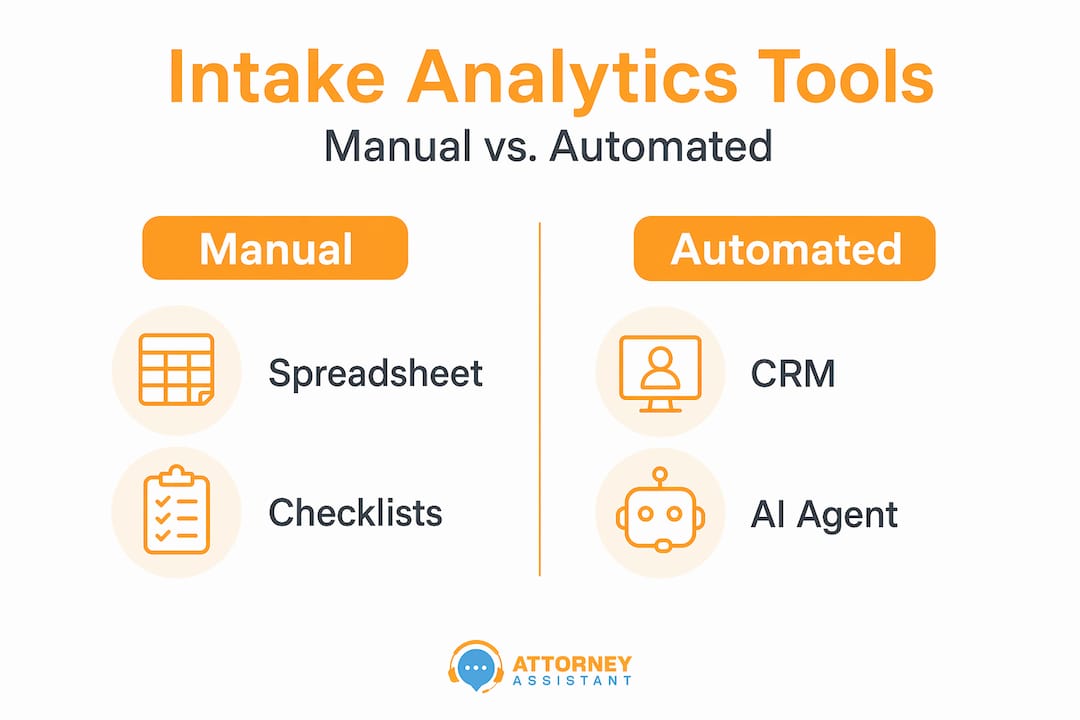
Not every firm needs the same solution. The right intake analytics tools depend on your volume, staff size, and how much operational infrastructure you already have. Here is a realistic comparison.
| Approach | Strengths | Weaknesses |
|---|---|---|
| Manual spreadsheet tracking | Low cost, easy to set up | No automation, data entry errors, no real-time alerts |
| CRM with basic intake fields | Centralized data, some reporting | Requires clean data input discipline, limited scoring |
| CRM plus intake automation | Triggers follow-up automatically, improves speed | Higher cost, requires proper configuration and intake contract |
| AI-powered intake agents | Compresses signal-to-action time, reduces staff burden | Requires quality data input and defined workflows to function correctly |
AI agents compress steps, automate triage, and allow humans to focus on approvals and high-stakes decisions. For high-volume personal injury or mass tort firms, this can be the difference between converting 30% and 60% of inbound leads.
The trap most firms fall into is buying a tool without fixing the intake contract first. A sophisticated CRM fed with inconsistent, open-text intake data produces sophisticated garbage. Explicit intake contracts prevent process failures by defining data ownership and workflow expectations before any tool touches the data. The tool is the last decision, not the first.
For firms just starting out, a structured intake form connected to a basic CRM with mandatory drop-down fields and a clear follow-up SLA will outperform an expensive platform with poorly designed intake forms. Start with data quality. Add complexity only after your foundation is solid.
Strategic steps to improve your intake analytics
Improving intake analytics is not a software purchase. It is a process redesign. These steps give you a practical path forward.
- Redesign your intake forms. Replace every open-text field that can be standardized with a structured drop-down. This single change improves the accuracy of all downstream intake data analysis immediately.
- Write your intake contract. Define who owns each data field, who is responsible for each follow-up step, and what happens when a lead reaches each scoring tier. Document it. Make it operational.
- Set time-to-first-touch targets. For most practice areas, the target should be under 15 minutes for warm inbound leads. Measure this weekly, not monthly.
- Create coverage rate benchmarks. Track what percentage of inbound leads received at least three follow-up attempts before being marked unresponsive. If that number is below 90%, you have a follow-up gap.
- Use intake data for staff coaching. If one intake specialist converts 45% of consultations to signed retainers and another converts 20%, that gap is visible in your analytics. Use it for targeted training, not annual reviews.
- Audit your data quality quarterly. Pull a sample of intake records and check for missing fields, inconsistent entries, and leads with no follow-up logged. Data rot is real and it compounds.
Pro Tip: The coverage rate metric is underused. It tells you not just whether leads converted but whether every lead was actually worked. A 95% coverage rate with a 30% conversion rate is a pricing or fit problem. A 50% coverage rate with a 30% conversion rate is an operational problem. Know which one you have.
The importance of intake analytics is not abstract. Every percentage point improvement in follow-up coverage and response speed translates directly to cases signed. This is measurable, trackable, and fixable.
My honest take on where firms go wrong
I have worked with law firms across practice areas and the pattern is almost identical. When intake conversion is low, the first instinct is to spend more on marketing. More leads means more cases, right? In my experience, that logic almost always makes the problem more expensive, not smaller.
What I have found is that most firms do not have a lead shortage. They have a follow-up failure and a data blindspot. They cannot see the failure because their intake data is too inconsistent to surface it clearly. And because they cannot see it, they do not fix it.
The uncomfortable truth about the importance of intake analytics is that it forces you to look at things that reflect poorly on internal operations. That is uncomfortable. It is much easier to buy more Google Ads than to confront the fact that your team is not calling leads back within an acceptable timeframe.
What actually drives revenue increases through better intake analytics is not a better dashboard. It is a better intake contract, cleaner form design, and a workflow that removes human memory from the equation entirely. When the system triggers the follow-up automatically, when the data is clean enough to segment by case value and source quality, and when every intake specialist knows their conversion rate, something changes. The work becomes measurable. And measurable work improves.
The firms I have seen do this well are not the ones with the fanciest tools. They are the ones who took the time to define what good intake looks like, measured against that standard, and built workflows that made the right behavior the default behavior.
— Nicole
How Attorneyassistant helps firms turn intake data into signed cases
If your firm is ready to move from data collection to actual conversion improvement, Attorneyassistant is built for exactly that. Most firms we work with are not short on leads. They are short on follow-through, fast responses, and consistent intake processes that actually capture and act on the right data.
Attorneyassistant handles lead follow-up and intake workflows so your team stops losing cases to slow response times and missed calls. From intake and reception support to administrative workflows, the services are designed to fix the operational gaps that analytics makes visible. You can also explore free tools for law firms to assess your current intake performance before committing to anything. When you are ready to talk through what is leaking revenue in your firm specifically, book a call to get a direct conversation about what to fix first.
FAQ
What is intake analytics in a law firm?
Intake analytics is the structured measurement of your law firm’s lead and client intake process, covering lead sources, response times, conversion rates, and follow-up activity. It goes beyond counting leads to identify where cases are lost and why.
What data does intake analytics track?
Intake analytics tracks lead source, time-to-first-touch, follow-up attempts, consultation conversion rates, case type fit, and intake staff performance. Structured intake forms with drop-down fields are required to make this data reliable.
How do you use intake analytics to improve conversions?
You use intake analytics by scoring leads on recency, case fit, and source quality, then triggering automated follow-up actions based on those scores. Response time under 24 hours is critical since lead value drops sharply beyond 72 hours.
Why is the intake contract important for analytics?
The intake contract defines who owns each data field and follow-up step. Without this definition, process failures go unrecorded, analytics become inaccurate, and cases fall through the gaps silently.
What is the most common intake analytics mistake law firms make?
The most common mistake is collecting data without attaching decisions to it. Analytics must guide next actions like coaching, follow-up triggers, or marketing adjustments. Data that is reviewed but not acted on produces no improvement in conversion.
Recommended
Related Articles

Productivity Tips for Law Offices That Actually Work
Unlock your firm's potential with effective productivity tips for law offices. Improve workflows and reclaim billable hours today!

Top 5 executiveassistantinstitute.com Alternatives 2026
Explore 5 executiveassistantinstitute.com alternatives to help you decide on the best resources for enhancing your administrative skills and career.

What is intake conversion? A personal injury firm's guide
Discover what is intake conversion and why it’s crucial for personal injury firms. Learn to boost client sign-ups and grow your practice!