Why Response Time Affects Cases: A 2026 Guide
Response time is the single most controllable variable in whether a case gets solved, a client gets signed, or a lead goes to a competitor. Across law enforcement, legal intake, and customer service, the gap between fast and slow response is not a matter of courtesy. It determines outcomes.
Here is what the evidence shows:
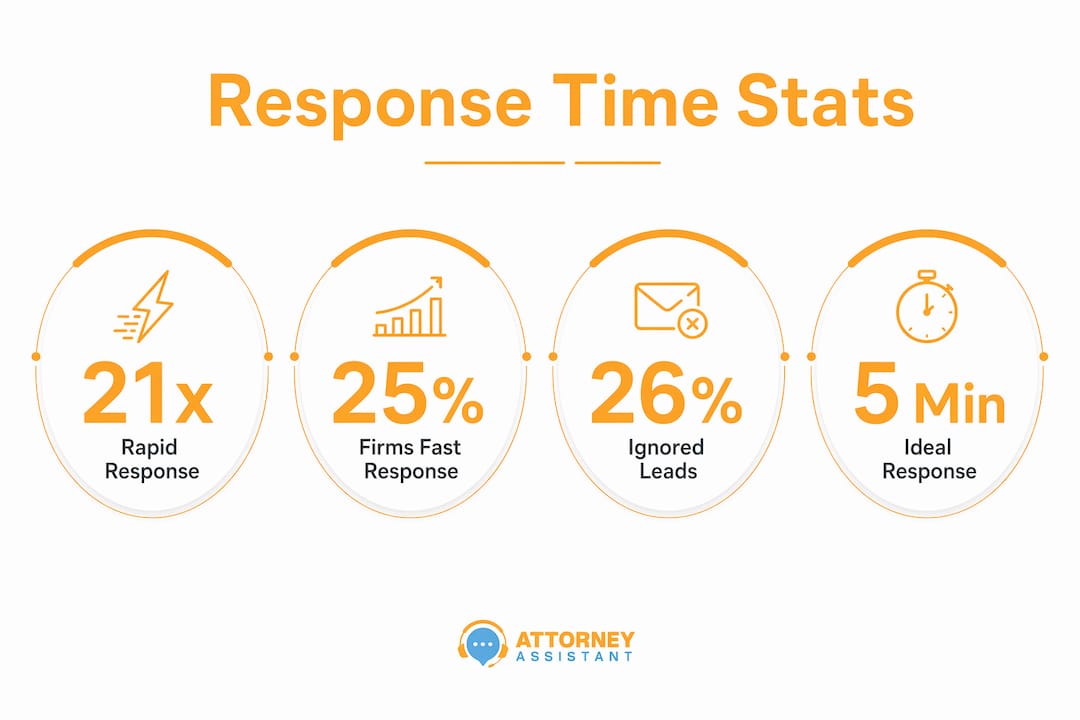
- Law firms that respond within 5 minutes are 21 times more likely to qualify a lead than firms that wait 30 minutes.
- 38% of legal inquiries arrive outside business hours, and firms without after-hours coverage lose more than 90% of them.
- Harvard Business Review research found companies contacting leads within one hour were nearly seven times more likely to make meaningful contact than those who waited longer.
- In policing, faster response preserves witness memory, slows evidence degradation, and reduces the window for suspects to flee.
- In customer service, delayed responses erode brand trust and accelerate client attrition.
The psychological driver is straightforward. Whether a crime victim is trying to recall a license plate or a personal injury prospect is deciding which attorney to call back, the window of peak motivation and memory is short. Speed does not just improve efficiency. It catches people while the situation is still actionable.
How police response time shapes crime clearance rates
Faster police response directly improves crime clearance rates, and the research from Bowdoin’s ungated archive on police response time makes the mechanism clear: each increment of delay reduces the probability of clearing a crime, with theft-related offenses showing the steepest drop-off.

Two things degrade simultaneously when response slows. First, witness memory. Victim and witness recall deteriorates rapidly in the minutes and hours after an incident. Officers arriving within the first 30 minutes are significantly more likely to get usable identifications and accurate scene descriptions. Second, physical evidence. Footprints get walked over, surveillance footage gets overwritten, and suspects put distance between themselves and the scene.
| Response Window | Effect on Clearance Likelihood | Primary Mechanism |
|---|---|---|
| Under 5 minutes | Highest clearance probability | Witnesses present, evidence intact |
| 5–30 minutes | Moderate clearance probability | Memory beginning to fade, scene partially disturbed |
| 30–60 minutes | Reduced clearance probability | Witness recall degraded, suspects may have fled |
| Over 60 minutes | Lowest clearance probability | Evidence compromised, scene cold |
Crime type also matters. Violent crimes with witnesses benefit most from rapid response because human testimony is the primary evidence. Property crimes depend more on physical trace evidence, which degrades on its own timeline regardless of witness availability.
Legal and procedural constraints compound the problem. Dispatch protocols, jurisdictional boundaries, officer availability, and mandatory documentation requirements all add time between the call and the arrival. Departments that have reduced these friction points through GPS-based dispatch, real-time unit tracking, and pre-cleared authorization protocols consistently outperform those still running manual routing.
How response time influences customer satisfaction and brand trust
Speed of response shapes how clients perceive competence before they have seen a single piece of work product. A prospect who submits a web form at 9 PM and hears nothing until the next afternoon has already formed an opinion about that firm’s attentiveness. That opinion is hard to reverse.
The consequences of slow response in service industries are concrete:
- Clients who wait more than 24 hours for a response are far more likely to have already contacted a competing firm.
- Delayed responses signal disorganization, which raises doubt about whether the firm can handle a complex case.
- In legal intake specifically, legal consumers are more sensitive to response time than to pricing, firm reputation, or attorney credentials.
- The first firm to respond meaningfully wins the client in the majority of competitive intake situations.
- Slow follow-up after an initial inquiry compounds the damage, because the prospect’s urgency has already peaked and begun to fade.
The psychological factor at work is urgency compression. People seeking legal help are rarely browsing casually. A DUI arrest, a divorce filing, a workplace injury. These are crisis moments. The attorney who responds while the prospect is still in that heightened state captures the relationship. The one who responds 18 hours later is calling into a different emotional context entirely.
For law firms, responsive client communication also affects what happens after the case is signed. Clients who experienced a fast, organized intake process tend to refer more and complain less. The intake experience sets the tone for everything that follows.
Practical strategies for improving response times
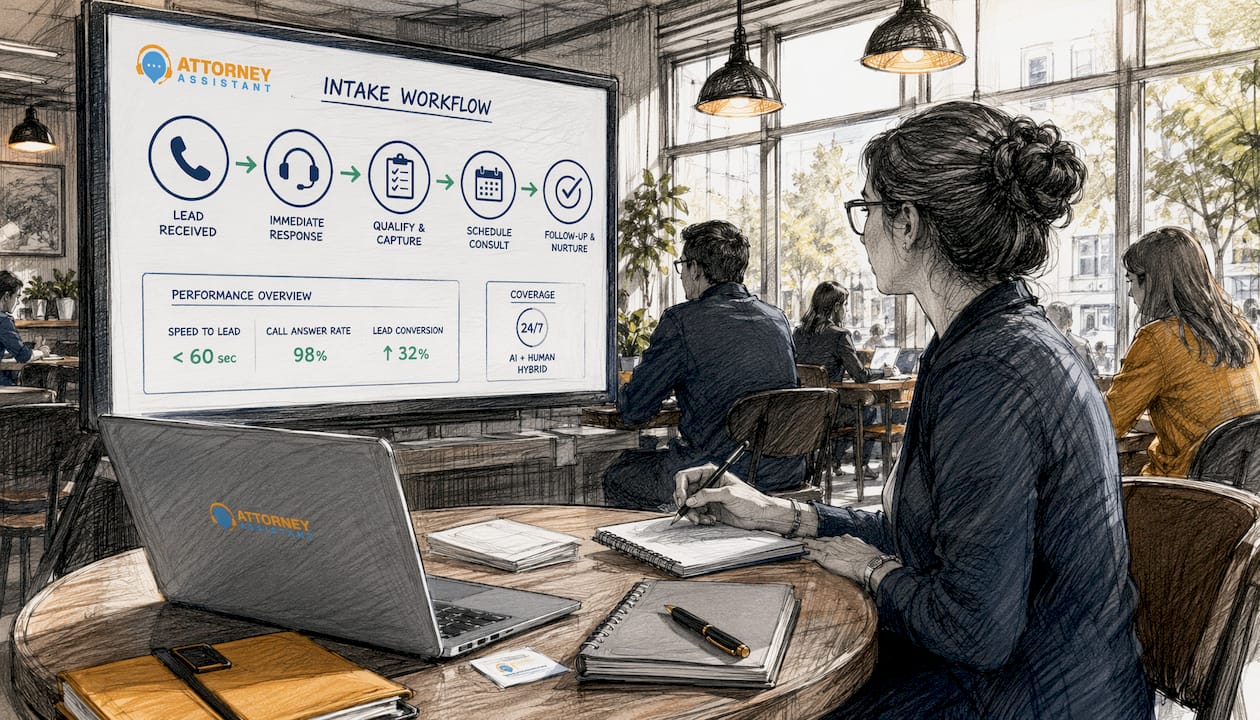
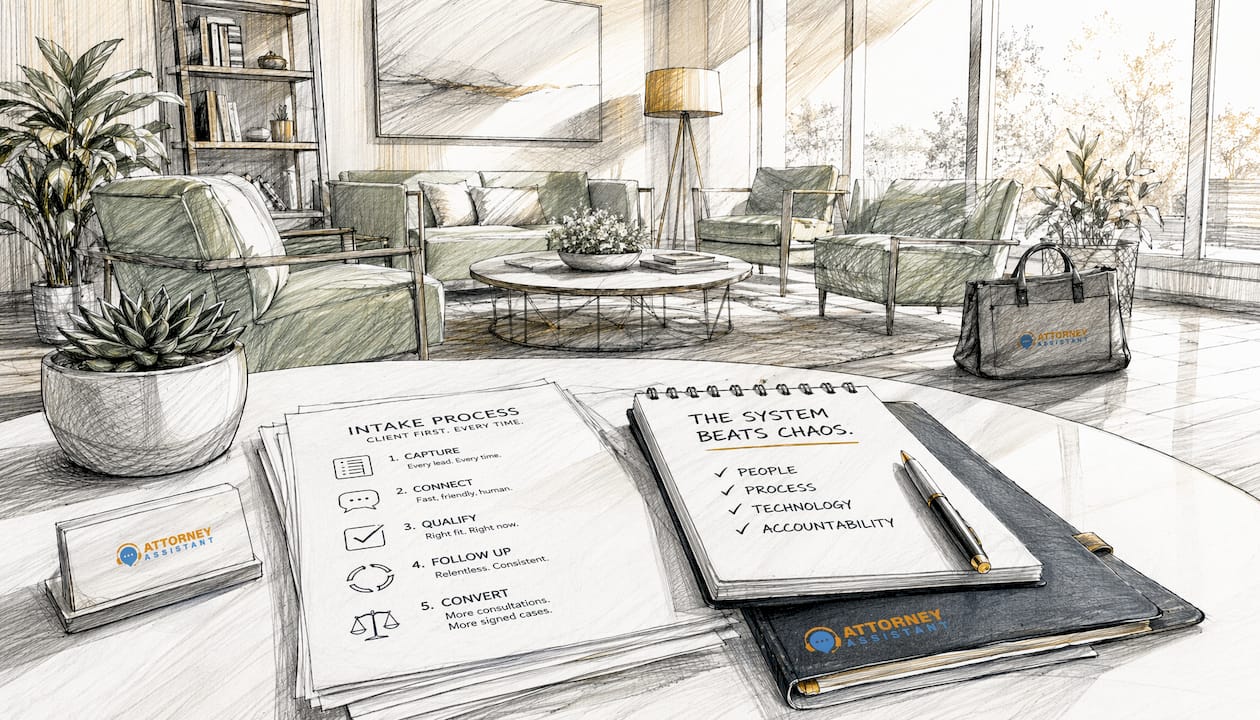
The firms hitting five-minute response benchmarks are not doing it through willpower. They have built systems that remove the human delay from the first three stages of intake: acknowledgment, qualification, and scheduling.
Operational and technology-based approaches:
- Automate the first acknowledgment within 60 seconds across every channel (web form, phone, SMS, email), so no inquiry sits unacknowledged while staff are occupied.
- Run real-time conflict checks in parallel with qualification, not sequentially, cutting intake processing from days to minutes.
- Integrate live calendar availability into the intake flow so prospects can schedule a consultation immediately without a back-and-forth exchange.
- Build 24/7 coverage using an AI-plus-human hybrid model for after-hours inquiries, which account for 38% of all legal leads.
- Track response time by channel and set alerts when any channel exceeds the five-minute threshold.
Staffing and training approaches:
- Define clear escalation paths so intake staff know exactly when to pull in an attorney versus handle the contact themselves.
- Train intake staff on UPL-safe scripts that gather qualification information without crossing into legal advice.
- Monitor response time metrics weekly, not monthly. Problems compound fast when they go undetected.
Cost-benefit reality: The Hennessey Digital 2025 study found that 25% of law firms now respond in under 5 minutes, up from 13% four years ago. The firms driving that shift are not spending more on marketing. They are recovering cases from leads they were already generating.
Pro Tip: Before investing in any new intake technology, log your actual response times across every channel for 30 days. Most firms discover their real average is two to three times longer than their self-reported estimate. That baseline is where the ROI calculation starts.
How faster response helps law firms convert and retain cases
The revenue math on response time is direct. According to the Clio Legal Trends Report, firms responding within one hour are 7 times more likely to qualify a lead compared to firms that respond after 30 minutes. Respond within 5 minutes and that multiplier reaches 21 times. The median law firm response time sits at 13 minutes, meaning most firms are already losing ground to the firms that have solved this.
Attorney Assistant’s intake model addresses the specific failure points that create this gap:
- Near-100% call answer rates eliminate the missed-call revenue leak that most firms never measure.
- Automated acknowledgment within 60 seconds, combined with real-time conflict checks, compresses intake processing from days to minutes.
- 24/7 coverage captures after-hours leads that would otherwise go unanswered and convert to a competitor.
- High-frequency follow-up sequences prevent qualified leads from going cold between first contact and signed retainer.
The downstream effects extend beyond the initial conversion. Clients who experience a fast, organized intake process have higher lifetime value, generate more referrals, and are less likely to disengage mid-case. The intake experience is not administrative. It is the first impression of how the firm operates under pressure.
“Firms that respond to leads very quickly capture clients at a substantially higher rate than firms responding the next business day.” — Clio 2025 Legal Trends Report
Attorney Assistant also handles the compliance architecture that makes fast automated response legally safe. TCPA obligations under 47 U.S.C. § 227, ABA Model Rule 5.5 on unauthorized practice of law, and Rule 1.7 conflict requirements are built into the intake workflow, not bolted on afterward. Speed and compliance are not in tension when the system is designed correctly from the start. For firms looking to close the intake response gap, the operational fix is available.
What delayed response actually costs
Delay is not a neutral outcome. Every hour a lead sits unanswered, the probability of converting it drops. Every missed call in a competitive practice area is a case that goes to whoever picks up next.
In customer service industries broadly, delayed responses drive measurable client attrition. The pattern in legal intake mirrors this: according to Clio, one-third of prospective clients contact a competing firm when they do not receive a response within 24 hours. For firms with response times exceeding 48 hours, that attrition rate climbs past 50%.
The financial consequence compounds. A firm spending $15,000 per month on marketing and generating 150 leads is paying a real cost per lead. When intake delays cause a meaningful percentage of those leads to go cold, the cost per signed case rises even if the marketing itself is performing well. The firm blames the campaign. The real problem is the gap between lead arrival and first contact.
26% of law firms did not respond to online leads at all in 2024. That is not a marketing failure. It is an operational one, and it is entirely fixable.
Case studies that show what response time variation produces
The Hennessey Digital annual lead form studies provide some of the clearest longitudinal evidence on this. In 2021, only 13% of law firms responded to online leads in under 5 minutes. By 2025, that figure had risen to 25%. The firms that made that shift did not change their marketing. They changed their intake infrastructure.
The competitive implication is direct. A prospective client who submits inquiries to three law firms simultaneously retains the first firm to respond meaningfully in the majority of cases. The firms that moved from a 25-minute median response to under 5 minutes did not just improve a metric. They started winning cases that previously went to faster competitors.
Criminal defense intake shows the most extreme version of this dynamic. When a family member has just been arrested, the decision to retain counsel happens within hours. A firm that answers immediately, gathers the key facts, and schedules a consultation in the same call wins that case. A firm that returns the call the next morning is almost always too late. The speed-to-lead data across practice areas consistently shows criminal defense and DUI as the categories where response time has the highest direct impact on signed cases.
How technology reduces response time in practice
The operational gap between a 25-minute response and a 5-minute response is almost entirely a technology and workflow problem. The firms closing that gap are using specific tools and architectures, not just working harder.
Automated intake platforms handle the first three stages of the funnel without attorney involvement: acknowledgment, qualification, and scheduling. An automated acknowledgment sent within 60 seconds confirms receipt, sets expectations, and begins gathering qualification information. A real-time conflict check runs in parallel. Calendar integration offers a consultation slot immediately, eliminating the scheduling back-and-forth that accounts for much of the average 3-day response time documented in the Clio data.
Communication channel coverage matters as much as speed. Web forms, phone, SMS, and email each require a separate response path. A firm that handles web forms quickly but lets phone calls go to voicemail is still losing a significant share of its leads. The Hennessey Digital 2025 study noted that text response has grown but remains subject to TCPA compliance requirements, meaning firms need explicit consent frameworks before deploying SMS automation.
For law enforcement, the technology parallel is GPS-based dispatch, real-time unit availability tracking, and pre-authorized response protocols that remove manual routing delays. Departments using these systems consistently achieve faster response windows than those relying on radio dispatch and manual unit assignment.
Legal and procedural constraints that slow response times
Speed does not operate in a vacuum. In both law enforcement and legal intake, procedural requirements create floors below which response time cannot drop without creating compliance risk.
For law firms, the primary constraints are:
- ABA Model Rule 5.5 prohibits automated systems from providing legal analysis or advice, which means acknowledgment scripts must be carefully reviewed to avoid unauthorized practice of law exposure.
- TCPA compliance under 47 U.S.C. § 227 requires explicit consent before sending automated SMS messages, which affects how firms deploy text-based acknowledgment systems.
- Rule 1.7 conflict checks must be completed before an attorney engages substantively with a prospect, which is why real-time automated conflict screening is a prerequisite for fast intake, not an optional add-on.
For law enforcement, mandatory documentation requirements, jurisdictional dispatch protocols, and officer safety procedures all add time that cannot be eliminated without creating different risks. The practical goal is not to remove these constraints but to reduce the friction in every step that does not carry a compliance requirement.
The firms and departments that achieve the fastest response times treat compliance as a design constraint, not an obstacle. They build the required checks into the automated workflow so they run in parallel with other steps rather than sequentially after them.
Key Takeaways
Response time directly determines case outcomes across law enforcement, legal intake, and customer service, and the gap between fast and slow response is measurable in clearance rates, signed cases, and client retention.
| Point | Details |
|---|---|
| 5-minute rule in legal intake | Firms responding within 5 minutes are 21x more likely to qualify a lead than those waiting 30 minutes. |
| After-hours coverage gap | 38% of legal inquiries arrive outside business hours; firms without automation lose over 90% of them. |
| Witness memory decay | Police arriving within 30 minutes significantly improve suspect identification before recall degrades. |
| Attrition from delay | One-third of prospects contact a competing firm when they receive no response within 24 hours. |
| Compliance as design | TCPA, ABA Rule 5.5, and Rule 1.7 conflict checks must be built into intake workflows, not added after. |
FAQ
Why does response time matter in legal cases?
Response time determines whether a prospect signs with your firm or a competitor. Firms responding within one hour are 7 times more likely to qualify a lead than those responding after 30 minutes.
Why are police response times often slow?
Mandatory dispatch protocols, jurisdictional boundaries, documentation requirements, and limited officer availability all add time between a call and arrival. Manual routing systems compound the delay in departments that have not adopted GPS-based dispatch.
What causes slow application response time in legal intake?
The most common causes are manual intake workflows, no after-hours coverage, sequential rather than parallel processing of conflict checks, and no automated acknowledgment system. The result is a median response time of 13 minutes across the industry, with 26% of firms not responding at all.
What does high response time mean for a law firm’s revenue?
It means leads are leaking. A firm with slow intake is paying to generate leads that go to faster competitors. According to Clio, one-third of prospects contact another firm when they do not hear back within 24 hours, and that attrition climbs past 50% beyond 48 hours.
How can law firms realistically hit a 5-minute response benchmark?
Automated acknowledgment, real-time conflict checks, and calendar integration handle the first three stages of intake without attorney involvement. Attorney Assistant’s lead follow-up system is built specifically to close this gap for law firms that are currently losing cases to slower competitors.
Most firms already have the leads they need to grow. The problem is that those leads are hitting an intake process that is too slow, too inconsistent, or simply not there after 5 PM. If you want to see exactly where your firm is losing cases, book a call with Attorney Assistant and we will walk through your current intake numbers together.
Recommended
Related Articles

Why Client Response Time Matters for Law Firms
Discover why client response time matters for law firms. Improve satisfaction and case acquisition with rapid replies to inquiries.

White Glove Support for Law Firms
Discover how white glove support transforms law firm intake and operations. Learn the metrics, staffing models, and workflows that actually sign cases.

10 Business Finance Course Options for Law Firms
Compare 10 business finance course options by level, format, workload, and law-firm relevance, then choose the right fit for your role and goals.