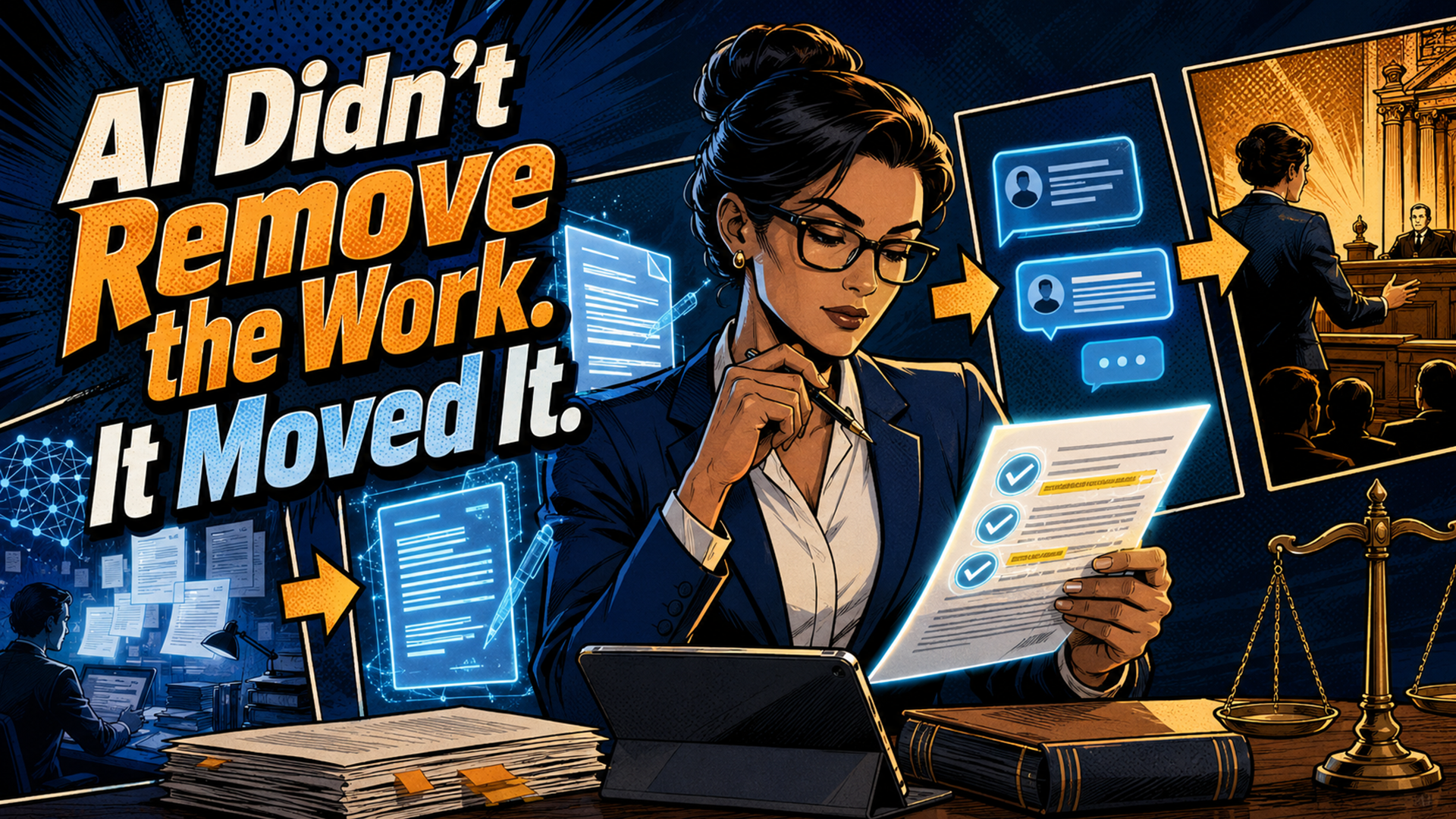
What AI is really changing in the legal system, and the cost most firms are not pricing in.
In 2023, a New York court sanctioned two lawyers for filing a brief full of cases that did not exist. ChatGPT had invented them. The legal world treated it as a cautionary oddity. Surely no careful lawyer would ever do that.
That assumption was wrong.
I see this from two angles most people do not get to watch at the same time. I run a personal injury and workers' compensation firm, Ethen Ostroff Law, where we handle a high volume of injured clients across Pennsylvania and New Jersey. I also founded Attorney Assistant, which builds AI-assisted intake and operations for law firms. One side is the courtroom. The other is the back office. AI is changing both, and not in the way the headlines suggest.
The biggest myth is that AI removes legal work. It does not. It moves it.
The fake-citation problem did not go away. It scaled.
Damien Charlotin, a researcher who teaches at HEC Paris, started tracking court decisions that involve AI-fabricated material. His database now holds more than 1,600 of them, and roughly 90 percent landed in 2025. Early that year he was adding about two cases a week. By December he was adding five or six a day.
The technology did not get more honest. Adoption grew, and more people started trusting the output without checking it.
Courts have stopped being patient. Early sanctions ran from $1,500 to $5,000. Now we are seeing fines of $15,000, $30,000, and in one case nearly $60,000 in combined penalties, plus bar referrals and mandatory training. One federal judge removed every lawyer from a case after fabricated citations turned up on both sides. The grace period is over.
AI widens access and clogs the courts at the same time
Both things are true, and they are connected.
The Legal Services Corporation found that low-income Americans get inadequate or no help for 92 percent of their serious civil legal problems. AI is the first tool that explains the law in plain language, at 2 a.m., for free. That is real access, and it matters.
But access without judgment floods the system. A study of federal courts found that self-represented filers generated roughly 48 percent more docket activity in simple cases once AI tools became widely available. There is a word forming for what happens next: cogency-washing. A chatbot takes a weak or confused claim and dresses it up as an authoritative filing. The claim is still weak. It just takes the court longer to see that.
What is actually changing in legal work
Research and first drafts changed first and changed most. Contract analysis and document review are right behind. Discovery has used machine assistance for years, so the leap there is smaller. In operations, intake and client communication are moving fastest.
What has not changed is judgment. Knowing which argument wins, which procedure controls, which fact actually matters. AI does not do that. It produces text that looks like it did.
Here is the part most firms miss. AI shortens production and lengthens verification. It writes the draft faster, then hands you a new obligation to check everything before it leaves the building. If you only measure the time saved on drafting and ignore the time added to checking, the math looks better than it actually is.
AI shortens production and lengthens verification. Most firms only measure the first half.
The verification burden shows up before the courtroom
The sanctions make headlines because a judge catches the error and attaches a number to it. But that is where the failure becomes visible, not where it starts.
It starts at intake and client communication. That is the highest-volume, lowest-supervision surface in any firm. It is where AI touches the most people the earliest, and where a wrong answer is cheap to produce and easy to miss. By the time something reaches a court filing, the mistake already happened upstream, usually in a conversation nobody was checking.
We built Attorney Assistant around that order. AI carries the front-line volume. A human owns anything that commits the firm or the client. I see the same thing every day at my own firm. The verification burden does not begin at the courthouse. It begins at the first conversation.
How to use AI without getting burned
Treat AI like a junior associate whose work always gets checked. ABA Formal Opinion 512, issued in 2024, already spells out the duties: competence, confidentiality, supervision, communication, and reasonable fees. In practice that means a written AI policy, a verification step before anything is filed, a record of what was checked and who approved it, and a hard rule against pasting client confidences into public tools.
And do not assume the expensive legal-grade tools are safe just because they cost more. A Stanford study of the leading legal research products found they still produced wrong or unsupported answers between 17 and 33 percent of the time, well above what their marketing claimed.
There is a quieter cost here too. Judgment used to get built by doing the grunt work: reading the bad cases, writing the weak draft, getting it marked up in red. If AI does the first pass and a senior lawyer does the final check, the middle disappears, and the middle is where judgment formed. The firms that take this seriously are making junior lawyers verify AI output line by line instead of generating it. Verification is the new apprenticeship.
The bottom line
AI will not replace lawyers. Someone has to be accountable, and software cannot be sanctioned or disbarred. What AI does is move the work. It shifts effort from producing to verifying, and verification is harder to see, harder to bill, and easier to skip. The firms that win with AI are not the ones that produce the fastest. They are the ones that build a system for checking what the machine produced.
If your firm is trying to figure out where AI belongs in your intake and operations, and where a human still has to own the outcome, that is the problem we solve at Attorney Assistant.

How Much Revenue Are You Leaving on the Table?
See how much missed revenue poor intake is costing your firm every month.
You're currently missing out on an estimated
$0 / month
That's 0 leads slipping through the cracks every month.
Related Articles
Medical Records Coordinator: What the Role Actually Does
A medical records coordinator manages records retrieval, summaries, billing, and liens for law firms. Learn duties, KPIs, and when to outsource vs hire.
Macs for Lawyers: The Hardware and Compatibility Guide
A practical guide to Macs for lawyers covering hardware choices, software compatibility, security tradeoffs, and recommendations by firm size and workflow.

Business Telephone Answering Service for Law Firms
How a business telephone answering service works for law firms, including 24/7 intake, qualification, warm transfers, pricing models, and what