Answering Service for Business: A Practical Guide for 2026

Your receptionist is helping a client, an attorney is in court, and another prospective client is calling the number on your latest campaign. The phone rings until it stops. Somewhere, a report will count that as a marketing lead. Nobody has established whether it became a conversation.
An answering service for business fills a coverage gap, but law firms need to ask what happens after someone picks up. A name and number, a qualified consultation, and a signed retainer are different outcomes. Judge the model by the matters it helps your firm sign and the work required to carry those matters forward, not by how pleasantly someone says hello.
Table of Contents
- Your Options for Business Call Coverage Compared
- How Fast Response Decides Who Gets the Case
- What Should Happen After the Phone Is Answered
- Confidentiality and Consent Rules to Require
- How to Test a Provider Before You Sign
- Confirm Your Coverage Gap This Week
Your Options for Business Call Coverage Compared
A business answering service is any added resource that picks up calls your team can't take, with models differing in who answers, when they're available, and what the caller receives.
Answering service models compared
| Option | Who answers | Hours covered | What the caller gets | Best fit | Typical pricing basis |
|---|---|---|---|---|---|
| Voicemail | Nobody | Whenever no one is free | A recording and maybe a callback | Firms with very low inbound call volume | Often bundled with the phone line |
| Message-taking answering service | Contracted operator | Set hours or 24/7 | Name, number and a short note | Overflow for non-urgent calls | Per call, per minute or monthly plan |
| In-house receptionist | Staff member on payroll | Business hours only | Full conversation, but only while on shift | Firms with steady daytime volume | Salary, benefits and payroll taxes |
| Live intake team (Frontline model) | Trained intake specialists | 24/7, including nights, weekends and holidays | Qualification, follow-up, warm transfers and retainer signing | Firms that need inbound leads converted into consultations | Action-based credits; confirm scope and pricing during discovery |
| AI receptionist | Automated system | 24/7 | Scripted routing and answers, limited judgment on case facts | Simple routing and triage with attorney review | Often subscription or per-minute |
Message-taking prevents an unanswered ring, but it postpones intake until someone calls back. It's a reasonable overflow option for routine inquiries, not a complete conversion process.
An in-house receptionist can learn your people and procedures closely, but one employee covers a shift, not the entire calendar. Automated routing handles predictable requests; unusual case facts need a defined human handoff rather than increasingly creative answers.
Frontline is Attorney Assistant's live intake team, not an answering service: it goes beyond messages by qualifying callers, following up, and signing appropriate matters under the firm's criteria.
Count internal labor, too
Using attorneys as the fallback front desk is an expensive staffing decision disguised as helpfulness. In its historical 2017 Legal Trends findings, Clio reported that lawyers averaged 2.3 hours of an eight-hour workday on billable tasks.
The pricing column describes billing methods, but the fair comparison is total monthly cost against the value of a matter a missed call would've lost. Include internal callback work, supervision, and duplicate data entry, not just the invoice.
Selection rule: Choose coverage around when calls arrive and what must happen before the caller hangs up.
If the gap is administrative capacity, more reception coverage won't clear it. Staffline supplies a dedicated assistant who learns the firm's processes, CRM, and standard operating procedures. Choose the model by your after-hours demand and the signed matters at stake, then confirm Frontline pricing during a discovery call.
How Fast Response Decides Who Gets the Case
A missed call can become a lost case before anyone at the firm sees the voicemail. A 411 Locals observational study described by CallForce, conducted from 2013 to 2015 and published in 2016, monitored 85 small businesses across 58 industries over 30 days. It found 37.8% of calls reached a person, 37.8% went to voicemail, and 24.3% received no response.
In that sample, about 62% of callers never connected with a person, and 70% of businesses answered fewer than half their calls. The sample is small and not a current national benchmark. It does, however, show the operational gap: staff cannot pick up while already occupied.
Response-time and call-answering benchmarks
| Benchmark | Figure | Source and scope |
|---|---|---|
| Calls reaching a live person | 37.8% | 411 Locals study, 85 small businesses over 30 days |
| Calls going to voicemail | 37.8% | 411 Locals study, 85 small businesses over 30 days |
| Calls receiving no response | 24.3% | 411 Locals study, 85 small businesses over 30 days |
| Median first response to law firm web leads | 13 minutes | Hennessey's 2025 study of 1,333 U.S. law firm websites |
| Firms responding within five minutes | 25% | Hennessey's 2025 study of 1,333 U.S. law firm websites |
| Firms responding within one hour | 56% | Hennessey's 2025 study of 1,333 U.S. law firm websites |
| Companies contacting a web lead within one hour | 37% | Harvard Business Review study of online sales leads, summarized by Goodcall |
A response needs an owner
Hennessey's 2025 study concerns online inquiries, not telephone pickup, and found that 33% of the 1,333 law firm websites responded within ten minutes. Keep web-lead response times separate from call-answering benchmarks; they describe different steps in intake.
The Harvard Business Review study of online sales leads, summarized by Goodcall, found 37% of companies contacted leads within an hour, 23% never responded, and companies contacting leads within an hour were nearly seven times more likely to qualify a lead than those waiting longer. That is broader sales evidence, not a promised law-firm conversion lift.
A Friday-evening inquiry left until Monday gives another firm time to speak with the caller first. The speed-to-lead guide covers the intake handoff. Attorney Assistant reports that a lean law firm client had inbound responses in under two minutes. Treat that as a specific client result, not a universal guarantee.
For urgent routing design, Fluidwave's instant response setup for incidents offers an adjacent operational model. Apply the same planning discipline to legal intake: identify who receives the call, define when it escalates, and confirm that someone acknowledges it.
Judge coverage by the matters it signs and the workflow behind each pickup. Audit missed calls and callback ownership for one week, then use a 30-day pilot to check whether the provider's actual handling fits the firm's intake criteria. The practical target is a fast human response with authority to move intake forward, not a notification sent to an inbox nobody owns.
What Should Happen After the Phone Is Answered
Taking a message is not intake. Intake gives the caller a defined next step and gives the firm a usable record, an owner, and a decision.
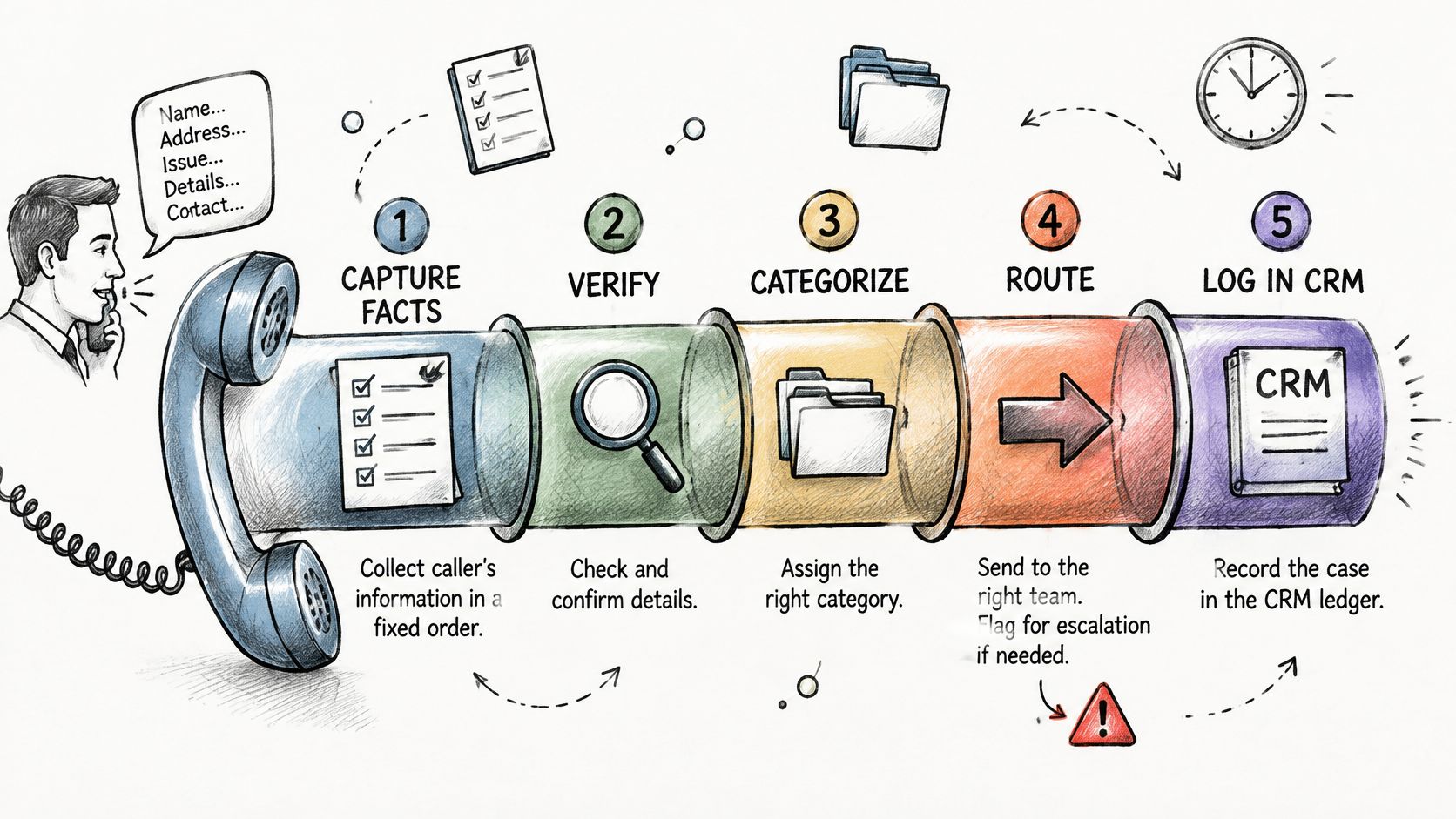
- Record facts in a fixed order. Capture name, safe callback information, opposing-party names for screening, location, and a brief account. Keep sensitive detail collection limited until the firm approves proceeding.
- Identify case type and urgency. Distinguish a new prospective matter from an existing client's update, and flag any stated hearing, filing, or immediate safety concern.
- Apply the firm's qualification criteria. Use attorney-approved practice-area, geography, and matter-fit rules. An operator shouldn't invent exceptions because the caller sounds persuasive.
- Offer a warm transfer or booked consultation. Confirm that the receiving person is available or that the appointment appears in the calendar.
- Flag attorney-review items and log the call that day. Assign ownership and a next action in the CRM. An email notification isn't a substitute for a record someone can work.
Say a caller mentions a filing deadline midway through the conversation. The operator records the date exactly as stated, flags urgency, avoids advising whether that date is legally correct, and transfers to an attorney or pages one while the caller remains connected.
Our call-flow guidance helps turn those decisions into a repeatable sequence. A script should support listening, not prevent it.
Follow-up needs a record, not good intentions
A callback four days later technically counts as follow-up. It isn't a sensible operating standard. Use a firm-approved, multi-attempt sequence with an assigned owner, permitted communication channels, and an outcome logged for every attempt.
Review a weekly sample of qualification decisions against consultation outcomes. Otherwise, weak screening can remain invisible until poorly matched prospects fail to attend, and everyone blames the calendar.
Use the law-firm web-response comparison as context: Hennessey's 2025 study of 1,333 U.S. law-firm websites supplies the 13-minute median and response bands in the benchmark table. They're competitive reference points, not conversion guarantees.
Track these measures:
- Responsiveness: Median first-human-response time, live-answer percentage, and web leads contacted within five minutes.
- Follow-up effectiveness: Contact rate by attempt number.
- Progression: Consultation-booking rate and signed-matter rate, with clearly defined denominators.
Segment results by practice area, lead source, geography, and business-hours versus after-hours origin.
Measure matters, not pickups. A perfectly answered call can still become a perfectly neglected lead.
Confidentiality and Consent Rules to Require
For law firms, confidentiality is an operating requirement, not a feature. A reassuring security paragraph doesn't establish who can open a prospect's intake record or where a recording ends up.
ABA Formal Opinion 477R says lawyers may generally transmit client-related information online when they take reasonable steps to prevent inadvertent or unauthorized access. Client agreements, applicable law, or sensitive information may require stronger safeguards.
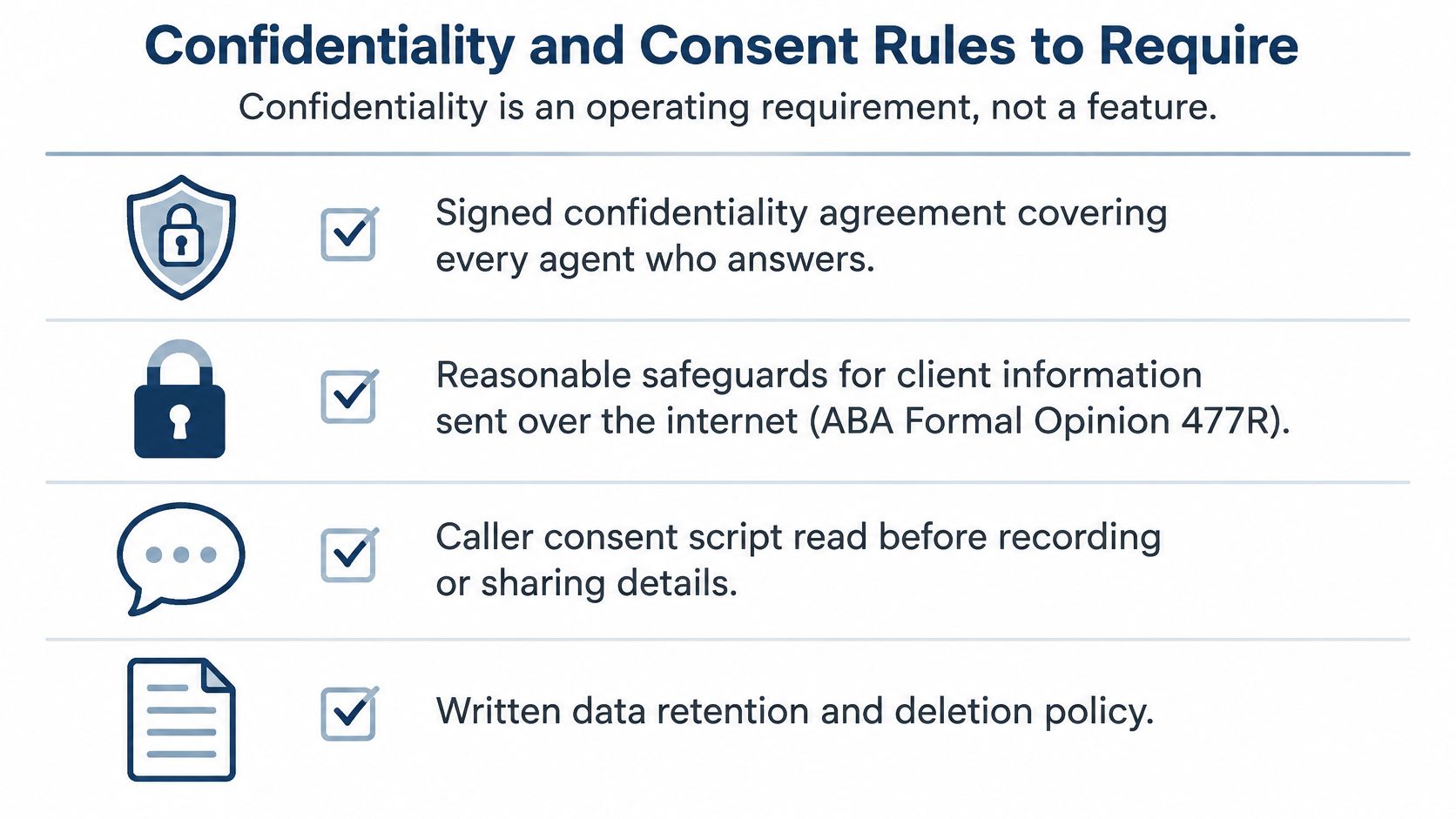
Put these questions in the vendor email
- Access controls: Does each agent have an individual account, least-privilege access, and multifactor authentication? Who removes access when an agent leaves?
- Approved storage: Are notes and attachments kept in approved systems with encrypted transmission, rather than personal inboxes or local downloads?
- Accountability: Can the firm review logs showing who viewed or changed an intake record?
- Recordings and transcripts: What are the retention, deletion, export, and backup rules?
- Workforce safeguards: Do confidentiality agreements cover every agent, and how are training and incidents handled?
Treat recording consent as a separate decision from buying recording software. Have firm counsel approve the consent script for applicable jurisdictions, including the client-consent and summary-verification considerations addressed by the New York City Bar opinion discussed below.
Our call-recording consent guide is a starting point for that review. For a complementary implementation resource, consider practical call recording guidance from Networking2000, while keeping legal determinations with the firm's counsel.
Write down the boundaries
Specify whether agents may repeat a caller's stated deadline, when they must escalate, and what they should do if someone starts disclosing sensitive facts before screening. Identify who reviews transcripts and summaries before the firm relies on them.
Language and time of day shouldn't change those boundaries. Define how multilingual calls reach a qualified agent and how an urgent overnight call reaches the designated attorney without broadcasting sensitive details to an entire distribution list.
With our after-hours coverage, every caller reaches a live person who knows the firm, its scripts, and its intake process. Live answering runs every evening, all weekend, and on holidays.
Governance test: If a provider can't explain the boundary between collecting facts and giving advice, don't let it improvise that boundary with your callers.
Get the operational answers in writing. They're specifications for the provider, not legal advice supplied by the provider.
How to Test a Provider Before You Sign
Run a one-week audit, not a sales call you take on trust. Use controlled scenarios, inspect the records they produce, and establish a baseline before committing to a longer pilot.
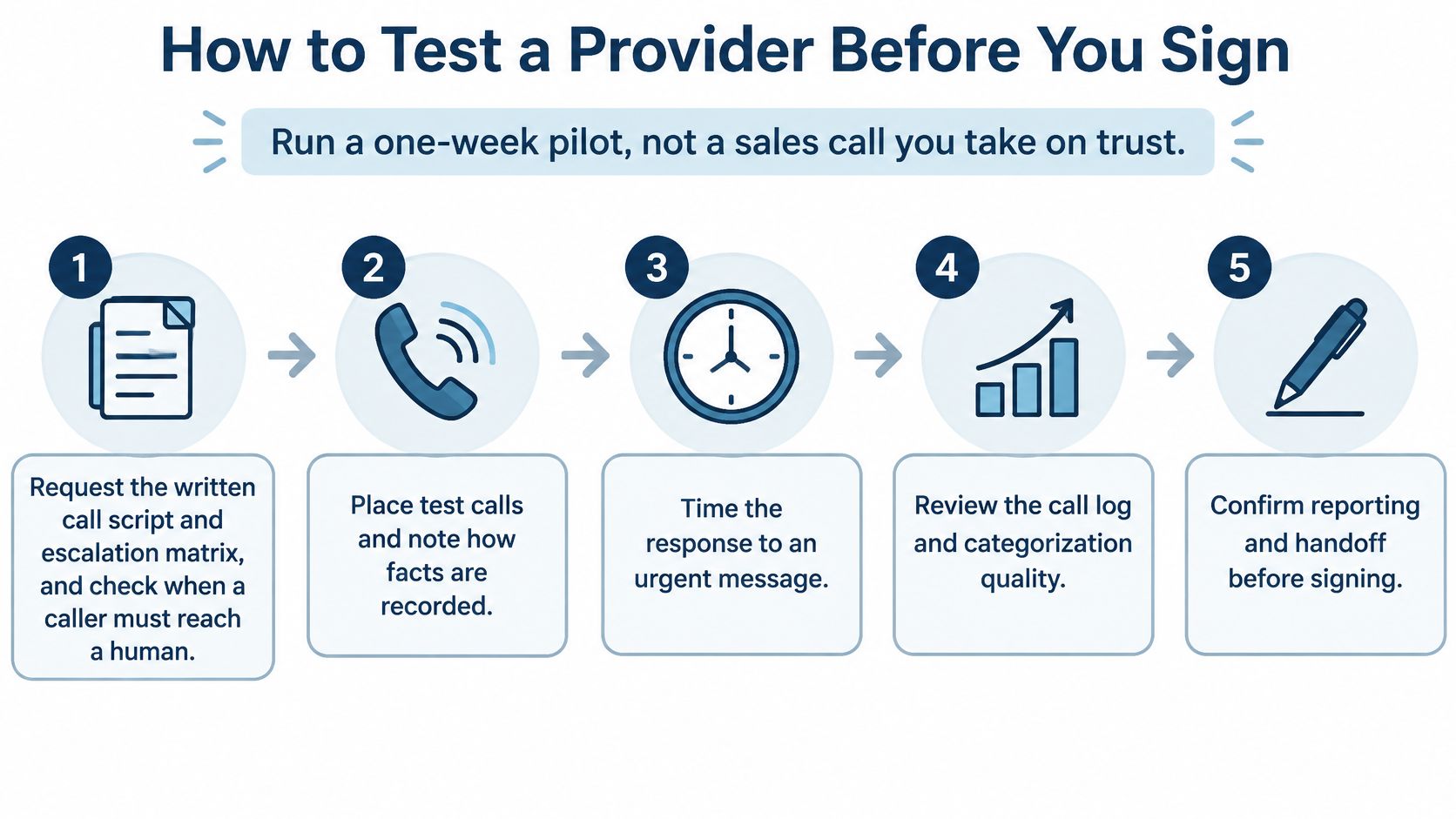
Inspect the work, not the demonstration
- Request the script and escalation matrix. Check the exact trigger for attorney contact, the backup recipient, and what happens if neither answers. An escalation instruction that ends with notify the firm isn't finished.
- Place three controlled calls: during business hours, in the evening, and on a weekend. Record time to a live person and whether the greeting and questions match the firm's instructions.
- Test a marketing-number route and website form. Use authorized test routing, not spoofed caller identification. Confirm each inquiry retains its source and lands with the correct owner.
- Use a deadline scenario with a named opposing party. Check fact capture, screening, urgency flags, and whether the operator avoids interpreting the deadline. Verify the resulting CRM entry.
- Request an authorized, appropriately redacted real-call sample with its recording, transcript, and summary. Compare them line by line for omitted conditions, incorrect names, and conclusions the caller never stated.
- Test overflow and closing-time rollover. Ask how simultaneous calls are handled and verify the route under an agreed test load. With our business-hours overflow coverage, calls are answered during spikes so callers don't reach voicemail.
- Compare a sample of qualification decisions with consultation outcomes. Include accepted and rejected inquiries. Otherwise, you'll inspect the attractive half of the process and miss inappropriate exclusions.
The New York City Bar's Formal Opinion 2025-6 advises obtaining client consent before recording, considering confidentiality and privilege, assessing tactical appropriateness, and verifying summaries before relying on them. A fluent summary isn't evidence that it preserved the conversation accurately.
Make the longer pilot accountable
Set a 30-day pilot using responsiveness, follow-up, consultation, and signed-matter measures, separated by lead source and after-hours origin. These are proposed evaluation periods, not published performance benchmarks.
Frontline's inbound handling includes live answering, intake when criteria are met, warm transfers or appointment scheduling, and Flag for Review where applicable. Test those distinct outcomes rather than treating every completed call as a successful intake.
Confirm retention, deletion, and data-export terms against the confidentiality checklist. Renew only if both the numbers and the call reviews hold up, allowing for matters whose signing decisions remain pending. Fast, inaccurate intake isn't an improvement; it's an error delivered ahead of schedule.
Confirm Your Coverage Gap This Week
A coverage gap often hides between systems: the phone log shows a missed call, the CRM has no lead, and the calendar has no consultation. Use phone-system exports, website submission timestamps, calendar entries, and CRM activity records to trace what happened. Assign one person to reconcile them so an unanswered inquiry does not vanish between reports.
Complete a practical coverage audit
- Pull one week of phone logs. Count inbound calls, missed calls, voicemails, and calls received outside business hours. Separate new prospects from existing clients, vendors, and duplicate calls.
- Measure median time to first human response for phone and web inquiries separately. An automatic acknowledgment is not a conversation.
- Find leads without a second attempt logged. Separate prospects already reached, callers who declined contact, and inquiries nobody pursued.
- Complete the worksheet and compare like-for-like measures with published benchmarks. Don't compare telephone answer rates with website response times.
- Choose the first gap to close: after-hours live intake, administrative capacity, or both. Assign an owner and a review date.
| Audit item | Your firm's result | Decision it informs |
|---|---|---|
| Total and missed inbound calls | Enter counts from phone logs | Daytime coverage |
| Voicemails and after-hours inquiries | Enter counts by time period | Evening and weekend intake |
| Median human-response time | Enter phone and web results separately | Routing and ownership |
| Uncontacted leads without another attempt | Enter count and assigned owner | Follow-up capacity |
| Qualified inquiries reaching consultation and signing | Enter outcomes, including pending decisions | Intake quality and conversion |
| Administrative tasks delaying new matters | List task, backlog, and owner | Dedicated case-support staffing |
Match the resource to the bottleneck
Frontline fits after-hours and inbound-conversion gaps. Its live intake team answers every call, qualifies inquiries, follows up, and signs cases on the firm's behalf. Inbound handling can include intake when criteria are met, warm transfers or appointment scheduling, and Flag for Review where applicable. Compare the matters it signs, not just the calls it answers.
Staffline fits ongoing operational work. Its dedicated, full-time professionals work with one firm, supporting case management, records, calendar management, CRM hygiene, and other legal support functions. Staff arrive pre-trained for legal support work. The firm teaches its specific workflows, while co-managed support helps keep the work aligned with them.
Pairing live intake with a dedicated full-time staff member can cover a firm from first call through case resolution. Frontline handles intake and signing; Staffline carries operational work forward under the firm's direction. A discovery call scopes the right mix.
Use a one-week audit to identify the gap, then a 30-day pilot to judge whether the service handles the right matters and fits the workflow. Free diagnostic tools are also available. You can discuss your numbers at +1 (215) 337-2677. The decision is whether your answering service for business needs to address availability, conversion, capacity, or a combination, rather than paying for coverage the firm does not need.
Attorney Assistant combines Frontline's 24/7 live intake with Staffline's dedicated legal support professionals and co-managed operations. Visit Attorney Assistant with your call logs, follow-up gaps, and administrative backlog to discuss a coverage and staffing mix.
Related Articles
Law Firm Lead Generation: 7 Intake and Follow-Up Tools
Law firm lead generation fails without fast intake and steady follow-up. Compare seven tools and what each one actually delivers for your firm.

Legal Intake Software: How It Works and When to Add People
Legal intake software captures, qualifies, and tracks new matters. See the workflow it supports, the features worth paying for, and where live intake fits.
Missed Call Text Back for Law Firm Intake
A missed call text back tells the caller you saw them, then hands the lead to live intake. See the timing, the first message, and the TCPA line.