Only a minority of U.S. law firms studied respond to an online inquiry within five minutes. That gap usually gets filed under discipline: call back faster, care more, coach the team. It rarely is.
A firm that loses a matter to a faster competitor usually isn't slow because nobody cared. It's slow because the form landed at 8:50 p.m. and the queue had no owner until someone opened a laptop the next morning. Speed to lead gets treated as a single callback metric, a number one person can hit on a good day. It's a coverage problem across hours, channels, and handoffs, and the clock runs from the moment the prospect hits send, not the moment an attorney notices.
The firms that miss the benchmark tend to miss it the same way every time. One channel staffed. One person responsible. Business hours only.
Table of Contents
- What Speed to Lead Means and Why the Clock Starts Early
- Speed to Lead Benchmarks Most Firms Miss
- How Slow Replies Turn Into Lost Cases
- How to Measure Speed to Lead Without Fooling Yourself
- How to Speed Up Intake Without Hiring Another Attorney
- Confirm Your Speed to Lead Before Next Month's Intake
What Speed to Lead Means and Why the Clock Starts Early
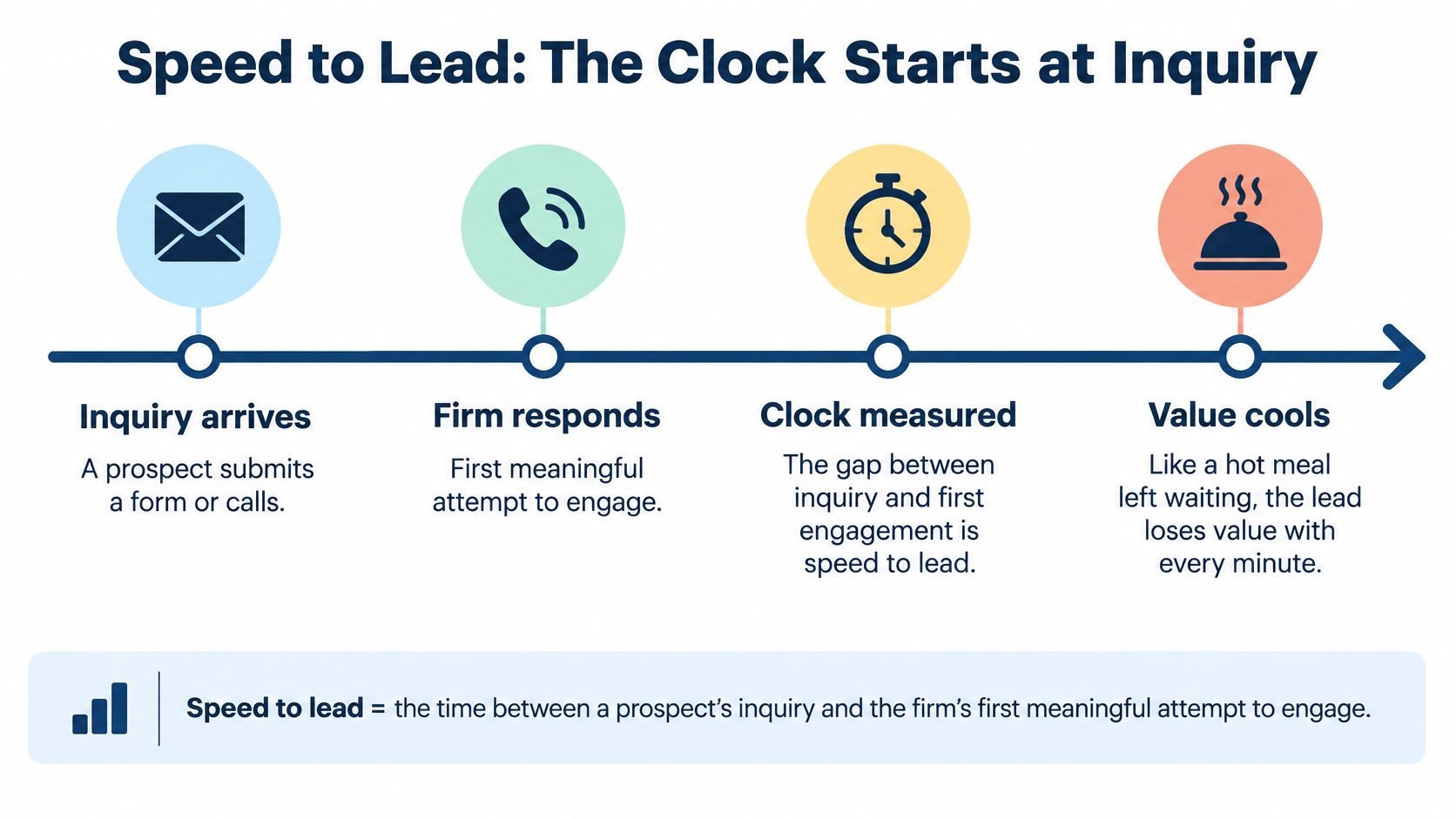
A lead response time measures the interval from a prospect's submission to the firm's first meaningful attempt to engage. That interval includes every handoff between the form, the inbox, and the person responsible for responding.
A delay can start before anyone sees the inquiry. A form arrives after hours, sits in an unmonitored inbox, then waits for someone to assign it in the morning. By the time the first call goes out, the prospect may already be speaking with another firm.
A 2007 Lead Response Management study by James Oldroyd and colleagues examined more than 15,000 web-generated leads and roughly 100,000 call attempts across six companies over three years. The study reported that contacting a lead within five minutes, rather than 30, made the odds of establishing contact roughly 100 times higher and the odds of qualifying the lead roughly 21 times higher.
Those are odds comparisons, not promises of signed cases. The study measured contact and qualification, not retained clients. Its practical lesson is narrower: a quick attempt gives the firm a better chance to reach and assess a prospect while the inquiry is still active.
Where the Clock Actually Runs
Four timestamps show where time goes: inquiry received, first contact attempt, qualification completed, and next step booked. A firm that tracks only the first attempt can miss a long delay before the inquiry reaches an owner, or after contact but before qualification.
For personal injury and mass tort firms, one prospect may submit several forms while comparing options. A response that arrives while the details are fresh gives the intake team a chance to understand the matter and explain the next step. Responsiveness also signals whether the firm is available to help.
An automated acknowledgment is not a human conversation. “We'll be in touch” confirms receipt, but it does not qualify the matter, check for conflicts, or book an appointment. It is a receipt, not intake.
The clock measures the whole queue. An intake specialist can respond quickly once an inquiry reaches them, while the inquiry itself waits in an inbox with no clear owner. Measure from submission through handoff and follow-up, not only from assignment to callback.
Speed to Lead Benchmarks Most Firms Miss
The median U.S. law firm took 13 minutes to respond to a web inquiry, and only 25% replied within five minutes, according to the 2025 law firm lead form response time study. Those figures describe a single point in the intake process: the time to reply. They do not show whether coverage holds across hours, channels, and handoffs.
| Response window | Share of U.S. law firms (2025) | What it means for intake |
|---|---|---|
| Median response time | 13 minutes | The typical firm is already behind the five-minute mark |
| Within 5 minutes | 25% | Only one firm in four meets the fast benchmark |
| Within 10 minutes | 33% | Cumulative share, still only a third of firms |
| Within 1 hour | 56% | Nearly half leave prospects waiting longer than an hour |
| More than 2 hours or no reply | 39% | Where a large share of inquiries quietly decay |
A 13-minute median against a five-minute target leaves a meaningful gap. The table also shows why a single callback metric can mislead: a firm may respond quickly during business hours yet leave after-hours inquiries or leads from another channel waiting. The study on med spa lead response offers a comparison from another field where lead response also matters.
What the Study Measures and What It Doesn't
These are operating benchmarks for web inquiries, not measures of case-acquisition rates. The study timed how quickly firms answered; it did not track how many inquiries signed. A fast reply is one part of intake, not proof that qualification, conflict checks, or the next step happened promptly.
For a useful comparison, measure from submission to the first human attempt, then track the handoff through qualification and the next step. Break results out by hour and channel. A firmwide average can look respectable while evening inquiries sit unanswered, or while a fast first call leads nowhere because nobody owns the follow-up.
How Slow Replies Turn Into Lost Cases
An inquiry arrives Friday at 9:12 p.m. from someone who was rear-ended on Wednesday and finally decided to do something about it. The website generates an automatic confirmation. Then the office closes for the weekend. Monday at 10:40 a.m., someone reads the form.
A competing firm called at 9:16 p.m. Friday and had the retainer signed before lunch on Saturday.
The assumption worth challenging here is that the automatic confirmation counts as a response. It doesn't, and the data backs that up. The 2022 law firm lead form response time study contacted 967 U.S. law firms with fictitious prospective-client inquiries and found that when a firm failed to respond within 15 minutes, it was unlikely to respond at all, and that contact needed to happen the same day as the inquiry.
Two Ways a Firm Loses the Same Case
Latency is a slow first reply. Failure is no reply at all. They look similar in a monthly report and are entirely different management problems.
The 2011 Harvard Business Review study "The Short Life of Online Sales Leads" measured both. In an audit of 2,241 companies, 37% replied within an hour, 16% within one to 24 hours, 24% took longer than a day, and 23% never replied at all. Companies that responded within an hour were nearly seven times more likely to qualify the lead than firms that waited an extra hour, per these speed to lead statistics drawn from that research.
Both failures cost the same three things: the matter, the trust of whoever referred it, and the attorney hours that never get billed because the case never starts.
Technically, calling someone back four days later is follow-up. It is not particularly useful follow-up.
Firms expect technology to save them, and it doesn't. Your CRM cannot follow up with a lead if nobody puts the lead in the CRM. A system can record that an inquiry exists; it cannot make the call, qualify the matter, or move anyone toward an appointment. That work requires a person with a name, a headset, and a reason to be at the desk at 9:15 on a Friday night. When the follow-up is bad, the client experience is bad for reasons that have nothing to do with the law, which is worth reading about in why poor client service loses cases.
How to Measure Speed to Lead Without Fooling Yourself
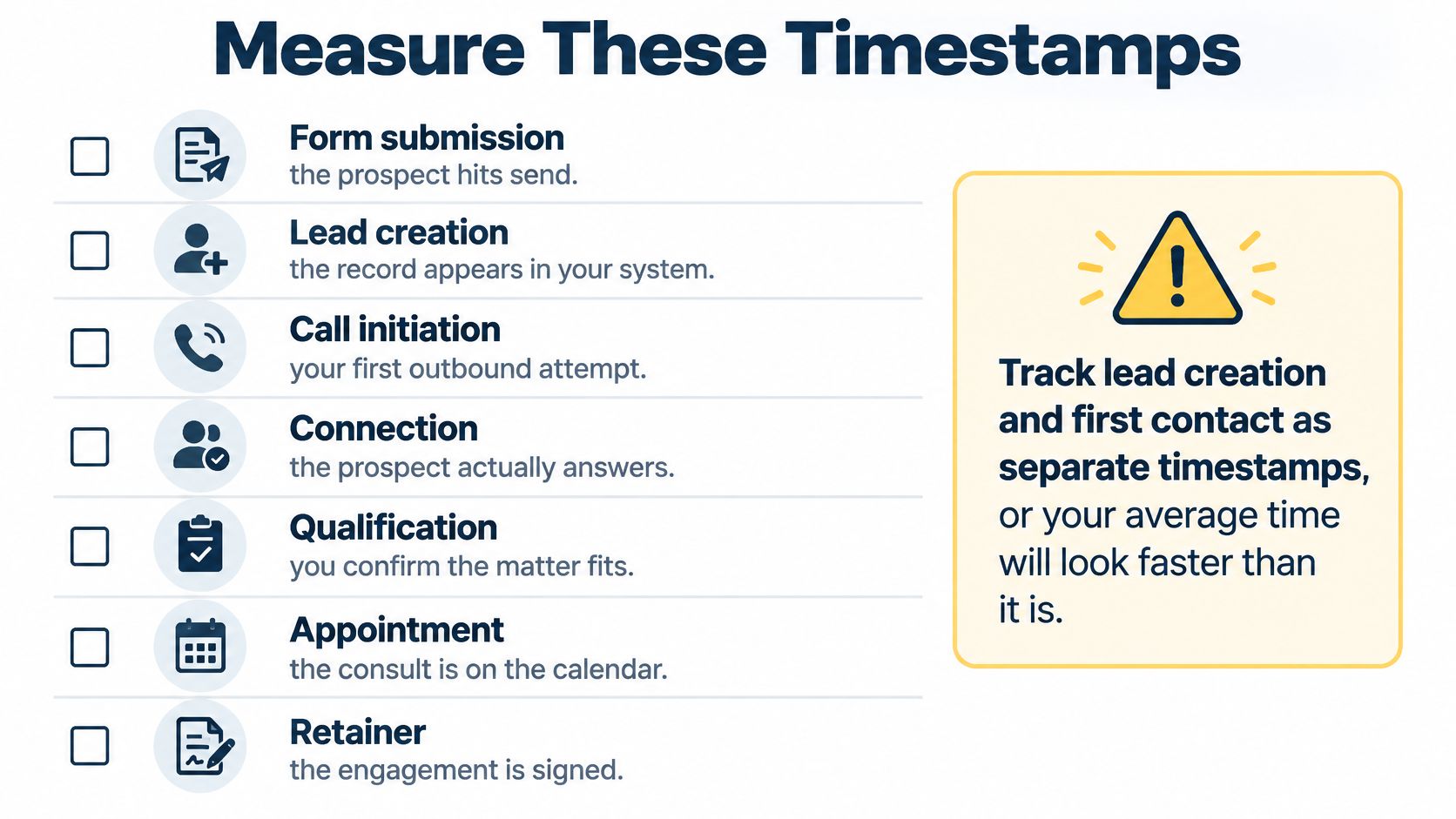
Most law firms can produce a response-time number. Very few can defend it. The figure is usually an average computed from whenever the CRM happened to record a status change, and it merges the two timestamps that should never share a metric: when the lead was created and when a human first tried to reach the person.
Start the clock at submission, not at the moment your team notices the inquiry. A form that sits in a shared inbox for an hour before anyone sees the notification still counts as an hour, because the prospect experienced an hour of silence. Every handoff between systems and people is part of the measurement.
| Metric | How to calculate it | Target to aim for |
|---|---|---|
| First human attempt | Time from lead creation to the first live contact attempt | Under 5 minutes for high-intent inquiries |
| Percent under 5 minutes | Share of inquiries with a first attempt under 5 minutes, by channel and hour | Above the 25% figure published as the 2025 legal benchmark; track by channel and hour |
| Median response time | Middle value of all first-attempt times | Below the 20-minute median for U.S. law firms |
| 90th percentile response | Response time that 90% of inquiries beat | An internal ceiling, reviewed by daypart, since the tail exposes coverage gaps the median hides |
| Inquiries with zero attempts | Leads with no completed contact attempt after all follow-up | Zero, reviewed weekly |
Capture the timestamps in order: submission, first automated acknowledgment, first human attempt, first live conversation, and each handoff. None of them are optional.
Read the Median and the Tail Together
A firm can report a four-minute average time to first contact while its 90th percentile runs three hours on nights and weekends. The weekday morning shift carries the average. The tail is where the high-intent after-hours inquiries went to die.
The evidence on conversion is thinner than the evidence on contact. A 2021 analysis of 55 million sales activities and 5.7 million inbound leads across more than 400 companies found conversion rates over 8 times higher when the first contact attempt happened within five minutes rather than between five minutes and 24 hours, and that 57.1% of first call attempts happened more than a week after the lead arrived, according to the InsideSales response time analysis. That is general sales data rather than a legal sample, so treat it as directional and check it against your own intake records.
Competitors are also getting faster, which raises the floor for everyone. The 2023 law firm lead form response time study examined 1,300 U.S. firms and found the median time from submission to first response fell from 25 minutes in 2021 to 20 minutes in 2023, while the number of firms responding in under five minutes increased by 97% over the prior study. The firms bidding against you for the same click are not standing still.
Pull 30 days of CRM events and do four things: group the timestamps by hour and by source, compare the median against the 90th percentile, count the leads with zero completed attempts, and check whether your busiest hours match your best coverage. Most firms discover their gap is not midday. It is the evenings, the weekends, and the ninety minutes around lunch. A proper intake analytics setup for law firms turns that pull into a recurring report instead of a quarterly archaeology project.
How to Speed Up Intake Without Hiring Another Attorney
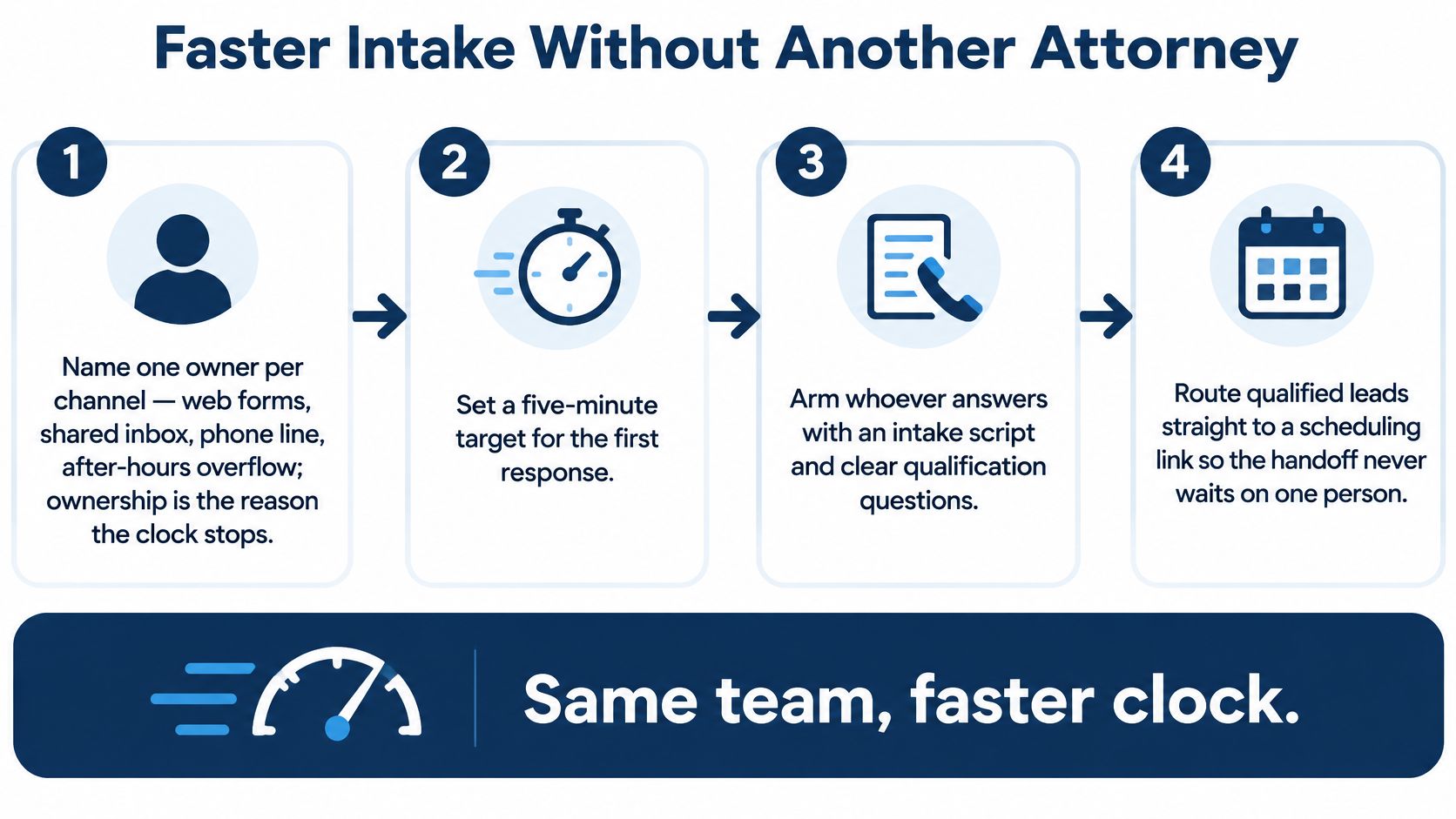
The fix for slow intake is rarely another attorney, and it's rarely more effort from the people already answering the phone. It's a routing and coverage problem, and routing problems respond well to process.
Six Moves That Stop the Leak
- Name one owner for every inbound channel. Web forms, shared inbox, main phone line, after-hours overflow. Each gets a named person and a named backup. Ownership is the reason the clock stops. Without it, every inquiry is nobody's job in particular, and that's exactly how a form sits untouched for two days.
- Set a five-minute target for the first human attempt on high-intent inquiries, with automatic routing to the backup. A target with no escalation path fails the moment the primary handler is on another call, which is most of the afternoon.
- Send an immediate acknowledgment that states what happens next. Say who will call, roughly when, and what to have ready. Avoid anything that reads as legal advice or implies representation before conflicts are checked. The generic auto-reply is the reason prospects assume the firm isn't interested.
- Run an escalation sequence with a disposition code on every lead. A call, then a text or email where permitted and consented, then repeated attempts at set intervals. Every lead ends with a code: reached, qualified, scheduled, pending, declined. No code means no accountability.
- Cover nights, weekends and overflow properly. Queues stretch at these times, and it's exactly when prospects are free to call. The intake problem isn't only on forms: a law firm client intake analysis notes that 2024 Clio Legal Trends findings reported only 40% of firms answered phone inquiries. A firm can brag about web-form speed while the phone rings out at 6 p.m. A dedicated 24/7 virtual receptionist and intake line closes that channel gap without adding a shift to the office manager's week.
- Review weekly, not annually. Three standing agenda items: the morning summary of after-hours leads, script changes that came out of recorded call reviews, and a list of every lead with zero attempts.
The Guardrail Nobody Mentions
Speed creates its own risk. The ABA's 2025 discussion of Formal Opinion 512 emphasized that lawyers must supervise AI-driven intake, review collected information, and make sure clients understand the scope and complexity of their issue, as this analysis of legal intake automation outlines. A fast but poorly governed interaction can leave you with incomplete facts, inconsistent qualification, and an unclear non-engagement message.
The workable model is safe speed: immediate acknowledgment, only the minimum necessary information, transparent status communication, fast escalation of emergencies, and attorney-reviewed decision points. Speed doesn't require delegating legal judgment. It requires removing waiting from the parts that don't need a lawyer.
There's a capacity argument too. A survey of 400 U.S. legal professionals reported that 39% estimated losing at least four hours of billable work each week to administrative tasks, and 78% said administrative work limited their ability to accept new clients, per the ABA Journal's report on the survey. Every attorney who stops to take a routine call is paying twice: once in lost billable time, again in the inquiry that waited while they did it.
Two small design fixes help before you change anything else. Shorten the form, since every added field costs you completions, and this guide to shorter high-converting forms covers the field-by-field trade-offs. Then decide, in advance, what happens when the form arrives at 9 p.m. If the answer is "someone will see it Monday," you have your first project.
If you'd rather see the handoff problem explained end to end before you rebuild the process, this short walkthrough is a reasonable place to start.
Confirm Your Speed to Lead Before Next Month's Intake
One practical test tells you more than a month of meetings. Pull ten inquiries from different channels and different hours, then count from the moment of submission, not from when someone first noticed the message. Record the minutes to the first live attempt, who made it, and whether each lead has a documented next step.
If fewer than half reached a live attempt within five minutes, the bottleneck sits in coverage and handoffs. Adding hours to the same unwatched inbox won't change the result. Another marketing campaign won't either.
The diagnosis to take seriously: a firm with a five-minute promise and a thirteen-minute median doesn't have a discipline problem. It has an unowned queue.
Closing that gap is what our Frontline intake team is built for. It provides 24/7 live coverage, nights and weekends included, answers and qualifies incoming matters, follows up persistently, and works toward signed cases rather than messages taken. Every after-hours inquiry lands in a qualified, prioritized summary your team sees each morning, leads are scored and ranked so the best opportunities get attention first, and high-value leads trigger instant notifications to your staff. Both Frontline plans include around-the-clock readiness of live agents, systems and routing, inbound and outbound lead handling, QA, and a dedicated Client Success Manager. Every lead call is recorded and reviewed for quality, and scripts get refined based on those reviews.
Then Staffline carries the matter once it's signed, with dedicated full-time professionals inside your systems handling records, liens, drafting, and admin. The two can be paired: one vendor, one relationship, one hiring bar covering the firm from the first call through final disbursement.
More leads will not fix a queue nobody is watching. The capacity was always the problem, and it is a fixable one.
Attorney Assistant builds the intake and support capacity that keeps a five-minute standard achievable, from the first ring to the signed retainer and everything the case needs afterward. If your own ten-inquiry test shows more misses than hits, visit Attorney Assistant and we'll walk through where the clock is running and what it would take to staff it properly, without adding another hour to an attorney's day.
Related Articles

After Hours Service for Law Firms: Models, Costs and KPIs
Learn how after hours service works for law firms: three operating models, what unanswered calls cost, and the metrics that prove coverage works.

Call Screening Service for Law Firms: A Practical Guide
Learn how law firms set up a call screening service: intake criteria, routing rules, consent checks and the metrics that prove it works.

Client Service Questionnaire Templates for Law Firms
Build a client service questionnaire for your firm: sample questions by stage, send timing, response metrics, and how to route results into intake.