Benefits of Responsive Client Communication for Law Firms

TL;DR:
- Responsive client communication builds trust and improves client retention and revenue for law firms. Implementing clear response-time standards and assigning communication owners can prevent client churn and increase signed cases. Operational systems, not just staff effort, are essential for consistent responsiveness and growth.
Responsive client communication is defined as the practice of replying to client inquiries within a predictable, agreed-upon timeframe while maintaining consistent quality across every interaction. Law firms that build this practice into their operations see measurable gains in trust, retention, and revenue. 50% of clients rank responsiveness as a non-negotiable when selecting a service business, and 36% abandon firms due to slow response. The benefits of responsive client communication are not abstract. They show up directly in signed cases, client loyalty, and firm growth.
1. Benefits of responsive client communication: trust and client satisfaction
Responsiveness signals reliability before a client ever meets you in person. When a firm replies quickly and clearly, it tells the client that their matter is taken seriously. That first impression sets the tone for the entire relationship.
Empathy and clarity are the two levers that drive client satisfaction in legal communication. Clients facing legal issues are often anxious. A clear, timely update reduces that anxiety and builds confidence in your firm’s ability to handle their case.
Intentional response boundaries, such as same-day replies for urgent matters and next-business-day replies for routine questions, build trust more effectively than attempting 24/7 availability. Constant availability creates unrealistic expectations and burns out staff. Defined windows create reliability.
Pro Tip: Set a written response-time policy for each communication channel, share it with clients at intake, and train every staff member to follow it without exception.
- Reply to all new inquiries within the same business day, even if only to confirm receipt.
- Use a dedicated channel for urgent matters so nothing critical gets buried.
- Send proactive updates at defined intervals, even when there is no new development.
- Acknowledge bad news quickly and always pair it with a next step or solution.
2. The revenue and retention impact of timely client responses
Poor communication is the single largest driver of client churn in professional services. Up to 96% of clients will terminate a relationship due to a bad service experience. That number reframes the entire conversation about firm growth. Most firms focus on acquiring new leads when the real problem is losing the clients they already have.
84% of companies that prioritize client communication report a direct revenue increase. That correlation is not coincidental. When clients feel heard and informed, they stay longer, refer others, and engage additional services.
Client satisfaction scores above 80% yield 20–30% higher retention rates and a 1.5x increase in cross-selling success. For a law firm, cross-selling means a personal injury client also retaining you for estate planning, or a business client returning for employment matters. Retention compounds.
The table below shows how communication quality maps to measurable firm outcomes.
| Communication quality | Client outcome | Firm revenue impact |
|---|---|---|
| Fast, clear intake response | Higher lead conversion | More signed cases per inquiry |
| Proactive case updates | Reduced client anxiety | Fewer cancellations and disputes |
| Consistent follow-up | Stronger client loyalty | Higher referral volume |
| Defined response windows | Realistic expectations | Lower complaint rate |
Firms that treat client retention as a communication problem, not just a service quality problem, outperform those that focus solely on lead volume.
3. Key strategies for implementing responsive communication in law firms
Effective client communication does not happen by accident. It requires deliberate systems, clear expectations, and consistent execution across every staff member who touches a client file.
Set response-time standards by channel
Define exactly how quickly your firm responds to phone calls, emails, and text messages. Post those standards internally and share them with clients at intake. Ambiguity about response times is one of the most common sources of client frustration.
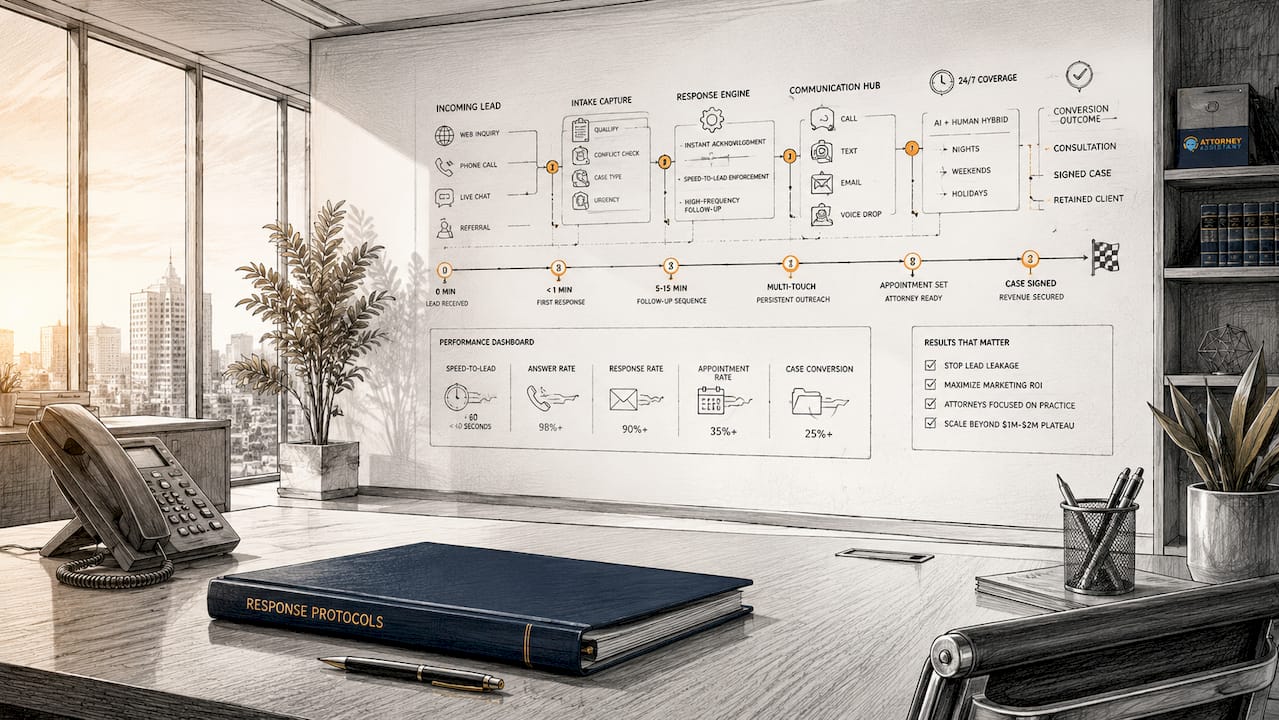
Use automation for first contact, personalization for follow-up
Automated acknowledgment messages confirm receipt of an inquiry within minutes. They buy time for a human to prepare a thoughtful, personalized reply. The combination of speed and substance is more effective than either alone.
Limit communication to designated channels
Mandating specific channels for different communication types prevents critical information from getting lost across email threads, voicemail, and text chains. Assign one channel for urgent matters, one for routine updates, and document every client interaction in a central system.
Schedule proactive check-ins
Do not wait for clients to ask for updates. Build scheduled touchpoints into every case workflow. A brief email confirming that work is progressing costs two minutes and prevents a frustrated phone call later.
Pro Tip: Assign one staff member as the communication owner for each active matter. Single ownership eliminates the “I thought someone else handled it” gap that kills client trust.
- Document your response-time standards in writing and share them at intake.
- Set up automated acknowledgment messages for all new inquiries.
- Assign a communication owner to every active client matter.
- Schedule proactive updates at fixed intervals regardless of case activity.
- Limit urgent communications to one designated channel only.
- Train staff to pair every piece of bad news with a concrete next step.
4. Common pitfalls in client responsiveness and how to avoid them
Most firms do not fail at communication because they do not care. They fail because their systems are not built to support consistent responsiveness at scale.
- Context sprawl. Using email, text, voicemail, and client portals simultaneously without a clear hierarchy buries critical information. Disorganized communication leads to misalignment and client frustration. Fix this by assigning one primary channel per communication type and enforcing it.
- Inconsistent tone across staff. When one paralegal sends warm, detailed updates and another sends terse one-liners, clients notice the inconsistency. It erodes confidence in the firm as a whole. Standardize templates for common communication scenarios.
- Treating feedback as a report card. Firms that collect client feedback only to measure satisfaction miss the real value. Client feedback is strategic intelligence that reveals emerging priorities and operational gaps. Use it to fix systems, not just to score staff.
- Chasing 24/7 availability. Attempting to respond at all hours creates staff burnout without meaningfully improving client satisfaction. Defined, reliable response windows outperform constant availability every time.
- Skipping intake stress-tests. Roleplaying as a new client through your own intake process reveals friction points before they affect real clients. Most firms never do this. The ones that do fix problems their competitors do not know they have.
The firms that improve law firm response time consistently are the ones that treat communication as an operational system, not a personality trait.
Key takeaways
Responsive client communication is the single most controllable driver of law firm retention, conversion, and revenue growth.
| Point | Details |
|---|---|
| Responsiveness drives conversion | 36% of leads are lost due to slow response, making speed a direct revenue factor. |
| Poor communication causes churn | Up to 96% of clients leave over bad service experiences, not bad legal outcomes. |
| High satisfaction scores compound | CSAT above 80% yields 20–30% better retention and 1.5x more cross-selling success. |
| Systems beat intentions | Defined channels, response standards, and communication owners outperform ad hoc effort. |
| Feedback is a growth tool | Treating client feedback as strategic intelligence prevents churn and guides firm development. |
Communication is an operational system, not a soft skill
Law firm owners often frame client communication as a people problem. The wrong attorney is too blunt. The paralegal forgets to follow up. The receptionist does not sound warm enough. That framing leads to hiring fixes and training sessions that rarely stick.
The real issue is structural. When your intake process has no defined response window, no assigned owner, and no follow-up trigger, the outcome depends entirely on whoever happens to be available. That is not a people problem. It is a systems problem.
I have seen firms with genuinely talented, client-focused staff still lose cases because no one owned the follow-up. The client called, left a message, and signed with the next firm that called back first. The original firm never knew they lost the case.
The firms that win on communication are not the ones with the friendliest staff. They are the ones with the clearest processes. They know exactly who responds to a new inquiry, in what timeframe, through which channel, and what happens if that person is unavailable. That clarity is what drives client conversion at scale.
Operationalizing feedback is the next step most firms skip entirely. Leading firms use client signals, response delays, and satisfaction data as early warning indicators of churn. They intervene before a client decides to leave. That is not reactive service. It is a competitive advantage built into the workflow.
— Nicole
How Attorney Assistant helps firms respond faster and convert more leads
Law firms lose revenue not from a shortage of leads but from gaps in follow-up and intake. Attorney Assistant is built to close those gaps operationally.
Attorney Assistant handles intake workflows, lead follow-up, and administrative processes so your team responds faster without adding headcount. The lead follow-up service ensures no inquiry goes unanswered, and the virtual webinar gives firm leaders a practical look at how to fix communication failures at the system level. If you want to see exactly where your firm is leaking revenue, book a call and we will walk through it with you.
FAQ
What are the main benefits of responsive client communication?
Responsive client communication increases client trust, reduces churn, and drives measurable revenue growth. Firms that prioritize responsiveness report higher retention rates and more referrals from existing clients.
How does slow response time affect law firm revenue?
36% of lost leads are directly attributed to slow responsiveness. Each unanswered inquiry represents a potential signed case that went to a competitor who responded first.
What is the difference between responsiveness and 24/7 availability?
Responsiveness means setting clear, reliable response windows and meeting them consistently. It does not require round-the-clock availability, which creates staff burnout without improving client satisfaction.
How should law firms use client feedback to improve communication?
Client feedback functions as strategic intelligence, not just a satisfaction score. Firms that analyze feedback for patterns in communication gaps can fix systemic issues before they cause client departures.
What is the fastest way to improve client communication in a law firm?
Assign a communication owner to every active matter, define response-time standards by channel, and set up automated acknowledgment messages for new inquiries. These three changes address the most common sources of client frustration immediately.
Recommended
- Why Clients Choose Responsive Firms: 2026 Guide | Attorney Assistant
- How Modern Technology Transforms Law Firm Efficiency and Enhances Client Satisfaction. - Attorney Assistant | Attorney Assistant
- Why responsiveness drives law firm client conversion | Attorney Assistant
- Boost client intake: top communication strategies for law firms | Attorney Assistant
Related Articles

Client Communication Guide: Boost Law Firm Intake
Learn how personal injury law firms can boost intake conversions with faster response times, empathy-first scripts, and a 7-step follow-up system that stops lead loss.
Medical Records Coordinator: What the Role Actually Does
A medical records coordinator manages records retrieval, summaries, billing, and liens for law firms. Learn duties, KPIs, and when to outsource vs hire.

Macs for Lawyers: The Hardware and Compatibility Guide
A practical guide to Macs for lawyers covering hardware choices, software compatibility, security tradeoffs, and recommendations by firm size and workflow.