Case Management Aide: A Law Firm Setup Guide
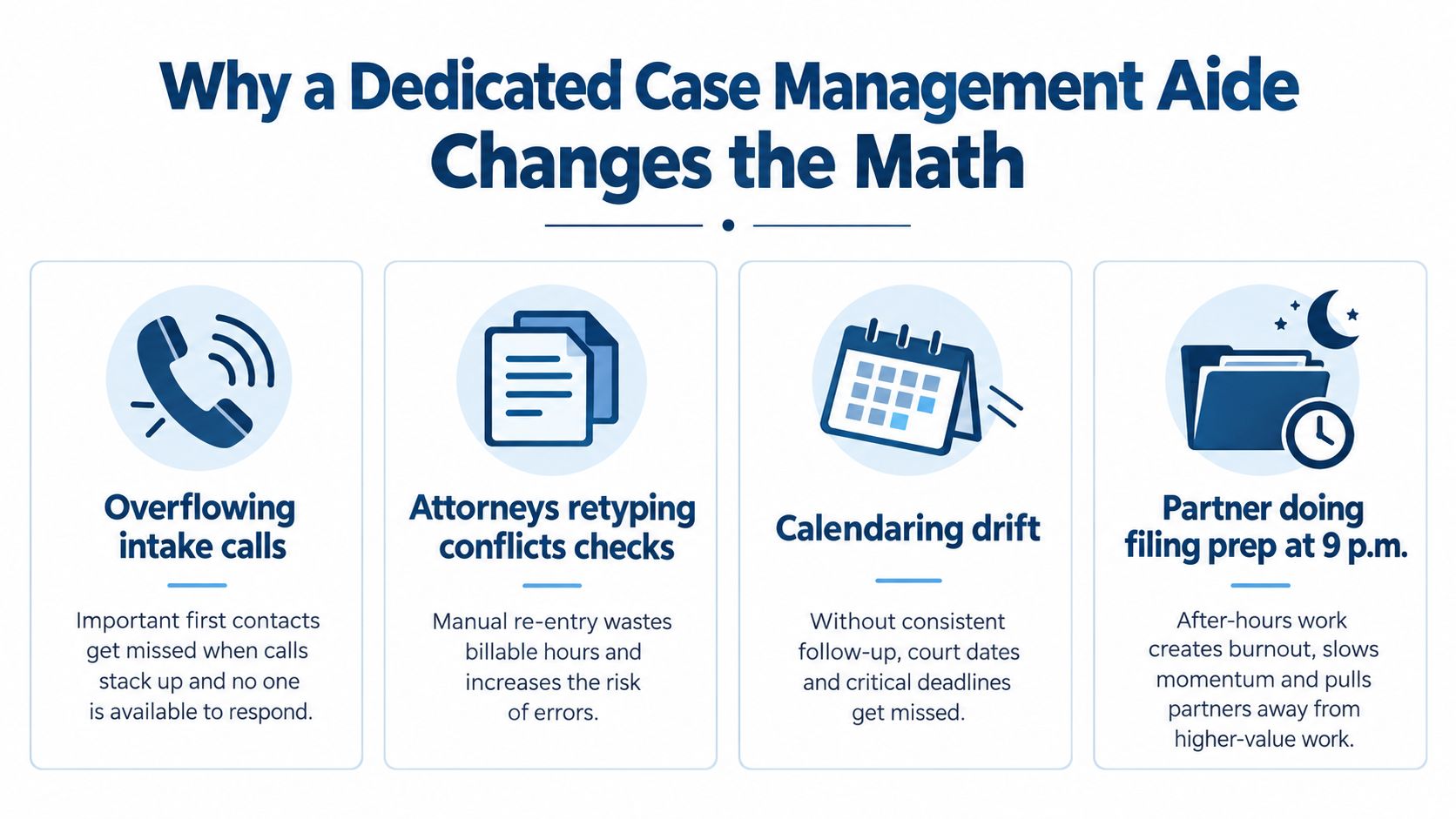
A mid-sized litigation firm rarely notices the staffing problem when it begins. A few intake calls roll to voicemail. An attorney retypes a conflict-check note. A deadline gets entered late because everyone assumed someone else owned it. Then a partner is preparing filing documents at 9 p.m., while the firm discusses hiring another associate to handle the “growth.”
That diagnosis is usually wrong. The missing capacity often sits between new-matter intake, case setup, and ongoing file maintenance. A case management aide can own that operational seam, keep work moving across the case management system, and leave attorneys with more time for legal judgment. The role isn't a clerical add-on, and it isn't a substitute for a paralegal or lawyer. It's a defined support function that makes the rest of the team more reliable.
Table of Contents
- Why a Dedicated Case Management Aide Changes the Math
- Tasks That Belong with a Case Management Aide
- Onboarding the Aide Without Breaking Your Week
- Wiring the Aide Into Intake, Calendaring, and Discovery
- QA and Oversight Inside a Co-Managed Model
- When to Add Aides Instead of Another Attorney
- A Practical Rollout Plan and What to Do Next
Why a Dedicated Case Management Aide Changes the Math
The familiar scene is easy to recognize. Intake calls are overflowing, but no one has a clean record of which prospects received a second call. Attorneys are retyping information from an inquiry form into the practice management system. Calendaring is scattered between a docketing tool, an Outlook calendar, and someone's memory. The partner doing filing preparation after dinner insists it's temporary. Temporary has a remarkable ability to renew itself.
The bottleneck isn't usually legal talent. It's the absence of an owner for the connective work. A case management aide can open the matter, enter the conflict information, create the client portal, issue the engagement documents, organize the initial file, and route the matter to the appropriate attorney. That continuity prevents the intake specialist from handing off an incomplete file and prevents the attorney from becoming the firm's most expensive data-entry employee.
The role is broader than clerical support
Case management aides commonly work within the broader social and human services assistant category. That field held about 415,100 jobs in 2022, was projected to grow 9% from 2022 to 2032, and had about 47,400 openings per year on average, according to the occupational data summarized by Bryant & Stratton College's case management assistant overview. The role has also developed alongside organized case coordination, from early social work and public health nursing to formal healthcare and public programs, as described by the Case Management Society of America's history of case management.
In a law firm, the aide's value comes from dedication and ownership, not from trying to perform every legal function. A general virtual assistant may split attention among several clients and handle broad administrative requests. A paralegal may prepare substantive documents and support legal analysis. The aide owns repeatable case-flow work, follows the firm's procedures, and escalates decisions that require legal judgment.
Practical rule: If the task requires judgment about legal strategy, keep it with the attorney. If it requires accurate movement of information through a defined process, consider assigning it to the aide.
The co-managed model is what makes the role scalable. The aide executes inside the firm's systems, a senior paralegal or attorney reviews higher-risk outputs, and an operations lead monitors performance and improves the workflow. One person doesn't become a magical cure for every backlog. The firm gets a dependable operating layer instead.
Tasks That Belong with a Case Management Aide
A useful division starts with the task, not the employee's title. Ask whether the work is repeatable, process-driven, and reviewable. If the answer is yes, a case management aide may be the right owner. If the work involves legal interpretation, negotiation, or strategic advice, it belongs elsewhere.
Delegate the connective work
At intake, the aide can create the matter, enter parties and opposing counsel, initiate the conflict-check workflow, send approved engagement materials, and confirm that required information is present. The intake specialist qualifies the opportunity and handles the live conversation. The attorney decides whether the firm should accept the matter and what legal advice to provide.
For calendaring, the aide can enter court dates, create internal reminders, maintain deadline ticklers, and prepare a proposed schedule from an order or rule set. A supervising attorney should review high-risk deadlines before they become final. The aide isn't deciding what a deadline means. The aide makes sure the decision is recorded, visible, and followed.
Records work is similarly suited to controlled delegation. The aide can identify providers, verify that the authorization is complete, submit requests in the required format, track each provider separately, follow up, and compare the returned packet with the treatment timeline. CloudLex's guidance on medical-record retrieval emphasizes separate provider tracking and completeness checks because a single incomplete packet can create rework and delay a demand package.
Discovery support can include organizing productions, tracking requests and responses, preparing standard shells, logging correspondence, and applying approved Bates-labeling procedures. A paralegal may handle substantive drafting and coordinate complex discovery. The attorney reviews strategy, objections, privilege questions, and final work product.
| Task | Aide | Paralegal | Attorney |
|---|---|---|---|
| Open a new matter in the CMS | Owns entry and checklist completion | Reviews exceptions | Approves acceptance |
| Run the administrative conflict workflow | Gathers and records information | Resolves process questions | Makes judgment calls |
| Enter court dates and reminders | Prepares and maintains entries | Reviews routine calendars | Approves critical deadlines |
| Prepare a pleading shell | Uses approved template | Drafts substantive sections | Reviews and signs off |
| Assemble discovery production | Organizes, logs, and formats | Coordinates substantive production | Decides strategy and privilege issues |
| Request and track records | Owns requests and follow-up | Reviews gaps and summaries | Uses records in legal analysis |
| Give legal advice or negotiate | Does not perform | May support preparation | Owns the work |
Keep the boundary visible
The aide should not provide legal advice, make substantive eligibility or liability decisions, draft legal arguments without supervision, negotiate a settlement, or independently decide whether a filing is legally sufficient. A clear escalation rule protects the client and the firm.
A good aide doesn't make attorneys less accountable. The aide makes accountability easier to exercise because the file is organized, the status is current, and the unresolved question is visible.
Onboarding the Aide Without Breaking Your Week
Onboarding fails when a firm treats access as training. Giving someone a login to Clio, Filevine, Litify, MyCase, or another system doesn't teach them how your firm names files, handles conflicts, routes urgent messages, or confirms a deadline. It merely gives them a front-row seat to the confusion.
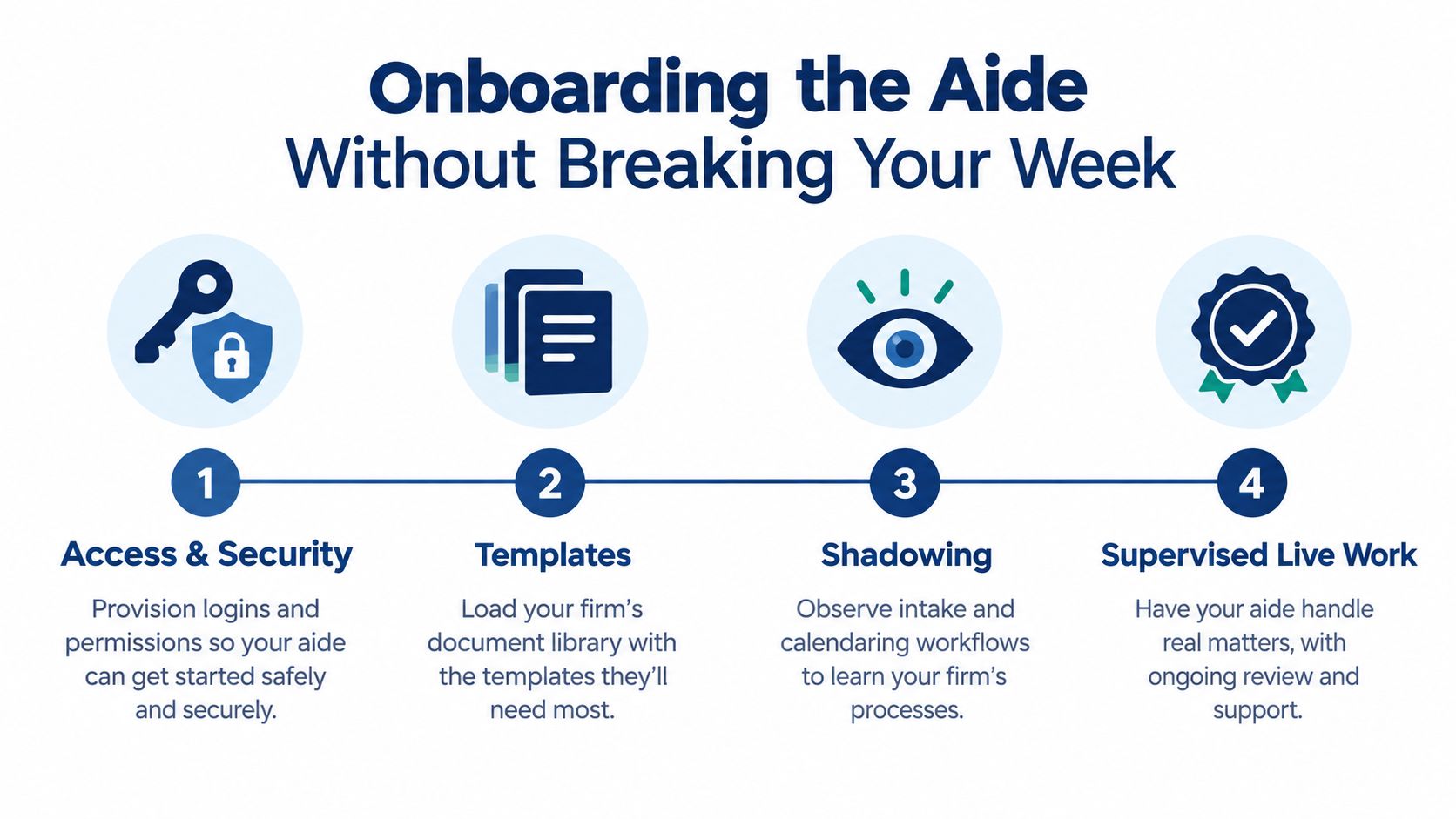
Start with access and security. Provision only the permissions the role needs across the case management system, document repository, email, phone tools, and e-filing environment. Confirm who can approve access, where credentials are stored, how client communications are documented, and what the aide must escalate immediately.
Build the firm's operating kit
The template library should include approved intake forms, caption pages, proofs of service, discovery shells, exhibit labels, records-request language, client status messages, and file-naming conventions. A template isn't a substitute for review. It is a way to stop recreating the same blank document every morning.
Document the small rules that experienced staff carry in their heads:
- Calendaring: Record the source document, proposed deadline, responsible attorney, reminder schedule, and review status.
- Conflicts: Identify required parties, search fields, escalation triggers, and the person who makes the final decision.
- File naming: Use one naming convention across pleadings, records, correspondence, and productions.
- Client communication: Define approved channels, response expectations, documentation requirements, and urgent-message routing.
For firms rebuilding several workflows at once, a practical resource on steps to improve workflow efficiency can help organize the documentation effort without turning the project into a six-month committee exercise.
Shadow first, then supervise live work
Pair the aide with a senior paralegal for observation. Let the aide watch intake setup, calendaring, records requests, and file reviews before asking for independent execution. The first live matters should run in parallel with full quality control. The aide completes the work, the experienced team member checks it, and the firm records the corrections in the SOP.
Tighten delegation after the initial observation period, not before. Skip the temptation to train on every practice area, every exception, and every obscure template on the first day. Insist on secure access, clear escalation rules, a usable starter library, and review of real work. The first month should build controlled independence, not produce an exhausted aide and a senior paralegal who now has two jobs.
Wiring the Aide Into Intake, Calendaring, and Discovery
A case management aide creates value where one workflow hands work to another. The firm should map those handoffs before assigning the role. Otherwise, the aide becomes another person waiting for information that no one owns.
New matters need a clean first handoff
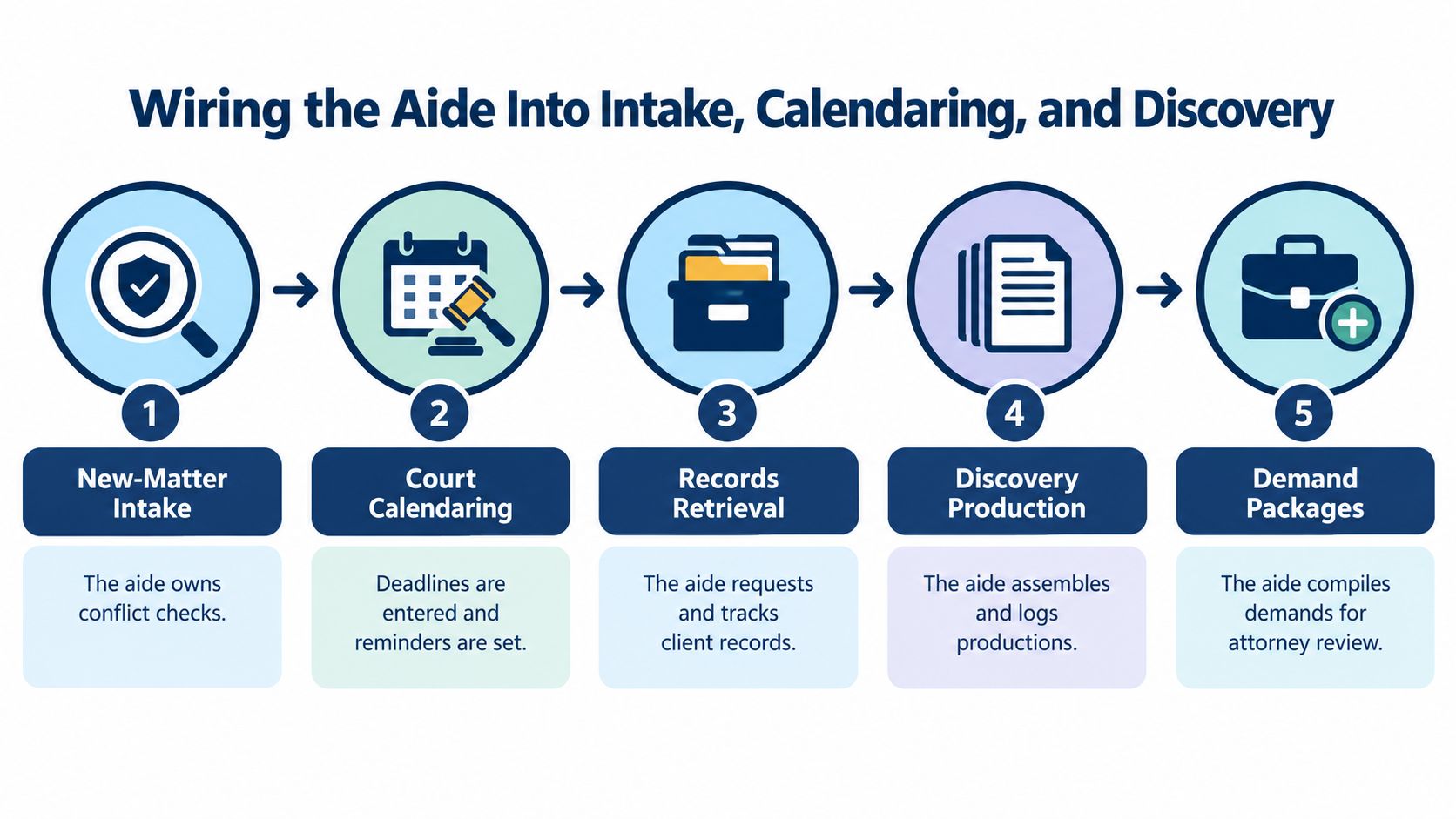
The aide receives the qualified intake record, confirms required information, enters parties and contacts, starts the conflict workflow, opens the matter, sends approved documents, and routes the file to the attorney. The intake specialist remains responsible for the conversation and qualification. The attorney retains the acceptance decision.
Law-firm intake has a basic accessibility problem before it has a conversion problem. Clio's secret-shopper study of 500 U.S. law firms found that only 40% answered the phone for a prospective client, down from 56% in 2019, and that 48% were largely unreachable by phone, according to the findings reported by InterCore's summary of legal client intake optimization. A 24/7 live intake team can answer nights and weekends, qualify appropriate matters, follow up persistently, and support English and Español coverage. A message pad cannot do those things, despite its long and distinguished career.
The aide's work begins after the first contact, but it must connect to that contact. A lead that isn't entered into the CMS can't receive structured follow-up, and a signed engagement document that isn't attached to the matter hasn't finished the intake process.
Calendaring and discovery need visible ownership
For court calendaring, the aide builds entries from source documents, records the rule or order that supports the date, sets reminders, and sends the proposed calendar for attorney approval. Entries should be locked or marked approved only after review.
For discovery, the aide can prepare standard request packages, track service and response status, organize incoming materials, log productions, and coordinate approved formatting. The paralegal handles substantive coordination, while the attorney decides what the discovery means and how the firm responds.
The same operating logic applies to records and demand packages. The aide tracks each provider, follows up repeatedly, checks completeness against the treatment timeline, and assembles records, billing materials, chronologies, and exhibits for attorney review. The Attorney Assistant case management system guide offers a useful reference for thinking about where the aide should write updates back into the CMS rather than maintaining a private spreadsheet that only one person understands.
A short daily huddle, attorney sign-off on high-risk dates, and weekly quality review keep the handoffs intact. The aide owns execution. The supervising attorney owns judgment. Operations owns the system that allows both to see what is happening.
QA and Oversight Inside a Co-Managed Model
Quality control works best when it sits inside the task. A monthly audit that discovers a missed escalation is useful, but it's late. The aide needs checklists before recurring work, review points for higher-risk outputs, and a clear path for correcting the process rather than merely correcting the person.
Use three layers of control
The first layer is a pre-task checklist. A calendaring checklist might require the source order, date basis, responsible attorney, reminder sequence, and review status. A records checklist might require the authorization, provider details, submission format, follow-up date, and completeness review.
The second layer is attorney-in-the-loop review. Court filings, deadline entries, client communications involving legal substance, and demand materials should have a defined reviewer. The aide shouldn't wonder whether review is required, and the attorney shouldn't discover the rule by accident.
The third layer is a dashboard that shows performance by matter type. Keep it small enough that someone will use it. A scorecard can track:
- Calendaring accuracy: Corrections identified during review, grouped by cause.
- Intake cycle time: Time from qualified inquiry to complete matter setup.
- Discovery backlog: Open requests and productions requiring action.
- Communication responsiveness: Outstanding client or provider follow-ups and aging.
| Metric | Target | Review Cadence | Owner |
|---|---|---|---|
| Calendaring accuracy | No unreviewed critical entries | Weekly | Supervising attorney |
| Intake cycle time | Within the firm's approved service standard | Weekly | Intake lead and aide |
| Discovery backlog days | Within matter-specific tolerance | Weekly | Paralegal |
| Client communication response rates | Within documented communication standard | Monthly | Operations lead |
Review the system, not just the score
A weekly standup should be short and specific. Review exceptions, recurring corrections, blocked matters, and workload changes. A monthly retrospective with operations should ask whether the SOP, template, permission structure, or staffing allocation caused the problem.
Co-management means shared accountability. The aide owns execution, the attorney owns legal judgment, and the operations lead owns the conditions under which the work gets done. Firms refining that structure can compare it with virtual staffing solutions for law firms while keeping the decision grounded in task ownership and review design rather than vague promises about saving time.
When to Add Aides Instead of Another Attorney
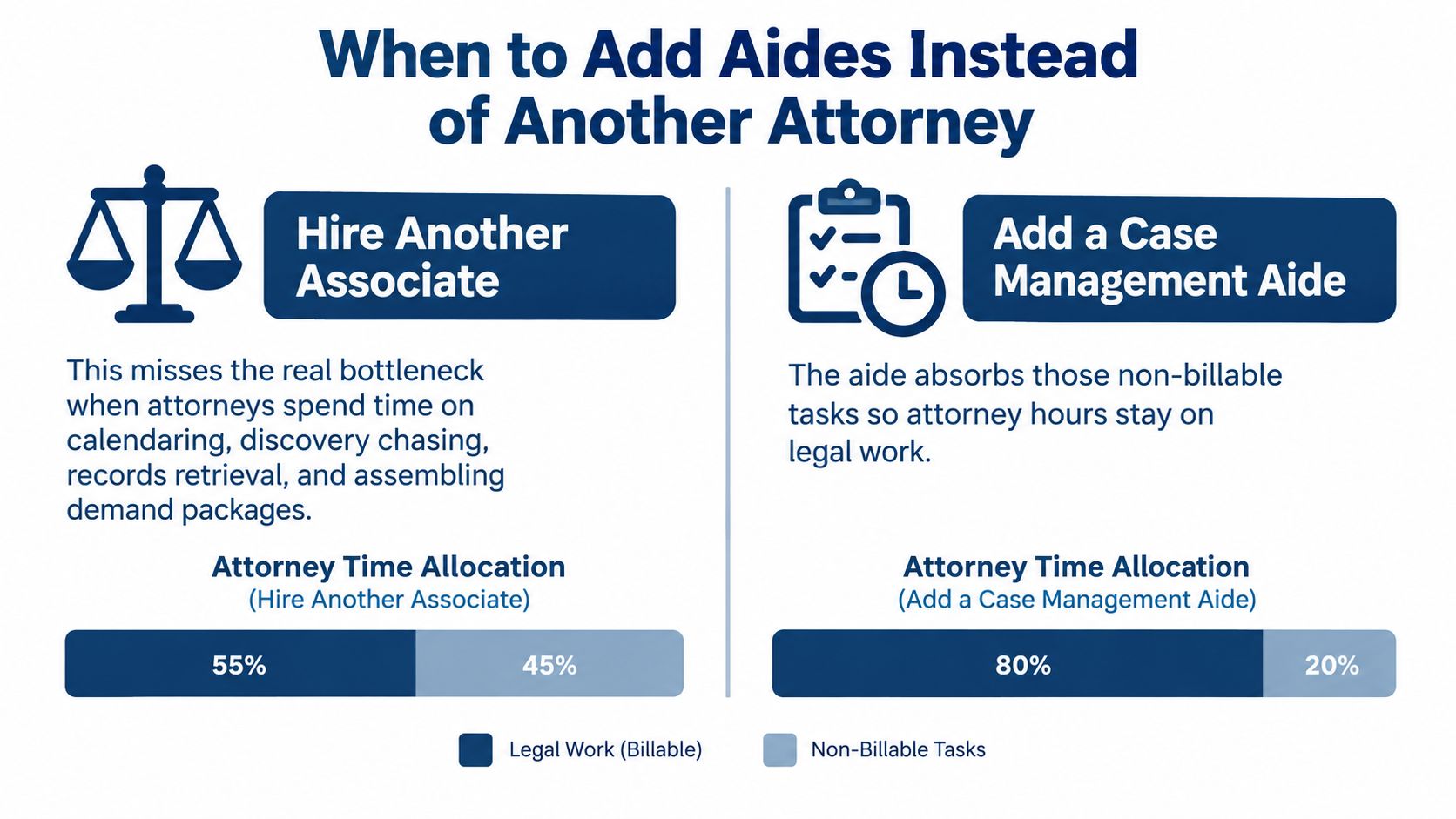
A growing caseload can make another associate seem like the obvious hire. Review the work first. If the new lawyer would spend the first month chasing medical records, entering deadlines, assembling discovery, and preparing demand exhibits, the firm is purchasing legal capacity and assigning it file administration.
The capacity problem often stays hidden because the work is scattered across several roles. Thomson Reuters Institute reported that partners write off over 300 hours of their own potentially billable time after recording it, due to pre-bill review and related reductions, in its law-firm billing write-downs report. A separate national survey reported that roughly one-third of lawyers' work hours in Michigan went unbilled, while 50% of respondents identified administrative or practice-management tasks, including document management, filing, docketing, and billing, as leading contributors in Legal News' coverage of the survey.
Diagnose the constraint before approving the requisition
Add a case management aide when:
- File setup consumes attorney time: Lawyers open matters, copy intake data, prepare routine forms, or chase missing signatures.
- Discovery is chronically behind: The team knows what needs to happen, but no one owns request tracking and production organization.
- Records stall case progression: Staff send one request and wait, while incomplete packets remain hidden.
- Calendaring has no single owner: Dates live in multiple places, and corrections arrive through hallway conversations.
- Lead follow-up lacks continuity: Intake handles the first call, then the prospect enters administrative limbo.
Approve another attorney when the constraint involves courtroom coverage, complex legal analysis, legal strategy, client advice, or substantive negotiation. Those responsibilities require a lawyer. A file-maintenance backlog calls for accountable operational support.
For firms comparing workload with available capacity, metrics and steps for resource allocation offers a useful planning lens. The useful question is concrete: who is doing the work today, and does that work require a license?
Scale support without multiplying management drag
A co-managed structure lets one supervising attorney oversee aides assigned to defined workflows or practice areas. The aide can work inside the firm's systems, learn its preferences, and receive ongoing operational support while remaining accountable for assigned file work. The case management model keeps ownership explicit at every handoff, rather than sending tasks into a shared queue and hoping the person who picks them up understands the matter.
The broader legal hiring market supports a deliberate staffing review. Recent market data indicated 24,300 paralegal jobs and 68,200 paralegal and legal operations roles were posted in 2025, according to Robert Half's legal hiring research. The practical lesson is straightforward: workflow-heavy support deserves planned capacity, while legal judgment should remain with attorneys.
A Practical Rollout Plan and What to Do Next
Start Monday with a task audit, not a job description. Review a sample of active matters and mark who currently performs each activity: aide, paralegal, attorney, intake specialist, or nobody. The last category is often the most revealing.
Then select the two workflows causing the most friction, usually intake setup and calendaring, records and discovery, or another pair specific to the practice. Write the SOPs for those workflows before expanding the role. Each SOP should state the trigger, required inputs, system location, owner, review point, escalation rule, and definition of complete.
Make the first rollout narrow and observable
Provision access in the CMS and document repository. Load the approved templates. Run a shadow week in which the aide observes the work, documents unclear decisions, and practices in a controlled environment. Move into live delegation only after the supervising team agrees on what the aide can complete independently.
Schedule a 14-day QA review before the first live matters are forgotten in the normal noise of practice. Examine missing fields, deadline corrections, incomplete records, response delays, and tasks that still return to attorneys without a clear reason. Fix the workflow where possible. Blaming the aide for an unclear process is an efficient way to preserve the unclear process.
A case management aide is the operational seam between first contact, file opening, deadline control, evidence collection, and attorney review. Scaling that seam through co-managed staffing helps firms avoid the familiar cycle of hiring another associate to solve a problem created by unsupported operations. Frontline captures and follows up on opportunities. Staffline provides dedicated full-time legal support across case management, records, liens, file opening, calendars, CRM hygiene, intake, and administration. The firm supplies its procedures and judgment. The operating team keeps the work moving.
Choose one measurable outcome for the first ninety days. For example, reduce attorney administrative hours per case by a defined amount established from your baseline, while maintaining deadline accuracy and review standards. If the firm can't see the change in its own records, it hasn't implemented a staffing model yet. It has only added another person to the hallway.
Attorney Assistant provides dedicated legal support staff through Staffline and 24/7 live intake through Frontline, with co-managed workflows for intake, case setup, records, follow-up, and ongoing administration. Visit Attorney Assistant to discuss where your firm is losing attorney time or case opportunities, and pressure-test whether a case management aide is the right next capacity hire.
Related Articles

1st Dollar Coverage in Law Firm Retainers: A Practical Guide
Understand 1st dollar coverage in legal and insurance contexts. Learn how it shapes intake, retainer strategy, firm revenue, and risk.

10 Business Finance Course Options for Law Firms
Compare 10 business finance course options by level, format, workload, and law-firm relevance, then choose the right fit for your role and goals.

Virtual Staffing Solutions for Law Firms
Discover how virtual staffing solutions build real operational capacity for law firms. Learn about co-managed models, dedicated legal support, and 24/7 intake.