
A phone rings while the attorney who should answer it is requesting medical records. The receptionist is already on another call, the case manager is trying to clean up yesterday's CRM entries, and the new lead goes to voicemail. By the time someone calls back, the prospective client has found another firm, or has just decided that no answer means no help.
That scene is less a lead-generation problem than a capacity problem. Virtual staffing solutions for law firms work best when they add the specific operational capacity a growing practice lacks, rather than functioning as a cheaper substitute for whoever happens to be overwhelmed today. The objective is straightforward: capture opportunities quickly, move matters forward consistently, and keep attorneys focused on work that actually requires legal judgment.
Table of Contents
- The Operational Reality of Law Firm Growth
- Where Attorney Time and Firm Revenue Disappear
- Moving Beyond Generic Outsourcing to Co-Managed Teams
- Matching Roles to Firm Bottlenecks
- Rethinking the Economics of Legal Staffing
- Measuring the ROI of Virtual Legal Operations
- Implementing Virtual Staffing Without Breaking Current Workflows
The Operational Reality of Law Firm Growth
Growth creates a peculiar kind of disorder in a law firm. New matters arrive, marketing performs, and the caseload becomes healthier. Then the same growth pushes intake into the hands of whoever is available, leaves records requests in an inbox, and turns attorneys into part-time administrators.
The firm may have enough demand to grow, but not enough operational support to absorb it. More advertising won't repair missed calls. A new attorney won't necessarily fix incomplete follow-up. Another software subscription won't put accurate information into the system if nobody owns the process.
Practical rule: Add capacity to the bottleneck, not prestige to the org chart.
Virtual staffing becomes useful when the firm separates two kinds of work. Frontline work captures, qualifies, follows up with, and signs suitable opportunities. Staffline work carries existing matters through the operational steps that keep cases moving. The person answering the phone shouldn't also be responsible for indexing documents, and the attorney reviewing a demand shouldn't be chasing a missing billing statement.
The broader virtual assistant services market illustrates how far remote staffing has moved beyond occasional administrative help. One industry analysis estimates growth from $3.41 billion in 2020 to $19.6 billion in 2025, with projections of $23.8 billion in 2026 and more than $34 billion by 2030, all figures reported in the virtual assistant services market analysis. Those figures describe a broad category, not a promise for any individual firm, but they reflect a structural shift toward distributed capacity.
The work that signs and the work that carries
A law firm needs both sides operating properly.
- Frontline capacity answers new inquiries around the clock, including nights, weekends, and overflow periods.
- Case-support capacity handles repeatable work such as file opening, records requests, calendar management, lien reduction, and CRM maintenance.
- Attorney capacity stays reserved for analysis, negotiation, advocacy, strategy, and client decisions.
That separation is the point. The firm isn't outsourcing responsibility. It's assigning work to people with the right training, access, oversight, and performance expectations.
AI can also help firms organize research, drafting, and workflow support, but it still needs a human process around it. A practical resource on AI for law firms is useful for evaluating where automation can assist without pretending that a tool can own intake, judgment, or accountability.
Where Attorney Time and Firm Revenue Disappear
The operational leak usually appears in places that don't show up neatly on a profit-and-loss statement. An attorney spends the morning requesting records, the afternoon answering routine status questions, and the evening cleaning up a matter file. The firm calls this “being busy,” which is accurate but not especially diagnostic.
Solo attorneys reportedly spend roughly 62% to 67% of the workday on non-billable tasks, equivalent to about 5 to 5.4 hours each day, according to the summary of Clio Legal Trends data on legal operations support. The exact burden varies by practice and workflow, but the operational conclusion is clear. A firm can be full of activity while its most expensive professionals spend much of their time on work that doesn't require a law degree.
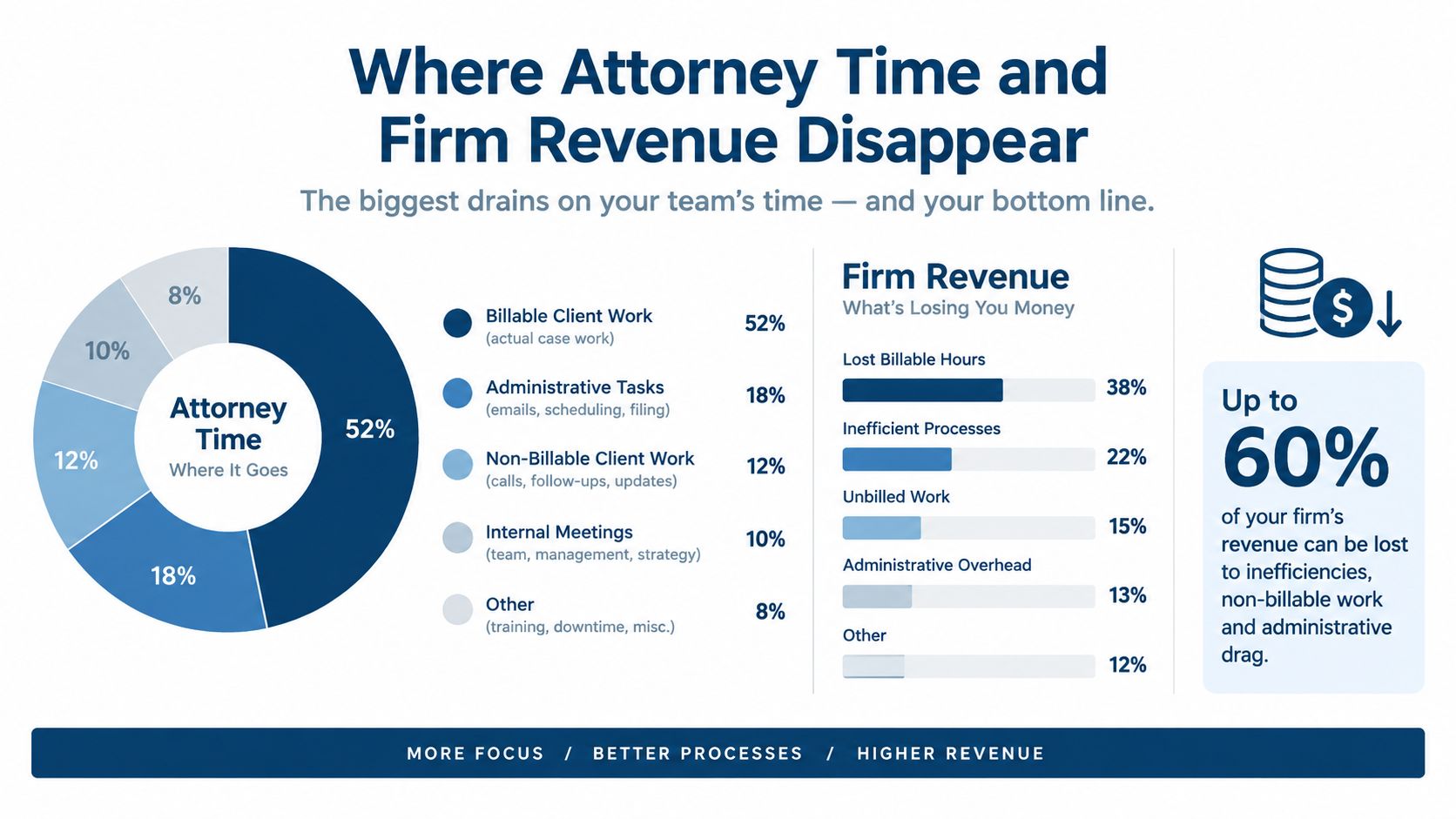
Phone access creates a separate leak. Clio's 2024 secret-shopper study of 500 U.S. firms found that only 40% answered an initial call, while only 52% were reachable at all after callbacks, leaving 48% effectively unreachable by phone, as summarized in legal client intake statistics from Pareto Legal. A missed call isn't merely a customer-service blemish. It can represent a matter the firm paid to attract and failed to handle.
The diagnosis is operational, not motivational
The usual response is to ask attorneys and staff to work harder. That may clear a temporary backlog, but it doesn't create a reliable system. If intake lives primarily inside someone's memory, the firm has built the world's least reliable CRM.
Look for these signs:
- Attorney-admin overlap: Lawyers routinely perform records, scheduling, data entry, or status-update work.
- Unowned follow-up: Nobody can state who contacts an unretained lead, when they do it, or how many attempts are expected.
- Phone dependency: The firm relies on one person being near a ringing phone during business hours.
- Stale systems: The CRM doesn't reflect the actual status of leads, matters, or outstanding requests.
- Handoff friction: A lead, file, or records request changes hands without a clear next action.
Marketing can increase the volume of opportunities, but it can't compensate for a process that loses them. The firm needs a staffing model that assigns ownership to each stage, measures completion, and gives attorneys fewer reasons to become the emergency backup for every administrative task.
Moving Beyond Generic Outsourcing to Co-Managed Teams
Generic outsourcing often fails because it treats legal work as interchangeable task volume. A remote worker receives a vague instruction, works in a separate environment, and sends something back for review. The firm remains responsible for the context, quality control, corrections, and eventual consequences. The invoice may be lower, but the management burden has merely changed clothes.
A co-managed team works differently. The professional operates inside the firm's systems, follows the firm's matter workflows, and works toward service-level expectations agreed with the firm. The provider handles sourcing, legal-support training, and performance support. The firm teaches its preferences, procedures, escalation rules, and definition of done.
Shared work versus embedded ownership
| Generic outsourcing model | Co-managed staffing model |
|---|---|
| Tasks are sent out as isolated requests | Work is assigned within a continuing workflow |
| The provider may share workers across clients | A dedicated professional supports one firm |
| The firm often manages quality alone | Oversight and performance management are shared |
| Context is repeatedly explained | The professional learns the firm's matters and systems |
| Success is measured by activity | Success is measured by completion, accuracy, and handoff quality |
Dedicated work matters because legal operations are full of exceptions. A records request isn't just a form. It has a matter, a provider, an authorization, a deadline, a follow-up history, and a person who needs to know what happens next. A case-management professional who knows the firm's naming conventions and escalation process will usually create less friction than a rotating worker starting from a blank screen.
The same principle applies to organizational support beyond law firms. A useful outsource HR UK guide frames outsourcing as a question of responsibility and operating design, not just labor price. Law firms should ask the same question: which responsibilities remain with the firm, and which ones should the staffing partner own?
Watch the short overview below for a visual explanation of the co-managed approach.
Build the operating relationship deliberately
The firm still directs daily work. That means leadership must define priorities, provide access, document workflows, and review results. Co-managed doesn't mean unattended. It means the firm isn't forced to carry every recruiting, replacement, training, and performance task by itself.
The practical model is also explained through this case management model for law firms, particularly the relationship between matter ownership, repeatable processes, and attorney oversight. The strongest virtual staffing solutions become part of that model instead of sitting beside it as a disconnected vendor layer.
Matching Roles to Firm Bottlenecks
A firm shouldn't begin by asking, “Should we hire a virtual assistant?” It should ask, “Where does work stop moving?”
If the bottleneck is new business, the answer is a live intake function. If the bottleneck is the existing caseload, the answer is dedicated case-support capacity. Those are different jobs with different schedules, training requirements, quality controls, and measures of success.
Use live intake when latency is the leak
Frontline intake is a latency-sensitive conversion pipeline. The team answers calls, qualifies matters, follows up with prospects, schedules consultations, and supports appropriate retainer signing. It needs coverage when the office is closed, not just when the receptionist is at her desk.
The legal intake data is blunt. Firms responding within 5 minutes reportedly achieve about 400% higher conversion than firms responding after 30 minutes or more, while only 25% of firms meet the 5-minute threshold, according to law-firm intake conversion benchmarks. The same source reports a 13-minute median response time, with 39% of firms taking more than 2 hours or never replying.
That makes the operating requirements specific:
- Coverage: Nights, weekends, holidays, and overflow periods.
- Qualification: A consistent script that identifies fit, urgency, jurisdiction, and the next appropriate step.
- Follow-up: Structured, persistent outreach rather than one call followed by silence.
- Quality assurance: Call reviews, escalation rules, and documented outcomes.
- Language access: English and Español where the firm's client base requires it.
Taking a message is not intake. Intake means creating a useful next step while the prospect is still engaged.
Use dedicated support when the caseload is stuck
Staffline-style support is designed for the work that carries a matter after the initial opportunity is captured. Roles may include case management, medical-record and bill retrieval, lien reduction, file opening, calendar and inbox management, CRM hygiene, and administrative support.
Medical records illustrate why ownership matters. HHS says covered entities generally must act on an individual's access request within 30 calendar days, with one additional 30-day extension permitted when the required written notice is provided, as explained in medical-record access requirements from HHS. A dedicated records professional can track authorization status, request routing, follow-up, receipt, indexing, and escalation before the process disappears into an inbox.
For a broader view of the administrative role, these administrative assistant tips from Virtustant Jobs help clarify how scheduling, organization, communication, and task ownership translate into measurable support work.
The simplest allocation rule is this: Frontline signs the case. Staffline carries it. Some firms need one function first. Growing firms often need both, but they shouldn't confuse their purposes.
Rethinking the Economics of Legal Staffing
Hourly pricing is easy to understand, which is why firms often use it as the entire staffing analysis. It answers what a person costs to be available. It doesn't answer what the firm recovered, completed, or prevented from falling through the cracks.
For intake, the useful unit may be a completed action: a qualified contact, a documented follow-up attempt, a booked consultation, a warm transfer, or a signed retainer. For case support, the useful unit may be an indexed record, a completed request, a clean file opening, a resolved lien task, or a handoff completed within the agreed service level.
That doesn't make hourly staffing irrelevant. A dedicated full-time professional may be the right choice when the firm has a steady queue, needs continuity, and wants one person to learn its systems thoroughly. Action-based intake can make more sense when call volume fluctuates and the firm wants to connect spend to completed work rather than idle coverage.
Price the cost of the missed action
Start with the firm's existing baseline:
- Count missed calls and unworked inquiries over a representative operating period.
- Record how many prospects receive a first response, and how quickly.
- Track follow-up attempts through consultation, qualification, and retainer.
- Compare the cost of the staffing model with the value of the opportunities it helps recover.
Don't claim that every contacted lead becomes a case. That would be marketing fiction with a spreadsheet attached. The defensible point is that faster response and consistent follow-up create more chances for the firm to evaluate and convert suitable matters.
A broader benchmark places the global remote staffing market at $36.3 billion in 2023 and projects a 15.4% compound annual growth rate from 2023 to 2030. The same remote staffing market analysis cites U.S. temporary help services revenue of about $106.4 billion in 2023 and SHRM-cited hiring costs of $4,129 for remote roles versus $5,500 for in-office roles. These figures indicate that distributed staffing is becoming a structural channel, but they don't decide which model fits a particular legal workflow.
Month-to-month terms can also reduce the friction of adjusting capacity. The trade-off is that flexible staffing still requires clear ownership. Scaling down a role without transferring its open tasks is not efficiency. It's how a backlog gets a new address.
Measuring the ROI of Virtual Legal Operations
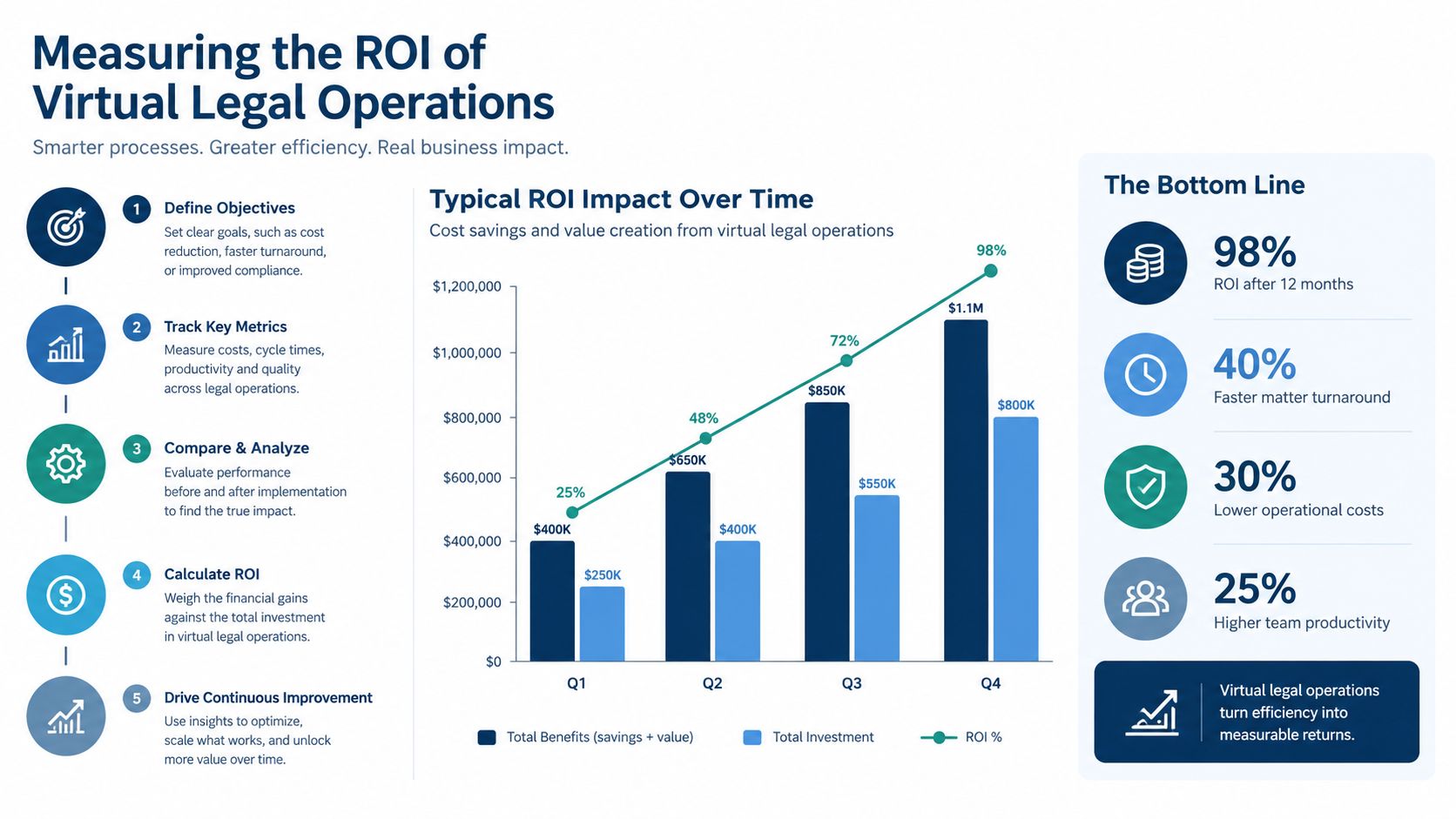
A virtual team proves its value through operational evidence, not a full calendar. The best metrics show whether work moves faster, arrives more accurately, and reaches the next owner without repeated intervention.
Start with intake latency:
- Median first-response time: How long a new inquiry waits before a human response.
- Five-minute contact rate: The share of leads reached within the critical early window.
- Thirty-minute contact rate: The share reached before the larger response delay appears.
- Follow-up completion: Whether the agreed sequence actually occurs.
- Handoff latency: The time between qualification and attorney, case manager, or consultation handoff.
The benchmark in the earlier intake analysis makes speed measurable rather than theoretical. A firm can review the numbers weekly, identify where the delay occurs, and change staffing coverage or escalation rules accordingly.
Measure case-support throughput separately
Remote staffing performs best when the work has a clear input, output, and review standard. Industry data cited in legal client intake and operations benchmarks reports remote teams completing 22% more projects and 13% more tasks per week, with 64% of employees reporting higher task accuracy. The same source reports office-cost savings of about $11,000 per remote employee per year and higher productivity reported by 91% of remote workers.
Those figures aren't a guarantee for a law firm. They show why process design matters. Track completion time, error rate, rework, backlog age, and handoff quality for each task family. A records team should not be judged by hours online if requests remain incomplete. A CRM specialist shouldn't be praised for activity if the pipeline still can't be trusted.
The practical virtual legal assistant cost framework is useful when comparing staffing expense with the amount of attorney time, missed opportunity, and administrative rework the role is designed to remove.
Implementing Virtual Staffing Without Breaking Current Workflows
A virtual staffing deployment should begin with a workflow audit, not a job title. The firm needs to know what work is entering the system, where it waits, who touches it, and what “complete” actually means.
Start with the queue
Pull a recent sample of open tasks, missed inquiries, aging records requests, unassigned leads, and files waiting for administrative action. Group them by volume and ambiguity.
Good early candidates usually have:
- Repeatable steps: The process can be written down and followed consistently.
- Clear outputs: Someone can verify completion without interpreting legal strategy.
- Defined escalation points: The professional knows when to stop and ask an attorney or manager.
- Useful system access: The work can happen in the firm's case-management system, CRM, email, calendar, and document tools.
- A measurable service level: The firm can track speed, accuracy, or backlog reduction.
Don't start with the most legally sensitive or poorly understood process. If the team can't explain how the work is done internally, a new professional won't magically discover the answer between two calendar invites.
Document the work before assigning it
Write a short standard operating procedure for each task. Include the trigger, required information, step sequence, naming conventions, quality check, escalation rule, and handoff recipient. Record a screen walkthrough if that is faster than writing, then turn the recording into a checklist.
For intake, document qualification criteria, disqualifiers, consultation rules, conflict-check routing, emergency escalation, and follow-up expectations. For records, document authorization review, request submission, status tracking, receipt handling, indexing, and billing-statement matching.
Onboard with controlled ownership
Use a staged handoff:
- Observe: The professional watches the current process and reviews examples.
- Practice: The professional completes sample work with immediate review.
- Own a lane: The professional takes responsibility for a defined task family.
- Expand carefully: Add adjacent work only after quality and timing are stable.
- Review routinely: Use a recurring scorecard for completion, accuracy, backlog, and escalations.
Keep an attorney out of routine supervision wherever a trained operations lead can handle it. The attorney should receive exceptions and decisions, not every ordinary question that could have been answered by a documented procedure.
A virtual legal assistants service model can support this kind of deployment when the role is defined around the firm's workflows rather than a generic list of tasks. The firm still owns legal judgment and process fit. The staffing partner should provide trained personnel, structured support, and accountability around the work.
Protect the handoffs
Every task should have one owner, one next action, and one due point. Review access permissions, confidentiality procedures, quality checks, and escalation paths before live work begins. Then compare the baseline with the new operating results, instead of relying on the pleasant but unreliable feeling that everyone seems less stressed.
Growth becomes manageable when the firm stops treating capacity as an emergency purchase. Staffline can provide dedicated legal support professionals for case management, records, liens, file opening, calendars, CRM hygiene, intake, and administrative work, while Frontline provides 24/7 live intake, qualification, follow-up, and appropriate case-signing support. To identify where your firm is losing attorney time or prospective matters, visit Attorney Assistant and evaluate the staffing model against your actual workflow.
Related Articles

Fear of Talking on Phone: 7 Practical Confidence Tips
Overcome fear of talking on phone with practical scripts, role-play, exposure exercises, and intake tools built for legal teams.

Preferred Method of Contact for Law Firm Intake
Discover how to capture and use the preferred method of contact in legal intake to improve conversions, ensure compliance, and streamline law firm operations.

1st Dollar Coverage in Law Firm Retainers: A Practical Guide
Understand 1st dollar coverage in legal and insurance contexts. Learn how it shapes intake, retainer strategy, firm revenue, and risk.