Lawyer Billable Hours Average Benchmarks for 2026

The lawyer billable hours average clusters around a 2025 median of about 1,597 annual fees-billed hours per attorney, and that figure is a production benchmark rather than a quota. That distinction matters more than the number itself, because most arguments about billable hours start when someone treats a median, a requirement, and a collected hour as the same thing.
They aren't. A firm can require one number, record another, invoice less than that, and collect less still, while every attorney in the building insists, correctly, that they're busy. The useful question isn't whether your lawyers clear some national bar. It's where time leaves the funnel between work done and cash collected, and whether that leak is an attorney problem or an operations problem wearing an attorney's clothes.
Table of Contents
- Average Billable Hours per Lawyer Across the Benchmarks
- Common Billable Targets by Firm Size
- Recorded, Invoiced, and Collected Hours in a Workday
- Diagnosing the Gap Between Hours Worked and Hours Billed
- Practice Area, Fee Model, and Region Change the Number
- How to Set a Billable Target from Your Own Data
- Where Administrative Work Takes Hours from Lawyers
- When a Billable Target Change Is Justified
Average Billable Hours per Lawyer Across the Benchmarks
There's no single lawyer billable hours average, but the credible benchmarks cluster in a fairly tight band once you sort them by what they measure. The 2025 law-firm financial benchmark survey from Withum reported median annual fees-billed hours of approximately 1,597 per attorney. That's the headline figure most readers came for, and it's also the one most likely to be misused.
Split it and the picture changes quickly. That same survey put small firms at about 1,266 hours and larger firms at about 1,419 hours, with larger firms showing a 90% billable-time ratio. Thomson Reuters, cited in the same benchmark guidance, reported legal-market productivity of approximately 115 hours per lawyer per month in its 2023 financial-index data, which works out to about 1,380 hours a year if sustained across twelve months.
Billed Hours Are Not Required Hours
Two other figures get folded into this conversation constantly, and they measure something different. Attorneys at more than 130 large U.S. law firms averaged 1,542 billable hours per lawyer in 2023, according to Wells Fargo's Legal Specialty Group survey as reported by ABA Journal. That's hours billed at big firms, and it sits comfortably below the requirements those firms typically advertise.
Requirements are a policy choice, not a measurement of output. NALP's older employer data put average requirements near 1,900 hours, and NALP noted that a 2,000-hour annual requirement was still not typical, even though it had become more common over time. When a managing partner compares a lawyer's billed hours against another firm's stated requirement, they're comparing production against aspiration. That's not benchmarking. That's just losing an argument with extra steps.
| Benchmark | Year | Figure (hours per year) | What it measures |
|---|---|---|---|
| Median fees-billed hours, all firms surveyed | 2025 | about 1,597 | Hours billed per attorney |
| Median fees-billed hours, small firms | 2025 | about 1,266 | Hours billed per attorney |
| Median fees-billed hours, larger firms | 2025 | about 1,419 | Hours billed per attorney |
| Average billable hours, large U.S. firms (130+ firms) | 2023 | 1,542 | Hours billed per lawyer |
| Legal-market productivity, Thomson Reuters index | 2023 | about 1,380 (about 115 per month) | Hours per lawyer if sustained for a year |
| Average billable-hours requirement, all surveyed employers | 2015-2016 | 1,892 | Required annual target |
| Average billable-hours requirement, firms over 700 attorneys | 2015-2016 | 1,930 | Required annual target |
How to Read This Without Lying to Yourself
Every figure in that table blends something. Averages combine partners, associates, different practice groups, and attorneys working under hourly, contingency, flat-fee, or hybrid arrangements. A partner who spends her week on origination and supervision and a third-year associate doing discovery review do not live in the same statistical universe, no matter what the spreadsheet says.
So use the table in two steps. First, find the row that matches your segment and firm size. Second, and many firms skip this step, check whether your internal number measures hours billed or hours required before you compare anything. If those two don't match, the comparison is noise.
Practical rule: Treat 1,597 hours as a production reference point for "what do firms like ours actually bill," and treat anything near 1,900 as a policy statement until your own data proves it's achievable.
Common Billable Targets by Firm Size
The most common annual target depends on headcount, and it has depended on headcount for a long time. NALP's summary of 2004 billable-hour requirements found that 1,800 hours was the most frequently reported nationwide minimum, reported by 24.0% of offices. That number became the profession's default answer, repeated so often that many partners treat it as a law of nature rather than a survey result from two decades ago.
Look at the size bands and the default starts to wobble. Among firms with 100 or fewer attorneys, 43.3% of offices reported 1,800 hours, making it the clear mode for that segment. At firms with 101 to 250 attorneys, 1,800 hours was also most common, at 26.8% of offices. Past that point, expectations climb.
| Firm size | Most common target (hours) | Share of offices reporting it |
|---|---|---|
| All surveyed offices nationwide | 1,800 | 24.0% |
| 100 or fewer attorneys | 1,800 | 43.3% |
| 101-250 attorneys | 1,800 | 26.8% |
| 251-500 attorneys | 1,900 | Most frequently reported in band |
| 501 or more attorneys | 1,950 | Most frequently reported in band |
Why the Ladder Makes Sense, and Where It Misleads
Larger firms set higher common targets partly because they can. They have deeper support benches, more specialized roles, and associates whose jobs are structured almost entirely around billable production. A 12-lawyer firm where partners review intake, chase records, and fix the calendar doesn't have that scaffolding, so importing a 1,950-hour expectation from a 600-lawyer firm is borrowing the number without borrowing the infrastructure that makes it possible.
The growth data since then reinforces how unevenly capacity expands. Clio's 2024 research on mid-sized firms reported that solo firms recorded only a little over 1% growth in captured billable hours since 2016, small firms recorded more than 8% growth, and mid-sized firms captured nearly 60% more billable hours than in 2016. That's not a rounding difference. Firm-level captured hours, individual lawyer billing, and collected revenue moved at very different speeds depending on size.
Clio also reported that the average lawyer in mid-sized firms billed 140% more and collected nearly 180% more, while solo lawyers saw individual billing rise by more than 75% despite that flat firm-level capture. Read those together and a less obvious conclusion emerges: revenue gains came substantially from rates, billing discipline, and collections, not just from piling on hours.
Use the 2004 Data for What It Is
Be candid about the vintage here. The NALP size bands are from 2004, so they're a historical anchor for how targets were set, not a current standard you should adopt wholesale. Technology, remote work, and fee structures have all moved since then.
Your action is simple and takes about a minute. Match your headcount to a row, note whether your firm's target sits above or below it, and then ask the harder question: does your support structure resemble the firms in that band, or just their number? If your attorneys carry intake and administration that a same-sized peer delegates, you're not below target. You're understaffed in a way the target can't see.
Recorded, Invoiced, and Collected Hours in a Workday
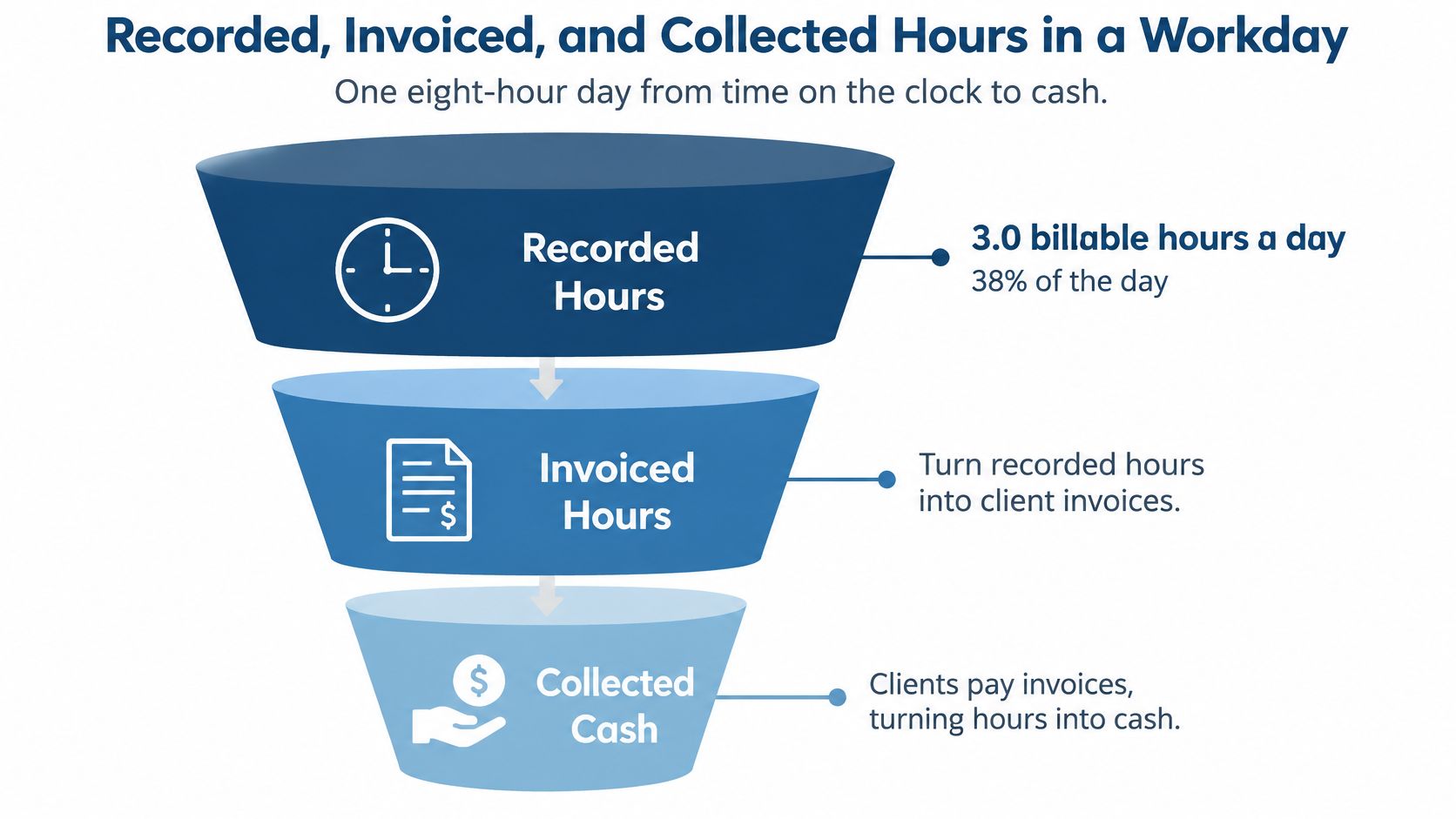
Annual totals hide the mechanism. Walk a single eight-hour day through the funnel and the lawyer billable hours average stops looking like a stamina contest and starts looking like a revenue system with three separate failure points.
Recent legal-industry benchmarking summarized by Lucen's law firm billable hours outlook indicates lawyers record billable work for roughly 38% of an eight-hour day, about 3.0 hours. Only about 88% of that time reaches an invoice, leaving approximately 2.6 invoiced hours. Firms then collect about 93% of invoiced value, equivalent to roughly 2.4 collected hours per eight-hour day.
The Older Clio Numbers Tell a Harsher Story
Set those figures beside the earlier Clio data and the funnel gets uglier. The Clio Legal Trends Report covered in Clio's press release found lawyers spent an average of only 2.3 hours per eight-hour workday on billable tasks, equivalent to 29% of the workday. After accounting for realization and collection, firms collected revenue corresponding to an average of only 1.6 hours of billable time per day.
That same report identified where the rest of the day went: 48% of lawyers' nonbillable time was attributed to administrative tasks, while 33% was spent on business development. Nearly half of nonbillable time going to administration is the single most actionable number in this entire topic, because administration is the category most amenable to delegation, process, and staffing fixes.
Why the Two Sources Disagree
You now have two funnels: one ending near 2.4 collected hours, one ending near 1.6. They disagree because they draw on different samples, different firm populations, and different definitions of realization and collection. Neither is lying to you. They're measuring different groups of firms at different times with slightly different yardsticks.
That disagreement is the point. It's a reason to measure your own firm rather than adopt either figure as your reality. The gap between sources tells you the range of plausible outcomes, and your job is figuring out where in that range you sit. Getting your time entries structured correctly at the increment level matters here, and our guide to attorney billing increments and how they shape recorded time walks through that mechanics in detail.
Pull three numbers for last quarter: hours recorded, hours invoiced, and cash collected. Divide the second by the first, then the third by the second. Those two ratios tell you more about your firm than any national average will.
An attorney who records more time but loses value to write-downs and slow payment can generate less cash than a lawyer with fewer recorded hours and clean realization. Once you see the day as a funnel, "bill more hours" stops being advice and starts being an incomplete sentence.
Diagnosing the Gap Between Hours Worked and Hours Billed
Each stage of that funnel leaks for a different reason, and each reason needs a different fix. Treating all of them as an effort problem is how firms end up exhorting attorneys who are already working long days, which everyone enjoys.
Start with the most common confusion: hours worked and hours recorded are different numbers. The gap between them is usually time never entered, or entered so late that short tasks, quick calls, and email work have evaporated from memory. Contemporaneous entry is the control here, and you can verify it cheaply by comparing time entries per day against hours on the clock. If an attorney reliably works ten-hour days and logs four entries, you don't have a productivity problem yet. You have a capture problem.
| Gap | Usual cause | What to measure |
|---|---|---|
| Hours worked vs hours recorded | Time not entered, or entered late | Time entries per day against hours on the clock |
| Hours recorded vs hours invoiced | Write-downs and delayed billing | Write-down rate per matter |
| Hours invoiced vs cash collected | Nonpayment and slow collections | Days from invoice to payment |
| Available hours vs billable hours | Intake, follow-up, records and scheduling | Non-billable admin hours per attorney per week |
| Partner time written down | Rework, learning unfamiliar law, correcting associate work | Partner write-downs of own time per year |
The Write-Down Leak Nobody Puts in the Target
The largest hidden leak sits in the last row. The Thomson Reuters Institute research on the AI-driven future of legal work reported that the average partner writes down approximately 300 hours of their own time annually, with the research emphasizing that much of this time may have been billable rather than nonbillable. The recurring sources of leakage include learning unfamiliar law, correcting associate work, legal research, and drafting litigation documents.
Think about what 300 hours means against a 1,800-hour target. That's a partner effectively producing at a 2,100-hour pace and invoicing at 1,800, with the difference absorbed by rework and inefficiency rather than rest. Telling that partner to bill more is technically a response. It's just not a useful one. The better questions are about matter staffing, supervision quality, and whether the same corrections get made on the same kinds of documents every month.
Match the Metric to the Gap
- Worked vs recorded: Fix entry habits and tooling first, since unentered time can't be realized or collected later.
- Recorded vs invoiced: Track write-down rate per matter, and review whether reductions cluster around certain clients, narratives, or billing delays.
- Invoiced vs collected: Track days from invoice to payment, because a collections problem disguised as a production problem leads to exactly the wrong hire.
- Available vs billable: Track non-billable admin hours per attorney per week, which is the number that makes delegation decisions for you.
Our breakdown of productivity changes that hold up in real law offices covers several of these measurement habits in practice. Measure the worked-to-recorded gap first. It's the cheapest to check, it sits at the top of the funnel, and every downstream ratio you calculate is fiction if the time never got entered.
Practice Area, Fee Model, and Region Change the Number
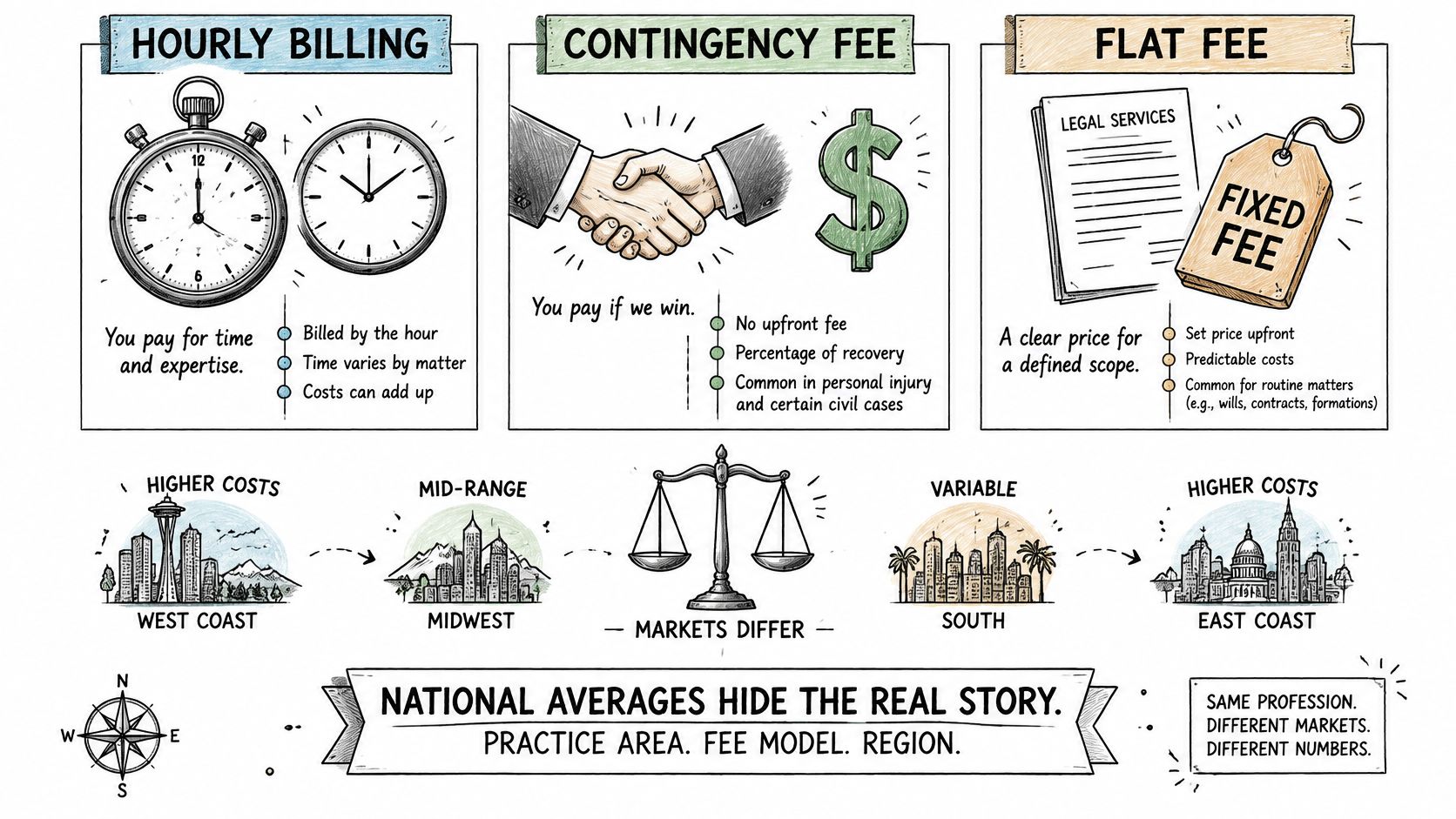
National benchmarks flatten at least three variables that determine whether a number applies to your firm at all. Fee model comes first. An hourly practice records time because time is the product being sold, and the billable hour is a direct revenue unit. A contingency or flat-fee practice may track time carefully for internal management, case valuation, or potential fee petitions, but an extra recorded hour doesn't automatically produce an extra dollar. Comparing those two firms on billable hours alone is comparing a speedometer to a fuel gauge.
Practice type reshapes the day just as much. A high-volume personal injury firm spends enormous operational energy on intake, medical records, billing records, and lien resolution, much of it necessary to move cases but none of it billable in the hourly sense. A transactional practice spends its hours drafting, negotiating, and reviewing agreements, work that maps neatly onto time entries. Both firms can be excellently run. Their hours profiles will look nothing alike.
A Hypothetical That Explains Most Benchmark Fights
Say two fictional 40-lawyer firms both set a 1,800-hour target. One is a personal injury practice where attorneys personally oversee intake quality, chase treatment records, and monitor liens. The other is a corporate boutique where support staff handle administration and attorneys spend their days on research and drafting. This example is hypothetical, not a real firm or client, but the operational contrast is the entire point: same target, completely different jobs hiding underneath it.
Seniority blends things further. Partners, associates, and counsel typically carry different targets and different administrative loads, since partners absorb management, supervision, and business development that associates don't. A firm-wide average blends those roles into a number that describes nobody in the building precisely.
On region, honesty is required: the sources behind these benchmarks don't provide reliable regional billable-hour figures, so inventing a Southeast-versus-Northeast adjustment would be decoration, not analysis. Compare within your own market, using local peers of similar size and practice mix.
Before you compare: Group your attorneys by role and matter type first. A benchmark applied to an un-segmented roster will misdiagnose your best people and excuse your worst bottlenecks.
How to Set a Billable Target from Your Own Data
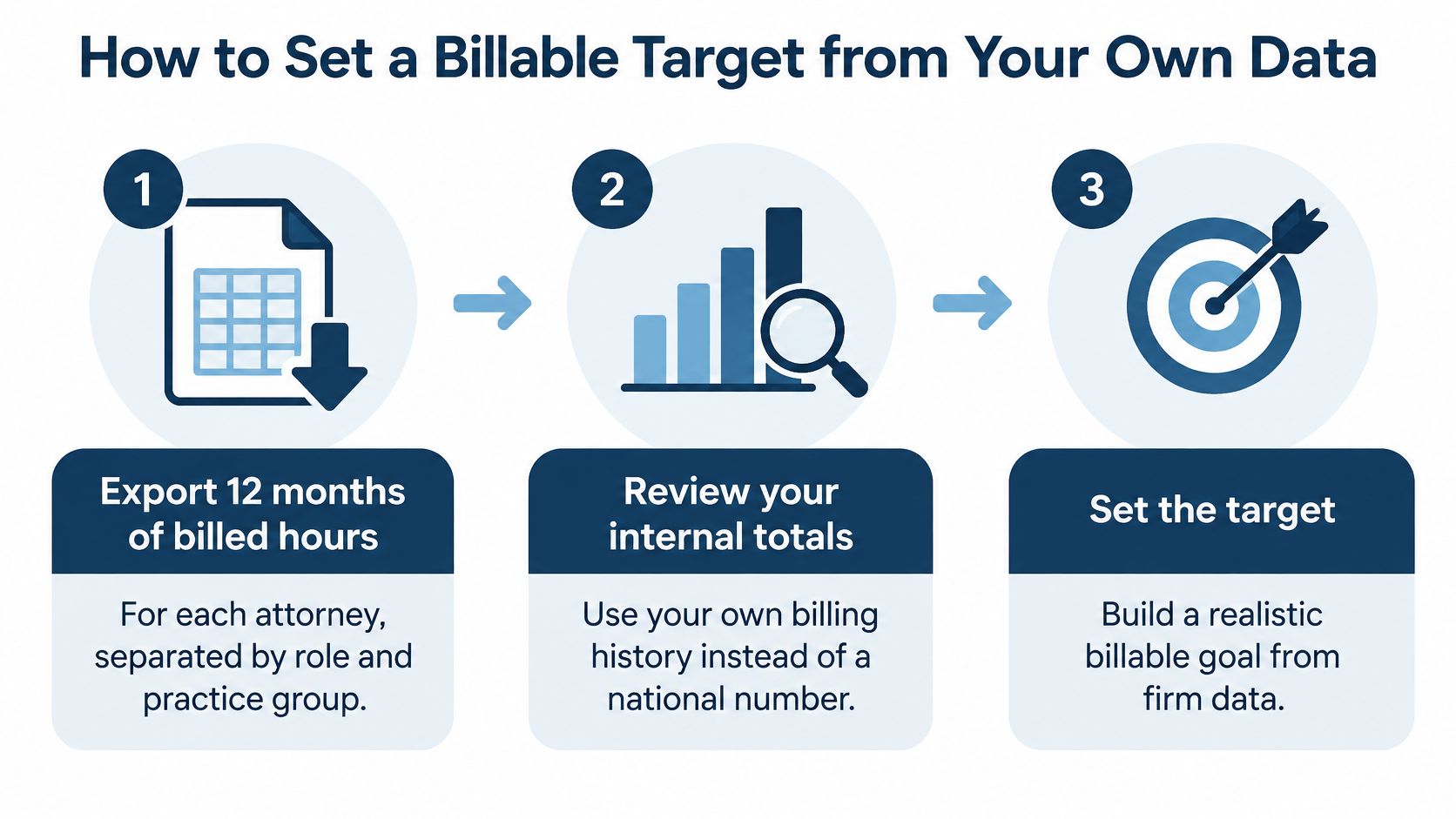
Borrowing a national number feels rigorous and takes eleven seconds, which explains its popularity. Building a target from your own billing history takes an afternoon and produces something you can manage against.
The Six Steps
- Export 12 months of billed hours for each attorney, separated by role and practice group so you're not averaging partners against first-years.
- Subtract vacation, holidays, leave, and training to get available workdays, because a 52-week calendar year never yields 52 working weeks for a human being.
- Pull your non-billable time codes for intake, records, scheduling, and administration, so you know exactly how many hours sit outside the target you're about to set.
- Calculate a rolling 12-month average for each role, which smooths out trial months, slow months, and the December effect.
- Check realization and collection next to the hours, because a target that looks strong in recorded time can hide write-downs that gut its value.
- Adjust the target only after you've quantified the administrative hours, otherwise you're raising expectations on top of an unmeasured workload.
Do the Weekly Arithmetic Before You Announce Anything
Targets often go unmet. NALP's 2015-2016 analysis of billable hour requirements reported an average billable-hours requirement of 1,892 hours per year across surveyed employers and 1,930 hours at firms with more than 700 attorneys. A target around 1,892 hours translates to roughly 36.4 billable hours per week if spread across 52 weeks, before accounting for vacation, holidays, leave, training, business development, and internal administration.
Now subtract a realistic block of leave and holidays and the weekly requirement climbs well past that figure, in weeks where the attorney also attends firm meetings, supervises staff, and talks to prospective clients. NALP also stated that a 2,000-hour annual requirement was still not typical, even though it had become somewhat more common, which should give pause to any 15-lawyer firm casually adopting it.
An annual requirement also says nothing about revenue. The target describes hours the firm expects to record as billable. Whether money follows depends on the time being entered, invoiced without reductions, and ultimately collected, which is why step five exists.
Decision rule: If an attorney is below target because of measured administrative time, the fix is delegation, not a longer week.
Set the target from your rolling average, stretch it modestly where the data supports it, and revisit it when the work underneath the number changes.
Where Administrative Work Takes Hours from Lawyers
Once you've measured non-billable time, the next task is sorting it. The core rule is simple: work that requires legal judgment stays with the attorney, while repeatable, process-driven work can be handled by trained legal support staff working to your firm's own procedures. Most firms blur that line out of habit rather than necessity, and attorneys end up doing expensive work badly because nobody else was assigned to do it well.
Your attorneys went to law school to practice law. Ideally, they should occasionally get to do that.
| Task | Needs attorney judgment? | Suitable for trained legal support? |
|---|---|---|
| First-contact intake and qualifying questions | No | Yes, with a scripted intake process |
| Lead follow-up and callbacks after missed calls | No | Yes, with a structured follow-up sequence |
| Medical records and bill requests | No | Yes |
| Lien tracking and reduction correspondence | Negotiation strategy: yes | Yes, for tracking and paperwork |
| Calendar and inbox management | No | Yes |
| Document organization and CRM hygiene | No | Yes |
| Case strategy, legal research and advice | Yes | No |
What to Confirm Before You Delegate Anything
Each row needs three things in place before it moves off an attorney's plate. First, a written script or workflow, because a process that lives inside someone's memory is the world's least reliable CRM. Second, a named owner, one person accountable for that task rather than a shared inbox where responsibility goes to be alone. Third, one measure that tells you whether it's working, such as lead response time, records turnaround, or days a file sits waiting on a document.
Take intake follow-up as the example. Technically, calling someone back four days later is follow-up. It is not particularly useful follow-up. A structured sequence with defined attempts, timing, and escalation rules converts that task from a partner's guilty conscience into a measurable operation. Our guide on how to move non-billable work off attorney plates without losing control of it lays out that handoff structure in more detail.
- Intake: Scripted qualifying questions, conflict-check prompts, and clear sign or decline criteria set by the firm.
- Records and bills: Request templates, provider follow-up cadences, and a tracker showing what's outstanding per file.
- Calendar and inbox: Triage rules for what reaches the attorney today, what waits, and what gets scheduled without asking.
- CRM hygiene: Required fields, follow-up dates, and a weekly audit, since your CRM cannot follow up with a lead if nobody puts the lead in the CRM.
Why These Tasks Come First
These categories lead the list because administration is the largest single drain in the daily figures, and because the work is important, repetitive, and procedural, which is precisely the profile that trained support staff handle consistently. Case strategy, legal research, client advice, and settlement decisions stay with the firm, full stop. Attorney Assistant is not a law firm and does not give legal advice or exercise legal judgment. Every legal decision stays with the client's firm.
Handled this way, delegation isn't about squeezing more hours from tired lawyers. It's about returning misallocated hours to the work only lawyers can bill for.
When a Billable Target Change Is Justified
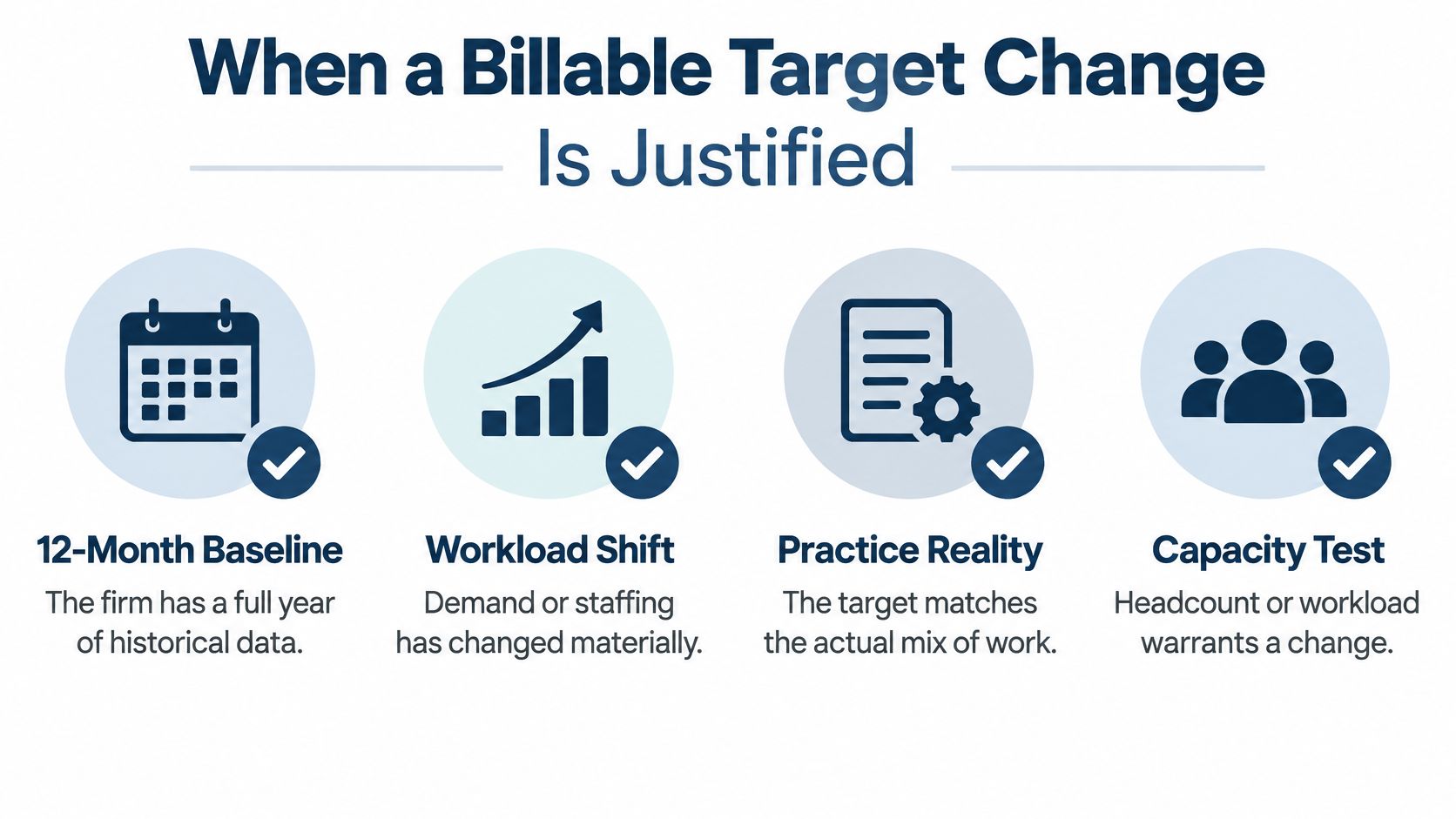
A target change earns a serious look only when four conditions hold at once. Your firm has a 12-month baseline for the attorney's role and practice group. Realization and collection are stable, so high hours aren't masking write-downs or unpaid invoices. Non-billable hours for intake, records, scheduling, and administration have been measured separately from billable time. And the gap between actual and target hours persists across a 90-day review, not one slow quarter or one attorney's parental leave.
If all four hold and the gap persists, examine the target itself, including the human cost of defending it. Acheloa Wellness offers a thoughtful resource on understanding billable hour burnout that's worth reading before anyone raises a quota. If administrative hours account for most of the shortfall instead, move that work first and measure again.
That's where we can help. Staffline provides dedicated, full-time legal support professionals who work inside your systems, while Frontline provides 24/7 live intake built to answer, qualify, follow up, and sign appropriate cases. Taking a message is not intake. Every engagement starts with diagnosing where the firm is losing revenue, then we map the firm's intake process, follow-up gaps and admin workflows, and we offer a free intake audit that shows where a firm's operational gaps are leaking revenue.
If your numbers show attorneys losing the week to intake, follow-up, records, and administration, Attorney Assistant can supply dedicated Staffline support and 24/7 Frontline intake so those hours return to billable legal work. Start with the free intake audit, see exactly where capacity is leaking, and decide from your own data rather than a national average.
Related Articles

Legal Staff Solutions: Models, Costs and How to Choose
Compare in-house, outsourced and co-managed legal staff solutions, with real cost drivers, pros and cons, and a way to choose the right model.

Appointment Setting for B2B: A Practical Guide for 2026
Appointment setting for B2B explained: the workflow, qualification criteria, outreach cadences and metrics that turn inquiries into booked meetings.

Client Service Questionnaire Templates for Law Firms
Build a client service questionnaire for your firm: sample questions by stage, send timing, response metrics, and how to route results into intake.