How to Outsource Non-Billable Work Without Losing Control

Yes, you can outsource non-billable work, and for most firms it’s one of the fastest ways to recover lost profit. Start by identifying repeatable, rule-based tasks that don’t require legal judgment, then run a small pilot before handing over anything permanent.
The roadmap looks like this:
- Identify repeatable tasks — pull a week of time entries and flag anything administrative, templated, or rule-based.
- Run a 30 to 90 day pilot with one vendor or virtual assistant on a narrow scope.
- Measure reclaimed billable hours weekly and compare against the cost of the pilot.
Pro Tip: Keep your first pilot to a single task category, like intake follow-up or billing prep, and set a daily check-in for the first two weeks. You’ll catch process gaps before they become client-facing problems.
Key Takeaways
Outsourcing non-billable work reclaims billable hours fastest when firms pilot high-impact, low-effort tasks under clear SLAs before expanding scope.
| Point | Details |
|---|---|
| Start with a pilot | Test one task category for 30 to 90 days before committing to a full rollout. |
| Prioritize by impact and effort | Outsource repeatable, rule-based tasks first, like intake and billing follow-up. |
| Track actual hours, not just billable | Measure reclaimed hours, utilization, and error rate monthly to prove ROI. |
| Keep legal judgment in-house | Anything requiring client advice or strategy stays with a licensed attorney. |
| Attorney Assistant handles intake and follow-up | Attorney Assistant manages intake, follow-up, and admin workflows so firms convert more existing leads instead of hiring more staff. |
Table of Contents
- What Counts as Outsourcing Non-Billable Work?
- Why Non-Billable Time Is Quietly Killing Your Margins
- Which Non-Billable Tasks Should You Outsource First?
- How Do You Actually Outsource Non-Billable Work Step by Step?
- Should You Automate This or Hire Someone?
- How Do You Measure ROI on Outsourced Non-Billable Work?
- How Should Law Firms Handle Outsourcing Differently?
- Why We Built Our Approach Around Intake First
- How Attorney Assistant Fits Into This Playbook
- Sources
- FAQ
What Counts as Outsourcing Non-Billable Work?
Billable work is anything a client agrees to pay for under the engagement letter, usually direct legal services like drafting, research, negotiation, or court appearances. Non-billable work is everything that keeps the firm running but doesn’t get invoiced: administrative tasks, internal training, and billing prep among them, according to TimeSolv’s ethical billing guidance. Actual hours combine both categories, and tracking that full number is what tells you where the day actually goes, not just where the invoice says it went.
Common non-billable tasks include:
- Time entry and billing cleanup
- Client intake and initial screening calls
- Billing follow-up and collections
- Document formatting and file organization
- Internal meetings and case status updates
- Continuing legal education (CLE)
- Marketing and referral outreach
- CRM and case management data hygiene
| Task | Typically Billable? |
|---|---|
| Drafting a motion for a client matter | Billable |
| Formatting that motion for filing | Non-billable |
| Client intake call and screening | Non-billable |
| Legal research tied to a specific case | Billable |
| Updating the CRM after a call | Non-billable |
| Attending CLE training | Non-billable |
Why Non-Billable Time Is Quietly Killing Your Margins
Most firms bill far fewer hours than they think. Industry benchmarks put average attorney utilization at roughly 38% to 45%, while best-in-class firms push utilization above 70% and recover hundreds of billable hours per lawyer every year. That gap between average and best-in-class is almost entirely non-billable drag: admin work, intake chaos, and follow-up that never gets automated or delegated.
Run the math on your own numbers:
- Take your hourly rate, say $350.
- Multiply by the hours you could reclaim weekly if admin work moved off your desk, say 8 hours.
- That’s $2,800 a week, or roughly $145,000 a year, sitting in tasks that don’t require a law degree.
Even a partial fix, reclaiming 3 to 4 hours a week per attorney, adds up fast across a firm with five or six timekeepers.
Which Non-Billable Tasks Should You Outsource First?
Outsource repetitive, rule-based tasks that don’t require client-facing legal judgment. That’s the filter. If a task follows a documented process and doesn’t require weighing legal strategy, it’s a candidate. If it involves advising a client on their case, it stays in-house.
A simple impact versus effort matrix makes prioritization concrete:
| Quadrant | Effort to Outsource | Impact on Billable Time | Example |
|---|---|---|---|
| Pilot first | Low | High | Intake screening, appointment scheduling |
| Plan carefully | High | High | Medical record retrieval, lien verification |
| Quick wins | Low | Low | CRM data entry, template formatting |
| Deprioritize | High | Low | One-off internal projects |
Start in the high-impact, low-effort quadrant. That’s usually intake and follow-up, since legal back office outsourcing on repetitive functions like billing, records, and accounting can cut operational costs 30% to 50% and free 10 to 15 hours per staff member weekly.
Task categories worth outsourcing, with rough time savings:
- Intake and lead follow-up: 5 to 10 hours per week for a small firm with steady inbound leads.
- Medical record retrieval and summarization: several hours per case, especially in personal injury work.
- Billing follow-up and collections prep: 3 to 5 hours weekly depending on caseload.
- CRM hygiene and file organization: 2 to 4 hours weekly, often done in short daily bursts.
- Document formatting and calendar management: 1 to 3 hours weekly per attorney.
Outside legal, consulting firms outsource proposal formatting and CRM upkeep, while creative agencies outsource invoicing and project status reporting. The pattern holds everywhere: anything templated and volume-heavy is a strong outsourcing candidate.
Pro Tip: Don’t try to outsource five task categories at once. Pick the single highest-impact, lowest-effort task and prove the model before expanding scope.
How Do You Actually Outsource Non-Billable Work Step by Step?
Selection comes first. Look for role clarity (does the provider specialize in legal support or generalist admin?), supervision needs, data security practices, overlap hours with your team, and backup coverage if someone is out sick.
Once you’ve picked a direction, whether that’s a legal virtual assistant or a back-office outsourcing partner, follow this sequence:
- Document the task in writing, including every step and decision point.
- Assign a supervisor internally who owns quality control.
- Run a test batch of 5 to 10 tasks before going live.
- Set an escalation path for anything outside the documented process.
- Review results weekly for the first month, then monthly after that.
Your onboarding checklist should cover:
- Written SOPs for every task in scope
- A named internal supervisor and backup
- Access credentials and data security agreements
- A test task list with pass/fail criteria
- A 30-day review date on the calendar
Questions worth asking any provider before you sign anything:
- What’s your average turnaround time on standard tasks?
- What’s your error rate, and how do you track it?
- Do you offer legal-specific screening, or is this general virtual assistant work?
- What happens if my primary contact is unavailable?
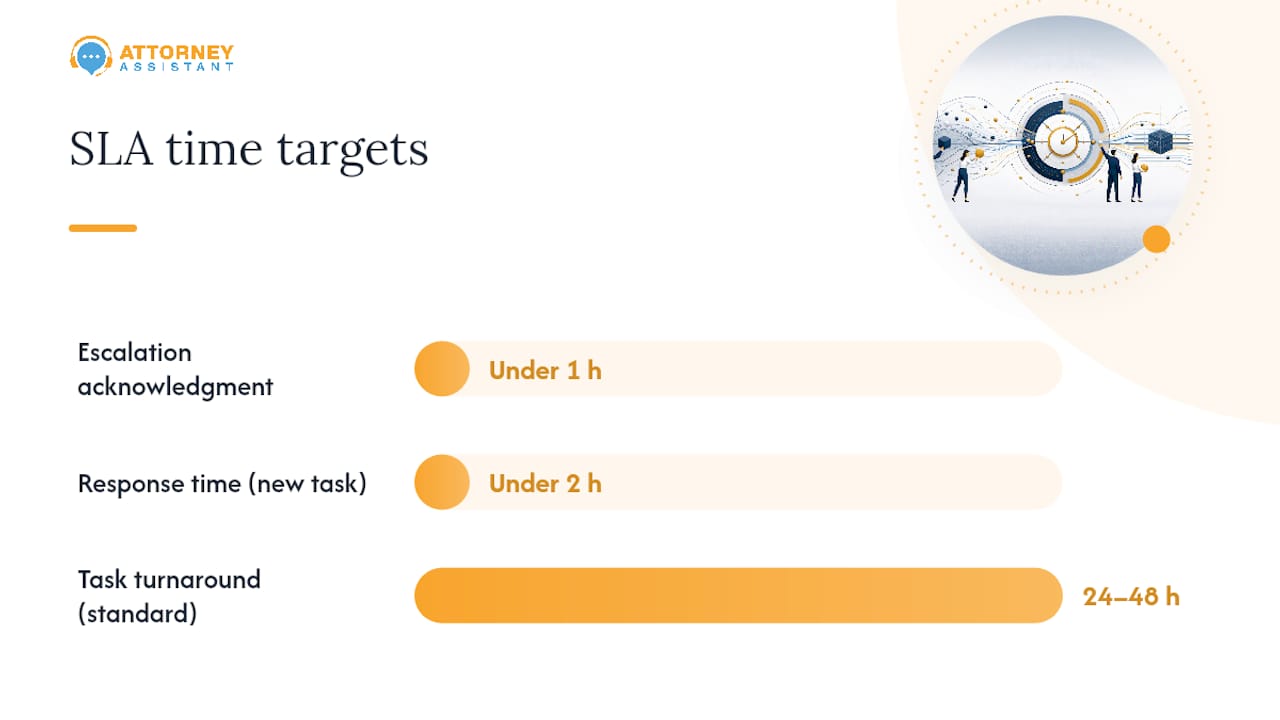
| SLA Metric | Reasonable Target |
|---|---|
| Response time to new task | Under 2 hours during business hours |
| Task turnaround (standard) | 24 to 48 hours |
| Error rate | Under 3% on repeat tasks |
| Escalation acknowledgment | Under 1 hour |
If the pilot hits these numbers for 30 to 60 days, that’s your signal to expand scope. Vetted legal staffing providers reduce risk versus generic freelance marketplaces because they build in domain screening and backup coverage from the start.
Should You Automate This or Hire Someone?
Automate rule-based, high-volume tasks you can fully instrument. Outsource tasks that need human judgment, client interaction, or supervision of an exception process. Most firms need both, not one or the other.
Tool categories worth knowing:
- RPA and workflow engines for repetitive data movement between systems.
- Intake forms and chatbots for capturing lead details before a human ever gets involved.
- Payment processors built for legal billing, which can speed collections and cut invoicing time without adding headcount.
- Case management platforms that auto-populate deadlines and calendar entries.
A common setup: a web intake form captures lead details and routes them instantly to a trained virtual receptionist, who triages urgency, schedules the consultation, and flags anything requiring an attorney’s immediate attention. The tool handles volume. The person handles judgment. Neither works well alone for personal injury intake, where speed and tone both matter.
Pro Tip: Write down exactly where the tool’s job ends and the human’s job begins. Vague handoffs cause tasks to bounce back and forth, which wastes more time than doing the task manually in the first place.
How Do You Measure ROI on Outsourced Non-Billable Work?
Track five numbers: reclaimed billable hours, utilization rate, cost per task, error or rework rate, and time-to-contact for new leads. These tell you whether the pilot is actually working or just moving the mess somewhere else.

A sample calculation shows that reclaiming several billable hours weekly per attorney can translate into substantial annual value, depending on hourly rates and overhead costs. Compare that to what the vendor costs. If the provider runs $1,500 a month for that scope of work, the math clears easily, even before counting the value of faster client response times.
Dashboard fields worth reporting monthly:
- Hours reclaimed per attorney
- Utilization rate before and after
- Vendor cost versus internal cost per task
- Error rate on outsourced tasks
- Average time-to-contact for new leads
Review pilot performance every 30 days for the first quarter, then shift to quarterly reviews once the process stabilizes.
How Should Law Firms Handle Outsourcing Differently?
Legal work carries privilege and unauthorized practice of law (UPL) risk that most industries don’t deal with. As a rule, anything requiring legal analysis, client advice, or strategic case decisions stays in-house. Administrative, intake, scheduling, and document prep tasks can move to a supervised vendor, provided the process is documented and a licensed attorney reviews anything client-facing.
Security and privilege checklist:
- Signed confidentiality and data security agreements with every vendor
- Restricted access to case files based on role, not blanket access
- A written escalation trigger for anything touching legal advice or strategy
- Regular audits of who accessed what, and when
Legal virtual assistants can free a couple of billable hours per day when used appropriately when deployed on intake, scheduling, and billing follow-up, as long as supervision and escalation rules are clear from day one.
Sample 30/60/90 day KPIs for a personal injury firm:
| Timeframe | KPI to Track | Target |
|---|---|---|
| 30 days | Intake response time | Under 5 minutes |
| 60 days | Signed retainer rate | 10% improvement over baseline |
| 90 days | Reclaimed billable hours | 5+ hours per attorney weekly |
| 90 days | Billing follow-up success | Significant reduction in aged receivables |
Pro Tip: Put the escalation trigger in writing before the pilot starts, not after the first mistake. A one-page document listing “always call the supervising attorney if…” prevents most UPL headaches.
Why We Built Our Approach Around Intake First
Most firms treat non-billable work as a cost problem. It’s actually a revenue problem. Every missed call or slow follow-up is a case that walks to a competitor, and no amount of internal reshuffling fixes that if intake itself is broken. Fixing speed-to-lead and follow-up consistency does more for conversion, and for reclaimed billable time, than almost any other operational change a firm can make. That’s the lens we bring to every recommendation in this guide.
How Attorney Assistant Fits Into This Playbook
Attorney Assistant isn’t a staffing vendor. We handle intake, follow-up, and administrative workflows so your firm answers faster, converts more of the leads you’re already paying for, and stops losing cases to slow response times. If the tasks in this guide, intake screening, billing follow-up, calendar management, CRM hygiene, sound familiar, that’s exactly the operational chaos we fix.
A pilot with us makes sense if you recognize any of these:
- Leads sit for hours before anyone calls them back.
- Your team is buried in admin instead of casework.
- Signed retainer rates have stalled even though lead volume hasn’t.
If that sounds like your firm, the next step is a conversation, not a contract. Book a call to walk through where your intake and follow-up gaps are costing you the most, and whether a pilot makes sense for your caseload.
Sources
- Law
- Legal Back Office Outsourcing Guide 2026
- Billable hours vs. actual hours: what every law firm needs to know to stay profitable (LawPay blog)
- Legal Virtual Assistants: Benefits, Compliance & ROI Guide | Lawyer Monthly
- Ethical Billing Guidelines: What Attorneys Can’t Bill For | TimeSolv
FAQ
What Does Non-Billable Work Mean?
Non-billable work is any task that supports the firm but isn’t charged to a client, such as admin, internal training, and billing prep, as opposed to billable work directly tied to client matters.
Does Non-Billable Mean Not Paid?
Non-billable doesn’t mean unpaid. Staff and attorneys are still paid for that time; it just isn’t invoiced to a client, which is why excessive non-billable time reduces firm profitability rather than staff pay.
Is 2,300 Billable Hours a Lot?
Yes, a heavy workload in most firms typically requires far more total hours worked once non-billable tasks are factored in, given that average utilization sits around 38% to 45% of a working day.
What Are Examples of Non-Billable Hours?
Common examples include client intake calls, CRM updates, billing follow-up, document formatting, internal meetings, CLE training, and marketing outreach. Attorney Assistant handles many of these tasks directly, including intake and follow-up, so attorneys can focus on billable casework.
Recommended
Related Articles

Appointment Setting Online: A Law Firm Guide
Master appointment setting online for law firms with proven strategies that turn leads into booked consultations and grow your practice.

Medical Records Request: A Practical Guide for Law Firms
Run a clean medical records request with HIPAA-compliant steps, sample language, timelines, fees, and follow-up tactics built for law firm operations.

Request for Discovery Template: A Practical Guide
Use our request for discovery template with annotated fields, jurisdictional notes, and filing instructions. Customize it for federal or state court cases.