
A records request lands in the case-management queue. Someone sends an authorization, marks the task “pending,” and moves on to the next emergency. Three weeks later, the provider says the request was incomplete, the imaging was never included, and nobody can say whether the original request was received. The file has not moved. The deadline, unfortunately, has.
A medical records request is not a form. It's a controlled workflow involving authority, scope, timing, fees, follow-up, review, and correction. Firms that treat it as a one-off transaction create avoidable delays for attorneys, clients, adjusters, and everyone else waiting for the chart to explain what happened.
Table of Contents
- Why a Medical Records Request Is an Operational Workflow
- What HIPAA Actually Requires on Timing and Fees
- Writing an Authorization That Will Not Get Rejected
- The Seven-Step Workflow From Custodian to File
- Setting Realistic Timelines by Facility Type
- The Fee Trap Most Operators Walk Into
- Common Pitfalls and a Records Request Checklist
Why a Medical Records Request Is an Operational Workflow
Most firms can identify the moment a request is sent. Fewer can identify who owns the next action, what deadline applies, or how the team knows the production is complete. That gap is where requests stall.
The practical fix is to treat every request as a queue item with a request date, custodian, scope, owner, expected completion date, fee status, and escalation trigger. A hospital, outpatient clinic, physician office, and long-term-care facility shouldn't receive the same planning assumptions because each request is labeled “medical records.”
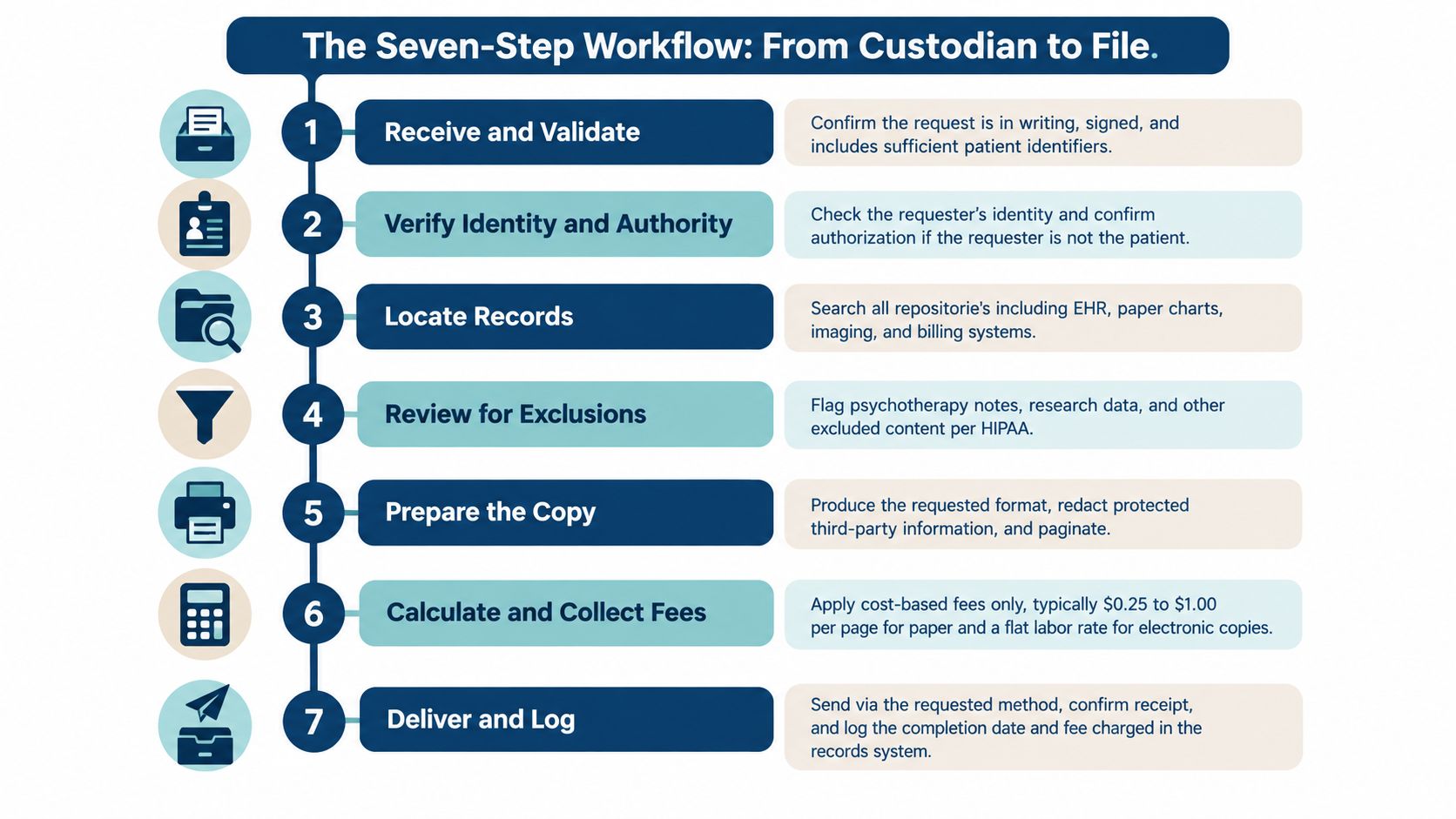
A useful workflow has seven stages:
- Identify the custodian and record categories.
- Obtain and validate authorization.
- Specify format and delivery destination.
- Transmit through the accepted channel.
- Log receipt, fees, deadlines, and follow-ups.
- Inspect the production against the requested scope.
- Issue a deficiency request when anything is missing.
Why the queue matters
The request is only one event in a longer chain. The team must know whether the provider received it, whether the authorization passed review, whether billing records were requested separately, and whether the production contains the dates, providers, imaging, operative reports, medication history, and related material the case requires.
A production can arrive quickly and still be incomplete. A late production can be predictable if the facility type and prior performance are tracked. Those are different operational problems, and the response shouldn't be the same.
Practical rule: Track medical records requests like open matters, not like postage.
The workflow also makes delegation safer. A trained records specialist can send requests, monitor acknowledgments, compare productions against a checklist, and prepare deficiency correspondence. Attorneys should receive a clean status update and an organized packet, not a mystery folder named “records final final.”
For firms handling personal-injury, medical-malpractice, disability, employment, or mass-tort matters, standardized records work improves case visibility. It also keeps attorneys from spending valuable time calling release-of-information departments to ask whether a fax machine has feelings.
What HIPAA Actually Requires on Timing and Fees
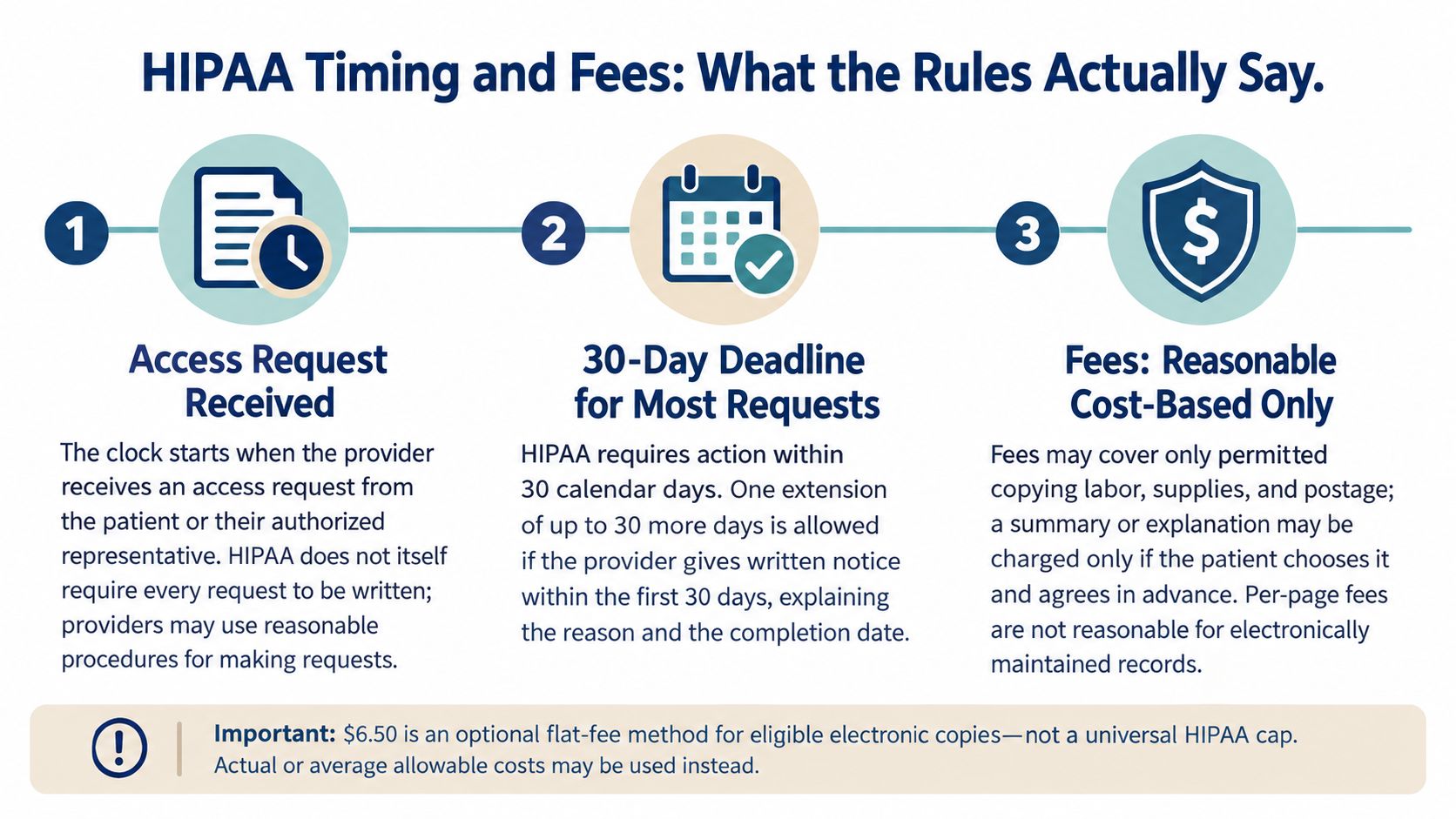
The HIPAA Privacy Rule establishes an enforceable patient right to inspect and receive copies of protected health information held by most health care providers and health plans. A covered entity generally must act on a request within 30 calendar days, and it may take one additional 30-day period only when it gives the requester a written explanation for the delay and the expected completion date within the original period. The federal baseline is described by the U.S. Department of Health and Human Services guidance on the right of access.
The right generally covers information in the provider's or plan's designated record sets, subject to limited exceptions. That means the request shouldn't be framed as “send the summary” when the case requires the underlying record categories, billing material, imaging, portal messages, or other responsive records.
Timing is a ceiling, not a production plan
The 30-day period is a federal access standard, not a sensible internal target for litigation operations. Build action before the deadline:
- Days 0 to 2: Validate the request, send it, and confirm the custodian and delivery channel.
- Days 10 to 14: Escalate if there is no acknowledgment or status update.
- Day 21: Re-send or call, documenting the contact and outstanding categories.
- Before day 30: Record any written extension, deficiency notice, or formal escalation path.
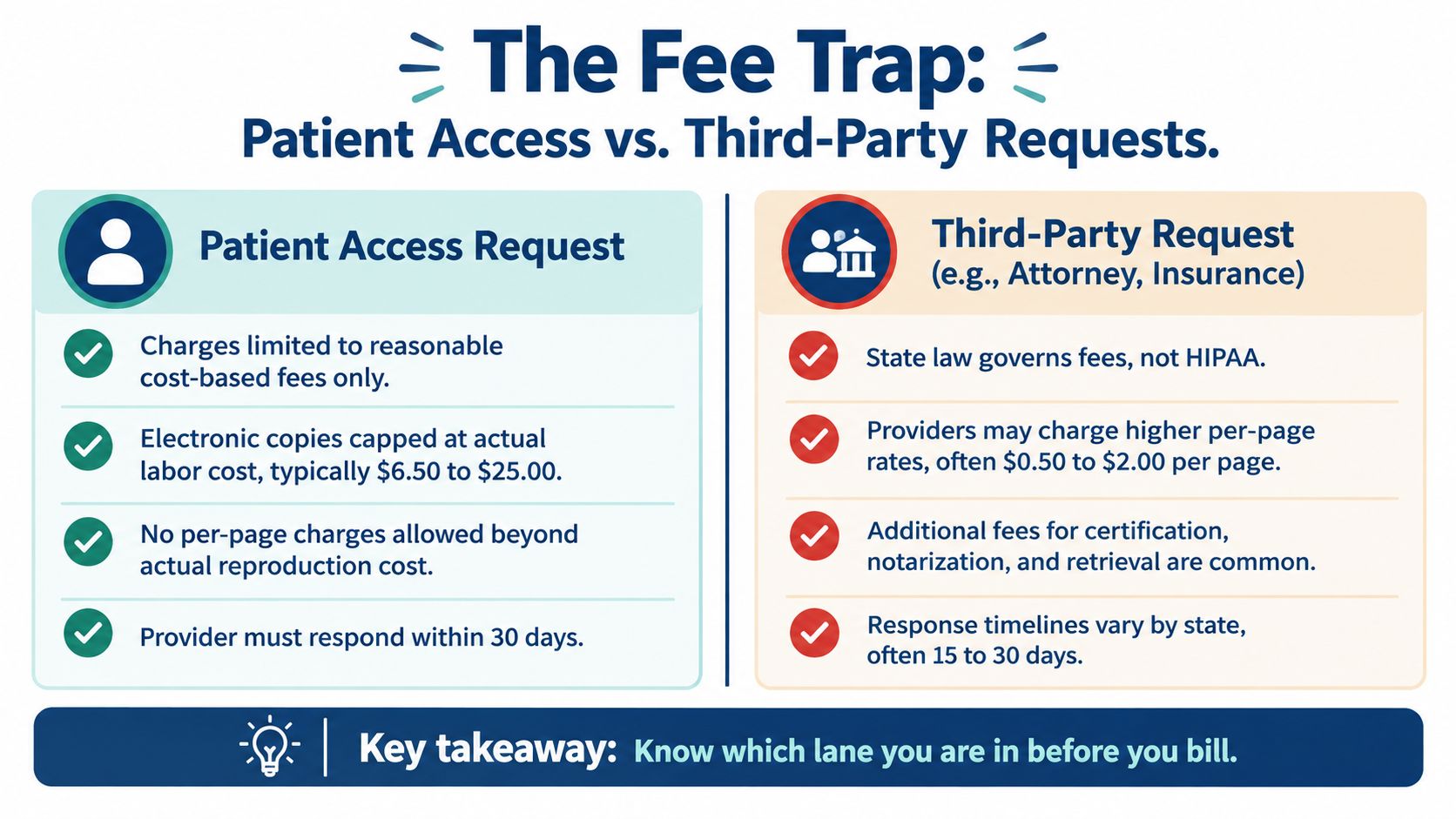
HIPAA fee rules also depend on the requester's legal posture. For a patient access request, the provider may charge only a reasonable, cost-based amount for permitted copying, supplies, labor, and postage when mailing is requested. The provider may not charge for searching for or retrieving the information.
That rule doesn't automatically control an attorney's third-party request. State law may govern fees when a patient authorizes an attorney or another entity to obtain records. Teams that document the requester, authorization type, jurisdiction, and fee basis before sending will have fewer surprises later.
For adjacent privacy documentation practices, the AI scribe HIPAA best practices resource offers useful context, although it doesn't replace a records-request review by counsel.
Writing an Authorization That Will Not Get Rejected
A defective authorization can waste more time than a slow custodian. The provider may not begin meaningful retrieval until the form identifies the patient, the records, the recipient, the purpose, the expiration term, and the person signing it.
CMS explains that written authorization is generally required for uses or disclosures of protected health information or personally identifiable information outside permitted categories such as treatment, payment, and health-care operations. For attorney-directed requests, a complete authorization is often the practical starting point, not an administrative detail to clean up later. The CMS privacy program guidance supports that distinction.
Put the scope in language a release team can execute
A request should identify:
- Patient: Full legal name, former names when relevant, date of birth, and another identifier requested by the custodian.
- Custodian: Facility name, location, department, and address or approved electronic destination.
- Date range: Specific treatment dates or a clearly defined period.
- Categories: Medical records, imaging, operative reports, medication history, itemized bills, payment records, and other case-specific material.
- Recipient: The firm, attorney, or designated records recipient by name and address.
- Purpose: Representation, claim evaluation, litigation, disability review, or another accurate purpose.
- Expiration: A stated date or event.
- Signature: Patient or authorized representative, with the date and required representative documentation.
A practical request paragraph might read:
I authorize [custodian] to disclose the requested medical records, diagnostic images, operative reports, medication history, itemized billing records, and payment information for [patient], covering [date range], to [law firm and recipient address] for purposes of evaluating and pursuing the patient's claim. This authorization expires upon [date or event]. I understand that I may revoke it in writing as permitted by law and that the disclosed information may be subject to redisclosure as permitted by applicable law.
Adapt the language to the custodian's form and the governing jurisdiction. Don't add categories the case doesn't need, but don't use “entire chart” when the team needs billing, imaging, and records from separate departments.
Run a pre-send rejection check
The most common avoidable defects are missing treatment dates, unclear facility identity, an unnamed recipient, an absent signature date, and a delivery method the custodian doesn't support. Check those items before transmission, then save the exact authorization with the request packet.
A one-page validation checklist is less glamorous than a second follow-up call. It is also much cheaper.
The Seven-Step Workflow From Custodian to File
A repeatable workflow gives every request the same basic controls while allowing the operator to adjust for the provider. The following sequence is suitable for a new-hire checklist, a case-management SOP, or a quality-control review.
Start with scope and authority
1. Identify the custodian and categories. Build the request around the actual source. Separate the hospital, physician office, imaging center, pharmacy, billing office, and long-term-care facility when they hold different material. Include itemized bills and lien-related balances when the matter requires them.
2. Validate authorization. Confirm the signature, date, patient identifiers, recipient, purpose, expiration, and scope. If the request is not a patient-directed access request, confirm that the authorization supports the attorney's role.
3. Choose format and destination. State whether the firm wants secure electronic delivery, portal access, paper copies, a disc, or another accepted format. Unsupported delivery requests create a convenient reason for a custodian to pause.
Control the request after sending
4. Transmit through the accepted channel. Use the provider's designated portal, fax, mail, or email process. Save proof of transmission and the request exactly as sent.
5. Log the request. Record the receipt date, custodian, scope, fee estimate, acknowledgment, extension notice, follow-up dates, person contacted, and expected completion date. A CRM or records tracker is useful only when someone enters the information. Your CRM cannot follow up with a provider if the request never made it into the CRM.
Review the production, then correct the gaps
6. Inspect the production. Compare the packet with the request. Check treatment dates, every listed provider, imaging, operative reports, medication history, itemized billing, and payment records. Don't assume a portal download is complete merely because it opens successfully.
7. Send a deficiency request. Attach the original authorization and identify the missing material precisely. Use language such as:
We received the production associated with the request dated [date]. The materials do not include [specific category or date range]. Please confirm whether those records are unavailable, maintained by another custodian, withheld under an applicable exception, or omitted from the production. Please provide the missing records or a written explanation of their status.
The workflow described in medical records retrieval services for law firms follows this same operational logic: request, track, follow up, organize, and verify rather than treating transmission as completion.
Setting Realistic Timelines by Facility Type
A generic “expected next month” date is not a forecast. It is a polite way of admitting that nobody checked.
An empirical study of healthcare-facility requests provides a useful benchmark. Among 1,518 eligible requests, 1,439 records were received, a 94.7% receipt rate, while 39 requests remained pending and 0.4% were refused. The study reported a median time to receipt of 26 days, with meaningful differences by facility type. See the study record at Weill Cornell's publication database.
| Facility Type | Median Days to Receipt |
|---|---|
| Hospitals | 22 |
| Outpatient clinics | 28 |
| Physician offices | 31 |
| Long-term-care facilities | 55 |
Use the benchmark as a trigger, not a promise
The range in that study extended from 1 to 679 days, so the median cannot predict every individual request. It can still help a firm decide when a request has moved from ordinary waiting to operational exception.
Assign every request:
- A custodian-specific expected completion date
- A median benchmark
- A separately tracked 90th-percentile turnaround
- An escalation date before the legal deadline
- A named owner responsible for the next action
Long-term-care facilities deserve earlier attention because their observed median exceeded the other listed facility types. Physician offices also exceeded hospitals and outpatient clinics. That doesn't mean every facility will follow the benchmark, but it does mean a firm shouldn't plan a case around the fastest category and hope the slowest one cooperates.
Send parallel requests when multiple providers are involved. Serial requests turn one missing chart into a chain reaction. The guide to acquiring medical records can help firms think through provider identification and follow-up as a coordinated process.
The study's receipt rate is a planning benchmark, not a guaranteed outcome for a personal-injury practice. Measure your own completion rate, deficiency rate, and days to complete by custodian and request type. A case-status meeting should produce a date, an owner, and a next action, not another version of “we're waiting on records.”
The Fee Trap Most Operators Walk Into
“Electronic” doesn't mean “free,” and “the patient signed it” doesn't always mean the federal patient-access fee standard governs the invoice.
The key distinction is who is making the request and under what legal posture. HIPAA's reasonable-cost-based fee rules generally apply to patient and patient-directed disclosures. When a patient authorizes a third party, such as an attorney, to request records, fees are generally governed by state law rather than the same federal cost-based standard. The Government Accountability Office's analysis of medical-record fees explains why nationwide firms need to track requester status and state rules instead of assuming one national fee schedule.
Screen the invoice before paying it
A pre-send fee screen is more useful than arguing after an invoice has already delayed production. Record the following before the request leaves the firm:
- Requester status: Patient, patient-directed recipient, attorney, insurer, or another third party.
- Jurisdiction: State law that may control the fee.
- Record categories: Medical records, imaging, billing, itemized statements, or certification.
- Format: Paper, portal, electronic file, disc, or another method.
- Permitted charges: Locating, preparation, per-page, imaging, postage, certification, or other charges authorized by applicable law.
- Invoice support: The provider's fee schedule, statutory authority, and itemized calculation.
For a patient access request, challenge a charge that includes searching or retrieving records, since those activities aren't chargeable under the federal reasonable-cost-based rule. For a third-party request, don't assume the same objection ends the analysis. State law may authorize categories that HIPAA doesn't govern in the same way.
A measured dispute preserves the working relationship:
Please provide the fee schedule and legal basis for the listed charges, including any locating, retrieval, preparation, imaging, certification, or electronic-production fees. We're reviewing the invoice against the requester status, applicable state requirements, and the categories requested. Please keep the records request active while the fee issue is clarified.
The practical lesson is simple: determine which lane you're in before approving the invoice. The related discussion of medical-record fees for law firms provides another operational lens on that review.
Common Pitfalls and a Records Request Checklist
Most failures are ordinary, not dramatic. The authorization is missing a date range. The request goes to the clinic instead of the imaging center. The portal produces a patient-facing summary, and everyone treats it as the complete designated record set. Billing sits in a separate system, winning.
Electronic access has expanded substantially. National ONC data show that the share of individuals offered and accessing an online medical record or patient portal rose from about 25% in 2014 to 65% in 2024, according to ONC data on portal and app access. App-based access also rose from 38% in 2020 to 57% in 2024, so firms need digital retrieval controls alongside traditional authorization and follow-up procedures.
Audit every request before and after transmission
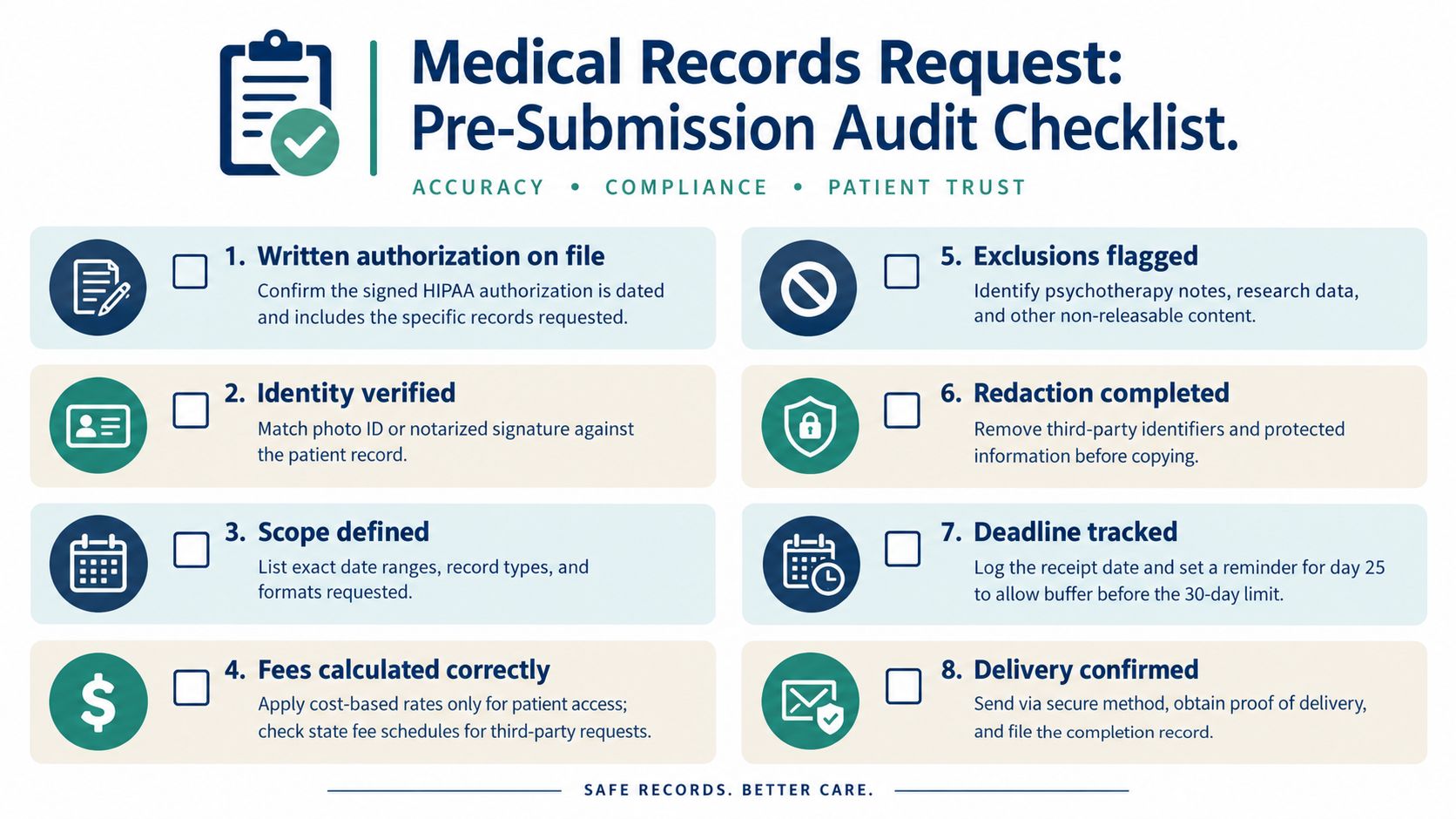
Use this checklist at the workstation:
- Authorization: Confirm the signed authorization includes the patient, recipient, scope, purpose, expiration, and signature date.
- Custodian: Verify the exact facility, department, address, and repository responsible for the requested material.
- Date range: State treatment dates clearly and avoid vague phrases such as “all relevant records.”
- Delivery: Confirm that the requested format and destination are accepted by the custodian.
- Fees: Separate patient-access rules from third-party state-law analysis before approving payment.
- Categories: Request medical records, imaging, operative reports, medication history, itemized bills, and lien-related balances separately when needed.
- Portal review: Verify the date span, provider list, record categories, and completeness of any portal download.
- Deficiency control: If material is missing, attach the original authorization and identify the exact gap in writing.
The strongest records teams also log whether missing material is unavailable, withheld, maintained elsewhere, or not requested. That distinction matters when an attorney evaluates the evidence and when a later custodian says the firm never asked for the category now considered essential.
A standardized queue produces predictable case velocity. It gives staff a clear next action, gives attorneys a defensible status update, and gives clients fewer explanations that begin with “the provider says they're still looking.”
Attorney Assistant provides dedicated legal support staff who can handle records acquisition, bill retrieval, lien work, tracking, and follow-up inside a firm's established systems, while Frontline provides 24/7 live intake for firms that also need consistent coverage for new opportunities. Visit Attorney Assistant to evaluate where records work, administrative tasks, or intake gaps are consuming capacity that your attorneys should be using for legal work.
Related Articles

Litigation Support Services: What Law Firms Need to Know
Discover how litigation support services streamline discovery, reduce costs, and improve case outcomes. Learn what to look for in a provider.

Preferred Method of Contact for Law Firm Intake
Discover how to capture and use the preferred method of contact in legal intake to improve conversions, ensure compliance, and streamline law firm operations.

White Glove Support for Law Firms
Discover how white glove support transforms law firm intake and operations. Learn the metrics, staffing models, and workflows that actually sign cases.