Medical Records Retrieval Services Explained for Law Firms

A case gets signed on Monday. Liability looks promising. Treatment is underway. The client is calling for updates. Your attorney wants to know when the demand can move. Your paralegal says the same thing they said last week: “We're waiting on records.”
That sentence runs half the plaintiff bar.
Not because anyone forgot how to send a request. Not because your staff lacks hustle. Usually it's because medical records retrieval sits in the awkward middle between legal work and administrative work, which means everybody depends on it and nobody wants to own the chaos full time. One provider needs a facility-specific release. Another split billing from chart records. Imaging is somewhere else entirely. Somebody faxed a rejection to a number nobody checks. Very modern. Very efficient.
For law firm owners, managing partners, COOs, and practice managers, medical records retrieval services matter because they decide case momentum. If records stall, demands stall. Lien review stalls. Chronologies stall. Settlement conversations stall. Your attorneys went to law school to practice law. Ideally, they should occasionally get to do that.
This is also why records problems are rarely just records problems. They're capacity problems. A firm can spend heavily on marketing, sign more matters, and still watch files pile up because the back-end work never got staffed properly. More cases do not fix weak operational follow-through. They expose it.
Table of Contents
- Introduction Why Records Retrieval Decides Case Momentum
- What Medical Records Retrieval Services Actually Do
- How the Medical Records Retrieval Process Works End to End
- Compliance and Privacy Considerations Law Firms Must Get Right
- Pricing Models and Turnaround Expectations Compared
- Integrating Retrieval Into Your Firm Workflow With Dedicated Support
- How to Choose the Right Medical Records Retrieval Partner
Introduction Why Records Retrieval Decides Case Momentum
In a busy PI or mass tort practice, records delay is rarely dramatic. It's usually death by ordinary nonsense. One missing operative note. One unsigned authorization. One provider that insists requests go through a portal nobody documented. Then ten files sit in “pending” status while everyone assures each other they're “in progress,” which is technically true and operationally useless.
Why leadership should care
Medical records retrieval sounds like a support task. It is a support task. It's also a throughput problem that affects revenue timing, staff workload, client communication, and attorney utilization.
When leaders treat retrieval as a side duty, three things usually happen:
- Case movement becomes uneven: Some files move quickly because the provider cooperates. Others vanish into follow-up limbo.
- Experienced staff get buried: Good paralegals end up chasing signatures, calling records departments, and renaming PDFs instead of doing higher-value case work.
- Attorneys become escalation managers: Nothing says “efficient law firm” like a lawyer forwarding a radiology request email chain at 9:12 p.m.
The problem usually isn't that firms don't know records matter. It's that nobody built enough operational capacity to manage them consistently at volume.
A retrieval service, whether internal, outsourced, or hybrid, exists to make this process predictable. The question isn't “Can someone request records?” Of course they can. The question is whether your firm has a repeatable system for authorizations, provider routing, follow-up, quality checks, and delivery into the matter file without turning every request into a bespoke adventure.
The useful way to think about it
If your intake team signs the case but your support team can't move the file forward, growth starts to look suspiciously like congestion.
That's why the better conversation is not “How do we get records faster?” It's “How do we build enough operational muscle so records stop controlling the pace of the case?”
What Medical Records Retrieval Services Actually Do
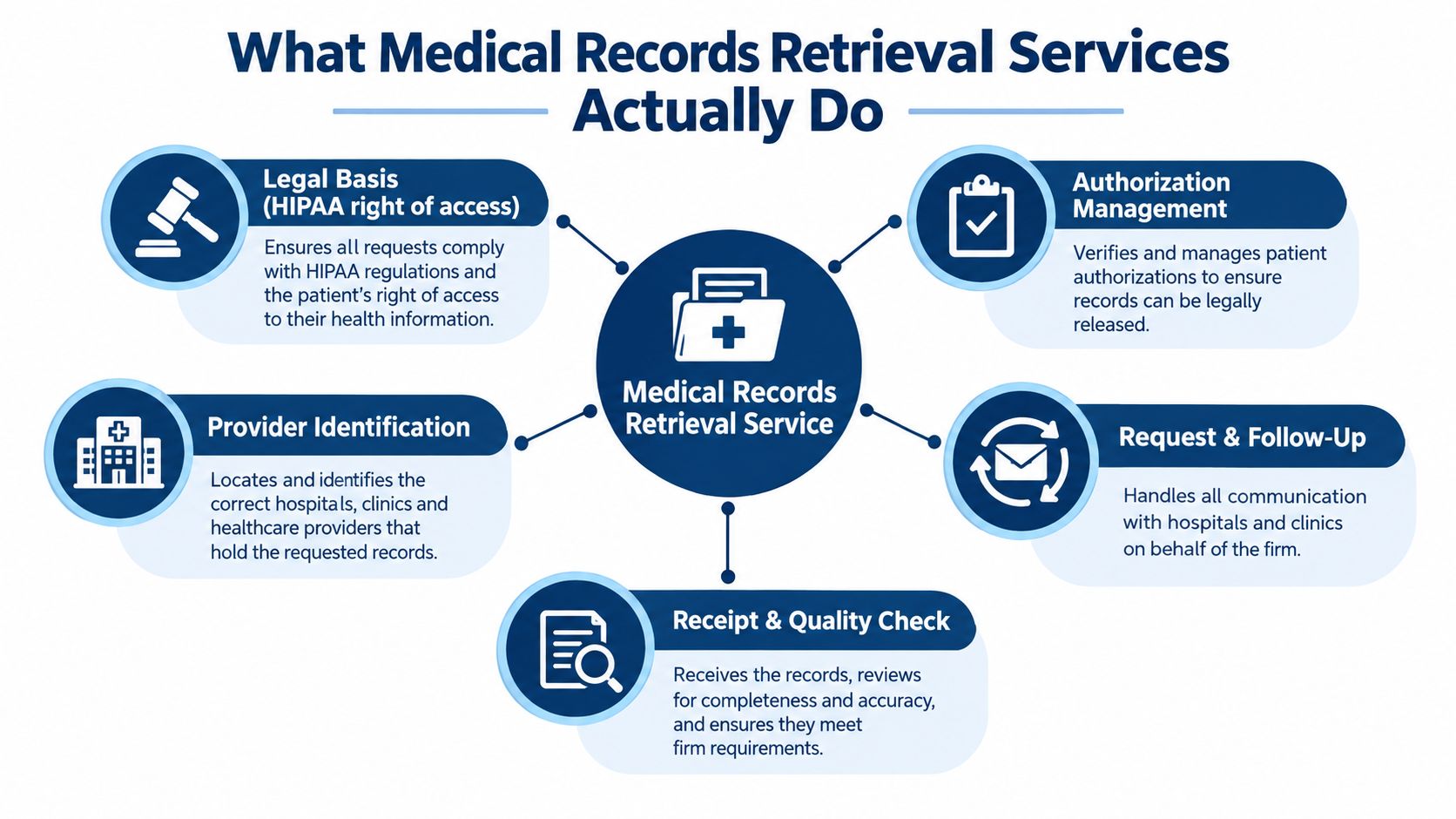
At the legal foundation level, record retrieval is not a favor you beg from the healthcare system. Under HIPAA's access rule, an individual has the right to inspect and obtain a copy of protected health information in a designated record set for as long as that information is maintained there, which is the core legal basis for obtaining a patient's records (45 CFR 164.524).
That legal right is the starting point. It is not the workflow.
Think of retrieval like a supply chain
A good way to understand medical records retrieval services is to treat them like a supply chain operation.
The “product” is the complete, usable record set your legal team needs. The obstacles are handoffs, missing paperwork, wrong destinations, fragmented provider systems, and quality issues after receipt. The retrieval team manages that chain from authorization to delivery.
Here's what that usually includes:
- Authorization handling: Making sure the right release is signed, dated, complete, and specific enough to avoid a preventable rejection.
- Provider identification: Confirming where the client treated, including hospitals, urgent care, specialists, imaging centers, pharmacies, and billing offices.
- Request submission: Sending requests through the method each provider accepts, which may be fax, portal, email, mail, or a release-of-information vendor.
- Follow-up and escalation: Tracking non-responses, deficiencies, and partial productions instead of assuming silence means progress.
- Receipt and organization: Reviewing what came in, naming it properly, checking whether it matches the request, and routing it into the firm's systems.
What retrieval is not
Readers often get mixed up.
Medical records retrieval is not the same thing as:
- Medical summarization: Turning records into a chronology or treatment timeline.
- Lien reduction: Negotiating balances with providers or lienholders.
- Case strategy: Deciding what the records mean for liability, damages, or settlement posture.
Those jobs connect to retrieval, but they aren't retrieval itself.
Practical rule: If your team receives a 700-page PDF with missing imaging and no billing records, retrieval is not “done” just because a file arrived.
What firms usually need retrieved
In plaintiff work, the scope often goes beyond chart notes. Firms may need medical records, itemized billing statements, imaging, and lien-related documents. For personal injury lien work, best-practice guidance includes confirming each lien directly with the lienholder, requesting itemized billing statements, identifying unrelated charges or billing errors, and getting any reduction agreement in writing before closing the matter (lien reduction guidance for PI attorneys).
So yes, retrieval is administrative. But “administrative” in law firms often means “critical, detailed, deadline-sensitive, and somehow still handed to the busiest person in the office.”
How the Medical Records Retrieval Process Works End to End
A retrieval workflow looks simple from far away. Up close, it's a chain of dependency. If one link is weak, the whole file slows down.
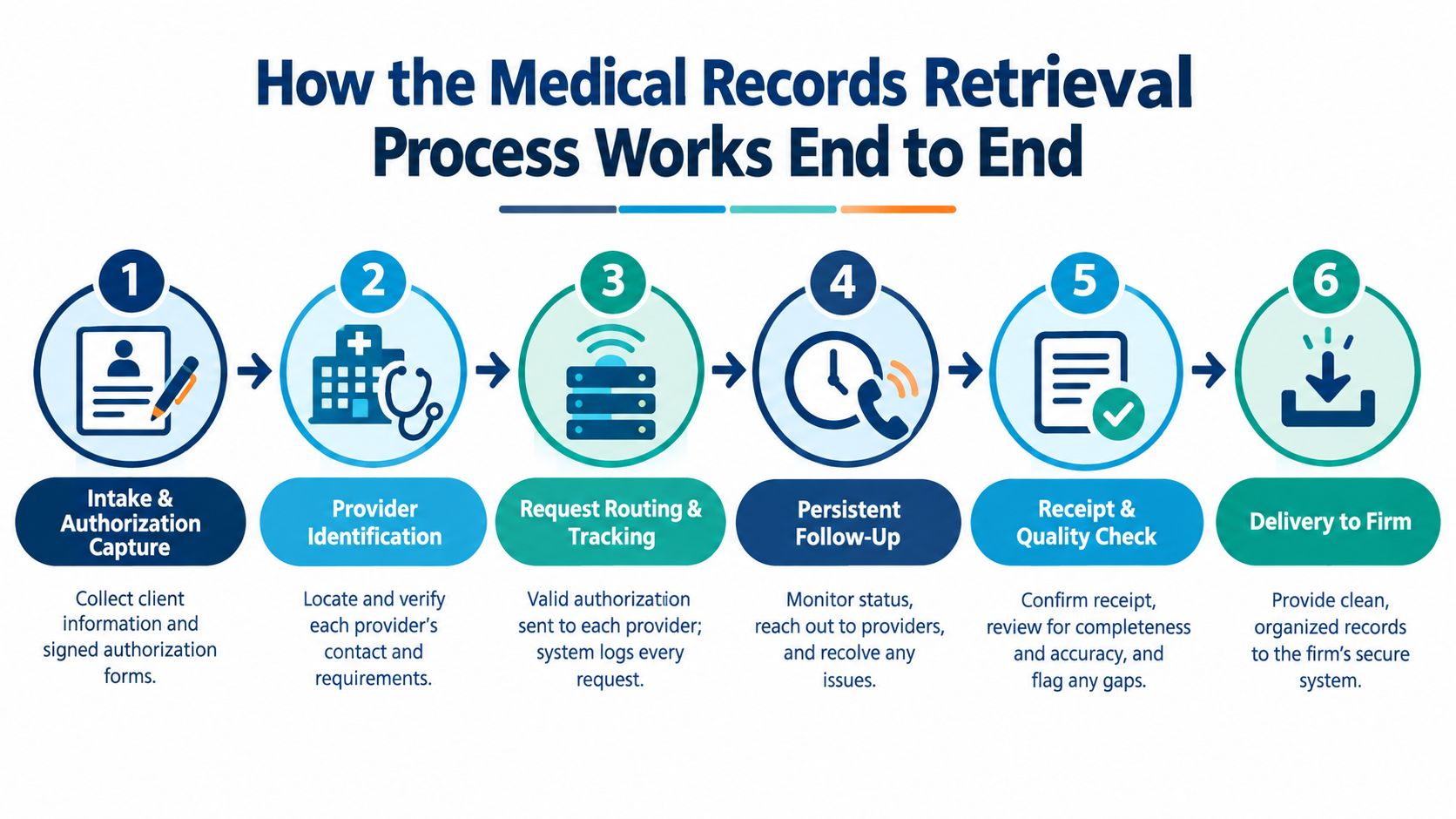
The six operational stages
Intake and authorization capture
The process starts when the client signs the firm and provides enough information to identify treaters. This is where weak intake creates downstream pain. If the client remembers “some urgent care near the highway,” that may be emotionally true and operationally thin.Provider identification
Staff builds the provider list. Hospitals, specialists, physical therapy, EMS, imaging, pharmacies, and billing entities may all sit in different places. One incident can create several requests.Request routing and tracking
Each provider has a preferred path. Some want portal uploads. Some still rely on fax. Some split requests by records type. Good teams log each request, date sent, destination, and status.Persistent follow-up
Most retrieval effort lives here. Not in sending the request. In chasing it. Calls, emails, portal checks, deficiency responses, status updates, and repeat touches until someone releases the file.Receipt and quality check
Once records arrive, someone needs to verify whether the production is complete, legible, and responsive. If the request asked for imaging, physician narratives, and itemized billing, a discharge summary alone does not win the day.Delivery to the firm system
Records need to land in the correct matter, in a usable format, with sensible naming and documentation. Otherwise the bottleneck just moves from retrieval to document cleanup.
Where the delays really happen
Medical records retrieval has become a sizable operational market. One industry source reports that leading providers process over 400,000 requests annually, and that traditional workflows often take 60 to 90 days, while digital or automated workflows can reduce turnaround to roughly 10 to 12 days, a 5 to 8x improvement in speed (medical record access statistics).
Those numbers are useful, but they can also distract from the practical point. Speed gains usually come from removing handoffs and standardizing follow-up, not from magic software.
For a deeper walkthrough of the workflow itself, Attorney Assistant has a useful breakdown of the medical record retrieval process.
Complexity changes everything
Independent legal and industry reporting indicates that manual retrieval commonly runs 20 to 45 days or even 60 to 90 days in complex workflows, while professional retrieval services are often reported at roughly 10 to 15 days on average. The same reporting notes that urgent limited-scope review can drop to 24 to 48 hours when AI-assisted extraction is paired with human quality control, and that 500 to 2,000-page multi-provider files typically stretch review to 2 to 6 weeks, while single-provider requests under 100 pages can turn much faster in constrained workflows (average turnaround analysis).
That's why high-functioning firms segment work:
- Simple file: One provider, narrow date range, small record set.
- Messy file: Several providers, unclear treatment history, split billing, possible imaging.
- Large file: High page volume, multiple custodians, likely quality-control issues after receipt.
Treating those three categories the same is how everything becomes late at once.
Compliance and Privacy Considerations Law Firms Must Get Right
Records work gets marketed as a chasing problem. It's also a compliance problem. A request can stall because a provider is slow. It can also stall because the paperwork was flawed before anyone hit send.
Right of access and authorization are not the same thing
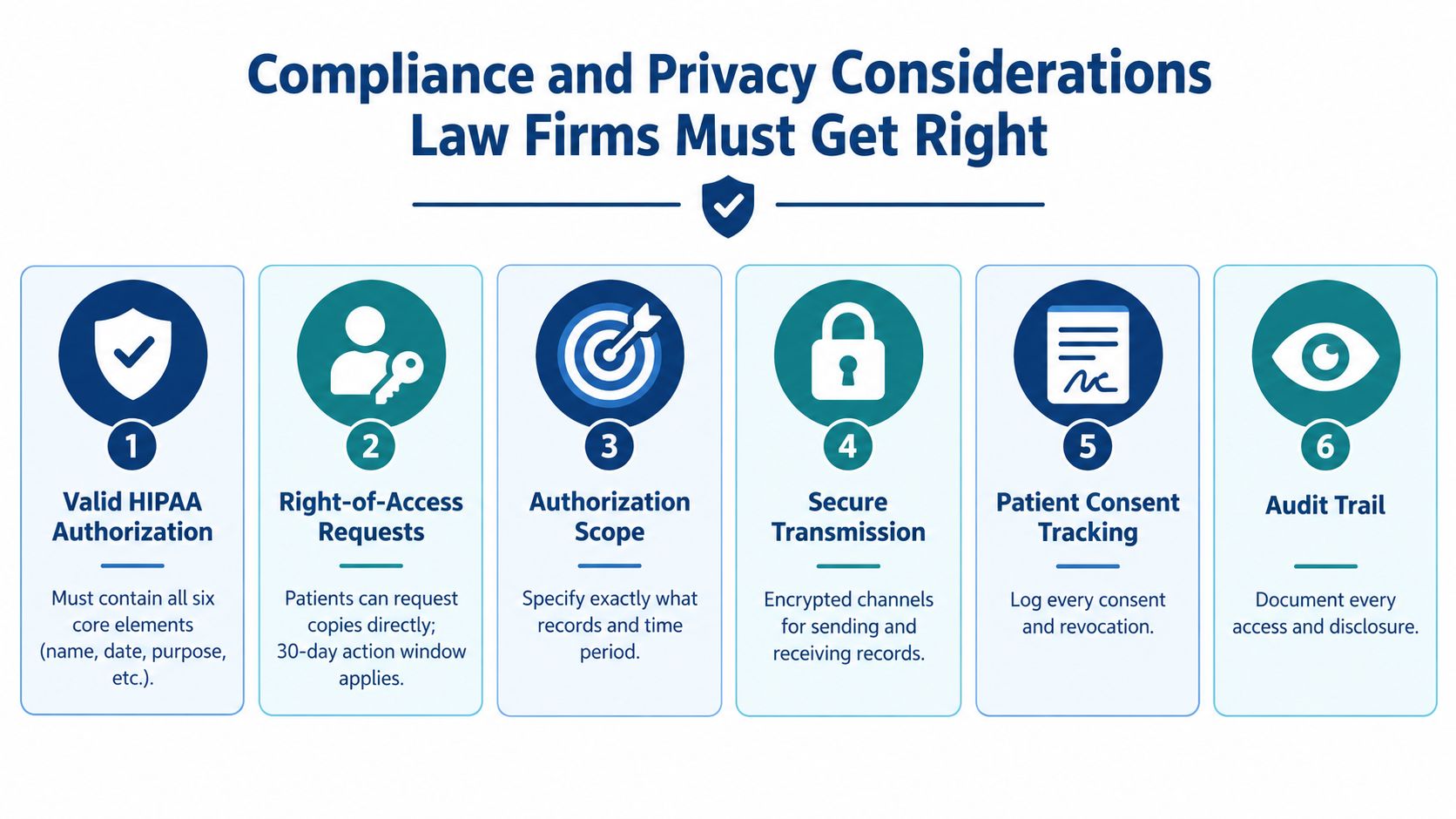
A standard HIPAA authorization is different from a patient right-of-access request. The authorization must include six core elements: a description of the information, the disclosing party, the recipient, the purpose, an expiration date or event, and the patient's signature and date (HIPAA authorization elements).
That distinction matters because firms often use authorizations operationally, while the legal right of access sits underneath the broader framework. If your release is vague, incomplete, or routed to the wrong place, the file can stall before anyone argues about timing.
The compliance ceiling is fixed
HIPAA created the federal patient-access regime that still frames this work. Congress passed HIPAA in 1996, the Privacy Rule took effect on April 14, 2001, and most covered entities had to comply by April 14, 2003. Under that rule, patients generally have up to 30 days to receive a copy of requested records (HIPAA Privacy Rule timeline).
The current HHS guidance is the operational rule firms need to remember: a covered entity must act on a medical-record access request within 30 calendar days of receipt and may use only one written extension of up to 30 additional days. If records are maintained on-site, the expected action window is 30 days. Off-site records can take up to 60 days (HHS right-of-access FAQs).
If your retrieval process starts with bad authorizations, weak provider identification, or lazy follow-up, the clock does not care.
Common compliance-adjacent failure points
Recent reporting points out that retrieval often fails operationally because of incomplete data, non-participating providers, certification gaps, and inconsistent formats. Missing imaging, operative notes, and physician narratives are called out as common problems, and healthcare leaders in 2025 identified inconsistent data formats as the top barrier to cross-system record access (fragmented systems and missing records).
That's why privacy and workflow have to meet in the middle. Secure transmission matters, but so does controlled internal access after the file arrives. If your team is tightening document handling, resources on clinical file access controls are useful for thinking through who should access what, and when.
A short compliance checklist
- Check the release first: Missing dates, unclear scope, or the wrong recipient can sink the request before it starts.
- Be specific about scope: Broad requests can create confusion. Overly narrow requests can produce incomplete files.
- Document each touch: If a provider asks for clarification, someone should log it and resolve it promptly.
- Control internal access: PHI should move through systems with defined permissions, not through whatever inbox happens to be convenient that day.
Pricing Models and Turnaround Expectations Compared
Many firms get lured into bad comparisons. One vendor says “fast.” Another says “full service.” A third says “low cost.” None of that means much unless you know how they charge and what kind of matter you're asking them to handle.
What drives cost and time
Retrieval pricing usually reflects some combination of provider count, page volume, billing-record needs, certification requirements, and the amount of follow-up needed to get a complete file. The more fragmented the treatment history, the less useful a headline turnaround promise becomes.
Industry reporting also suggests the bottleneck is often provider inconsistency, not the firm's request speed. Traditional workflows are still often 25 to 60 days per facility, while modern services report averages around 4 days, with only 30 to 40% same-day returns, which shows just how uneven provider cooperation can be (why retrieval is still slow).
Medical Records Retrieval Pricing and Turnaround Comparison
| Model | How It Charges | Best For | Typical Turnaround |
|---|---|---|---|
| Per-request | One fee per request, sometimes plus pass-through provider costs | Lower-volume firms with predictable single-file needs | Varies by complexity and provider responsiveness |
| Per-provider | Charges by each custodian contacted | Cases with simple, trackable provider lists | Varies. Can become expensive on fragmented files |
| Subscription | Monthly fee tied to expected workflow volume or support scope | Firms with steady records volume that want process consistency | Better for ongoing queue management than one-off spikes |
| Bundled case-support model | Retrieval packaged with broader administrative support | Firms that want records integrated into daily operations | Depends on staffing model and internal handoffs |
If your team is also trying to budget pass-through copy costs and file expenses, Attorney Assistant has a practical explainer on medical records fees for law firms.
Cheap retrieval that still requires your staff to chase updates isn't actually cheap. It's a bill plus your labor.
Match the model to the matter mix
A personal injury firm with recurring, moderate-volume records work may prefer a capacity-based setup because it reduces internal coordination. A firm with occasional complex catastrophic files may tolerate more variable billing if it gets stronger follow-up and better quality control.
The point is not to buy the lowest line item. It's to buy the least disruptive workflow.
Integrating Retrieval Into Your Firm Workflow With Dedicated Support
Retrieval gets messy when firms treat it as a disconnected errand. It works better when it sits inside the same operating system as intake, file opening, case management, client communication, billing requests, and lien follow-up.

Where records actually live in the case lifecycle
In a healthy workflow, the handoff looks something like this:
- Frontline signs the case: New matter information is captured accurately, including treatment details and signed paperwork.
- Staff support opens the file: Provider lists get built, requests go out, and statuses are tracked in the firm's systems.
- Case management stays current: Notes, received documents, deficiencies, and follow-ups stay visible to the people who need them.
- Lien and billing work follows: Once records and bills are in, downstream case-support work can proceed without staff reconstructing the file from scattered emails.
This is why “Frontline signs the case. Staffline carries it.” is more than a slogan. It describes the operational truth. Intake without support capacity creates backlog. Support without clean intake creates confusion. Law firms usually get both problems at once, for free.
Why dedicated support matters more than shared help
Attorney Assistant's medical records support fits here as one operational option. Through Staffline, firms use dedicated full-time legal support professionals who work with one firm, 40 hours per week, inside that firm's systems and workflows, with Attorney Assistant helping co-manage performance.
That dedicated model matters because records work rewards repetition and context. The person handling requests should learn your naming conventions, your case types, your provider trouble spots, your intake fields, and your escalation habits. Shared labor can complete tasks. Dedicated support can carry a process.
What a good integrated workflow looks like
Instead of pushing attorneys or senior paralegals into status-chasing, firms can structure retrieval around repeatable ownership:
- One person owns the queue: Not five people checking the same portal occasionally.
- Authorizations are reviewed early: Before the request bounces back a week later.
- Statuses live in one place: Your CRM cannot follow up with a lead if nobody puts the lead in the CRM. The same logic applies to records.
- Received files trigger the next task: Bills reviewed, liens confirmed, chronology queued, demand support advanced.
Records rarely stall because no one cared. They stall because ownership was diffuse and the workflow depended on memory.
That's the broader operational lesson. Medical records retrieval services are useful, but they work best when the service plugs into a staffed process rather than floating beside it.
How to Choose the Right Medical Records Retrieval Partner
Most vendor decisions go sideways in one of two ways. Firms buy on price alone, then discover their staff is still doing half the chasing. Or they buy on a shiny turnaround claim that ignores provider fragmentation, record gaps, and the ugly fact that one difficult hospital can wreck the timeline anyway.
What to evaluate
A strong retrieval partner should be able to answer practical questions without theatrical hand-waving.
Look for:
- Dedicated versus shared staffing: Who owns your requests day to day?
- Legal workflow familiarity: Do they understand PI, mass tort, bills, liens, and matter-level organization?
- Follow-up rigor: What happens after the initial request goes quiet?
- Quality control: Who checks for missing components, partial productions, and filing errors?
- HIPAA handling: How are authorizations managed, stored, transmitted, and tracked?
- System fit: Can they work inside your existing case management and admin process?
- Visibility: Can your team see statuses clearly without starting a scavenger hunt through email?
- Scalability: Can they handle a surge without turning your queue into archaeology?
Red flags that deserve skepticism
Some warnings are subtle. Some are not.
- Vague speed promises: “Fast” means nothing without context about provider count and complexity.
- No clear ownership: If everyone touches the file, nobody owns the result.
- Records-only thinking: A partner who ignores intake quality, naming, and downstream use will create more cleanup for your team.
- Tech talk without workflow talk: The software may be polished. The process may still be held together by polite panic.
If your team often wrestles with records coming out of different EHR environments, even basic system context helps. A practical primer on choosing between eClinicalWorks and Epic can help operations leaders understand why provider-side differences continue to shape records handling.
A simple decision test
Ask one plain question: Will this partner remove work from my attorneys and core staff, or just rearrange it?
That standard cuts through most sales language.
If record requests are stalling cases, burying your staff, or pushing attorneys into administrative follow-up, the issue usually isn't effort. It's capacity. A deliberate staffing model for records and bill retrieval can fix that faster than another spreadsheet, another shared inbox, or another promise that everyone will “stay on top of it.”
If your firm needs more than occasional help chasing records, Attorney Assistant provides dedicated legal support staff for records and bill retrieval, lien work, intake, and other operational tasks that keep cases moving. It's a practical option for firms that want more capacity inside their workflow without pushing more administrative work onto attorneys.
Related Articles

White Glove Support for Law Firms
Discover how white glove support transforms law firm intake and operations. Learn the metrics, staffing models, and workflows that actually sign cases.

5 Case for Support Examples for Law Firms
Review five case for support examples for law firms, with strategic breakdowns, reusable templates, and practical tactics for staffing, intake, and growth.

Call Screen Service Options for Law Firms Compared
Compare call screen service options for law firms. Evaluate in-house staff, auto-attendants, and 24/7 legal intake teams to stop losing cases to missed calls.