Lead Qualification Services Explained for Law Firms

The marketing report says the campaign worked. New inquiries came in, forms were submitted, and calls reached the firm. Then someone checks the intake notes and discovers that several leads are still sitting in an inbox, one caller received a callback after the attorney's day filled up, and another got a voicemail with no documented next step. The firm generated demand. Its operating system declined to process it.
That's the problem lead qualification services are meant to solve. They don't merely answer phones or add names to a spreadsheet. They capture inquiries, determine whether a matter fits the firm, identify urgency and priority, follow up across channels, and route viable opportunities to the right person while the context is still fresh.
The familiar speed-to-lead research explains why this matters. Contacting an inbound lead within five minutes makes a firm about 21 times more likely to qualify that lead than waiting 30 minutes, according to the Lead Response Management research summary. The same research is widely cited for a 100x advantage in making contact within five minutes rather than 30 minutes, with qualification probability falling sharply when the first response slips from five to 10 minutes. For a practical introduction to how scoring models qualify leads, the useful distinction is that qualification combines fit, intent, urgency, and next action, not just a lead score.
This guide treats intake as an operations issue. It covers qualification frameworks, response workflows, measurement, provider selection, and the staffing capacity required after a lead says yes. Because a signed case still needs records, calendars, CRM updates, follow-up, and administrative support. A firm can't convert more demand by sending every new matter directly into the same overloaded process and hoping the attorneys develop extra hours overnight.
Table of Contents
- Introduction Why More Leads Rarely Fix Conversion
- What Lead Qualification Services Actually Do
- Lead Qualification Frameworks Law Firms Actually Use
- How a High Converting Qualification Workflow Works
- KPIs That Prove Qualification Is Working
- How to Choose and Co Manage a Lead Qualification Provider
- Building Capacity That Converts More of What You Already Have
Introduction Why More Leads Rarely Fix Conversion
A managing partner usually sees the problem first as a marketing question. The firm needs more calls, more forms, better campaigns, or a larger referral network. Those may help, but more inquiries only increase the pressure on a weak intake process. If nobody responds promptly, asks useful questions, records the answers, and owns the next step, additional lead volume creates a larger pile of unworked opportunities.
A missed call illustrates the issue neatly. The caller may have a legitimate matter and may be ready to speak with counsel. The firm's receptionist takes a message, the message enters a general inbox, and the attorney plans to return it “when things calm down.” Things rarely calm down. They become discovery deadlines, court appearances, billing questions, and another message marked urgent.
The legal-industry reporting summarized by Talkroute says only 20% of missed calls to law firms are returned, and recommends callback service-level agreements of five to 10 minutes during business hours. It also describes automated SMS follow-up within 30 seconds to five minutes as a way to reduce lost opportunities. Those figures appear in this practical analysis of missed-call recovery for law firms. Technically, returning a call four days later is follow-up. It's not particularly useful follow-up.
Qualification protects revenue already created
Marketing creates opportunities. Qualification protects them. The work includes:
- Capture: Record the caller's details, source, contact method, and inquiry without relying on someone's memory.
- Fit: Check practice area, jurisdiction, timing, conflicts process, and the firm's matter criteria.
- Priority: Distinguish urgent, high-intent inquiries from matters that need nurture, more information, or a later review.
- Follow-up: Continue contact through phone, SMS, and form responses when the first attempt doesn't connect.
- Handoff: Give the attorney or intake owner a complete, usable summary and a clear next action.
This is why the search for lead qualification services isn't really a search for a better script. It's a search for a dependable operating layer between demand generation and legal work. The reader wants to know who responds, how quickly, what questions get asked, how qualified leads reach attorneys, and what happens to everyone else.
The rest of the process should be judged accordingly. Total leads and calls answered are useful activity measures, but they don't prove that the firm is converting opportunity. The harder questions are whether the right people were reached, whether viable matters received consistent attention, and whether the firm had enough capacity to carry the case after intake.
What Lead Qualification Services Actually Do
A real qualification process performs three jobs in sequence: filter, prioritize, and route. The order matters. Routing every inquiry directly to an attorney wastes attorney time. Filtering too aggressively can reject a matter before someone understands it. Prioritizing without documented criteria turns the process into whoever happens to answer first.
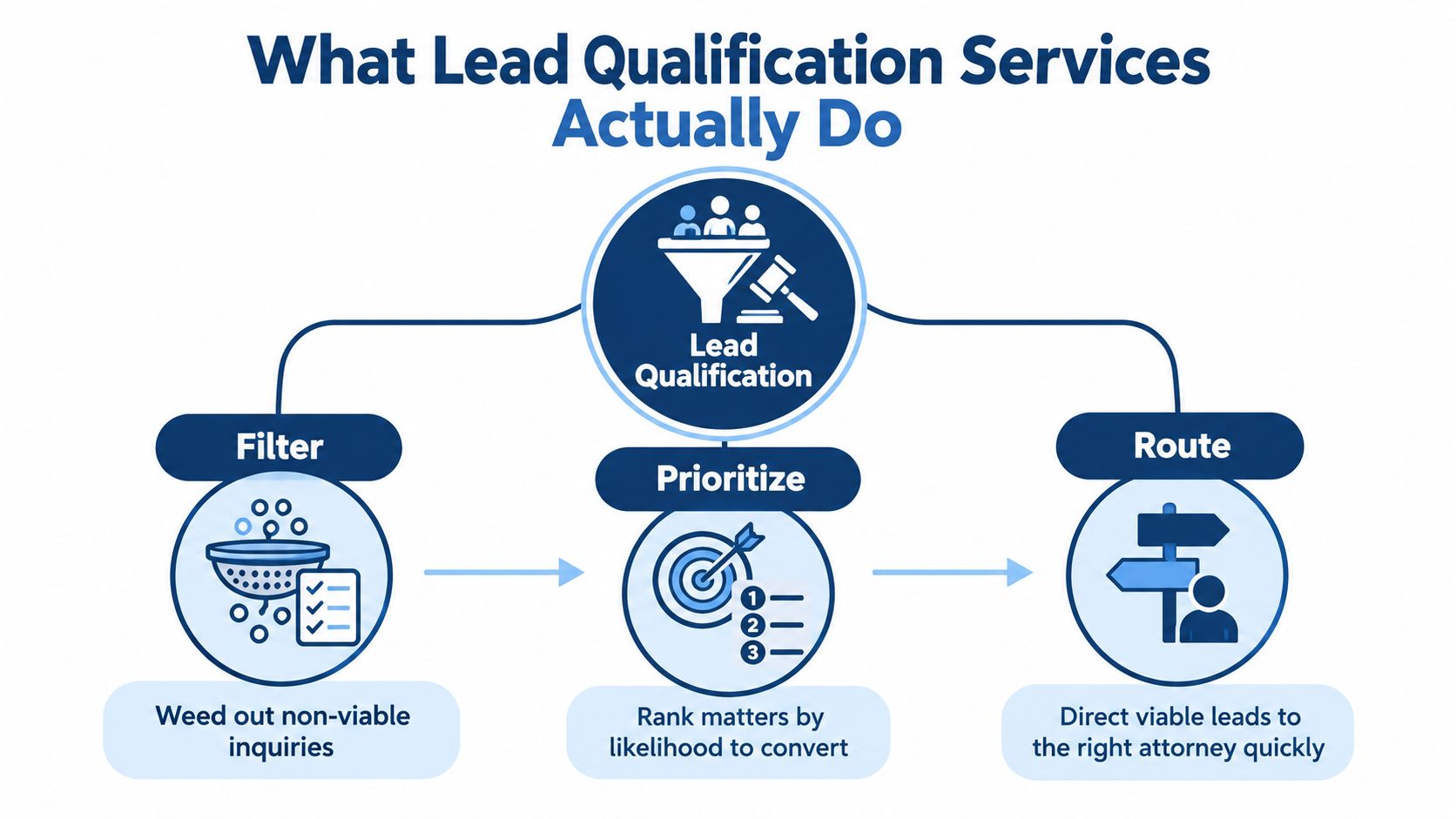
Filter for the firm's actual criteria
Filtering doesn't mean dismissing callers with a curt “we don't handle that.” It means collecting the facts needed to determine whether the inquiry fits the firm's work. Depending on the practice, that may include:
- Matter type: What happened, who was involved, and what legal issue does the caller believe exists?
- Location: Where did the event occur, where do the relevant parties reside, and can the firm act in that jurisdiction?
- Timing: When did the event happen, and is there a deadline or immediate risk?
- Representation: Is another lawyer involved, has a claim already been filed, or has the caller signed an agreement elsewhere?
- Urgency: Does the caller need immediate escalation, a scheduled consultation, or a later follow-up?
- Required records: What documents, notices, photographs, medical information, or other material may support review?
The questions should sound like a conversation, not an airport security interview. A trained intake professional can gather the facts while explaining what happens next.
Prioritize and route with context
Priority depends on the firm's criteria, not on a generic score copied from another industry. A severe matter with a short deadline may need immediate attorney review. A potentially viable matter without enough information may need a “needs review” status rather than a premature rejection. A poor-fit inquiry should be closed cleanly, with the reason documented.
An answering service generally takes a message. An appointment setter generally tries to book time. Qualification requires judgment, documentation, and ownership of the handoff. AI-enabled systems can help identify fields, trigger routing, and preserve records, but trained people still need to handle nuance, urgency, and appropriate escalation.
For firms building a broader growth process, a guide to legal pipeline growth can help connect intake activity with the stages that follow. The operational test is simple:
Taking a message is not intake. Intake ends when the firm knows what the inquiry is, whether it fits, who owns it, and what happens next.
Lead Qualification Frameworks Law Firms Actually Use
Law firms don't need to import a sales methodology unchanged. They need a repeatable way to ask good questions without making every caller feel like they're defending a deposition before the consultation. The framework should fit the matter type, the urgency, and the firm's ability to accept work.
BANT, meaning Budget, Authority, Need, and Timeline, offers a straightforward starting point. Budget can translate into fee arrangement or ability to fund the engagement. Authority becomes the caller's role in the matter and who can approve representation. Need identifies the legal problem, while timeline captures urgency and relevant deadlines. It's useful for simple, high-volume intake, but budget-first questioning can sound tone-deaf in consumer legal matters.
CHAMP, Challenges, Authority, Money, and Prioritization, starts with the caller's problem. That usually feels more natural in legal intake because the person is contacting the firm to explain an event, not to announce a purchasing plan. The framework helps the intake team understand what happened, who is affected, whether representation is possible, and how urgent the matter is before discussing financial arrangements.
MEDDICC, Metrics, Economic Buyer, Decision Criteria, Decision Process, Identify Pain, Champion, and Competition, is designed for complex sales with several stakeholders. Most firms won't need the full structure for an initial personal-injury inquiry, but parts of it can help with business litigation, employment matters, or organizational clients. The useful adaptations are decision criteria, decision process, urgency, and who must participate before the firm can be retained.
ANUM, Authority, Need, Urgency, and Money, puts authority and need ahead of financial questions. It can work when the caller's immediate problem must be understood before the firm discusses a fee structure or engagement path.
| Framework | Core Focus | Best For | Watch Out |
|---|---|---|---|
| BANT | Budget, authority, need, timeline | High-volume inquiries with clear commercial fit | Can feel too transactional |
| CHAMP | Challenge, authority, money, priority | Consumer matters and problem-led conversations | Requires careful listening |
| MEDDICC | Decision structure and complex deal risk | Business, institutional, or multi-party matters | Too heavy for routine intake |
| ANUM | Authority, need, urgency, money | Fast triage where timing matters | Can oversimplify nuanced matters |
Add legal-specific filters
A framework is only the skeleton. The firm must add its own criteria, including jurisdiction, practice-area fit, conflict-check requirements, statute concerns, damages or remedy questions where appropriate, and whether the firm has capacity to take the matter. The intake team shouldn't make legal judgments outside its role, but it can identify facts that require attorney review.
Start with one primary framework and a short practice-specific question set. Review the results with attorneys who understand which facts predict fit. Over-scripting creates a different failure: the team completes the form while missing what the caller is trying to say.
How a High Converting Qualification Workflow Works
A high-converting workflow behaves like a relay race. The inquiry must move from response to qualification, routing, and follow-up without dropping the baton. Each stage needs an owner, a record, and a defined next action. Otherwise, a firm can buy more leads while its intake queue becomes a storage unit.
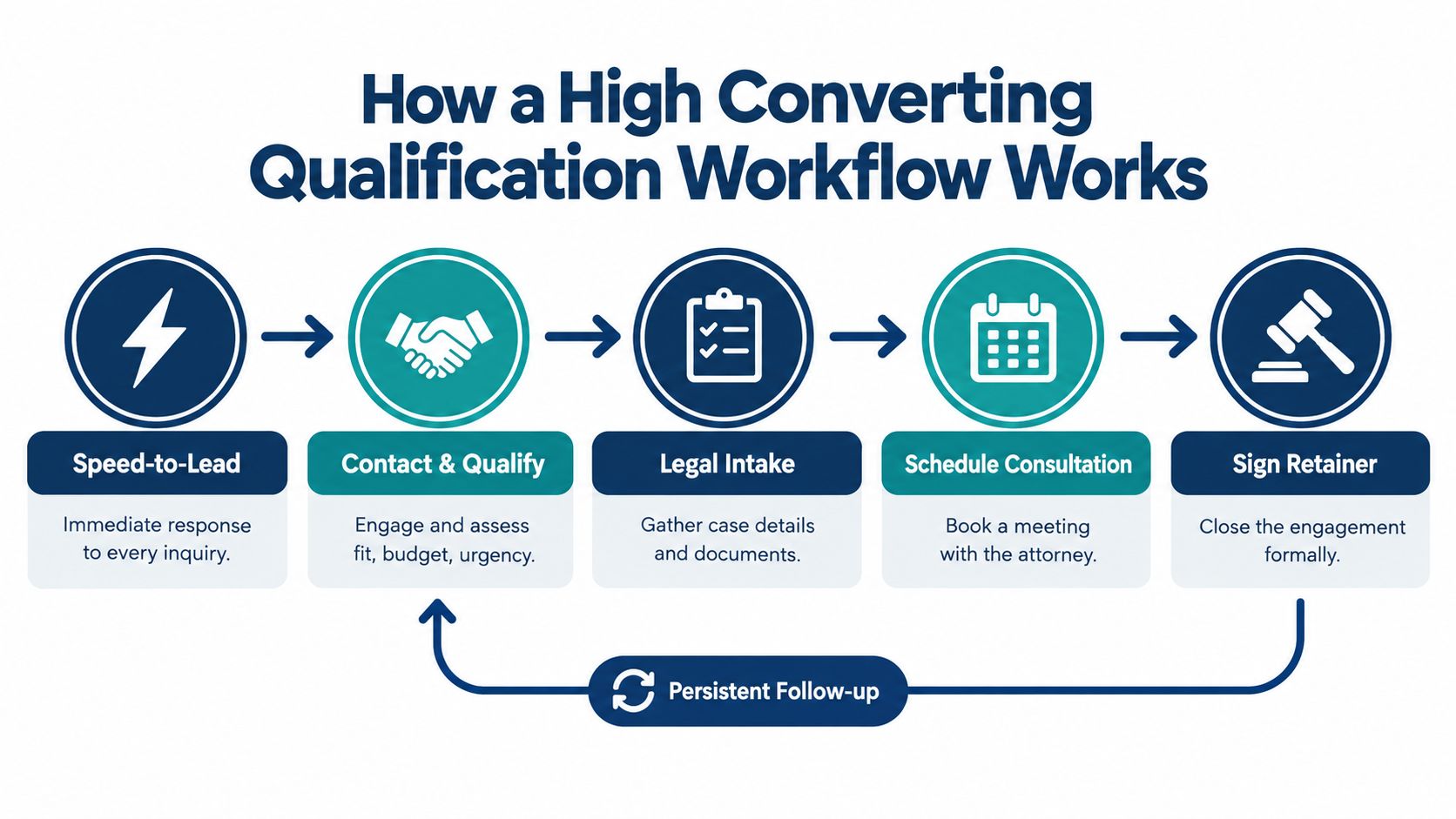
Start with speed and a useful response
The first response should acknowledge the inquiry, confirm the preferred contact method, and create a clear route to a human conversation. Web forms need immediate routing. Missed calls need a named callback owner. SMS can confirm receipt and keep the conversation alive while an intake professional gathers the required information.
The five-minute window discussed earlier is why the response service level should be measured in minutes, not hours. A separate 2026 speed-to-lead benchmark reports a 42-hour median B2B response time, only about 7% responding within five minutes, and conversion of roughly 21% for five-minute responders compared with 2.3% for teams waiting a day.
Set the rule plainly: define a response service level in minutes, then monitor it by source, channel, weekday, hour, and after-hours period. Coverage matters as much as speed. A fast response that reaches only web forms leaves missed calls and messages waiting in the same old queue.
Qualify, document, and route
The intake professional collects matter facts, applies the agreed criteria, and selects a status such as qualified, not qualified, or needs review. The CRM record should include the conversation summary, attempts made, documents requested, conflict-check information, appointment details, and the person responsible for the next step.
Warm transfers work when an attorney or designated reviewer is available. Otherwise, schedule the consultation with enough context for preparation. A calendar invitation without the caller's story is just a more organized form of confusion.
Follow up until the firm has made a decision
One unanswered call is not a workflow. It is an abandoned experiment. Use structured multi-attempt sequences across phone, SMS, and email, with rules for pausing, recycling, closing, or escalating a lead. The workflow automation best practices can help configure those triggers, while staff retain judgment about exceptions.
Frontline, Attorney Assistant's 24/7 live intake team, handles answering, qualifying, following up, and signing appropriate cases across nights, weekends, and regular business hours. Staffline provides dedicated, full-time legal support professionals who work inside one firm's systems. That arrangement can keep CRM records, appointment preparation, and case-support handoffs from becoming disconnected favors.
Firms auditing their current process can use this lead follow-up system for law firms as a practical reference. The aim is capacity control: every viable inquiry receives timely attention, the right matters reach the right reviewer, and the firm can see where work is waiting.
KPIs That Prove Qualification Is Working
A dashboard should tell an intake leader where the process breaks. It shouldn't merely confirm that the team answered a great many calls while viable matters wandered elsewhere.
Measure the chain, not the activity
Speed-to-lead measures the time from inquiry to first response. Track the median and the slower outliers, then split results by channel, weekday, hour, and after-hours period. The benchmark above shows why the first few minutes deserve separate attention. Another benchmark reports that moving from under five minutes to five to 10 minutes reduces qualification odds by about 90% relative to baseline, while one to two hours brings the decline to roughly 97% versus the five-minute mark. That analysis is detailed in this lead-response-time resource.
Contact rate tells you whether the team reached people, not whether it dialed them. Pair it with attempts per lead and channel. A low contact rate with fast first responses may indicate poor contact information or weak channel selection. A low contact rate after one attempt usually indicates that the firm stopped too soon.
Qualification rate measures the share of inquiries meeting the firm's criteria. Read it with disqualification reasons. If the rate changes suddenly, the cause may be a campaign shift, inconsistent judgment, or a script that no longer matches the practice.
Show rate and retainer rate reveal what happens after qualification. A low show rate may point to weak confirmation, poor scheduling, or unclear expectations. A low retainer rate may reflect attorney availability, consultation quality, fee communication, or a mismatch between the qualification standard and actual case acceptance.
Cost per qualified lead connects marketing spend with operational output. It's more informative than cost per form when many forms never reach a meaningful review.
Keep the reporting clean
Use required CRM fields, consistent status definitions, source tracking, and reason codes. Audit a sample of calls and records for accuracy, empathy, completeness, and compliance with the firm's instructions. A dashboard built on inconsistent statuses is not analytics. It's decorative arithmetic.
For firms that want to understand the relationship between intake activity and downstream outcomes, intake analytics for law firms offers a useful reference point. The COO should be able to answer whether the bottleneck is response speed, reachability, qualification judgment, scheduling, attorney capacity, or follow-through.
How to Choose and Co Manage a Lead Qualification Provider
Choosing among lead qualification services requires more than comparing hourly rates or asking whether someone answers the phone. The question is whether the provider can operate inside the firm's standards when a caller arrives at night, a web form appears on a weekend, or an attorney needs a complete handoff before a consultation.
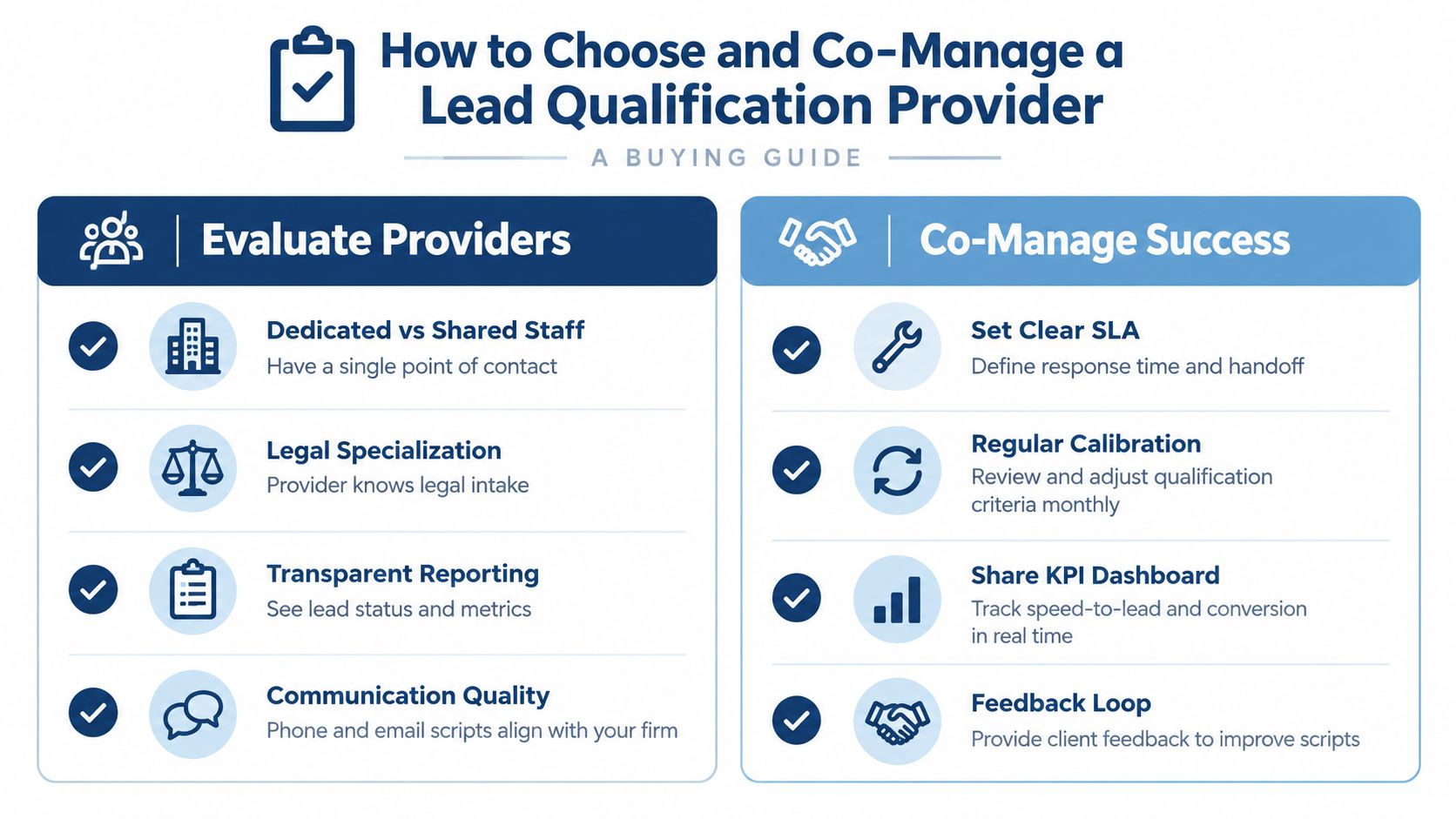
Evaluate the operating model
| Decision area | Shared or generic coverage | Dedicated or embedded support |
|---|---|---|
| Firm knowledge | Usually broad and limited | Builds familiarity with the firm's criteria |
| Ownership | Handoffs may be transactional | Roles and next actions can be assigned |
| Coverage | May focus on standard hours | Can be designed around nights, weekends, and overflow |
| Reporting | Activity reports may dominate | Status, quality, and conversion context can be reviewed |
| Training | Often script-centered | Can include systems, practice areas, and procedures |
Ask providers to demonstrate an actual intake call, not just show a dashboard. Find out how they handle a caller who is unsure of the practice area, how they document a matter needing attorney review, and what happens when the first call is unanswered. Confirm whether staff support English and Español if the firm serves both audiences. Review quality assurance, call monitoring, escalation, system access, CRM updates, and the process for changing qualification criteria.
The 2024 law-firm response study reported that 25% of firms responded to online leads in under five minutes, while 56% responded within two hours, and 26% made no personal response within seven days. The same source reported that under-five-minute response performance rose from 18% in 2023 to 28% in 2024, illustrating that improvement can occur unevenly. These findings are available in the law-firm lead form response study. Coverage gaps matter because daytime responsiveness doesn't protect a firm that misses nights, weekends, texts, and forms.
Co-manage instead of disappearing behind a vendor
Set the service-level agreement together. Define response time, callback ownership, qualification statuses, warm-transfer rules, consultation scheduling, documentation standards, and escalation conditions. Review the dashboard regularly, sample calls, and adjust criteria when attorneys report that the wrong matters are reaching them or good matters are being rejected.
Dedicated Staffline professionals work with one firm, 40 hours per week, inside the firm's systems and processes. Attorney Assistant sources, vets, and trains staff on legal support fundamentals, while the firm trains the professional on its own procedures and Attorney Assistant helps co-manage performance. For firms comparing intake coverage with broader administrative capacity, this guide to appointment-setting companies provides a related buying perspective.
The provider should be accountable for performance, but the firm must remain involved in defining what quality means. Outsourcing responsibility for a workflow doesn't outsource the firm's judgment.
Building Capacity That Converts More of What You Already Have
Lead qualification is often described as a marketing function because the lead enters through a campaign, referral, form, or phone number. The conversion result, however, depends on staffing, systems, coverage, and ownership. A firm with excellent marketing and inadequate follow-up has purchased opportunities it cannot reliably process.
The capacity plan should start with an audit:
- Trace every channel: Include calls, web forms, SMS, referrals, and after-hours inquiries.
- Measure the first response: Record who responded, when, and whether the response created a real conversation.
- Review disposition quality: Check whether qualified, not qualified, and needs-review statuses match attorney decisions.
- Inspect follow-up: Identify leads with one attempt, missing notes, no owner, or no scheduled next action.
- Find attorney leakage: Look for records, calendars, CRM updates, document requests, and other administrative work sitting with lawyers.
The operational economics are visible before a firm adds another campaign. Thomson Reuters Institute reported that silent partner write-offs account for over 76 hours and nearly $47,000 per partner per year in lost potential fees, as described in its law-firm billing write-downs report. A LexisNexis survey summary also reported that more than 1,000 attorneys identified administrative or practice-management work among the top activities responsible for non-billable hours, and that firms waste roughly one-third of hours worked as unbilled time, according to this summary of legal administrative time.
That's why the final decision isn't whether to buy lead qualification services. It's whether the firm needs a workforce that can absorb demand after the inquiry arrives. Frontline signs the case. Staffline carries it. Frontline provides 24/7 live intake, qualification, follow-up, warm transfers, appointment setting, and retainer signing. Staffline adds dedicated legal support for intake administration, case management, records, liens, calendars, inboxes, CRM hygiene, and related operational work.
A firm can still improve without hiring a provider. Define response SLAs, assign ownership, build a follow-up sequence, require clean CRM fields, and review the numbers by channel and hour. But if attorneys and existing staff can't perform those tasks consistently, the issue is capacity, not motivation.
Attorney Assistant provides Frontline 24/7 live intake and Staffline dedicated legal support professionals for firms that need faster qualification, structured follow-up, and more operational capacity after a case is signed. Review how Attorney Assistant can fit into your intake and staffing workflow, then compare the gaps you find with the support your firm needs.
Related Articles

Case Management App for Law Firms in 2026: How to Choose
Compare case management app options for law firms on intake, documents, calendaring, security and pricing, with a checklist to pick the right fit.
Business Telephone Answering Service for Law Firms
How a business telephone answering service works for law firms, including 24/7 intake, qualification, warm transfers, pricing models, and what

Call Flow Customer Service for Law Firms: A Practical Guide
Design a call flow customer service system for your law firm that captures leads, qualifies matters, and signs cases. Practical guide