
A lead calls your firm after dinner. The office line rings into voicemail, the caller hangs up, or someone answers and writes the name on a sticky note that later disappears beneath a deposition folder. By morning, the prospect has contacted another firm, forgotten why they called, or decided that a firm that couldn't return a call probably won't handle a case very well.
That isn't a technology problem by itself. It's an operating problem.
The phrase call answer phone sounds like a simple search for a receptionist, a forwarding rule, or an automated menu. For a law firm, the harder question is: what happens after someone answers? Does the team identify a viable matter, document the facts, follow up, schedule the consultation, complete the handoff, and move the prospect toward signing?
Answering the phone is the beginning of intake. Treating it as the finish line is how firms pay for marketing and then donate the resulting cases to competitors.
Table of Contents
- The Intake Myth Most Law Firms Believe
- Choosing Between Live Coverage and Automated Routing
- Building a Script That Qualifies Without Sounding Robotic
- Setting Up Warm Transfers and Appointment Workflows
- Why After-Hours Coverage Is a Conversion Channel
- Staffing Decisions That Actually Move the Needle
- Measuring Intake Performance and Fixing Leaks
The Intake Myth Most Law Firms Believe
The phone rings at 8:47 p.m. A caller reaches voicemail, hears an invitation to leave a message, and hangs up without saying a word. The firm may later report that the call was “handled.” Technically, the phone system performed its assigned task. The prospective client did not receive intake, a qualification conversation, or a reason to wait.

A widely cited observational study of 85 small businesses across 58 industries found that only 37.8% of inbound calls were answered by a live person, while 37.8% went to voicemail and 24.3% received no response at all. In practical terms, roughly 62% of calls were effectively missed, according to the study on the cost of slow lead response. For a law firm, that isn't merely an inconvenient customer-service statistic. The call may be the firm's first opportunity to identify an injury, deadline, conflict issue, or case type that another firm is ready to accept.
Operational rule: A message is a data point. Intake is a managed path to a decision.
The gap appears in the minutes after contact. A receptionist may capture a name but fail to ask what happened. An automated system may collect a phone number but provide no urgency screening. A busy attorney may promise to call back and then spend the next day in court. None of these actions creates reliable case conversion.
Answering and converting are different jobs
A useful intake workflow has at least four distinct outcomes:
- Capture: Record the caller's identity, contact details, source, and basic reason for calling.
- Qualify: Determine whether the inquiry fits the firm's practice, jurisdiction, timing, and acceptance criteria.
- Advance: Schedule a consultation, arrange a warm transfer, or assign a specific callback owner.
- Recover: Re-engage the caller if the first contact ends without a signed representation agreement.
A firm that handles only capture has built a message-taking operation. Taking a message is not intake.
The distinction matters because caller patience is limited. A U.S. law-firm mystery-shopper study found that 35% of 1,200 business-hours calls went unanswered, and 80% of callers who reached voicemail hung up without leaving a message. The same study reported that 94% of consumers were more likely to choose a firm that responded quickly, 78% hired the first lawyer or firm that answered, and only 7% of leads became retained clients, as reported by Bigger Law Firm's national study coverage.
The exact percentages matter less than the operational lesson. A caller who leaves no message cannot enter your callback queue. A caller who does leave one still needs a prompt, competent response. Your CRM cannot follow up with a lead if nobody puts the lead in the CRM.
Choosing Between Live Coverage and Automated Routing
Law firms generally choose between two call-handling models. Live human coverage puts a trained person in the conversation. Automated routing uses menus, voicemail, forwarding rules, bots, or scheduling tools to direct the caller or collect information.
Both models have a place. The mistake is treating them as interchangeable.
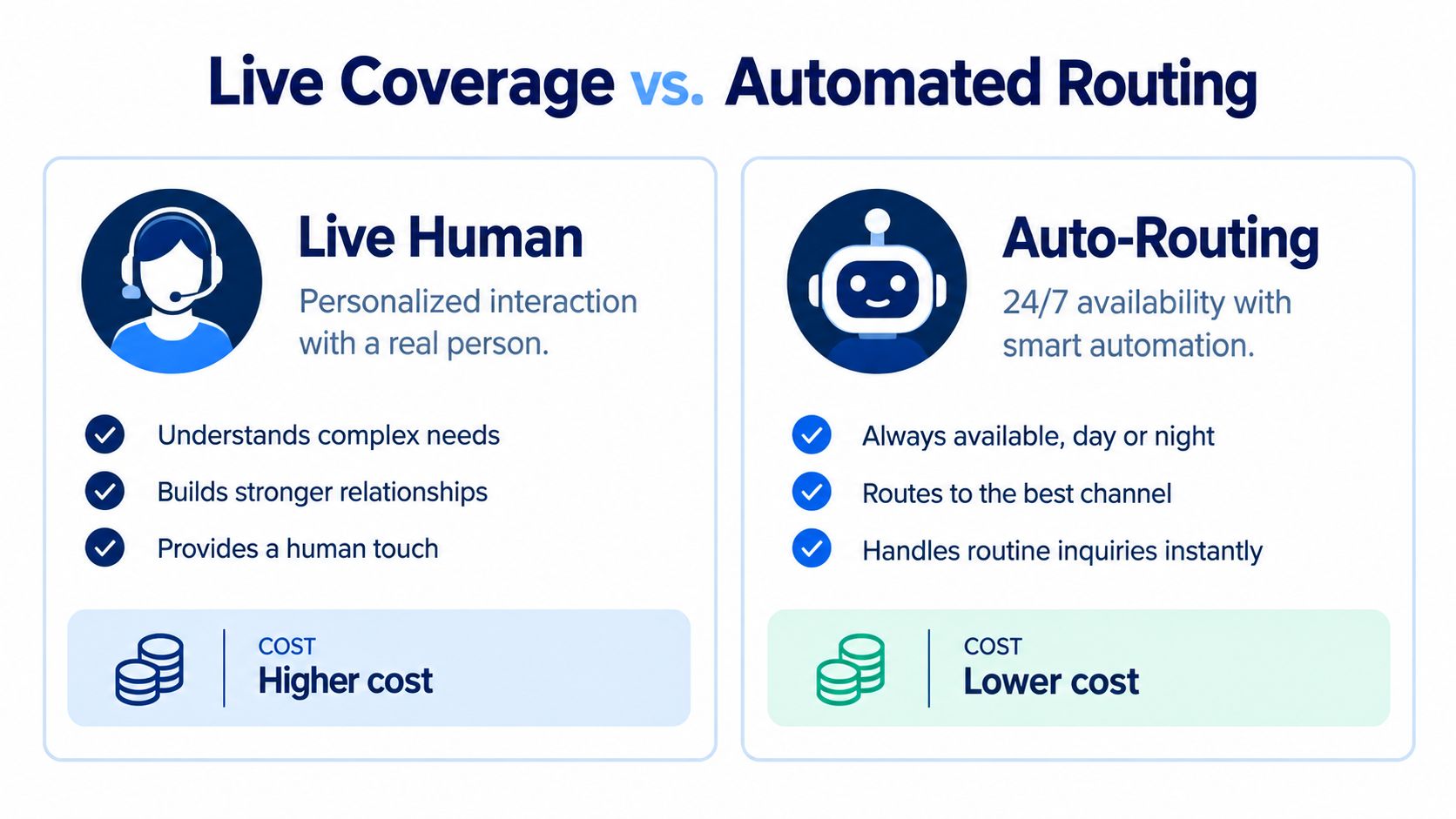
Automated routing handles predictable traffic well. It can separate existing clients from new inquiries, direct billing questions to staff, offer basic scheduling, and remain available when the office is closed. It also creates consistency when the alternative is an overworked receptionist improvising between calls.
But routing isn't qualification. A menu can send a caller to the right extension. It can't reliably understand a complicated fact pattern, recognize that a deadline makes the inquiry urgent, or explain what the caller should expect next. A voicemail box is available around the clock, too. That doesn't make it a 24/7 intake team.
The operational trade-off
| Model | Where it helps | Where it breaks down |
|---|---|---|
| Live human coverage | Builds rapport, asks follow-up questions, qualifies matters, schedules consultations, and can attempt a warm transfer | Requires training, oversight, coverage planning, and clear authority |
| Automated routing | Handles predictable routing, basic information capture, and routine availability outside office hours | Often pushes work into a later callback queue and may lose context or urgency |
| Hybrid workflow | Uses automation for sorting and live staff for qualified or sensitive conversations | Needs disciplined ownership so automation doesn't become a polite dead end |
Large-scale call analytics from Invoca, based on 70 million tracked calls, found that 56% of calls were answered by a person across all industries. The answer rate rose to 65% for calls lasting longer than 15 seconds and 71% for calls lasting longer than 30 seconds, according to the call-answering data summarized by JustCall. The useful point isn't that every call deserves a long conversation. It is that meaningful interactions depend on getting past the first moments without a routing failure or immediate hang-up.
For firms comparing staffing options, the best place to hire virtual legal assistants can help frame the difference between general administrative support and people assigned to legal workflows. The selection question should be practical: can the person follow your intake criteria, document the conversation, use your case-management system, and take the next action without waiting for an attorney to explain the process each time?
Review Attorney Assistant's call handling services with that same standard. The right system doesn't merely make the line available. It gives every viable inquiry a defined next step.
Building a Script That Qualifies Without Sounding Robotic
A good intake script doesn't force callers through an interrogation. It gives the intake specialist a reliable map so the conversation feels natural while the firm captures what it needs to make a decision.
Start with the opening. The caller should hear a human greeting, the firm's name, and a direct invitation to explain the reason for contacting the firm. “How can we help today?” will usually produce more useful information than a rigid request for the caller's full name, date of birth, and address before anyone has established why the person called.
Build the conversation in layers
A practical script moves through these stages:
Open the conversation. Confirm the caller has reached the right firm and invite a short explanation in the caller's own words. Don't interrupt a useful opening narrative just to fill a form field.
Identify urgency. Ask questions that reveal immediate risk, upcoming deadlines, active treatment, detention, threats, or other facts that require escalation under the firm's policy. Intake staff shouldn't give legal advice. They should recognize when the matter needs faster attention.
Establish fit. Gather the facts needed to evaluate practice area, location, timing, adverse parties, and the basic event. The questions should reflect the firm's actual acceptance criteria, not a generic checklist copied from an unrelated practice.
Clarify the desired next step. A caller may need a consultation, a document request, a callback from a specific team, or a direct connection to an available attorney. Never end with “someone will get back to you” unless the firm has assigned ownership and a documented timeframe.
Confirm the record. Repeat the critical facts, spell names when necessary, confirm the preferred contact method, and tell the caller exactly what happens next. This is where confidence is built or eroded.
A script should also define what staff must not do. Intake personnel shouldn't promise an outcome, interpret the law, speculate about fees, or imply that an attorney-client relationship exists before the firm has completed its process. They can be warm, clear, and helpful without pretending to be counsel.
Give staff room to think
Rigid scripts create strange conversations. A caller says, “I was hit by a truck yesterday,” and the intake specialist responds by asking for a mailing address. The script may be technically complete. The interaction is not.
Use branching guidance instead. If the caller describes an urgent event, the specialist follows the escalation path. If the matter falls outside the firm's scope, the specialist explains the next step respectfully and records the disposition. If the caller isn't ready to schedule, the team sets a specific follow-up task rather than marking the lead “not interested.”
Practical test: Read five completed call records without listening to the recordings. If you can't tell what happened, what the caller needs, and who owns the next action, the script is collecting fields instead of managing intake.
Train with call recordings, role-play objections, and examples of strong summaries. Review whether the specialist asked the right question at the right time, not just whether every required field contains text. A natural conversation can still produce excellent data. A robotic one can make a qualified caller disappear.
Setting Up Warm Transfers and Appointment Workflows
A transfer is not warm because the phone system uses the word “warm.” It is warm when the receiving person has context, is ready to speak, and understands why the caller is being connected.
The weak version looks familiar. An intake specialist sends a number to an attorney with a note that says “new lead” and hopes the attorney answers. The attorney sees an unfamiliar call, asks the caller to start over, and discovers that the prospect has already explained the story twice. By then, the firm has made the caller do administrative work for the privilege of becoming a client.
The handoff needs a payload
Before attempting a transfer, the intake specialist should confirm:
- Matter fit: The basic issue, jurisdiction, date or stage, and any firm-specific acceptance criteria.
- Caller readiness: Whether the caller wants an immediate conversation, a scheduled consultation, or time to gather information.
- Urgency: Any fact that changes the priority or requires escalation.
- Contact record: Correct name, phone number, email, referral source, and preferred method of communication.
- Conversation summary: A concise explanation the receiving attorney can absorb before saying hello.
The receiving attorney or staff member should accept the handoff actively. The intake specialist introduces both parties, gives the summary aloud, and remains available long enough to confirm that the conversation has started. If no one answers, the system should not treat the attempted transfer as a completed outcome.
For firms that need a clearer distinction between handoff types, this explanation of warm transfers versus cold transfers provides a useful operational baseline.
Appointments need ownership
Appointment setting belongs in the same workflow because a calendar entry isn't a retained case. The intake team should offer appropriate times, record the purpose of the appointment, confirm the caller's contact information, and send the agreed details through the firm's approved system.
Set service expectations around each stage. Define how quickly a qualified lead receives an attempted transfer, how quickly an unsuccessful transfer enters the callback queue, who reviews urgent matters, and how appointment confirmations are handled. The exact targets should come from the firm's capacity and practice, but they must exist in writing.
A good workflow also includes a failure path:
- The transfer connects: The receiving professional confirms the caller's identity and takes ownership.
- The transfer fails: The intake specialist documents the attempt and assigns a callback owner.
- The caller misses the appointment: The system creates a follow-up task instead of quietly closing the lead.
- The matter is declined: The firm records the reason and communicates the disposition consistently.
A warm transfer carries context, ownership, and a next action. Remove any one of those, and you have forwarding.
Why After-Hours Coverage Is a Conversion Channel
After-hours calls aren't a courtesy queue for people who forgot office hours. They are a separate opportunity stream with different staffing and response requirements.
A 2026 benchmark reported that 40.9% of tested personal-injury firms did not provide a live response to after-hours calls, according to CallShift's law-firm intake benchmark. Other coverage found that 41% of inbound calls arrived outside normal business hours, and 67% of those after-hours calls went to voicemail, as summarized in the same benchmark source. A firm that closes its live intake when the office closes has made an explicit decision to compete only during a portion of the caller's decision window.
That decision may be reasonable for some practice areas. It shouldn't be automatic.
Match coverage to the matter
Personal injury, criminal defense, family law, immigration, and other urgent or emotionally charged practices often receive inquiries when the caller's problem is actively unfolding. A caller with a routine estate-planning question may tolerate a scheduled response. A person facing an arrest, an accident, or an immediate family crisis may contact several firms and choose the first credible human response.
Don't assume every after-hours inquiry deserves identical treatment. Use a simple priority model:
- Urgent and likely fit: Attempt live qualification and an immediate transfer when the firm's policy allows.
- Likely fit but not urgent: Complete intake, schedule a consultation, and confirm the appointment.
- Unclear fit: Gather the facts needed for a next-day review, then assign an owner.
- Out of scope: Provide a respectful disposition and record the reason for future reporting.
Hennessey Digital's 2025 study found that 39% of law firms took more than two hours to respond to online leads or didn't respond at all, while only 25% replied in under five minutes and 56% responded within an hour, according to the firm's lead-form response study. Online response isn't the same as phone intake, but the operational principle carries over. A lead that waits enters a different decision environment.
24/7 coverage also protects the daytime team. Attorneys shouldn't have to interrupt a hearing preparation session to answer an unknown number, and receptionists shouldn't be expected to provide overnight coverage indefinitely. The answer is a designed coverage model with live staff, escalation rules, and follow-up ownership.
Staffing Decisions That Actually Move the Needle
The cheapest person who can answer a call isn't necessarily the cheapest intake model. Law firms pay for the consequences of weak qualification, missing notes, poor routing, and abandoned follow-up long after the call itself ends.
A receptionist, a general virtual assistant, and a dedicated legal intake team can each work in the right environment. Compare them by operating requirements rather than job title.
| Staffing model | Best fit | Questions to ask |
|---|---|---|
| Internal receptionist | Predictable office-hours volume and straightforward routing | Can this person answer consistently during peaks, breaks, meetings, and leave? |
| General virtual assistant | Administrative capture, scheduling, and defined support tasks | Who teaches legal intake, handles escalation, audits records, and covers absences? |
| Dedicated legal intake team | Firms that need qualification, follow-up, after-hours coverage, and accountable handoffs | Does the team use the firm's criteria, systems, scripts, and quality process? |
| Dedicated full-time legal support professional | Ongoing intake plus case administration and operational work | Can the person become part of the firm's team rather than a shared resource? |
The difference between a general assistant and a legal operations specialist isn't decorative. Legal intake requires judgment about what information matters, when a matter needs escalation, how to avoid unauthorized legal advice, and how to document a conversation so the next person can act.
It also requires system discipline. The worker should know where to create a lead, how to classify the inquiry, how to record the source, where to schedule the consultation, and what happens when a caller doesn't respond. If the process depends on an attorney remembering a verbal promise, the firm has built the world's least reliable CRM.
Choose capacity, not just coverage
A firm may need more than a phone answerer. The same operational team might handle lead recovery, appointment confirmations, CRM hygiene, records requests, file opening, calendar management, or lien-related administration. That broader view matters because a live intake channel can create work faster than the back office can absorb it.
Attorney Assistant provides Frontline, a 24/7 live intake team that answers, qualifies, follows up with, and signs appropriate cases, with coverage for nights and weekends, English and Español support, warm transfers, appointment setting, and call quality assurance. Its Staffline model provides dedicated, full-time legal support professionals assigned to one firm for work such as case management, records and bill retrieval, lien reduction, file opening, CRM hygiene, and administrative support.
The relevant recommendation is simple: choose a model that matches the entire workflow. If the phone is answered but no one owns follow-up, you haven't added capacity. You've moved the bottleneck one step downstream.
Measuring Intake Performance and Fixing Leaks
A firm can't improve what it labels vaguely. “The phones seem busy” and “intake is doing fine” aren't measurements. They are impressions formed by whoever happened to be standing near the reception desk.
Start with the path from ring to signed matter. Track each stage separately so the firm can see whether the leak occurs at answering, qualification, handoff, follow-up, appointment attendance, or retention.
Use a small set of decisive measures
Answer rate shows whether callers reach a person. Separate live answers, voicemail outcomes, abandoned calls, and calls that receive no response. The distinction matters because a voicemail system can make the dashboard look active while callers leave without entering the pipeline.
Speed to first response should cover both new calls and missed-call recovery. A firm that returns every voicemail eventually may still be losing callers who expected a response while the matter was fresh.
Qualification completion measures whether the intake record contains the facts needed for a decision. Don't reward staff for filling fields that don't help the firm accept, decline, prioritize, or schedule a matter.
Transfer completion reveals whether a “warm transfer” reached the intended person. Log attempted, connected, failed, and rescheduled outcomes separately.
Appointment progression follows the lead after scheduling. Track confirmation, attendance, rescheduling, and next action. An appointment without ownership is just a calendar ornament.
Retained-case conversion connects intake activity to the business result. Review it by practice area, source, time of day, intake staff, and disposition, provided the firm has enough consistent records to make those comparisons responsibly.
A legal-industry benchmark cited in the CallRail legal intake ebook reports a 28% missed-call rate for law firms, with missed calls treated as unworked leads rather than harmless administrative noise, as described in CallRail's speed-to-lead ebook. The number gives firms a benchmark to investigate, not a substitute for their own call records.
Audit the minutes after the call
Pull a sample of recent inquiries and ask:
- Was the call answered by a person or routed elsewhere?
- Did the record capture why the caller contacted the firm?
- Was the matter qualified against written criteria?
- Did someone own the next action?
- Was the caller contacted again when the first attempt failed?
- Did the receiving attorney receive a useful summary?
- Did the firm record the final disposition?
Use recordings and CRM records together. A completed form can hide a poor conversation, while a strong recording can expose a missing field or a broken handoff. Review both quantitative results and qualitative quality assurance, then coach against specific examples.
Hennessey Digital's 2024 study found that the median law-firm response time to online leads was 13 minutes, down from 21 minutes in 2023, while 28% of firms responded in under five minutes, according to the 2024 response-time study. Faster response is useful, but speed alone won't rescue a process that doesn't qualify, follow up, and sign.
For a practical overview of the systems behind this measurement, see this guide to call tracking for law firms. The firm should know not only how many calls arrived, but what happened to each one.
The right call answer phone setup is therefore a workflow, not a gadget. It puts a trained person in front of the caller, captures useful facts, creates ownership, and keeps working after the first conversation ends.
Attorney Assistant provides Frontline for 24/7 live intake, qualification, follow-up, warm transfers, appointment setting, and case signing, along with Staffline dedicated legal support for the operational work that follows. Visit Attorney Assistant to evaluate where your firm is losing callers, follow-up capacity, or attorney time, and build coverage around the gaps.
Related Articles
5 Case for Support Examples for Law Firms
Review five case for support examples for law firms, with strategic breakdowns, reusable templates, and practical tactics for staffing, intake, and growth.

Call Screen Service Options for Law Firms Compared
Compare call screen service options for law firms. Evaluate in-house staff, auto-attendants, and 24/7 legal intake teams to stop losing cases to missed calls.

Live Virtual Receptionists for Law Firms: A Practical Guide
Learn how live virtual receptionists help law firms capture more leads, qualify intake, and operate 24/7 without adding attorney workload.