What Is Call Tracking? A 2026 Guide for Law Firms

TL;DR:
- Call tracking assigns unique numbers to marketing sources to link calls with specific campaigns or channels. It enhances attribution accuracy and provides real-time context to intake managers, improving conversion rates for law firms. Proper implementation and CRM integration ensure valuable data leads to better marketing decisions and case signings.
Call tracking is defined as a system that assigns unique phone numbers to specific marketing sources, then links every inbound call back to the campaign, keyword, or channel that generated it. For law firms, this technology closes the attribution gap between marketing spend and signed cases. It integrates directly with CRM platforms to give intake managers real-time context on every caller before the conversation starts. Understanding how call tracking works, and how to act on its data, is the difference between a firm that converts leads and one that loses them to voicemail.
What is call tracking and why do law firms need it?
Call tracking is the practice of assigning distinct phone numbers to each marketing source, whether that is a Google Ads campaign, a billboard, a social media ad, or an organic search result. When a prospect dials one of those numbers, the system logs the call, captures metadata, and routes it to the firm’s main line. The caller never notices the difference. The firm, however, now knows exactly which campaign generated that call.
Law firms spend heavily on marketing but often have no reliable way to connect a signed case back to the ad that started it. A prospect might see a Google search ad on monday, visit the firm’s website twice, and call on friday. Without call tracking, that signed case gets attributed to nothing, or to the wrong source entirely. Call tracking closes that gap by linking calls to campaigns in real time, giving marketing managers accurate data to allocate budget.
The technology also integrates with CRM systems to surface a caller’s full digital history before the intake conversation begins. That context changes the quality of the call. An intake manager who knows a prospect visited the personal injury practice area page three times is better positioned to qualify and convert that lead.
How does call tracking technology work in law firms?
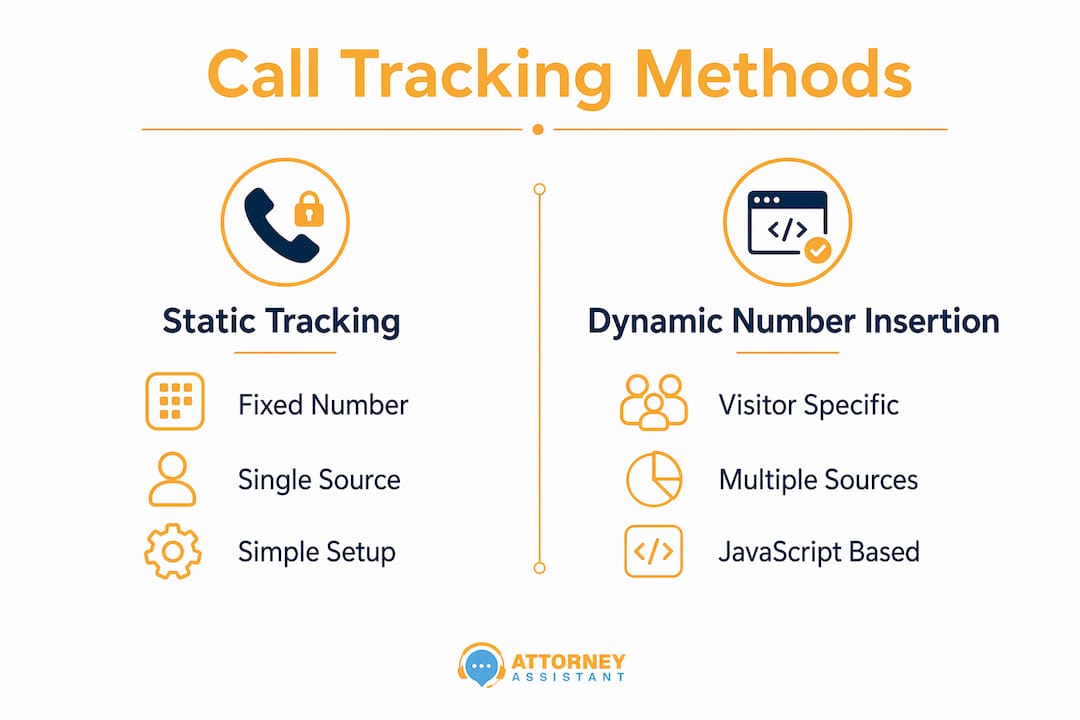
Two primary methods power call tracking: Static Number tracking and Dynamic Number Insertion (DNI). Each serves a different purpose, and most law firms need both.
Static number tracking
Static tracking assigns one fixed phone number to a single marketing source. A firm running a radio ad, a direct mail campaign, or a billboard uses a dedicated number for each. When that number rings, the system attributes the call to that specific offline asset. Static tracking for offline ads is straightforward to set up and requires no technical configuration on the website.
Dynamic Number Insertion
DNI works differently. A JavaScript snippet on the firm’s website detects each visitor’s source, whether they arrived from a paid search ad, an organic result, or a referral link, and swaps the displayed phone number in milliseconds. The visitor sees a unique number tied to their session. DNI on websites logs metadata including caller ID, location, timestamp, and the exact page viewed before the call, then forwards the call to the firm’s office line without any delay the caller would notice.
The process works in four steps:
- A prospect clicks a Google Ads link and lands on the firm’s website.
- The JavaScript snippet detects the traffic source and swaps the displayed number to a session-specific tracking number.
- The prospect calls. The platform logs all metadata and routes the call to the intake team.
- The call record, including duration, recording, and source attribution, syncs to the CRM automatically.
Pro Tip: Test your DNI setup weekly. A misconfigured JavaScript snippet causes the default number to display for all visitors, which breaks attribution entirely and loses lead data silently.
What are the key benefits of call tracking for law firm marketing and intake?
The core benefit of call tracking is attribution accuracy. Without it, marketing managers make budget decisions based on incomplete data. With it, they can see which keywords, ads, and pages generate calls that convert into signed cases, not just calls that ring.
The benefits extend well beyond reporting:
- CRM integration turns data into action. Without CRM integration, call tracking is a reporting tool. With it, intake staff receive real-time context on every caller, including their online journey, the page that triggered the call, and prior interactions with the firm. That context improves qualification and conversion on every call.
- Keyword-level attribution reveals true ROI. Long-tail keywords can yield 40% higher client conversion than generic terms. Knowing which specific search terms drive case-signing calls lets firms shift budget toward what actually works.
- Call segmentation improves budget decisions. Firms can filter calls by duration, source, and outcome to identify which campaigns generate qualified leads versus wrong numbers and solicitations. That segmentation prevents inflated ROI metrics from distorting spend decisions.
- Missed call and follow-up gaps become visible. Call tracking logs every call, including unanswered ones. Firms can see exactly how many leads went to voicemail and when, which creates accountability for intake teams and reveals staffing gaps.
- Visitor-level session tracking identifies tipping points. Visitor-level tracking shows the specific pages that triggered calls. A firm that discovers its practice area pages drive three times more calls than its homepage can prioritize content investment accordingly.
Pro Tip: Connect call tracking data to your lead nurturing workflows so that unclosed calls automatically trigger a follow-up sequence. Most firms lose leads not because the prospect said no, but because no one followed up.
For personal injury firms specifically, the role of intake call tracking goes further, helping firms identify which case types are calling and route them to the right intake specialist before the first word is spoken.
How to implement call tracking effectively and avoid common pitfalls
Implementation determines whether call tracking delivers value or just generates noise. The technology is only as useful as the rules and processes built around it.
- Filter calls under 30 seconds. Calls under 30 seconds are almost never qualified leads. Including them in your lead count inflates ROI metrics and distorts campaign performance data. Set a minimum duration threshold before any call is counted as a lead.
- Test DNI before and after every website change. JavaScript conflicts with other scripts are common after site updates. A broken DNI setup silently attributes all calls to the wrong source or to none at all. Test on multiple browsers and devices after any site change.
- Define conversion criteria before you launch. Decide what counts as a qualified call, a signed case inquiry, a consultation request, or a specific practice area question. Without clear criteria, your data will be inconsistent and your attribution unreliable.
- Use multi-touch attribution, not last-touch only. Multi-touch attribution maps the full digital path a prospect took before calling. A firm that only credits the last click misses the ad, the blog post, and the practice area page that built the decision to call.
- Push qualified call data to intake staff in real time. The value of call context disappears if it reaches the intake manager after the call ends. Configure your CRM integration to surface caller data before or during the call, not in a report reviewed the next morning.
Firms that skip these steps end up with call tracking data they cannot trust. Inaccurate data is worse than no data because it drives confident decisions in the wrong direction. For a broader view of managing inbound volume, the 2026 guide to inbound call management covers how to structure intake workflows around the data call tracking produces.
Which call tracking metrics matter most for law firm decisions?
The metrics that matter are the ones tied to case outcomes, not call volume. Volume is easy to measure and easy to misread.

| Metric | What it measures | Why it matters for law firms |
|---|---|---|
| Call duration | Length of each call | Filters out non-leads; calls under 30 seconds rarely qualify |
| Source attribution | Which campaign or keyword drove the call | Identifies which spend generates signed cases |
| Call recording | Full audio of each conversation | Enables intake performance review and training |
| Sentiment analysis | AI-scored caller intent and tone | Flags high-intent callers for priority follow-up |
| First call resolution | Whether the prospect moved forward on the first call | Measures intake effectiveness, not just lead volume |
AI-driven conversation analytics assess conversion likelihood and client intent automatically. That means a firm with high call volume can prioritize callbacks based on which prospects showed the strongest intent, rather than returning calls in the order they came in.
Keyword-level attribution is the metric most firms underuse. Knowing that “car accident lawyer near me” drives calls that sign at twice the rate of “personal injury attorney” tells a marketing manager exactly where to increase Google Ads spend. Marketing managers can see the exact landing page and keyword that converted a prospect, which removes the guesswork from budget decisions entirely.
Call recordings serve a second purpose beyond attribution. They give managing partners an objective record of how intake conversations are handled. That record supports coaching, identifies training gaps, and creates accountability without relying on self-reporting from intake staff.
Key takeaways
Call tracking delivers value only when CRM integration, defined conversion criteria, and real-time data delivery work together to improve intake decisions, not just marketing reports.
| Point | Details |
|---|---|
| Define what counts as a lead | Filter calls under 30 seconds to avoid inflating ROI metrics with non-leads. |
| Integrate with your CRM | Push caller context to intake staff before the call ends to improve conversion. |
| Use keyword-level attribution | Identify which search terms drive signed cases, not just calls, to direct budget accurately. |
| Test DNI after every site change | A misconfigured JavaScript snippet silently breaks attribution and loses lead data. |
| Measure quality, not volume | Sentiment scores and call duration reveal intake performance better than raw call counts. |
Why most firms are measuring the wrong thing
Law firms that implement call tracking and then check a dashboard of call volume every week are missing the point. I have seen firms celebrate record call months while their case sign rate dropped. The calls were coming in. The intake process was losing them.
The real value of call tracking is not knowing how many people called. It is knowing which campaign sent a caller who was ready to sign, and what happened on that call. That distinction changes how you allocate marketing budget and how you train intake staff.
The firms that get the most from this technology are the ones that treat call recordings as a coaching tool, not a compliance record. When an intake manager listens to a call where a qualified prospect said “I’ll think about it” and hung up, that is a training moment worth more than any ad spend adjustment.
CRM integration is where most implementations fall short. Firms set up the tracking numbers, connect the platform, and then never configure the data to reach intake staff in real time. The data sits in a report that gets reviewed on friday afternoon, long after the prospect has called another firm.
Visitor-level session tracking is the feature I would prioritize if a firm could only implement one thing beyond basic number assignment. Knowing which page triggered the call tells you where your website is doing its job and where it is losing people before they ever pick up the phone.
— Nicole
How Attorney Assistant helps law firms act on call tracking data
Call tracking tells you what is happening. Attorney Assistant makes sure your firm responds to it. Most firms that implement call tracking still lose leads because no one answers fast enough, follows up consistently, or qualifies the caller before the conversation stalls.
Attorney Assistant handles law firm intake and reception so your team responds to qualified calls immediately, follows up on missed ones, and moves prospects through intake without gaps. The operational side of call tracking, the part where data becomes a signed case, is where Attorney Assistant works. If you want to see how this fits your firm’s intake process, book a call with the team.
FAQ
What is call tracking in simple terms?
Call tracking assigns a unique phone number to each marketing source so firms can see exactly which ad, keyword, or channel generated each inbound call. The caller dials a tracking number, and the system logs the source before routing the call to the firm’s main line.
How does Dynamic Number Insertion work?
Dynamic Number Insertion uses a JavaScript snippet on your website to detect each visitor’s traffic source and display a unique tracking number in milliseconds. The system logs the visitor’s session data, including the page they viewed and the keyword they searched, before forwarding the call.
What call tracking metrics should law firms prioritize?
Call duration, source attribution, and call recordings are the three metrics that most directly affect intake decisions. Calls under 30 seconds should be filtered out as non-leads to keep attribution data accurate.
Does call tracking work without CRM integration?
Call tracking without CRM integration functions only as a reporting tool. CRM integration enables real-time data delivery to intake staff, which is what converts call data into improved case sign rates.
How does call tracking improve law firm conversion rates?
Call tracking improves conversion by giving intake managers context on each caller before the conversation starts, identifying which campaigns drive qualified leads, and flagging high-intent callers for priority follow-up using AI-driven sentiment analysis. Firms that use this data to optimize lead follow-up convert more of the leads they already have.
Recommended
Related Articles

Preferred Method of Contact for Law Firm Intake
Discover how to capture and use the preferred method of contact in legal intake to improve conversions, ensure compliance, and streamline law firm operations.

1st Dollar Coverage in Law Firm Retainers: A Practical Guide
Understand 1st dollar coverage in legal and insurance contexts. Learn how it shapes intake, retainer strategy, firm revenue, and risk.

24 7 Phone Answering Service: Law Firm Guide
Discover how a 24 7 phone answering service can help your law firm capture every lead and provide round-the-clock client support. Learn best practices here.