Warm Transfer vs Cold Transfer: What to Use and When

A warm transfer means the first agent briefs the next agent before connecting the caller. A cold transfer means the caller gets routed straight through with no briefing at all. For most customer interactions, warm transfers protect CSAT and first-contact resolution better, while cold transfers save agent time but raise the odds of a repeat call or an abandoned one.
Neither is universally right. The choice depends on stakes, volume, and what the customer is actually trying to get done. Here’s the immediate trade-off breakdown:
- Customer experience: Warm transfers preserve context and cut frustration. Cold transfers force repeat explanations, which is the single biggest driver of complaint calls.
- Handle time: Warm transfers add some briefing time upfront, generally under a few minutes. Cold transfers are faster in the moment but often cost more time downstream through repeat contacts.
- When cold works fine: Simple routing, customer requests a specific agent by name, or call volume is spiking and capacity matters more than context.
The rest of this guide covers exact definitions, decision rules for your team, ready-to-use scripts for both transfer types, mitigation tactics when a cold transfer is unavoidable, the KPIs to track before and after any policy change, and what this all means for law firms specifically, where a fumbled transfer doesn’t just annoy a customer. It loses a case.
Key Takeaways
Warm transfers preserve context and drive better resolution and satisfaction, while cold transfers trade speed now for repeat contacts and lower conversion later.
| Point | Details |
|---|---|
| Default to warm for high stakes | Use warm transfers for new prospects, escalations, and high-value accounts every time. |
| Reserve cold for low-stakes routing | Cold transfers work for named-agent requests, single-purpose queues, and true volume surges. |
| Track FCR and repeat-call rate | These two metrics reveal whether a cold transfer actually saved time or just delayed the real fix. |
| Mitigate unavoidable cold transfers | Collect a callback number, name the destination, and push a CRM note even without a live briefing. |
| Standardize policy, don’t improvise | A written rule by call category stops agents from defaulting to cold transfers to game their own AHT. |
| Get operational support for law firm intake | Attorney Assistant provides intake coverage and follow-up support so new prospects get warm, briefed handoffs instead of cold routes to voicemail. |
Table of Contents
- Warm Transfer vs Cold Transfer: Definitions and Related Terms
- Warm Transfer vs Cold Transfer: A Side-by-Side Comparison
- When Should You Use a Warm Transfer Instead of a Cold One?
- How Do You Perform a Warm Transfer Correctly?
- How Do You Minimize Damage From a Cold Transfer?
- Which Metrics Should You Track After Changing Transfer Policy?
- What Can You Do When a Warm Transfer Isn’t Possible?
- Why Transfer Policy Is a Revenue Problem for Law Firms
- A Practitioner’s Take on Getting Transfer Policy Right
- How Attorney Assistant Closes the Transfer Gap for Law Firms
- Sources
- FAQ
Warm Transfer vs Cold Transfer: Definitions and Related Terms
A warm transfer, also called an attended, assisted, or consultative transfer, happens when the original agent calls or messages the receiving agent, explains the situation, and only then connects the customer. The customer never has to start over.
A cold transfer, also called a blind or unattended transfer, routes the call directly to the next agent or queue with zero handoff communication. The receiving agent picks up knowing nothing. The customer has to explain their issue again from scratch.
Here’s a quick glossary for anyone standardizing terminology across a team:
- Attended transfer: Interchangeable with warm transfer. The sending agent stays on the line during the handoff.
- Consultative transfer: A subtype of warm transfer where the sending agent briefs the receiver privately before either connects the customer or stays on to make introductions.
- Blind transfer: Interchangeable with cold transfer. No briefing occurs.
- Attended-with-join: The sending agent introduces both parties by name and stays on the line briefly to confirm the handoff landed correctly, then exits. This is the gold standard for high-stakes calls.
- Soft vs. hard transfer: Some telephony platforms use “soft” for warm and “hard” for cold, though this terminology varies by vendor.
These definitions extend past phone systems. A chat agent looping in a specialist with a summary is a warm transfer. A customer getting bounced from one support form to another with no context carried over is a cold transfer in disguise, and it does just as much damage over SMS or live chat as it does on a phone line.
The core difference isn’t technical. It’s whether the receiving agent knows anything about the customer before they say hello. That single fact determines almost everything downstream: how long the call takes, whether the issue gets resolved on the first contact, and whether the customer feels handled or handed off.
Warm Transfer vs Cold Transfer: A Side-by-Side Comparison
The two transfer types perform differently across the metrics that actually matter to a call center manager. Here’s how they stack up:
| Dimension | Warm Transfer | Cold Transfer |
|---|---|---|
| Customer experience (CSAT/NPS) | Higher. Customer doesn’t repeat themselves; feels attended to. | Lower. Repetition breeds frustration and lower satisfaction scores. |
| Speed / efficiency (AHT) | Adds 30 to 120 seconds of briefing time per transfer. | Faster for the sending agent in the moment. |
| Resolution likelihood (FCR) | Higher. Receiving agent starts with full context. | Lower. Missing context leads to more repeat calls and lower FCR. |
| Best-fit scenarios | Escalations, sales handoffs, sensitive or emotional calls, high-value accounts. | Simple routing, named-agent requests, high-volume surge periods. |
| Agent effort | Higher upfront (briefing takes coordination). | Lower upfront, but shifts cost downstream. |
Pros of warm transfers: the customer stays oriented, the receiving agent isn’t caught off guard, and complex issues get resolved without a second explanation. A billing dispute that’s already escalated once benefits enormously from a warm handoff because the receiving agent can pick up mid-conversation instead of restarting the diagnosis.
Cons of warm transfers: they tie up two agents at once, however briefly, and during a call surge that capacity cost adds up fast.
Pros of cold transfers: they’re quick, they don’t require the sending agent to track down an available colleague, and for a genuinely simple request (like “please connect me to billing”) the customer barely notices.
Cons of cold transfers: the customer has to repeat themselves, the receiving agent is working blind, and if nobody picks up on the other end, the call just drops.
Read the table with your business goal in mind. If you’re optimizing for conversion, like sales handoffs or legal intake, weight CSAT and FCR heavily and accept the AHT cost. If you’re optimizing purely for cost control during a call surge, AHT and agent effort matter more, and cold transfers earn their place.
When Should You Use a Warm Transfer Instead of a Cold One?
Use this as a working policy, not a rigid law. The stakes of the call should drive the decision every time.
- Use a warm transfer when the call involves money, escalation, or emotion. Billing disputes, angry customers, or anyone who’s already been transferred once before all warrant a briefed handoff.
- Use a warm transfer when the caller is a prospect, not an existing customer. A sales inquiry that gets cold-transferred often just hangs up and calls a competitor instead.
- Use a warm transfer for named or VIP accounts. High-value customers expect continuity, and losing it is one of the fastest ways to lose the account.
- Cold transfer is acceptable when the customer explicitly asks for a specific person or department by name. They already know where they’re going; no briefing adds meaningful value.
- Cold transfer is acceptable during genuine volume surges when every agent is juggling multiple queues and adding briefing time would create a bigger bottleneck than it solves.
- Cold transfer is acceptable for single-purpose queues, like a dedicated line for scheduling or password resets, where the destination agent already has narrow, predictable context.
A simple SOP your team can lift directly:
- New prospect or sales lead calling in? Warm transfer, always.
- Escalated or emotional call? Warm transfer, always.
- Existing high-value account? Warm transfer, always.
- Simple, single-purpose request with a known destination? Cold transfer is fine.
- Volume surge and the queue is backing up? Cold transfer with mitigation steps (covered below).
Nextiva’s guidance backs this pattern: warm transfers win on satisfaction in almost every case, and cold transfers earn their keep only in narrow, low-stakes situations.
How Do You Perform a Warm Transfer Correctly?
A warm transfer done badly is barely better than a cold one. Here’s the checklist that actually works:
- Ask for consent. Tell the customer you’re going to transfer them and confirm they’re okay holding for a moment.
- Put the caller on hold, not mute. Muting risks the customer thinking they’ve been dropped.
- Brief the receiving agent with the essentials: the issue, what’s already been tried, the customer’s tone, and any account specifics that matter.
- Confirm the receiving agent is ready before connecting. Don’t hand off to someone who’s mid-conversation with someone else.
- Introduce the caller by name to the receiving agent, and vice versa, so both parties know who they’re talking to.
- Bridge the call and confirm the handoff landed before you drop off the line.
Script for high-volume environments (concise version):
Agent 1 to customer: “I’m going to connect you with our billing specialist who can get this sorted faster. One moment.” Agent 1 to Agent 2 (customer on hold): “I’ve got Sarah on the line, invoice dispute on account 4521, she’s already tried the online portal and it failed twice. Can you take it?” Agent 1 to customer: “Sarah, I’ve got Mike on the line, he’s got your account pulled up and knows exactly where you left off. Mike, this is Sarah.”
Script for escalations or sensitive calls (full version):
Agent 1 to customer: “I understand this has been frustrating, and I want to make sure the right person handles this for you. I’m going to bring in my supervisor, Dana, who has more authority to resolve this today. Are you okay holding for about a minute while I brief her?” Agent 1 to Agent 2 (customer on hold): “This is a second-time caller, account 8832, upset about a billing error that’s happened twice. She’s asked to speak with a supervisor. Here’s the account history…” Agent 1 to customer (reconnecting): “Thank you for your patience. Dana has your full account history and understands exactly what’s happened so far. Dana, this is Maria.”
Pro Tip: Set up a CRM screen-pop that auto-populates the receiving agent’s screen with the last five interactions the moment the transfer initiates. It cuts briefing time nearly in half because the receiving agent is reading while listening, not starting from zero.
How Do You Minimize Damage From a Cold Transfer?
When a cold transfer is genuinely the right call, a few guardrails keep it from tanking customer experience.
- Tell the customer exactly who they’re being transferred to before you route them: “I’m connecting you with our claims department now.” A named destination feels intentional, not like a brush-off.
- Collect a callback number before transferring, every time, in case the call drops or nobody answers on the other end.
- Push a screen-pop or CRM note to the receiving agent even without a live briefing. A one-line summary field that auto-populates from the intake form gives the next agent something to work with, even if it’s not a full handoff.
- Set a hard timeout on unanswered transfers. If nobody picks up within 20 to 30 seconds, route to voicemail or a scheduled callback instead of leaving the customer in transfer limbo.
- Build clear routing rules for surge periods so cold transfers go to defined queues, not random extensions, reducing the odds of a dead-end transfer.
MightyCall’s guidance on blind transfers confirms these are the standard mitigation tactics used successfully across call centers that still rely on cold routing for high-volume queues.
One important number: warm transfers typically add just 30 to 120 seconds of upfront agent time, but that briefing window often saves more time overall than the multiple minutes lost when a customer has to re-explain their issue to a second, or third, agent after a cold transfer goes sideways.

Which Metrics Should You Track After Changing Transfer Policy?
Any change to transfer policy should be measured, not assumed. Track these five metrics before and after:
- Average Handle Time (AHT): Expect this to rise slightly with more warm transfers and drop with more cold ones.
- First Contact Resolution (FCR): This is the metric that usually moves the most. Warm transfers tend to lift it because the receiving agent isn’t starting blind.
- CSAT or NPS: Track satisfaction specifically on transferred calls, not just overall scores, so the signal isn’t diluted.
- Transfer rate: How often calls get transferred at all. A high rate signals a routing or training problem upstream.
- Repeat-call rate: The clearest proxy for whether a cold transfer actually resolved anything or just delayed the real conversation.
Here’s the trade-off pattern in plain terms:
| Metric | Effect of More Warm Transfers | Effect of More Cold Transfers |
|---|---|---|
| AHT | Increases (30 to 120 seconds per transfer) | Decreases in the short term |
| FCR | Increases | Decreases |
| CSAT/NPS | Increases | Decreases, especially on repeat contact |
| Repeat-call rate | Decreases | Increases |
If you’re testing a policy shift, run a small pilot before rolling it out: pick one call category (billing escalations, for example), require warm transfers for four weeks, and compare FCR and CSAT against the prior month’s baseline for the same category. A meaningful shift usually shows up within a few hundred calls, enough volume to smooth out day-to-day noise without waiting a full quarter to see if it’s working.
RingCentral’s analysis makes the underlying point clearly: the speed you gain from a cold transfer is often borrowed against future repeat calls, not actually saved.
What Can You Do When a Warm Transfer Isn’t Possible?
Sometimes no agent is free to take a briefing, or the destination queue is genuinely overwhelmed. A few fallbacks protect the customer experience without forcing a bad cold transfer:
- Scheduled callback: Offer the customer a specific callback window instead of a blind transfer into a dead queue. This outperforms a cold transfer whenever wait times are unpredictable.
- Case or ticket creation with detailed notes: Log the issue thoroughly and hand it to the next available agent asynchronously, rather than transferring live into an overloaded queue.
- Chat-to-phone warm handoff: If a chat conversation needs to escalate to voice, carry the full chat transcript into the phone system so the receiving agent has the same context a live briefing would provide.
- AI qualification with context capture: Structured intake questions asked upfront, whether by a bot or a script, mean the next human in the chain effectively gets a warm transfer even without a live handoff between agents.
Each of these works best with a short template already built. A callback confirmation script, a standard set of CRM fields for ticket notes, and a chat-transcript export button all turn a “we can’t do a warm transfer right now” moment into something that still feels intentional to the customer.
Why Transfer Policy Is a Revenue Problem for Law Firms
For a personal injury or contingency-fee law firm, a bad transfer isn’t a satisfaction score. It’s a lost case. A new prospect who calls in, gets cold-transferred to an unavailable intake line, and has to leave a voicemail is a prospect who’s already dialing the next firm on their list. Missed calls and slow handoffs are one of the most common ways firms leak cases they already paid to generate.
Here’s the practical policy for law firm intake lines:
- New prospects always get a warm transfer, or better, they get answered by someone who can actually qualify the case on the first contact. A cold transfer to voicemail on a new lead is close to the same as not answering at all.
- Existing clients calling about case status always get a warm handoff to whoever has their file open, not a blind route to a general queue.
- Escalations, like a client upset about settlement delays, get a warm transfer to a supervisor or the handling attorney, never a cold route into a general mailbox.
- Routine scheduling calls can go through a simpler, faster path, since the stakes are lower and speed matters more than briefing depth.
The intake details matter as much as the transfer type. Every handoff, warm or cold, should log the caller’s name, case type, referral source, and urgency into the CRM immediately, not after the fact. Responsive, coordinated client communication measurably improves retention and case conversion, and that starts with the very first transfer a prospect experiences.
Pro Tip: Audit your firm’s intake line for one week and log every transfer: warm, cold, or straight to voicemail. Firms are often surprised to find a large share of new-prospect calls are getting the cold-transfer treatment simply because nobody built a rule against it.
A Practitioner’s Take on Getting Transfer Policy Right
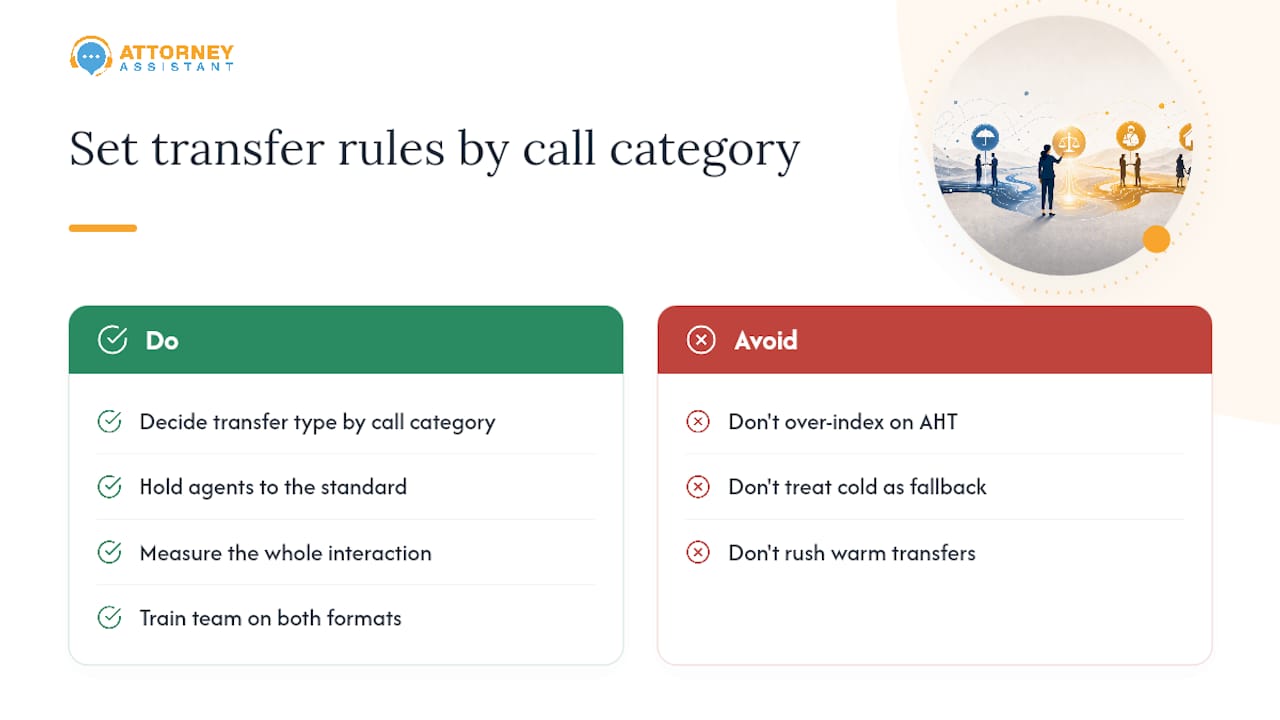
Most call centers don’t have a transfer policy problem. They have a transfer default problem. Agents pick whichever option is fastest for them in the moment, and nobody’s measuring what that default actually costs in repeat calls and lost conversions. The fix isn’t complicated: decide in advance, by call category, which calls always get a warm handoff, and hold agents to it the same way you’d hold them to any other quality standard.
Where I’d push back on conventional call center wisdom: teams over-index on AHT as the north star metric, and cold transfers look great on that dashboard right up until you cross-reference it against repeat-call rate and realize you’re not saving time, you’re just moving the cost to a different call, a different day, and often a different agent who now has to untangle a colder trail. Measure the whole interaction, not the slice that makes one metric look good.
Train your team on both formats, not just warm transfers as the “good” one and cold as the fallback. A well-executed cold transfer, with a callback number collected and a CRM note logged, beats a rushed, sloppy warm transfer where the briefing was too fast to matter. Format matters less than discipline.
How Attorney Assistant Closes the Transfer Gap for Law Firms
Every mitigation tactic in this guide, screen-pops, callback scripts, CRM notes, only works if someone is consistently executing it on every call, including nights, weekends, and the surge after a marketing campaign lands. That’s the gap Attorney Assistant closes for law firms. Our intake coverage and lead follow-up work means new prospects get a live, briefed handoff instead of a cold route to voicemail, and every call detail lands in your CRM before the next agent picks up the file.
We’re not a staffing vendor filling seats. We fix the operational failure point where warm transfers turn into cold ones because nobody was available to brief the next person. If your intake line is leaking prospects to competitors because of transfer gaps, our lead follow-up service is built specifically to close that. Book a call to walk through your current transfer setup and see where the leaks are.
Sources
- Warm transfer vs cold transfer: key differences and impacts | RingCentral
- Cold transfers vs. warm transfers: What you need to know | Nextiva
FAQ
What Is Considered a Warm Transfer?
A warm transfer is any handoff where the sending agent briefs the receiving agent on the caller’s issue and context before connecting them, so the customer never has to repeat themselves.
What Are the Main Types of Call Transfer?
The two core types are warm (attended, assisted, or consultative) and cold (blind or unattended), with variations like attended-with-join for formal introductions and soft versus hard transfer used by some telephony vendors.
What Does a Cold Transfer Mean?
A cold transfer, also called a blind transfer, routes a caller directly to another agent or department with no briefing, meaning the receiving agent has zero context when they pick up.
How Do You Perform a Warm Transfer?
Get the customer’s consent, place them on hold, brief the receiving agent on the issue, confirm the receiving agent is ready, introduce both parties by name, and bridge the call before dropping off.
Which Transfer Type Should Law Firms Use for New Prospects?
New prospects should always get a warm transfer or a live, briefed answer, since a cold route to voicemail on a first-time caller often means losing that lead to another firm entirely.
Recommended
Related Articles
Litigation Support Services: What Law Firms Need to Know
Discover how litigation support services streamline discovery, reduce costs, and improve case outcomes. Learn what to look for in a provider.
Keep the Conversation Going: 8 Intake Follow-Up Tactics
Learn how to keep the conversation going with law prospects using eight practical intake and follow-up tactics, from speed-to-lead to attorney handoffs.
Preferred Method of Contact for Law Firm Intake
Discover how to capture and use the preferred method of contact in legal intake to improve conversions, ensure compliance, and streamline law firm operations.