
Friday, 4:52 p.m. A demand package is due Monday, three depositions need confirming, and an attorney just asked for "the Smith file" in a tone that suggests he isn't sure which Smith. Somewhere in your office, one person is handling all of it, and you're about to write a job posting for a legal secretary or a paralegal without being entirely certain which one you need.
That's how this decision usually gets made. Someone quits, a caseload doubles, an attorney starts answering the phone at 9 p.m., and the response is a job title copied from the last posting. The title is the least useful part of the decision.
What separates the roles is accountability for the work and how much billable time each role consumes. A legal secretary answers for whether the file is complete, the deadline is calendared, and the correspondence went out. A paralegal answers for whether the analysis is right, subject to attorney review. Mix those up and you pay twice, once in salary and again in unbilled hours a higher-paid person spent on work someone else could have done.
Judge the two roles that way and the hiring question stops being mysterious.
Table of Contents
- Legal Secretary and Paralegal Side by Side
- What Each Role Handles Day to Day
- Qualifications, Training and Credentials Compared
- What Each Hire Costs and Returns
- Who Should Own Intake and Follow-Up
- Where AI and Supervision Draw the Line
- Choose the Role Your Firm Needs Before You Hire
Legal Secretary and Paralegal Side by Side
The plain difference fits in one sentence. A legal secretary keeps the firm moving. A paralegal moves the case forward under an attorney's supervision.
The U.S. Bureau of Labor Statistics 2025 estimates put the median annual wage at $55,570 for legal secretaries and legal administrative assistants across 157,600 jobs, and $62,890 for paralegals and legal assistants across 404,900 jobs (BLS occupational outlook for secretaries and administrative assistants).
Legal secretary and paralegal at a glance
| Criterion | Legal Secretary | Paralegal |
|---|---|---|
| Primary focus | Calendars, filings, correspondence and records flow | Research, drafting and case work under attorney supervision |
| Typical entry education | High school diploma or equivalent | Associate degree |
| Median annual pay, 2025 | $55,570 | $62,890 |
| U.S. jobs, 2025 | 157,600 | 404,900 |
| Substantive legal analysis | Not part of the role | Yes, under attorney supervision |
| Time usually billed to clients | Usually not | Often, through matter-level timekeeping |
The pay gap is real, roughly $7,300 at the median, and it settles nothing by itself. A paralegal who spends her afternoons chasing calendar conflicts is an expensive scheduler, and her salary line tells you nothing about whether that's happening.
The employment split is the more interesting number. Paralegals outnumber legal secretaries by better than two to one nationally, which tells you where firms have been putting their support dollars for the last decade.
Work that must be billed or supervised belongs on the paralegal side of that table. Work that keeps calendars, files and correspondence accurate is usually well covered by the secretary side. Most firms of any size need both, and which one comes first is a separate question from which one is worth more.
What Each Role Handles Day to Day
Take a three-attorney personal injury office on a Tuesday. Ordinary enough to be useful, busy enough that the split stops being theoretical.
At 8:40 the legal secretary reconciles three calendars that disagree with each other, confirms a deposition date with opposing counsel's office, opens a file for a referral that came in over the weekend, routes the mail, and logs a returned client call with enough detail that the attorney can dial back without asking what it was about. At the same hour the paralegal pulls medical records for a demand that has been sitting, builds a chronology of treatment dates, and drafts first interrogatories for attorney review.
The two workstreams barely overlap, which is the entire point.
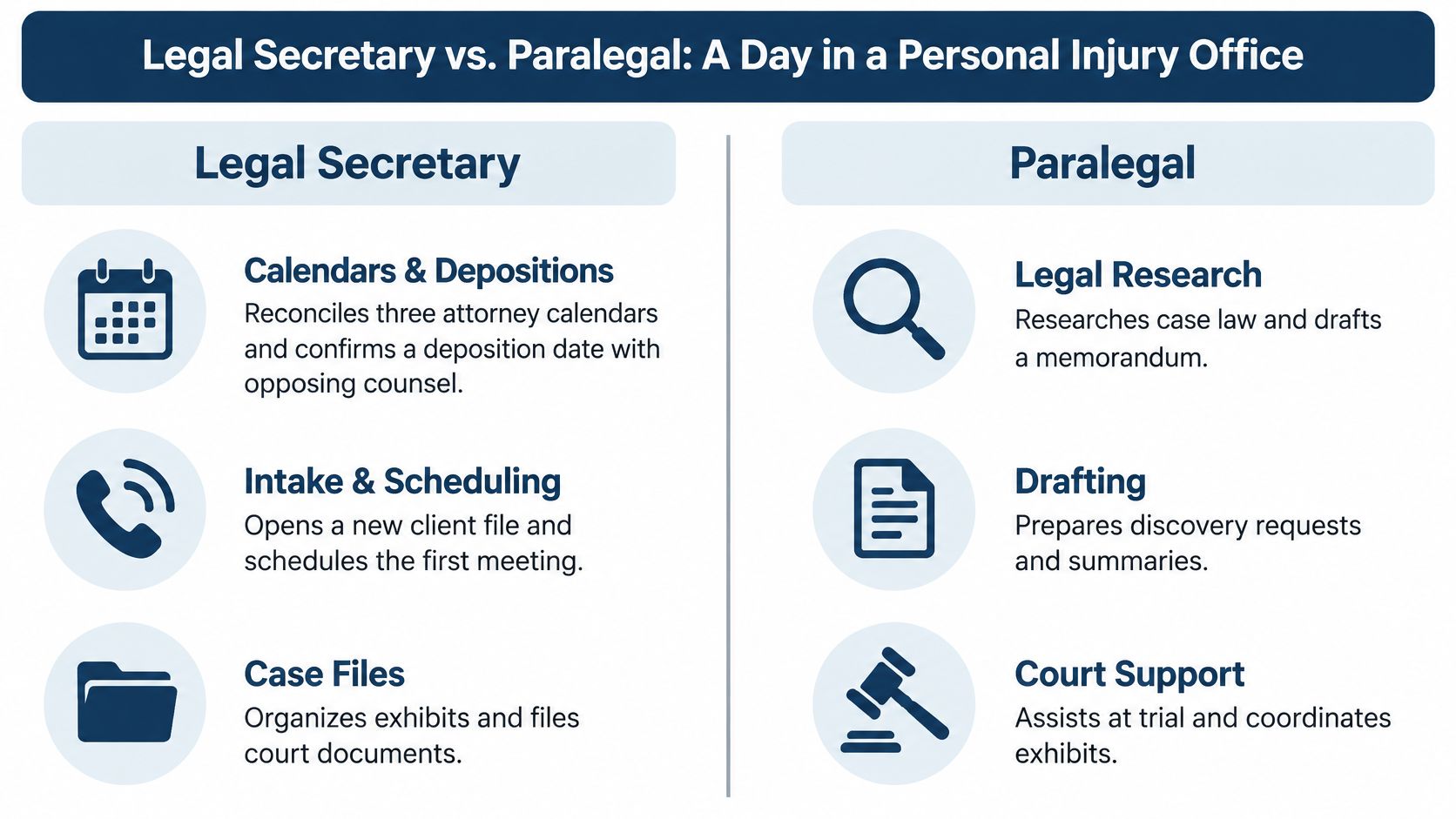
By early afternoon the secretary is updating the docket and sending deadline notices. The paralegal is condensing a 400-page records set into a two-page treatment summary, flagging a gap in the imaging records, and assembling an exhibit list. Both touched the same file. Neither did the other's job.
Federal data tracks that division of labor. The Bureau of Labor Statistics found legal services accounts for 75% of paralegal and legal assistant positions, and projected approximately 40,800 openings a year between 2025 and 2035 even with little or no change in total employment, largely because workers leave the occupation and have to be replaced (BLS paralegals and legal assistants). Openings that come from turnover rather than growth tell you something useful: the demand is steady even when the headcount isn't.
Where the accountability line sits
Both roles touch files. The difference is who answers for what.
The secretary answers for the file being complete and on time. The paralegal answers for the accuracy of the work product, subject to attorney review. The attorney answers for legal judgment and for anything that reaches a client or a court.
When a summary omits a treatment date, the question that matters isn't which job title was on the task. It's who checked it and who signed off.
Sort your own task list with that rule. Work that requires reading a document to judge its meaning belongs on the paralegal side. Work that keeps a record accurate and moving on schedule belongs on the secretary side. Work that requires neither judgment nor tracking probably belongs in software, or with an admin who costs less than both.
Keeping the file coherent across all of that is where most firms lose hours, and a shared approach to legal documents management buys more throughput than another hire usually does.
Qualifications, Training and Credentials Compared
Entry requirements look similar on paper and diverge fast in practice.
A legal secretary typically enters with a high school diploma or equivalent, and what your interview should actually test is typing accuracy, legal document formatting, calendaring and docketing software, and the discretion to handle privileged information without narrating it in the break room. A paralegal typically enters with an associate degree, though firms also hire from ABA-approved paralegal programs, certificate courses for people who already hold a bachelor's degree in something else, and occasionally from a strong internal candidate with years of legal office experience.
Certifications are voluntary and worth what the hiring partner thinks they're worth. NALA offers the Certified Paralegal (CP) credential. NFPA offers the Paralegal Advanced Competency Exam (PACE). Neither is a license to practice law, which means a paralegal always works under attorney supervision and cannot give legal advice, set fees, or represent a client in court. A certified paralegal is still a paralegal.
What you can train and what you can't
Sort the gaps by fixability before you write the posting.
- Trainable in weeks: case management software, your document templates, billing codes, file naming conventions, e-filing portals, and the way your phone should be answered.
- Trainable in months: practice-area vocabulary, the shape of a standard discovery set, how medical records are organized in a given specialty.
- Not quickly trainable: research judgment, jurisdiction-specific deadline rules, drafting that survives a motion to strike, and the instinct to notice that a date doesn't fit the chronology.
A firm that hires a paralegal for calendar control has bought the expensive version of a $55,570 job. The person figures that out in about six weeks, and then you're hiring again.
Four questions that test the right skill
Run these as timed exercises, not conversation.
- The calendar conflict. Hand over three deposition notices and a trial order, then ask for the week's schedule. You're testing whether they spot the conflict, not whether they type quickly.
- The records summary check. Give two pages of records and a summary with one treatment date missing. Watch whether they read for meaning or skim for keywords.
- The deadline calculation. Give a rule and a triggering event, ask for the deadline, and require a short explanation. The explanation is the answer.
- The confidentiality scenario. A caller says he's the client's brother and wants an update. You're listening for "I'll take a message," not a summary of the case.
Practical rule: Hire for the judgment the job requires, then train the software. Reversed, that order produces a beautifully formatted document nobody checked.
The common mistake is hiring for a credential when the job is calendar control, or hiring for enthusiasm when the job is drafting. Both errors are expensive in the same way. They end with a resignation and a job posting that is somehow worded worse than the last one.
What Each Hire Costs and Returns
The salary is the starting number, not the cost. Benefits, payroll taxes, recruiting, and the unproductive first months all sit on top of it. A paralegal who takes four months to reach full speed has consumed a third of a year before the first clean draft lands on your desk.
The better test is utilization. NALA's 2024 executive summary defines utilization as billable time entered for client matters divided by the billable hours budgeted, and realization as the portion of recorded time that stays billed and is paid by the client. It also reports a nationwide average paralegal billing rate of $134 per hour and notes that about one-third of paralegals support two to five attorneys (NALA Carpe Diem newsletter). The illustrative benchmark in the same publication is 1,200 billed hours divided by 1,500 budgeted hours, or 80% utilization.
Utilization and billing measures for paralegal capacity
| Measure | How to calculate it | Benchmark or example |
|---|---|---|
| Utilization | Billable hours divided by budgeted hours | Illustrative: 1,200 / 1,500 = 80% |
| Realization | Share of recorded time that is billed and paid | Every write-down lowers it; a widening gap between recorded and collected hours is the warning sign |
| Average billing rate | Hourly rate charged for paralegal time | $134 per hour nationwide (NALA 2024) |
| Attorney-to-paralegal span | Attorneys each paralegal supports | About one-third support 2 to 5 attorneys (NALA 2024) |
Here's where the cheaper hire stops being cheaper. Say a paralegal at that $134 rate spends 300 hours a year on scheduling, filing, and chasing records. If those hours had been billable, they'd be worth up to $40,200. Some of that work has to happen and some of it isn't billable to any client, so treat the figure as a ceiling rather than a recovery. The logic holds anyway: a paralegal doing secretary work costs you the wage differential plus everything the paralegal didn't bill.
Upper bound, not a promise. The $40,200 is what those hours would be worth if every one of them converted to billed and collected time. Most firms recover a fraction.
The monthly habit that keeps this honest
Pull five numbers for each paralegal once a month: billable hours, budget attainment, write-downs, collections, and attorney-to-paralegal span. Five minutes of a spreadsheet, no dashboard required.
When utilization drops, look at what crowded it out. Scheduling, filing, and records requests are the usual suspects, and those belong with a legal secretary or an admin. Moving them isn't a demotion for anybody. It's arithmetic.
Build turnover into the cost too. Even where net employment is flat, the occupation keeps replacing people, so every paralegal hire is also a future replacement hire with its own recruiting and onboarding bill. If the math says the firm needs capacity rather than judgment, the options for legal staff solutions are worth pricing before the next job posting goes live.
Who Should Own Intake and Follow-Up
Clio's 2024 study of law firm responsiveness found that only 40% of firms answered researchers' phone calls, down from 56% in 2019. Counting firms that eventually called back, just 52% connected by phone, leaving 48% effectively unreachable. Email was worse: 33% of firms responded, against 40% in 2019 (Clio 2024 Legal Trends Report highlights).
Read that plainly. From a prospective client's point of view, roughly half of the firms they contact appear to be closed.
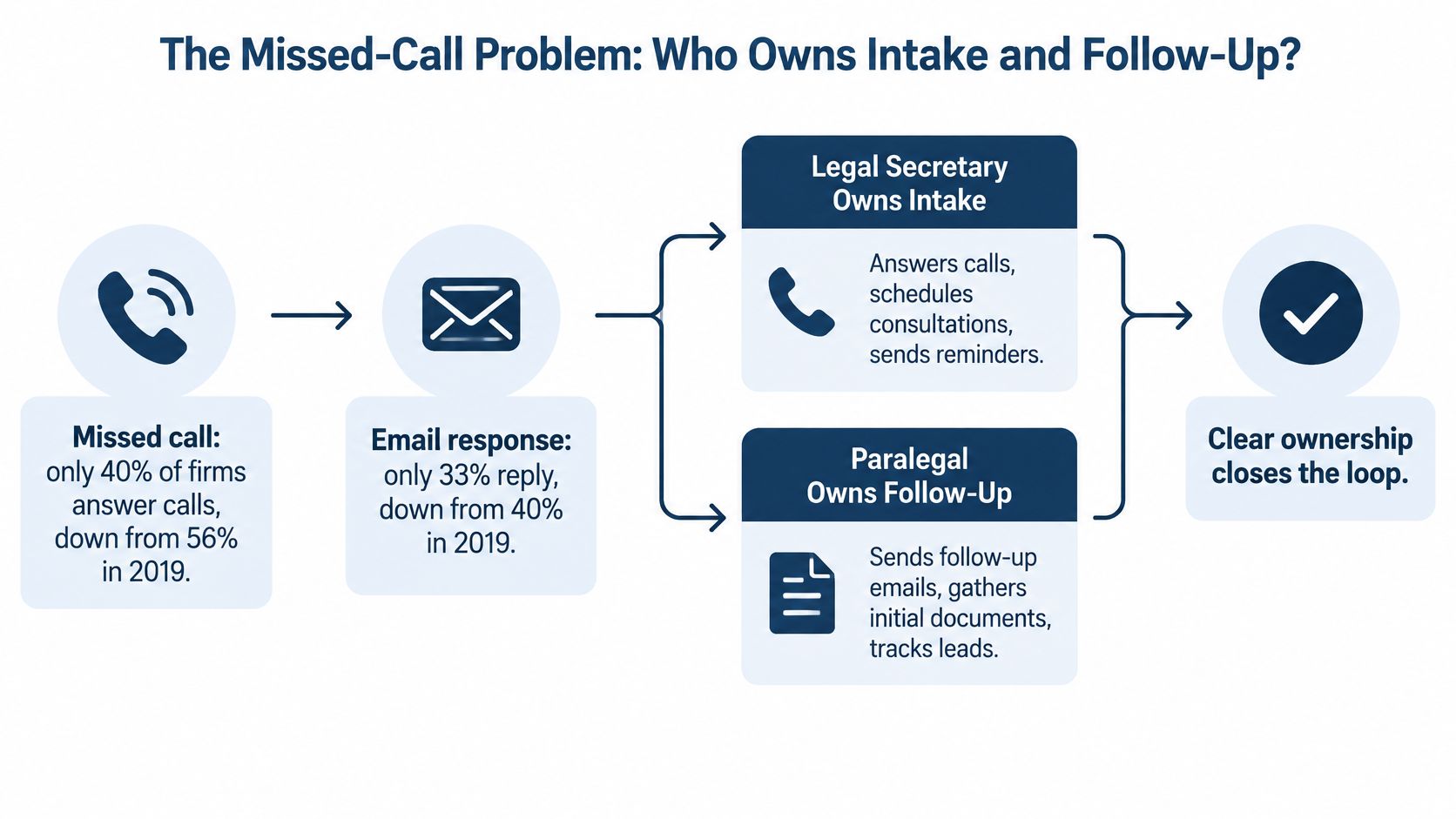
Intake is not one action. It's five, and they get assigned to different people.
- Answer: someone has to pick up, at 11 a.m. and at 9 p.m.
- Capture: name, contact details, how they found you, and what happened, in a record that survives the week.
- Qualify: does the matter fit your practice, your jurisdiction, and your capacity? A secretary can run a script and route, but case merit is not a secretary's call.
- Next action: a consultation booked, a document requested, a retainer out the door with a date attached.
- Follow-up: repeated, scheduled, and owned by a named person until the matter lands or is formally declined.
A legal secretary can own steps one, two, four, and the logistics of five. A paralegal working under attorney-set screening rules can own a structured questionnaire and the matter record, with the attorney making the acceptance decision. What neither should do is improvise.
Taking a message is not intake. A voicemail does not qualify a case, and it does not create a next action.
Intake also produces a record that has to survive a file review six months later, which is why documenting incoming and outgoing calls in a consistent, searchable place beats a legal pad and whoever happened to answer. Firms that treat the intake specialist role as a designed job rather than a chore tend to have this written down before the phone rings.
So ask the question that ends the debate. Who answers a call at 7 p.m. on a Saturday, and does that person have a written process for what happens next? If the answer is "whoever notices," you don't have an intake problem. You have an ownership problem wearing an intake costume.
Where AI and Supervision Draw the Line
The prediction that AI makes both roles obsolete has been circulating long enough to test, and the results look uneven rather than decisive.
The ABA's 2025 Legal Industry Report found that 31% of surveyed legal professionals personally used generative AI at work, up from 27% the year before, while a report citing ABA data put law firm adoption at 21% in 2024 and noted that nearly three-quarters of billable lawyer and paralegal tasks may be exposed to automation (Virginia State Bar future of law report). Exposure is a strange word to build a staffing plan on. A task can be exposed to automation and still require someone to check whether the automated version is right.

Think in terms of an accountability ladder rather than a task list.
- AI drafts or organizes. Summaries, chronologies, first passes at routine language.
- A legal secretary coordinates and verifies completion. Did the records request go out, did the summary get reviewed, did the deadline move because a date changed?
- A paralegal performs supervised substantive analysis. Is the summary accurate, does the chronology hold, is anything missing that should be there?
- An attorney keeps legal judgment and client advice. No amount of software inherits that, and it shouldn't.
For every AI-assisted task in your office, write down three things: which steps require mandatory human review, how each review gets logged so there's an audit trail, and who owns the error when an automated summary leaves out a material fact. If nobody's name is on the third item, the process isn't supervised. It's hopeful.
Software can draft, organize, and summarize. It cannot be accountable. Accountability still requires a person with a name and a calendar.
This is also where the boundaries of any outside support matter. Attorney Assistant is not a law firm and doesn't give legal advice or exercise legal judgment. Every legal decision stays with your firm, and any support arrangement that blurs that line is a liability with good marketing.
Run one test this week. List three tasks where AI already touches your work, and name the person who signs off on each one. If the answer is nobody, you've found your first gap, and it costs nothing to fix except the admission.
Choose the Role Your Firm Needs Before You Hire
Match the situation to the first hire. The rest is sequencing.
Which role to add first, by firm situation
| Firm situation | Add First | Why |
|---|---|---|
| Solo attorney with heavy phone and calendar load | Legal secretary | Coordination fills the day and does not need legal analysis |
| Personal injury firm with a records backlog | Paralegal for summaries, secretary for requests | Summaries need supervised judgment, requests need tracking |
| Litigation team behind on discovery drafts | Paralegal | Substantive drafting drives billable output |
| Attorneys doing their own administration | Legal secretary | Returns attorney hours to legal work |
| Calls going unanswered after hours | Intake coverage before either hire | The gap is availability, not a missing role |
Notice the last row. Firms often post a job to fix a problem that a schedule fixes. If your calls go unanswered at night, a new paralegal won't answer them either.
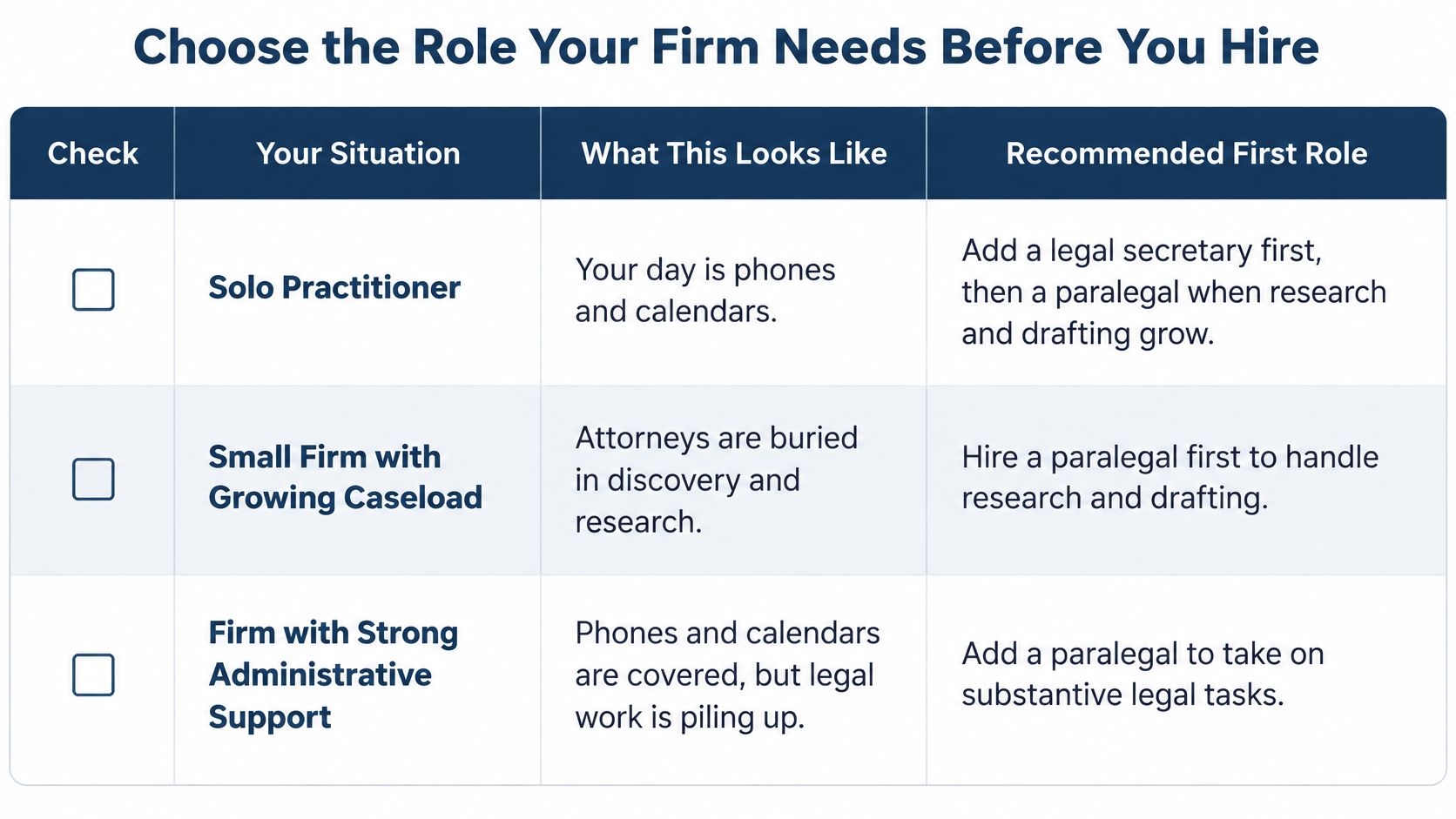
Work through this before you write the posting.
- Export 30 days of support tasks. Pull them from time entries, email, and the case management system, not from memory.
- Tag each task as billable, unbilled, or attorney-only.
- Calculate utilization for every current paralegal using the formula above.
- Name a sign-off owner for every AI-assisted task in the list.
- Decide which gap closes first, then price both the hire and the delay.
If the honest answer is capacity rather than judgment, some firms start by looking at virtual paralegals rather than committing to a full-time seat, then compare that scope against a local hire. Either way, get the task list in writing first. A role defined by a job description you wrote from memory is a role you'll be redefining in four months.
When the list is done, bring it to a discovery call, where we scope dedicated Staffline support or 24/7 Frontline intake against your actual workload rather than a generic package. Engagements run month to month with no long-term commitment, so the downside of testing the math is mostly the hour you spend on the call.
Most firms don't need a bigger payroll so much as the right work landing on the right desk. Attorney Assistant provides dedicated, full-time legal support through Staffline and 24/7 live intake through Frontline, built for law firm workflows rather than generic office work. Bring your task list to Attorney Assistant and see what your capacity looks like when the scheduling, records, and calls stop living in an attorney's calendar.
Related Articles

Legal Staff Solutions: Models, Costs and How to Choose
Compare in-house, outsourced and co-managed legal staff solutions, with real cost drivers, pros and cons, and a way to choose the right model.

Virtual Case Manager Role, Duties, and Fit
See what a virtual case manager owns in records, discovery, liens, and file admin, plus metrics and when virtual beats hiring in-house.

Call Answering Service for Law Firms: What Actually Works
A call answering service for law firms should sign cases, not take messages. Learn pricing models, vendor criteria, and 24/7 intake that converts.