Reduce No-Shows at Your Law Firm: A Practical 1-Week Plan
The fastest way to cut client no-shows is a four-touch confirmation cadence, a low-friction intake step, self-serve rescheduling, and a callback inside minutes of booking. Firms that add structured confirmation and reminder workflows commonly see 15 to 30 percent improvements in consultation attendance within 30 to 60 days. None of it requires new software you haven’t heard of.
Do these first:
- Turn on a same-day reminder and a 24-hour confirmation request, not just a booking email.
- Add one short intake question before the consult (“What’s the main issue you want to solve?”).
- Put a reschedule link in every reminder so clients can move the appointment instead of skipping it.
- Call new leads within 5 minutes of booking, before interest cools.
Key Takeaways
A structured reminder cadence, active confirmation, easy rescheduling, and fast callbacks together cut law firm no-show rates by 15 to 30 percent within two months.
| Point | Details |
|---|---|
| Use a four-touch cadence | Send confirmation at booking, a 24-hour confirmation request, a same-day reminder, and a pre-call SMS. |
| Make confirmation active | Ask clients to reply “YES” or click a link rather than sending a passive reminder. |
| Add friction to skipping | Use a short intake form or refundable deposit, where bar rules allow, to raise commitment. |
| Recover missed appointments fast | Call within 30 minutes, follow with a text, and send a rebook link within 24 hours. |
| Automate the cadence | Attorney Assistant enforces speed-to-lead and follow-up so reminders and callbacks never lapse. |
Table of Contents
- What Causes Clients to Skip Their Consultations?
- Building a Reminder Cadence That Actually Works
- Which Tools Enforce This Cadence Without Manual Work?
- How Do You Roll This Out in One Week?
- Recovering Revenue From a Missed Appointment
- What Happened When One Firm Fixed Its Intake Process
- Training Front Desk and Intake Staff to Hold the Line
- Which Appointments Deserve Priority Scheduling?
- How Attorney Assistant Keeps No-Shows Down Without Adding Staff
- Sources
- FAQ
What Causes Clients to Skip Their Consultations?
Most no-shows trace back to six fixable problems, not flaky clients. Forgetting is the biggest one: a lead books three weeks out, life happens, and the appointment slips their mind. Scheduling friction shows up when a client wants to move a meeting but has to call the office during business hours to do it, so they just don’t show instead.
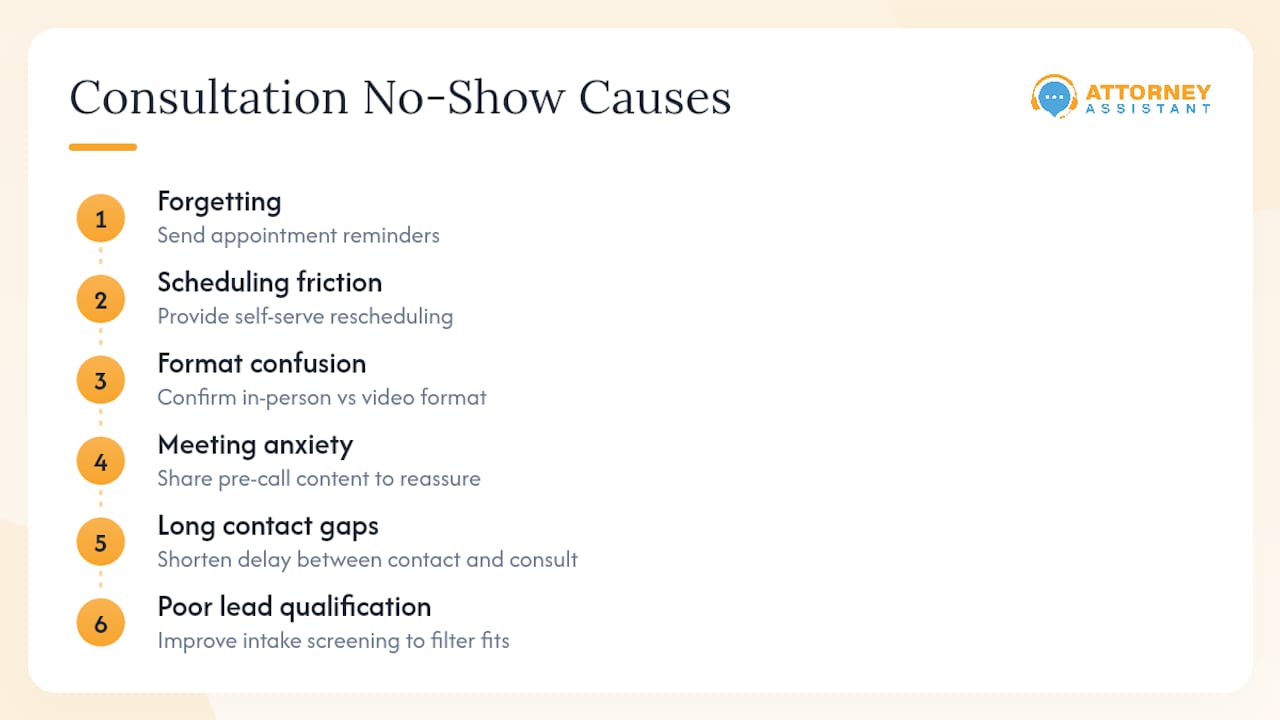
Format confusion is specific to law firms doing hybrid intake: a client expects an in-person meeting, shows up at the office, and finds out it was supposed to be a video call. Anxiety about the meeting matters more in legal intake than most firms admit. Clients calling about a divorce, a DUI, or a wrongful termination are often dreading the conversation itself.
Long gaps between first contact and the actual appointment kill attendance. A lead who waits two weeks for their consult has had two weeks to call a competitor or lose motivation. Poor lead qualification rounds out the list. A firm that books anyone who fills out a form ends up with a share of appointments that were never a real fit.
Each cause has a direct fix: forgetting needs reminders, friction needs self-serve tools, confusion needs explicit format confirmation, anxiety needs pre-call content, delay needs faster scheduling, and mismatch needs better intake screening.
Building a Reminder Cadence That Actually Works
A single email confirmation is not a strategy. The cadence that shows up across multiple audits and clinical studies alike uses four touches: confirmation at booking, a 24-to-48-hour confirmation request, a same-day morning reminder, and a short SMS 30 to 120 minutes before the call. Multi-touch reminder sequences with behavioral framing produce larger attendance gains than a single reminder, and the pattern holds whether the appointment is a medical visit or a legal consult.
Here’s why each touch earns its place:
- Confirmation at booking locks in the appointment while intent is highest and sets the format (video, phone, or in person) in writing.
- The 24 to 48 hour confirmation catches schedule conflicts early enough to rebook the slot instead of losing it entirely.
- The same-day reminder fights plain forgetfulness and restates the meeting format and link.
- The pre-call SMS cuts last-minute no-shows caused by distraction, not disinterest.
Active confirmation beats passive reminders. Asking a client to reply “YES” or click a link to confirm creates a small commitment that behavioral research consistently links to higher follow-through, compared with a reminder that just sits in an inbox. Pair that with a branded calendar invite (.ics file), a one-page prep checklist listing what documents to bring, and a 60-second video from the attorney explaining what to expect. That last piece matters more than firms think. Pre-call materials and a short attorney video reduce anxiety-driven no-shows by making the meeting feel familiar before it starts.
Commitment tactics work too, within limits. A refundable consultation fee or small deposit, where your state bar rules permit it, filters out low-intent bookings and raises show rates for the ones that remain. A short pre-call intake form does the same job without touching money: it asks the client to describe their situation in their own words, which increases their investment before they ever sit down.
Make rescheduling self-service. A reschedule link in every reminder, with real-time calendar availability, sounds counterintuitive, since it seems easier for a client to bail. In practice it does the opposite: clients who can move a meeting in two clicks reschedule instead of ghosting, and you keep the lead instead of losing it silently.
Pro Tip: For high-value cases, personal injury, business litigation, anything with real fee potential, skip the automated template. A 30-second personalized video from the intake attorney, sent by text the day before, converts skeptics who ignore generic reminders.
Which Tools Enforce This Cadence Without Manual Work?
You need four pieces working together: a scheduler, an SMS provider, a short intake form, and a CRM that connects them. Anything less and the cadence depends on a staff member remembering to send messages by hand, which fails the first busy week.
The integration pattern that works:
- Scheduler captures the booking and triggers the CRM record.
- CRM fires the confirmation, the 24-hour request, and the same-day reminder on a fixed schedule.
- A calendar invite (.ics) goes out automatically with the correct format and location.
- A webhook flags no-replies for a human follow-up call instead of letting them fall through.
That last rule matters most. Automated integration between scheduler, CRM, and SMS provider reliably sustains a cadence that staff, on their own, tend to drop during busy weeks. Automation should escalate to a person when a client goes silent, not replace human judgment entirely.
One privacy note: client contact data used for SMS and email reminders is still protected client information. Store it inside your CRM, not scattered across personal phones, and confirm your state bar’s rules on consultation fees or deposits before you add either one. If your firm doesn’t have the staff bandwidth to manage this stack daily, an operations partner like Attorney Assistant can run speed-to-lead enforcement and follow-up so the cadence never lapses.
How Do You Roll This Out in One Week?
Don’t try to fix everything at once. A one-week rollout gets the highest-impact pieces live without overwhelming staff.
- Day 1 to 2: Configure the booking confirmation message with meeting format, location or link, and duration stated explicitly.
- Day 3: Add the 24-hour and same-day automated reminders through your scheduler or CRM.
- Day 4: Launch active confirmation requests (“Reply YES to confirm”) instead of passive reminders.
- Day 5: Build a self-serve reschedule link and test it end to end.
- Day 6 to 7: Brief staff on scripts for confirmation calls and no-show follow-up, then go live.
Track a simple baseline: no-show rate equals missed appointments divided by total scheduled appointments, times 100. If your firm books 40 consults in a month and 10 don’t show, that’s a 25 percent no-show rate. Legal and financial practices average closer to 14 percent overall, though first-time consultations from weak intake sources often run 25 to 40 percent.
| Metric | Baseline | Target | Timeframe | Decision Rule |
|---|---|---|---|---|
| No-show rate | Calculate from last 30 days | Reduce by 15 to 30% | 30 to 60 days | If drop is under 10% after 30 days, add a deposit or extra confirmation touch |
| Confirmation reply rate | Track from first cadence launch | 60%+ replying | 30 days | If under 40%, switch to active confirmation language |
| Reschedule vs. no-show ratio | Track from week 1 | More reschedules than no-shows | Ongoing | If no-shows outpace reschedules, reschedule link isn’t visible enough |
Segment by intake source and case type once the baseline is stable. A family law consult booked from a Google ad behaves differently than a business law referral from another attorney. The referral rarely needs a deposit; the cold ad lead often does.
Recovering Revenue From a Missed Appointment
A no-show isn’t dead, it’s delayed. Fast recovery outreach reclaims a meaningful share of missed opportunities that most firms simply write off.
The sequence: call within 30 minutes (“Hi, we had you down for 2pm, everything okay?”), leave a voicemail if no answer, follow with a text or email within 60 minutes, then send a priority rebook link within 24 hours. Keep every message non-judgmental. Nobody rebooks after a guilt trip.
Pro Tip: Frame the follow-up text as concern, not correction: “Wanted to check in, still want to talk through your case? Here’s a link to grab a new time.” That single sentence rebooks more people than a generic “you missed your appointment” message.
What Happened When One Firm Fixed Its Intake Process
A mid-sized personal injury firm was averaging a 32 percent no-show rate on first consultations booked through paid ads. The intake process had no confirmation step beyond a booking email, and follow-up on missed appointments was inconsistent, sometimes happening days later, sometimes not at all.
The fix combined three changes: automated confirmation and same-day reminders, a short pre-call intake form, and a 30-minute callback rule for anyone who missed their slot. Within 60 days, the no-show rate dropped to under 15 percent, and consult-to-retainer conversion rose because the clients who did show up had already answered basic case questions before walking in.
Three takeaways other firms can copy directly:
- Automate the reminder cadence before touching anything else. It’s the highest-leverage, lowest-effort fix.
- A callback within 30 minutes of a missed appointment recovers cases that a next-day call loses.
- A short intake form filters weak leads before they occupy a calendar slot meant for a real prospect.
Training Front Desk and Intake Staff to Hold the Line
Automation handles the reminders. People handle the moments automation can’t: a nervous client calling to ask what to bring, or a lead trying to reschedule for the third time. How your staff responds in those moments decides whether the appointment happens.
Train intake staff to confirm the meeting format out loud on every call, not just in writing. A quick verbal recap, “so we’ll see you Thursday at 2pm by video, and I’ll text you the link”, catches confusion before it turns into a no-show. Staff should also ask one qualifying question during the first call rather than saving everything for the consult itself. It gives the client a reason to feel invested and gives the firm a read on fit before the calendar slot is locked in.
Scripts matter more than most managers assume. A confirmation call that sounds like a scheduling formality gets ignored. One that sounds like a person who remembers the client’s situation gets answered. Write two or three short scripts: one for initial booking, one for the 24-hour confirmation call, one for no-show recovery, and drill them until staff can deliver them without sounding robotic.
Staff should also know when to escalate. If a lead goes silent after two reminder touches, that’s a signal for a live phone call, not a third automated text. Automation covers the routine; a trained person covers the exception. Firms that treat intake staff as an afterthought to their scheduling software tend to see the cadence break down exactly where it matters most, on the calls that need a human read.
Which Appointments Deserve Priority Scheduling?
Not every consult carries the same weight, and treating them identically wastes your best time slots on low-value bookings while high-value cases wait in a general queue. Case prioritization means scoring incoming leads before they hit the calendar, not after.
Score on three factors: case value (a catastrophic injury case versus a minor claim), urgency (a statute of limitations closing in weeks versus months out), and intent signal (a referral from a past client versus a cold search ad click). A referral for a serious injury case should get a same-day or next-day slot with a partner. A cold lead asking general questions can go into a standard queue handled by an associate or intake specialist.
This triage also protects your reminder investment. High-value, high-urgency cases justify the personalized attorney video mentioned earlier; a routine matter doesn’t need that level of attention to show up reliably. Building this into your CRM lets qualification tags trigger which cadence a lead receives automatically, so the fix compounds instead of requiring a manual decision every time a new lead comes in.
Firms that skip triage often discover, only after reviewing their numbers, that their highest-value leads had the worst show rates, because those cases sat in the same slow queue as everything else.
Author perspective: lessons from running intake for law firms
Every firm blames marketing when consults don’t show. Almost none of them check how long it took to call the lead back. Speed-to-lead is the blind spot that costs more than any reminder template ever will. If I had one rule to repeat: call within five minutes, every time, no exceptions.
How Attorney Assistant Keeps No-Shows Down Without Adding Staff
Attorney Assistant is the operational fix for firms that have already tried reminder templates and still watch consults fall through. The approach enforces speed-to-lead, meaning leads get a call within minutes instead of hours, combined with high-frequency follow-up and intake automation that catches the clients a generic scheduler misses. This isn’t staffing overflow. It’s a system built specifically around the leak points covered above: slow callbacks, inconsistent confirmations, and no recovery process for missed appointments.
If your firm wants a clear read on where consults are actually being lost, before you spend another dollar on ads, book a short call and get a look at your lead follow-up process from the outside.
Sources
FAQ
What is a good process to reduce no-shows?
Combine a four-touch reminder cadence (booking confirmation, 24-hour confirmation, same-day reminder, pre-call text), active confirmation replies, a short intake form, and a callback within 30 minutes of any missed appointment.
How should staff professionally handle a no-show?
Call within 30 minutes using non-judgmental language, such as asking if something came up, then follow with a text offering a rebook link rather than pointing out the missed meeting.
What strategies reduce no-show rates the most?
Multi-touch reminder sequences with active confirmation requests produce the largest gains, and practitioner audits report 15 to 30 percent improvement within 30 to 60 days of adding structured cadences.
How can a law firm reduce missed consultations specifically?
Confirm the meeting format explicitly (video, phone, or in person), add a self-serve reschedule link to every reminder, and use a pre-call intake form to increase client investment before the appointment. Firms without the bandwidth to manage this daily often bring in an operations partner like Attorney Assistant to keep the cadence consistent.
Recommended
Related Articles
Appointment Setting Online: A Law Firm Guide
Master appointment setting online for law firms with proven strategies that turn leads into booked consultations and grow your practice.
Medical Records Request: A Practical Guide for Law Firms
Run a clean medical records request with HIPAA-compliant steps, sample language, timelines, fees, and follow-up tactics built for law firm operations.
Request for Discovery Template: A Practical Guide
Use our request for discovery template with annotated fields, jurisdictional notes, and filing instructions. Customize it for federal or state court cases.