Request for Discovery Template: A Practical Guide

A polished request for discovery template won't save a poorly chosen discovery device, an incorrect deadline, or a demand broad enough to make opposing counsel reach for the objection boilerplate. The popular advice is usually to download a form, fill in the caption, and start numbering. That's backwards. The form is the final expression of a decision process involving the court, procedural stage, discovery method, proportionality, service rules, and the evidence you need.
A usable template helps a firm make those decisions consistently. It distinguishes interrogatories from requests for production and requests for admission, identifies the right custodians and repositories, specifies an ESI format, and gives the responding party a clear place to answer or object. The objective isn't to create more paper. It's to create requests that survive the meet-and-confer and produce information someone can use.
Table of Contents
- Why Most Discovery Templates Fail Before Service
- The Federal Rules That Shape Every Template
- Anatomy of an Annotated Request for Production
- Jurisdictional Variations That Break a Generic Template
- Drafting Requests That Survive Proportionality and Privilege
- Designing the Response Block for the Other Side
- Filing, Service, and Deadline Checklist
- Customization, Workflow, and When to Outsource the Drafting
Why Most Discovery Templates Fail Before Service
The most common mistake is treating “request for discovery” as one document. Federal practice doesn't work that way. Interrogatories under Rule 33 seek written factual answers, requests for production under Rule 34 seek documents, electronically stored information, tangible things, or inspection access, and requests for admission under Rule 36 ask the other side to admit or deny narrow propositions.
Those devices have different purposes and different risks. An interrogatory asking who communicated with a particular witness is not interchangeable with a production request for the emails exchanged with that witness. A request for admission concerning the authenticity of a contract serves a different purpose again. A single generic packet usually produces generic drafting, which is how “all documents relating to the case” continues its long career as a highly objectionable sentence.
Start with the device, not the download
Use interrogatories when you need the opposing party to identify people, dates, communications, contentions, damages, or documents. Use requests for production when the evidence itself matters, particularly email, text messages, cloud files, images, recordings, databases, metadata, and paper records. Use admissions to narrow what remains disputed, establish authenticity, confirm ownership, or secure uncontested facts.
The court and procedural stage matter just as much. A federal civil case, a state action, a juvenile proceeding, and a specialized tribunal may use different forms, limits, service rules, or disclosure procedures. A template that ignores those differences isn't efficient. It's a procedural trap wearing a clean typeface.
Practical rule: Before opening the form, answer three questions: What information do I need, which discovery device obtains it, and what court's rules control the request?
The right request for discovery template therefore starts with a decision screen. Identify the governing court, check the scheduling order, determine whether a Rule 26(f) conference controls, confirm the case type, and decide whether you need answers, documents, admissions, or a subpoena. Only then should the document generate caption fields, definitions, instructions, numbered requests, response blocks, and service language.
The Federal Rules That Shape Every Template
Rule 26 supplies the boundary around every federal discovery device. Discovery must concern nonprivileged matter relevant to a claim or defense and must be proportional to the needs of the case. Proportionality considers the importance of the issues, the amount in controversy, access to information, party resources, and the burden of the proposed discovery compared with its likely benefit. A request can be relevant and still be excessive.
Rule 33 governs interrogatories. A party generally may serve no more than 25 interrogatories, counting discrete subparts, unless the parties stipulate otherwise or the court permits more, as explained in Federal Rule of Civil Procedure 33. Each interrogatory generally must be answered separately and fully in writing under oath. A useful interrogatory template should therefore prevent compound questions and provide a field for the subject, relevant issue, and discrete factual answer.
Rule 34 governs production. Each item or category must be described with reasonable particularity, and the requesting party may specify the form in which ESI should be produced. The rule's 2006 amendments expressly placed electronically stored information alongside paper documents, while the 2015 amendment required objections to be stated with specificity. The governing text is available through the U.S. House Code database.
Match the request to the rule
Consider three properly framed examples:
- Interrogatory: Identify each person who communicated with the plaintiff about the incident, stating the person's name, role, dates of communication, and subject matter.
- Production request: Produce nonprivileged emails and text messages between the listed custodians concerning the incident during the defined date range, in native format where reasonably available.
- Admission request: Admit that the attached agreement bears the defendant's signature and was in effect on the date identified in the request.
Federal written discovery generally starts with a 30-day response period, but the service method, local rule, court order, and governing rule must be checked before service. A template should calculate that deadline rather than assume it.
Rule 36 deserves special attention because unanswered requests for admission may be deemed admitted under applicable rules, potentially establishing the matter conclusively in the litigation. That makes a response-control field essential. A form that tracks only the requests and forgets the consequences of silence is not a litigation tool. It's a numbered list with aspirations.
Anatomy of an Annotated Request for Production
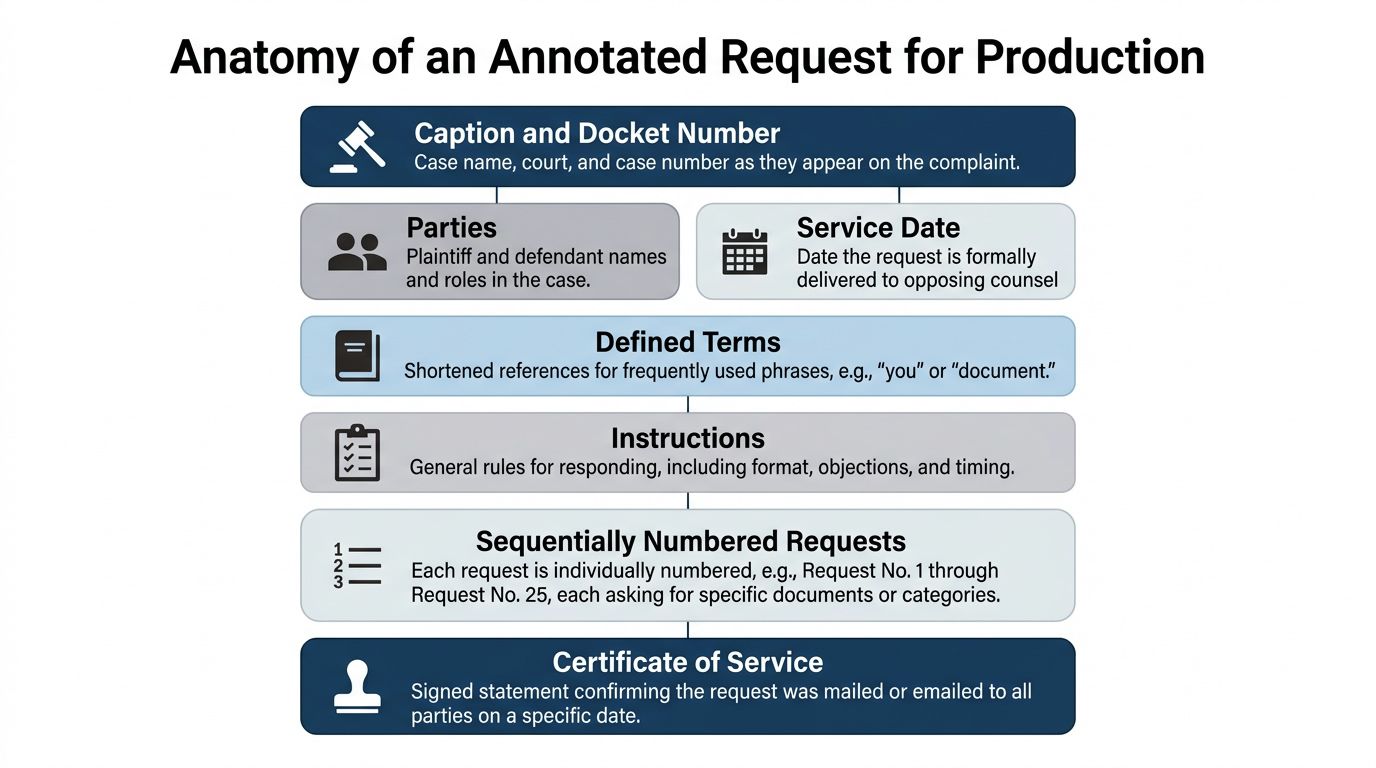
A strong production template reads like a controlled workflow. Every field should answer a procedural question, reduce ambiguity, or preserve proof that the request was properly served.
Build the front matter correctly
Caption and docket number come first. Copy the case name, court, and case number exactly as they appear on the complaint or docket. A typo in the caption rarely improves anyone's confidence in the requests that follow.
Parties and responding party identify who served the requests and who must respond. Include the set number when the firm serves successive discovery. Service date records the date of formal delivery to opposing counsel, which becomes the starting point for deadline calculation.
Defined terms should shorten recurring phrases without expanding them unexpectedly. Define “you,” “your,” “document,” “communication,” “incident,” and relevant entities only as needed. If “document” includes ESI, specify whether the term covers email, text messages, cloud files, databases, images, recordings, metadata, and other retrievable material. The definition should clarify scope, not turn one noun into the entire universe.
Make every request independently usable
Instructions should address response format, objections, production method, privilege, redaction, confidentiality, and continuing obligations where applicable. Then number each request sequentially. One request should normally target one identifiable subject or document category, with a defined time period, custodian group, repository, and connection to a pleaded issue.
A practical architecture looks like this:
- Request number: A unique sequential identifier.
- Subject: The issue, transaction, event, or document category.
- Scope: Custodians, date range, repositories, and file types.
- Production form: Native files, images, metadata, or another reasonably usable form.
- Response block: Production statement, objection, partial response, or privilege notation.
For firms managing large matters, the template should live where the case team already works. A defined legal document management workflow can preserve the final request set, service record, productions, privilege log, and follow-up tasks together. That matters because a request is only useful if the team can locate the response, identify what remains outstanding, and connect the production to the issue it was meant to resolve.
Finish with a certificate of service stating when and how the request was served on the parties. It should be signed by the person responsible for service. The certificate is not decorative footer text. It is the record that supports the service date your deadline calculation depends on.
Jurisdictional Variations That Break a Generic Template
A blank response-deadline field is better than a hard-coded deadline, but only if someone completes it. Federal practice commonly uses 30 days for written discovery, yet local rules, court orders, service methods, and specialized systems can alter the calculation. State courts may use their own forms and limits. Specialized tribunals may have entirely different procedures.
California illustrates why a generic federal form can mislead. California guidance describes form interrogatories as the easiest option in many matters, while local rules may impose separate aggregate limits. Federal practice generally limits interrogatories to 25 per party, counting discrete subparts, but that doesn't make the federal limit portable to every state system.
A Northern District of California packet instructs users to identify the set number, review definitions, avoid filing discovery unless ordered, and calendar a 30-day response period, or 33 days when served by mail, as described in the applicable court discovery guidance. Those instructions show why service method belongs in the template's calculation logic.
Compare the defaults before you serve
| Jurisdiction | Default Response Period | Interrogatory Cap | Key Formatting Note |
|---|---|---|---|
| Federal civil practice | Generally 30 days, subject to rule, order, service method, and local rule | Generally 25, counting discrete subparts | Rule 34 requests must describe items with reasonable particularity and state ESI objections specifically |
| California-style state practice | Check the governing state rule and case order | Form and local limits may apply | Form interrogatories may be available, but the correct state form and service rules control |
| Northern District example | 30 days, or 33 days when served by mail under the referenced guidance | Federal limit generally applies | Identify the set number, leave response space, and avoid filing discovery unless ordered |
| Specialized tribunal | Confirm the tribunal's own rule or order | May differ from federal practice | Use a jurisdiction-specific deadline and response structure |
The template should prompt for court, case type, discovery device, set number, service method, service date, response rule, and court-specific order. It should also ask whether discovery must be filed, served only, or submitted through a designated system.
Formatting can be just as consequential as timing. One federal district requires space after each request for the response or objection, full quotation of the request before the response, and separate sequential numbering for each discovery device and responding party. A template that merges interrogatories, production requests, and admissions into one numbering sequence may look tidy while violating the local convention.
The practical answer is simple. Don't maintain one universal form and call it efficiency. Maintain a base architecture with jurisdiction-specific modules. Otherwise, the firm has automated the production of documents that still need repair.
Drafting Requests That Survive Proportionality and Privilege
A request for production should read like a search protocol, not a dare. Courts expect defined people, repositories, time periods, file types, and issues, tied to a claim or defense. Give the responding party a defensible way to search. “All documents relating to the case” gives them none.
Replace the broad demand
The weak version is familiar:
“Produce all documents relating to the case.”
It leaves the custodian, time period, repository, file type, subject, and relevance boundary undefined. The predictable objections are vagueness, overbreadth, undue burden, lack of proportionality, and privilege.
A stronger request identifies the evidence and its limits:
“Produce nonprivileged emails, text messages, and attachments exchanged between the identified project managers and the defendant's claims personnel concerning the reported incident, repair estimates, and coverage position, from the date of the incident through the date of the coverage determination. Produce emails in native format where reasonably available and identify any withheld materials on a privilege log.”
That wording identifies the subject, custodian group, date range, file categories, production format, and privilege procedure. It also permits a targeted objection instead of inviting a blanket refusal. Draft every request with the same discipline.
Draft the search before drafting the argument
Build the likely collection questions into the request:
- Custodians: Identify the people likely to possess responsive information. “All employees” is not a custodian list.
- Date ranges: Tie the start and end points to the event, notice, contract, communication, or pleaded issue.
- Repositories: Name email accounts, messaging systems, shared drives, cloud folders, case platforms, and device categories when known.
- Search method: Ask the responding party to describe the reasonable search, including custodians, repositories, terms, filtering, or technology-assisted review where relevant.
- ESI format: Request native files, images, metadata, or another reasonably usable form based on how the evidence will be analyzed.
Recent eDiscovery case-law insights highlight judicial concern about overbroad requests that depend heavily on keyword searches. Do not ban search terms. Require a reasonable, diligent process and enough transparency to evaluate it. Litigation support services can handle collection and privilege-log work that follows, but the request still needs to define what that work must cover.
AI-generated material creates the same drafting problem in a newer form. If logs, prompts, outputs, or related records may bear on a claim or defense, identify those sources and address preservation, privacy, confidentiality, and segregation. Sensitive personal data may require a narrower repository, a protective order, redaction, or phased production. More material is not a discovery strategy. It is often more work for the person writing the objection.
Designing the Response Block for the Other Side
The response block is where a request becomes operational. It should make the responding party state what is being admitted, denied, produced, withheld, or contested. A request without a usable response field leaves the case team to reconstruct decisions from emails, letters, and memory. Memory remains an impressive technology for losing deadlines.
For production requests, the response should allow the party to state whether responsive materials will be produced, have already been produced, are being withheld, or cannot be located after a reasonable search. Objections should be specific to the request. The template should provide a place to identify the scope of the objection and explain whether responsive material is being withheld because of it.
Build the possible outcomes into each item
A practical response block includes:
- Production statement: State whether responsive documents will be produced, have been produced, or are unavailable after a reasonable search.
- Specific objection: Identify the precise objection and the portion of the request it affects.
- Partial response: Separate material that will be produced from material that is withheld.
- Inability after inquiry: State that the party cannot admit, deny, or locate responsive material after reasonable inquiry when that response is applicable.
- Privilege trigger: Mark whether material was withheld under privilege or work-product protection.
- Withheld-material identification: Identify the nature of withheld material sufficiently to support a privilege log, subject to the governing rules and protective arrangements.
- Verification or signature: Include the responsible signature or verification where required.
Requests for admission need an even more deliberate design. The response area should clearly offer admit, deny, or an explanation that the party cannot admit or deny after reasonable inquiry. An objection should be separately stated, not buried inside a denial. Because an unanswered admission request may be deemed admitted under applicable rules, the response tracker should flag every unanswered item rather than treating silence as an empty cell.
The requesting team also needs a follow-up field. Record the production date, Bates range or file location, deficiency, meet-and-confer status, agreed extension, and next action. A privilege log trigger belongs in the same record, not in a separate spreadsheet that someone remembers to update after the dispute has already matured.
The response block should tell the team what happened, what was withheld, why it was withheld, and what someone must do next.
That design protects the requesting party from ambiguous productions and gives the responding party a structured way to state its position. It also makes the meet-and-confer less theatrical. Everyone can see the request, response, objection, missing material, and proposed cure.
Filing, Service, and Deadline Checklist
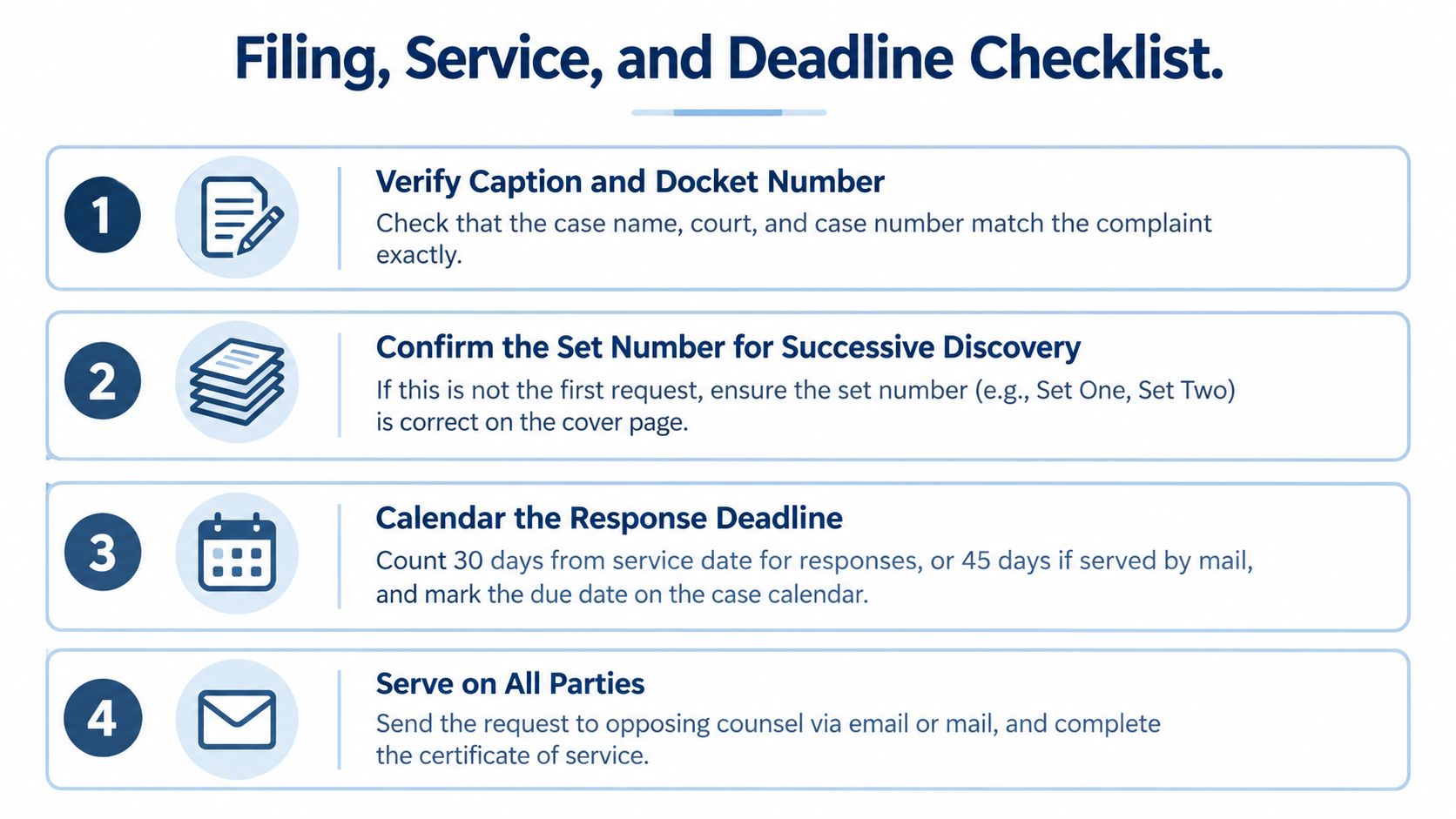
Use this checklist before every service. It catches the errors that flourish when a lawyer assumes someone else checked the form.
- Verify the caption and docket number. Match the case name, court, and case number to the complaint and docket.
- Confirm the discovery device. Make sure the document is clearly labeled as interrogatories, requests for production, or requests for admission.
- Confirm the set number. Successive discovery should identify the correct set for the responding party.
- Review definitions and instructions. Remove terms that expand scope accidentally and confirm the production format.
- Check local formatting. Confirm response spacing, quotation requirements, numbering, page format, and any court-specific instructions.
- Calculate the response deadline. Start with the applicable rule, then adjust for service method, court order, and local rule. Federal written discovery commonly begins with 30 days, while the referenced Northern District example uses 33 days when served by mail.
- Attach the certificate of service. State the service date and method, then obtain the required signature.
- Confirm filing treatment. Some courts instruct parties not to file discovery unless ordered. Others require filing through a designated process. Check before sending the document into the docket.
- Calendar follow-up. Track the response deadline, production review, meet-and-confer date, privilege-log review, and any motion deadline.
Service and deadline control should sit inside the matter workflow. A trial preparation checklist can help connect discovery responses to witness preparation, exhibit organization, outstanding records, and readiness tasks instead of leaving production review in an isolated inbox.
Customization, Workflow, and When to Outsource the Drafting
A template works only when the firm assigns the work around it. Someone must open the matter, load the pleadings, identify the claims and defenses, select the discovery device, enter custodians and date ranges, calculate the response deadline, review productions, update the privilege log, and escalate deficiencies. If those tasks belong to “whoever notices,” they belong to nobody.
A good operating workflow gives each step an owner:
- Matter setup: Enter the case, caption, parties, docket number, and set history into the case-management system.
- Draft preparation: Build requests from the firm's approved language, then tailor scope to the pleaded issues.
- Quality review: Have an attorney confirm relevance, proportionality, privilege treatment, and requested ESI format.
- Deadline control: Assign a staff member to calendar service, responses, follow-up, and meet-and-confer events.
- Production management: Store received files, track missing categories, preserve Bates references, and prepare the privilege-log review.
- Audit: Compare successive sets for numbering, definitions, objections, and unresolved deficiencies.
This is the same operational gap that causes intake failures. If a firm can't consistently route a new inquiry, assign a next action, and follow up, it may also struggle to track a production deficiency after the initial request leaves the office. A template can reduce drafting friction, but it can't assign ownership by itself.
Attorney Assistant provides dedicated legal support staff through Staffline for case management, records and bill retrieval, file opening, calendar and inbox management, CRM hygiene, intake, and administrative support. Its Frontline team provides 24/7 live intake, including nights and weekends, qualification, structured follow-up, English and Español coverage, quality assurance, and appointment or signing support. That combination addresses the underlying capacity problem, not just the form on the screen.
The practical decision is straightforward. If attorneys are still drafting every routine discovery set, chasing missing records, and manually checking deadlines, add dedicated case-support capacity. If leads are also going unanswered while the litigation team is buried in administration, evaluate intake coverage separately. Frontline signs the case. Staffline carries it.
Attorney Assistant provides trained legal support staff and 24/7 live intake that can help law firms organize discovery workflows, manage case-support tasks, follow up consistently, and capture new matters after hours. Visit Attorney Assistant to evaluate where dedicated support could remove administrative weight from your attorneys and strengthen the operating process behind your templates.
Related Articles

Litigation Support Services: What Law Firms Need to Know
Discover how litigation support services streamline discovery, reduce costs, and improve case outcomes. Learn what to look for in a provider.

Keep the Conversation Going: 8 Intake Follow-Up Tactics
Learn how to keep the conversation going with law prospects using eight practical intake and follow-up tactics, from speed-to-lead to attorney handoffs.

Preferred Method of Contact for Law Firm Intake
Discover how to capture and use the preferred method of contact in legal intake to improve conversions, ensure compliance, and streamline law firm operations.