Responsiveness in Client Experience: A Legal Guide

TL;DR:
- Responsiveness in law firms involves prompt and consistent communication that builds client trust and retention. It is a measurable operational process that impacts client satisfaction, ethical compliance, and revenue growth. Implementing standardized workflows, technology, and team accountability enhances responsiveness and reduces client attrition.
Responsiveness in client experience is a law firm’s ability to promptly and consistently communicate with clients, addressing their needs and questions to build trust and drive retention. The role of responsiveness in client experience is not a soft skill or a courtesy. It is a measurable operational capability that directly determines whether clients stay, refer others, and pay on time. According to BTI Consulting’s 2026 survey, best-in-class firms outperform typical firms on responsiveness by 9–15 times. That gap is not about talent. It is about process.
How does responsiveness drive client satisfaction in legal practice?
Client satisfaction in legal services is tied directly to communication speed. CSAT scores drop sharply from 92% for responses under five minutes to just 51% when a client waits 24 hours. That 41-point gap represents clients who feel ignored, anxious, and ready to call another firm.
Speed alone does not explain the full picture. A quick acknowledgment that a message was received outperforms a slow reply with a complete answer. Clients interpret a fast first response as proof that the firm is organized and attentive. A delayed response, even with a thorough answer, signals disorganization and indifference.
Client expectations in 2026 are specific and demanding. 88% of clients expect weekly updates, and 83% demand same-day responses to their queries. These are not preferences. They are thresholds. Firms that fall below them lose clients to competitors who meet them.
Responsiveness also reduces the anxiety that legal matters naturally create. Clients dealing with litigation, family law, or personal injury cases are under real stress. Consistent, timely communication signals that their case is being handled. That signal builds loyalty more reliably than any marketing campaign.
- Respond to all new inquiries within the same business day, at minimum
- Send proactive case updates at least once per week, even when there is no new development
- Acknowledge receipt of documents or messages within one hour during business hours
- Set clear expectations at intake about how and when the firm communicates
Pro Tip: Set an automated acknowledgment message for after-hours inquiries. Clients who receive a confirmation that their message was received are far less likely to call a competing firm the next morning.
What do legal ethics rules require for client communication?
Responsiveness in legal practice is not optional. Illinois Rule of Professional Conduct 1.4 requires lawyers to promptly comply with reasonable client information requests and to keep clients reasonably informed about the status of their matters. This rule ties responsiveness directly to a client’s ability to make informed decisions about their own case.
Ethical communication is not a marketing convenience. It is a legal obligation that protects client interests and firm integrity. When a client cannot reach their attorney or receives no updates for weeks, their ability to participate in their own case is compromised. That is not just a service failure. It is a professional conduct issue.
“Keeping clients reasonably informed” under Rule 1.4 means proactive communication, not reactive replies. Waiting for a client to call before providing an update does not satisfy the standard.
Firms that treat responsiveness as an ethical baseline rather than a customer service goal build stronger compliance cultures. They also reduce bar complaints, malpractice exposure, and client churn simultaneously.
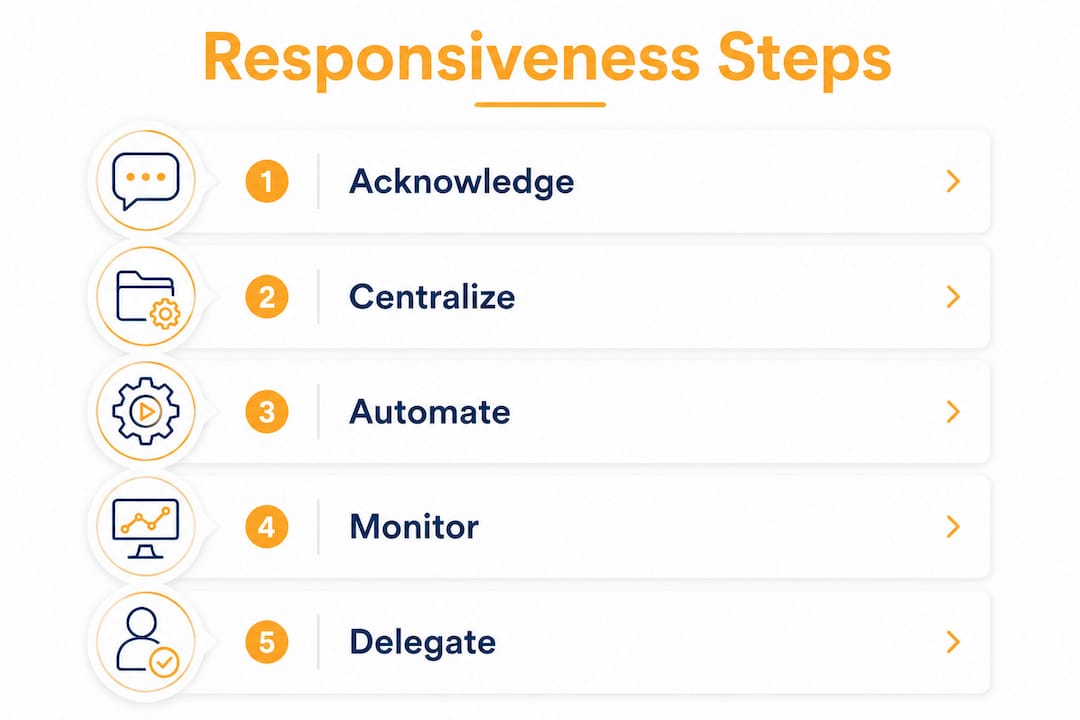
Practical steps to align operations with ethical communication standards:
- Define what “prompt” means internally: set a firm-wide standard of 24 hours or less for all client communications
- Document all client communications in a centralized system so any team member can provide accurate updates
- Build weekly update workflows into case management so attorneys do not rely on memory or individual habit
- Review responsiveness metrics monthly to catch lapses before they become ethics violations
Pro Tip: Frame your internal responsiveness policy as an ethics policy, not a customer service policy. Attorneys take ethics obligations seriously. Framing communication standards this way increases compliance across the team.
What operational strategies improve responsiveness across a law firm?
Consistent responsiveness requires process design, not individual effort. Designing responsiveness protocols around client decision points, including intake, onboarding, and status updates, produces consistent experiences regardless of which staff member handles the interaction. Person-dependent responsiveness fails the moment a key employee is out sick or overwhelmed.
Technology is the backbone of scalable responsiveness. Unified CRM platforms give every team member visibility into client communication history, open requests, and pending follow-ups. Without that visibility, clients repeat themselves, staff duplicate effort, and response times suffer. A law firm CRM built for legal intake eliminates those gaps.
Internal service-level agreements, or SLAs, translate ethical obligations into operational targets. SLAs tied to Rule 1.4 requirements give teams clear benchmarks: respond to all client messages within four business hours, send case updates every Friday, acknowledge new leads within 15 minutes. These targets survive workload spikes because they are embedded in workflow, not left to individual judgment.
| Responsiveness Tactic | Primary Impact | Implementation Effort |
|---|---|---|
| Automated intake acknowledgment | Reduces lead abandonment at first contact | Low |
| Weekly case update workflow | Meets 88% client expectation for updates | Medium |
| CRM with communication history | Eliminates repeated client questions | Medium |
| Internal SLAs for response time | Sustains consistency under workload pressure | Medium |
| After-hours answering service | Captures leads outside business hours | Low |
Monitoring responsiveness performance closes the loop. Client feedback surveys, response time reports from your CRM, and regular team reviews reveal where gaps exist. Firms that measure responsiveness improve it. Firms that assume it is fine typically are not.
Pro Tip: Audit your last 30 client interactions and measure actual response times against your stated standards. Most firms discover a gap of several hours or more between what they believe they deliver and what clients actually experience.
What challenges do law firms face with consistent responsiveness?
Workload pressure is the most common reason responsiveness deteriorates. Attorneys managing active caseloads, court deadlines, and client meetings cannot realistically monitor every communication channel in real time. The result is delayed replies, missed calls, and clients who feel deprioritized.

Staffing constraints compound the problem. Small and mid-size firms often rely on one or two people to handle all client communication. When those people are unavailable, the firm goes silent. That silence costs money. 87% of legal consumers expect contact returned within the same business day, and firms that miss that window are often eliminated from consideration before the attorney even knows a lead existed.
Communication channel overload creates its own failure mode. Clients reach out by phone, email, text, and web form. Without a centralized system, messages fall through the cracks. A client who sent an email and left a voicemail and received no reply within 24 hours does not assume the firm is busy. They assume the firm does not want their business.
Practical solutions that address these challenges directly:
- Assign a dedicated intake coordinator responsible for all first-contact responses
- Use a legal answering service or virtual assistant to handle after-hours and overflow calls
- Consolidate all communication channels into a single inbox or CRM view
- Set realistic availability expectations in your engagement letter and on your website
Pro Tip: Delegation is not a sign of a disorganized firm. It is a sign of a well-run one. Clients do not need the attorney to answer every call. They need someone knowledgeable to respond quickly and accurately. Build that capacity into your operations before you need it.
Inconsistent responsiveness also drives referral loss. A client who felt ignored during their case will not refer friends or family, regardless of the legal outcome. The impact of communication speed on referral behavior is direct and measurable. Firms that respond well retain clients and generate word-of-mouth growth. Firms that do not, lose both.
Key takeaways
Responsiveness is a measurable operational standard that determines client satisfaction, ethical compliance, and firm revenue in legal practice.
| Point | Details |
|---|---|
| Speed determines satisfaction | CSAT drops from 92% to 51% when response time increases from 5 minutes to 24 hours. |
| Ethics mandate communication | Illinois Rule 1.4 legally requires prompt, proactive client updates, not just reactive replies. |
| Process beats individual effort | Responsiveness protocols tied to client journey stages outperform person-dependent habits. |
| SLAs sustain consistency | Internal service-level agreements aligned to ethical rules prevent lapses under workload pressure. |
| Silence costs revenue | 87% of legal consumers abandon firms that miss same-day contact, often before the attorney knows. |
Why responsiveness is the competitive edge firms overlook
I have worked with enough law firms to know that most attorneys believe they are more responsive than their clients experience them to be. That gap is not dishonesty. It is a measurement problem. Firms that do not track response times cannot see where they are losing clients, and they tend to attribute client churn to pricing or competition rather than communication failure.
Responsiveness is not a personality trait. It is a system. Firms that build it into their intake workflows, case management processes, and team accountability structures outperform those that rely on individual attorneys to stay on top of every message. The BTI Consulting data makes this concrete: elite firms outperform peers on responsiveness by 9–15 times. That is not a talent gap. That is a process gap.
The firms I have seen struggle most with responsiveness share one trait: they treat communication as something that happens after the real work is done. The real work and the communication are inseparable. A client who does not hear from you is not a satisfied client waiting patiently. They are a client actively reconsidering their choice of firm.
Responsiveness also has a compounding economic effect. Faster intake responses convert more leads. Consistent updates reduce client-initiated calls, freeing attorney time. Proactive communication generates referrals. Every hour of delay at intake is revenue that does not enter the firm. Every week without a client update is a referral that does not happen.
Firms that want to grow do not need more leads. They need to stop losing the ones they already have.
— Nicole
How Attorneyassistant helps law firms respond faster and convert more
Law firms that recognize the problem often struggle with the fix because the fix requires operational change, not just intention.
Attorneyassistant handles the intake, follow-up, and communication workflows that most firms leave to chance. From lead follow-up services that contact new inquiries within minutes to free tools that help firms measure and improve their response times, Attorneyassistant builds the infrastructure that makes responsiveness consistent. If you want to see how these systems apply to your firm’s specific intake and communication gaps, the virtual webinar is a practical starting point. You can also book a call to walk through your current workflow and identify where revenue is leaking.
FAQ
What is responsiveness in legal client experience?
Responsiveness in legal client experience is a firm’s ability to reply to client inquiries promptly, provide proactive updates, and maintain consistent communication throughout the client relationship. It is both an ethical obligation under rules like Illinois Rule 1.4 and a measurable driver of client satisfaction and retention.
How quickly should a law firm respond to client inquiries?
87% of legal consumers expect contact returned within the same business day, and CSAT scores are highest when responses occur within five minutes of initial contact. Firms should set internal SLAs that reflect these expectations and build workflows to meet them consistently.
Does responsiveness affect law firm revenue?
Responsiveness directly affects conversion rates, client retention, and referral volume. Firms that miss same-day contact windows lose leads before the attorney is even aware of them, and clients who feel ignored during their case do not generate referrals regardless of legal outcome.
How can a law firm improve responsiveness without hiring more staff?
Firms can improve responsiveness by centralizing communication channels into a CRM, using automated acknowledgment messages for after-hours inquiries, and delegating first-contact responses to a dedicated intake coordinator or legal answering service. Process design reduces the person-dependency that causes most responsiveness failures.
Is client responsiveness an ethical requirement for attorneys?
Illinois Rule of Professional Conduct 1.4 requires attorneys to promptly comply with reasonable client information requests and keep clients reasonably informed about their matters. This makes responsiveness a professional conduct obligation, not a discretionary service standard.
Recommended
Related Articles

Appointment Setting Online: A Law Firm Guide
Master appointment setting online for law firms with proven strategies that turn leads into booked consultations and grow your practice.
Medical Records Request: A Practical Guide for Law Firms
Run a clean medical records request with HIPAA-compliant steps, sample language, timelines, fees, and follow-up tactics built for law firm operations.

Request for Discovery Template: A Practical Guide
Use our request for discovery template with annotated fields, jurisdictional notes, and filing instructions. Customize it for federal or state court cases.