Retainer Not Signed? Intake Playbook to Stop Losing Cases
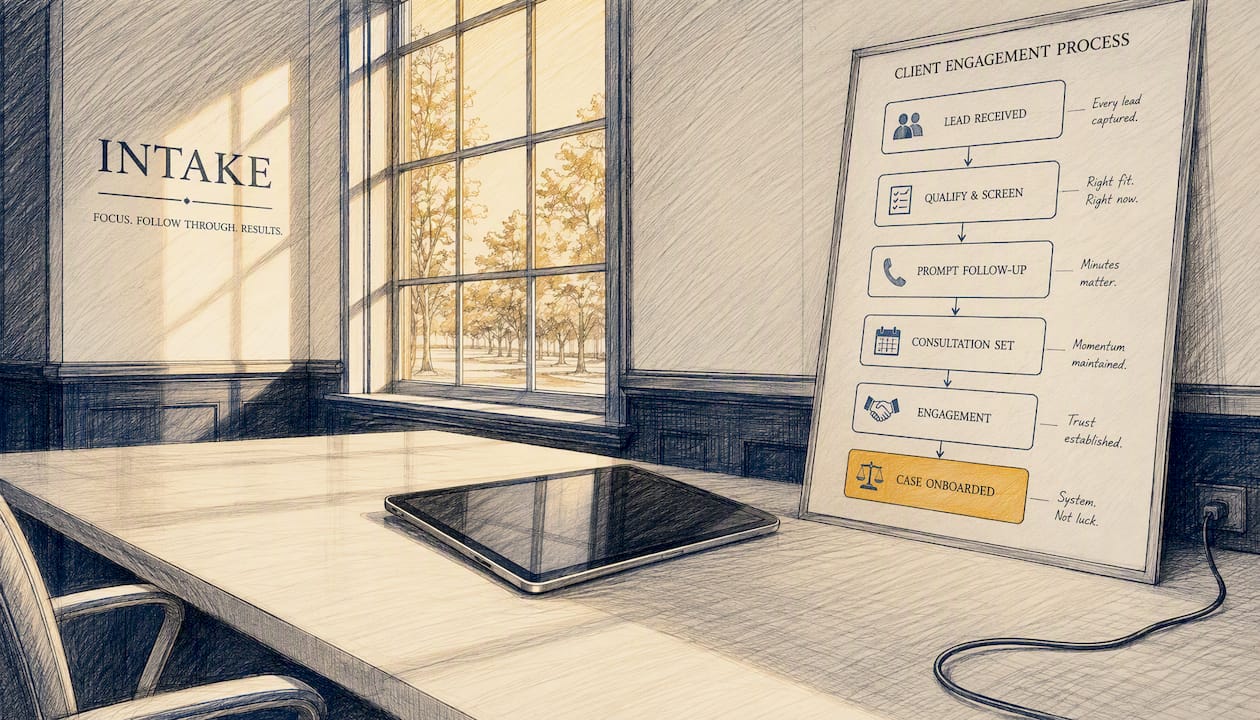
When a retainer is not signed, pause all non-essential work on that file immediately, move it to holding status, and start a time-bound follow-up sequence with a hard deadline for signature and payment. That’s the whole first move. Everything else in your intake process depends on getting this step right, because an unsigned engagement letter sitting in an inbox is not a paperwork delay. It’s a lead you already paid for, walking out the door.
Here’s what your intake team should do in the first 24 hours:
- Set the file to holding status in your practice management system so no billable work starts.
- Send a summary email that restates scope and fee, with the engagement letter link attached.
- Trigger the payment request for the retainer deposit alongside the signature request.
- Escalate to a supervisor or attorney if there’s no response within a set window, typically 24 to 48 hours.
Your team should also confirm:
- The engagement letter reflects ABA Model Rules requirements on fee disclosure.
- No file moves to active status until the trust account shows cleared funds.
- Someone owns the follow-up, not “whoever has time.”
Pro Tip: Never activate a matter until your trust-account verification gate confirms the retainer deposit has cleared. Attorney Assistant builds this gate into daily intake operations specifically because firms lose files when this step gets skipped under deadline pressure.
Key Takeaways
An unsigned retainer is an intake failure, not a client problem, and it gets fixed with gates: holding status, two-person QA, trust-account verification, and a time-bound follow-up sequence.
| Point | Details |
|---|---|
| Pause work immediately | Set the file to holding status the moment a retainer goes unsigned, before any billable work starts. |
| Enforce the trust-account gate | Never move a file to active status until the retainer deposit clears and is verified. |
| Automate the follow-up cadence | Use timed reminders at 24, 48, and 5 days to recover a significant portion of unsigned prospects. |
| Populate letters from intake data | Map questionnaire fields directly into engagement-letter templates to cut drafting errors. |
| Let Attorney Assistant run enforcement | Attorney Assistant embeds holding-status discipline, QA review, and 24/7 follow-up into daily intake operations. |
Table of Contents
- Step-by-Step Intake Workflow That Prevents Unsigned Retainers
- Signature Capture Methods and Follow-Up Automation That Actually Work
- Operational Policies That Stop Ad-Hoc Exceptions From Leaking Revenue
- Metrics and Training That Keep Signature Rates High
- Intake Checklist and Engagement-Letter Fields to Populate Every Time
- How to Get Clients to Actually Sign the Retainer
- What to Do When a Client Disputes or Refuses to Sign
- Common Failure Modes We See and Two Quick Fixes
- How Attorney Assistant Closes the Unsigned-Retainer Gap
- Sources
- FAQ
Step-by-Step Intake Workflow That Prevents Unsigned Retainers
Most unsigned retainers aren’t the client’s fault. They’re a symptom of a workflow with no gate, no owner, and no deadline. Fix the workflow and the signature problem mostly disappears.
The flow should run in five stages: prospect, engagement letter sent, signature pending, retainer deposit verification, active matter. Each stage needs a named owner and a maximum time limit. A prospect who lingers in “signature pending” for six days without a follow-up isn’t a prospect anymore. They’re a lost case with a paper trail.
Here’s the sequence that works:
- Intake staff captures client details through your web form or phone intake and confirms scope of representation.
- Engagement letter is auto-populated from those intake fields, not typed from scratch.
- A second person reviews the letter for accuracy before it goes out. Names, fee basis, and scope language get checked line by line.
- The letter is sent with an e-sign link and payment request in the same message.
- Trust-account verification confirms the deposit cleared before anyone touches the file as an active matter.
Who does what matters more than most firms admit. The intake coordinator prepares the letter. A second staff member or a supervising attorney performs QA. Billing or trust-account staff confirms the deposit. Only after that confirmation does someone flip the file to active in your practice management system.
Mapping your intake questionnaire directly into engagement-letter variables removes the most common source of errors: mismatched names, wrong fee structures, and missing scope language. Automating this handoff means the attorney reviews a nearly finished letter instead of drafting one, which cuts turnaround from hours to minutes.
Your practice management system should be configured so the “active” status is locked behind two conditions: a recorded signature timestamp and a confirmed trust deposit. If your software allows manual status changes without those two checks, someone will eventually skip them during a busy week.
Pro Tip: Build the trust-account check into your software’s workflow rules, not into a staff member’s memory. Memory fails during busy weeks. Workflow rules don’t.
Signature Capture Methods and Follow-Up Automation That Actually Work
The fastest way to get a retainer signed is to ask for the signature while the client is still on the phone or still in the room. A retainer-first flow, where the client e-signs and pays in the same session as the consultation, captures commitment while motivation is highest. Waiting until “tomorrow” gives the client time to call a competitor, talk to a spouse who says wait, or simply forget.
Four practical signature methods, ranked by speed:
- Same-session e-sign. Present the letter during the call or meeting and collect a signature before the client hangs up.
- In-person signing. Still the gold standard for high-value personal injury matters where trust matters more than speed.
- Conditional interim agreements. A limited-scope letter that covers urgent early tasks while the full retainer works through review.
- Acceptance-by-payment. The signed deposit itself serves as evidence of acceptance when paired with a written letter on file.
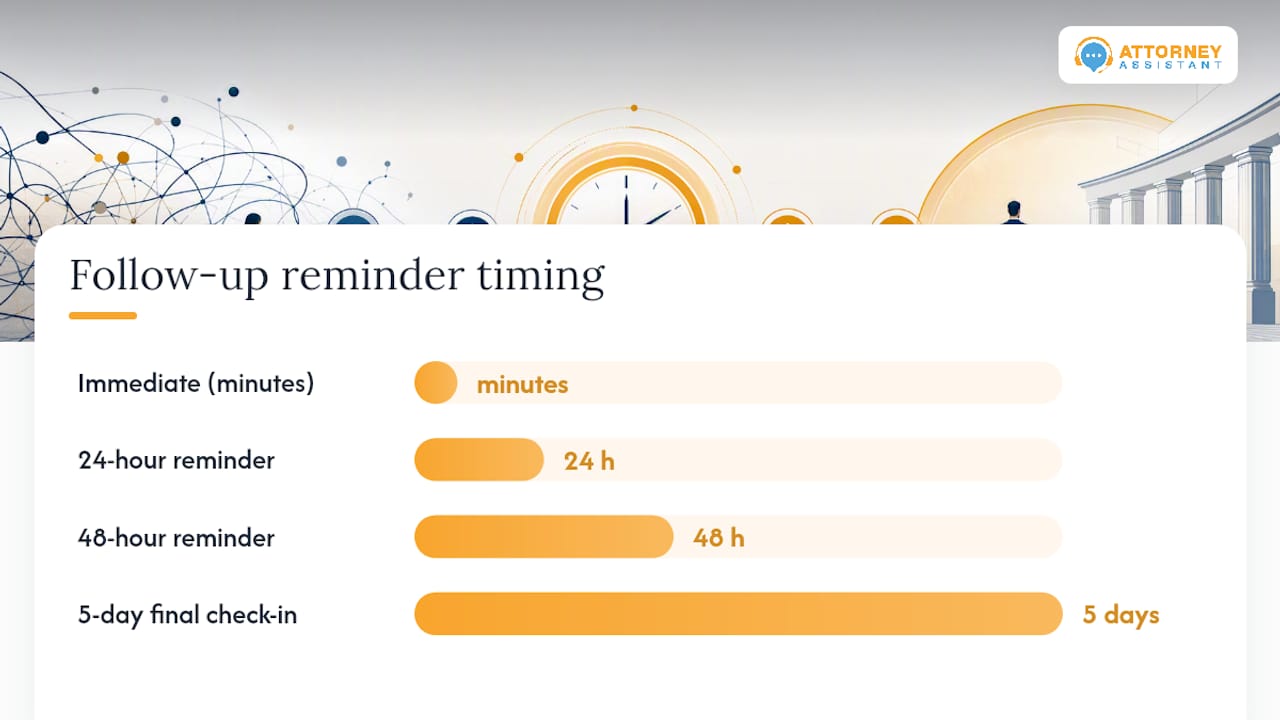
For everyone who doesn’t sign on the spot, automation carries the weight. A tested follow-up cadence looks like this:
- Immediate confirmation within minutes of the consultation ending.
- A 24-hour reminder if no signature yet.
- A 48-hour reminder with a restated deadline.
- A five-day final check-in with a soft cutoff for holding the file open.
Every reminder should stop firing the moment the client signs. Nothing kills trust faster than a “please sign your retainer” email landing in someone’s inbox after they already paid.
Every engagement letter template needs, at minimum: correct party names, scope of representation, fee basis, retainer amount, billing cadence, and a signature block with date fields. Pre-populate all of it from intake data. Log every signature event and payment confirmation with a timestamp, because that audit trail is what protects the firm if a fee dispute ever surfaces later.
Operational Policies That Stop Ad-Hoc Exceptions From Leaking Revenue
Every firm that loses money on unsigned retainers has one thing in common: someone made an exception, and the exception became the norm. Written policy stops that drift before it starts.
Core rules worth enforcing without exception:
- No billable work begins before a signed engagement letter and a cleared retainer deposit, full stop.
- Every engagement letter gets a second-person review before it’s sent.
- All retainer funds route directly into the client trust account, never operating accounts.
When early work is genuinely unavoidable, such as an approaching statute of limitations, document it:
- Record the reason for the exception and who approved it.
- Require sign-off from a partner or supervising attorney, not the intake staffer alone.
- Log the exception in a shared tracker reviewed monthly.
Trust-account verification remains the true financial gate. The record shouldn’t change from prospect to active client until deposited funds are confirmed and reconciled. This isn’t bureaucracy. It’s what keeps your firm compliant with safekeeping-of-client-property obligations under state bar rules modeled on the ABA framework.
Pro Tip: Keep every exception in one shared log, not scattered across email threads. When a dispute surfaces eighteen months later, that log is the only thing standing between your firm and a fee complaint.
Metrics and Training That Keep Signature Rates High
You can’t fix what you don’t measure. Four numbers matter most: unsigned-retainer rate, median time-to-sign, consultation-to-signed-matter conversion, and follow-up response rate.
Review them on a rhythm, not randomly:
- Daily: an intake dashboard flagging any file stuck in “signature pending” past 24 hours.
- Weekly: a conversion review comparing consultations booked against retainers signed.
- Monthly: a full audit of exceptions logged and trust-account entries reconciled.
Firms that run a structured three-touchpoint follow-up within 72 hours recover an estimated 15% to 25% of prospects who would otherwise never sign. That number alone should justify the training investment.
Train intake staff on scripted prompts for requesting signatures, run periodic role-play for handling hesitant clients, and schedule a quarterly QA review of engagement letters against trust-account entries.
Pro Tip: Put time-to-sign on the same dashboard as lead volume. Most firms track how many leads came in and ignore how many stalled at the finish line.
Intake Checklist and Engagement-Letter Fields to Populate Every Time
Before any engagement letter goes out, run this checklist:
- Confirm correct client and firm names, spelled exactly as they’ll appear on the signature line.
- Confirm scope of representation matches what was discussed in the consultation.
- Confirm fee basis, retainer amount, and billing cadence are filled in, not left as placeholders.
- Confirm trust-account details and payment instructions are current.
- Confirm the signature block includes date fields for both parties.
Required fields that must populate directly from intake data:
- Party names and contact details
- Scope language specific to the matter type
- Fee structure (contingency, hourly, flat) and retainer amount
- Dispute-resolution clause, if your jurisdiction or matter type requires one
The QA step is simple: a second person reviews the populated letter, timestamps their approval, and only then does it go out for signature. Skipping this step is how firms end up with a signed letter that has the wrong fee percentage typed into it.
How to Get Clients to Actually Sign the Retainer
Clients who understand why the retainer matters sign faster. Clients who don’t, stall, and stalling is where firms lose them.
Explain the retainer in plain terms during the consultation itself, not in a follow-up email three days later. Tell the client exactly what the signed letter protects: a clear fee structure so there are no surprises later, a defined scope so both sides know what’s covered, and a formal record that starts the clock on their case. Frame the retainer deposit as the step that activates their file, not as a hurdle.

Avoid legal jargon in the explanation. Say “this locks in the fee we discussed” instead of “this constitutes the fee agreement referenced herein.” Clients sign faster when they understand what they’re signing.
Set a specific expectation for timing. Tell the client directly: “We’ll email this within the hour. Sign and send the deposit today and we can start work tomorrow.” Vague timelines invite delay. Specific ones create urgency.
Some firms find success walking through the letter section by section on the call, especially for personal injury clients dealing with medical bills and lost wages who may be anxious about cost. A two-minute walkthrough removes the confusion that causes hesitation later. For contingency-fee matters, spell out exactly what percentage applies and when it applies, since fee confusion is one of the most common reasons clients delay signing even when they’ve already decided to hire the firm.
What to Do When a Client Disputes or Refuses to Sign
A refusal to sign isn’t always a lost case. Sometimes it’s a client who has a real question that never got answered.
Start by finding out why. Is it the fee structure, the scope, or genuine hesitation about proceeding at all? A five-minute call to ask directly resolves more refusals than firms expect. If the objection is about fee percentage or billing cadence, offer to walk through the number again with a concrete example tied to their situation.
If the client wants changes to scope or terms, document the requested change, get attorney sign-off, and issue a revised letter rather than negotiating verbally and hoping everyone remembers the same terms.
For clients who remain unwilling to sign a full retainer but need urgent help, a narrowly scoped, limited-engagement letter can cover a single task, such as filing an emergency motion, without committing either party to full representation. This protects the firm from doing unpaid work while still serving a client with a genuine emergency.
If a client refuses entirely, close the file formally with a non-engagement letter that states clearly the firm is not representing them. This step matters more than firms think. An ambiguous “we never heard back” file with no formal closure can create liability if the client later claims they believed the firm was handling their matter. Document the refusal, the date, and the reason, then move on. Chasing a client who has clearly declined wastes time better spent on the next lead.
Common Failure Modes We See and Two Quick Fixes
The failures we see most often: slow follow-up, engagement letters missing key fields, and staff starting work before the retainer clears out of habit or pressure.
Two fixes pay off immediately. First, enforce holding status paired with an automated 24 to 48 hour follow-up sequence. Second, require two-person QA on every letter before it goes out. Fixing intake converts leads you already have. It doesn’t require another dollar of marketing spend.
How Attorney Assistant Closes the Unsigned-Retainer Gap
Attorney Assistant runs the enforcement layer most firms are missing: holding-status discipline, 24/7 follow-up that doesn’t stop until a client signs or formally declines, engagement-letter automation pulled straight from intake data, and trust-account verification gates built into the daily workflow, not left to memory.
This isn’t staffing. It’s operations. Attorney Assistant’s team handles the two-person QA, the reminder cadence, and the escalation calls, so your attorneys spend time on billable work instead of chasing signatures. If your firm is losing leads between consultation and signed matter, book a call through our virtual webinar and see exactly where your intake process is leaking cases.
Sources
- Law Firm Client Intake Process Flow Chart: Key Steps - LegalClarity
- Why Prospective Clients Ghost Your Law Firm After the First Call — And How to Fix It | LegalStack Review
- Law Firm Client Intake Automation: Step-by-Step Guide 2026 | US Tech Automations
- The Retainer-First Revolution: How Solo & Small Law Firms Are Converting 3x More Consultations in 2026 | Formfy Blog
FAQ
What Happens if a Retainer Is Unsigned?
The matter should stay in holding status with no billable work until the client signs the engagement letter and the retainer deposit clears the trust account.
Can a Retainer Be Unenforced Without a Signature?
Firms typically treat an unsigned retainer as unenforceable for fee purposes, which is exactly why the two-person review and trust-account gate exist before any file moves to active status.
How Long Should Firms Wait Before Following Up on an Unsigned Retainer?
Send the first reminder within 24 hours, a second at 48 hours, and a final check-in around day five with a stated deadline.
What Are the Most Common Retainer Contract Issues Firms Face?
Missing or incorrect fields, such as fee basis, scope language, or party names, are the most common issues, which is why letters should populate directly from intake data and pass a second-person review.
How Does Attorney Assistant Help With Unsigned Retainers?
Attorney Assistant enforces holding-status rules, runs automated 24/7 follow-up sequences, and builds trust-account verification directly into intake workflows so fewer signed retainers slip through the cracks.
Recommended
Related Articles

Request for Discovery Template: A Practical Guide
Use our request for discovery template with annotated fields, jurisdictional notes, and filing instructions. Customize it for federal or state court cases.

Litigation Support Services: What Law Firms Need to Know
Discover how litigation support services streamline discovery, reduce costs, and improve case outcomes. Learn what to look for in a provider.

Keep the Conversation Going: 8 Intake Follow-Up Tactics
Learn how to keep the conversation going with law prospects using eight practical intake and follow-up tactics, from speed-to-lead to attorney handoffs.