Convert more leads into signed cases for injury firms

TL;DR:
- Improving intake processes and responding quickly can significantly increase law firm conversion rates.
- Firms should audit their current bottlenecks, implement proper tools, and follow a disciplined, empathetic follow-up sequence.
- Consistent tracking and regular process reviews are essential to sustain growth and maximize signed client outcomes.
Every dollar you spend on marketing generates a lead. But if that lead never becomes a signed client, you just paid to fill someone else’s pipeline. Personal injury firms face this painful reality daily: phones ring at the wrong time, follow-ups fall through the cracks, and potential clients sign with a competitor who simply called back first. The good news is that you don’t need more leads to grow your revenue. You need a tighter process for the leads you already have. This guide walks you through diagnosing your intake gaps, building the right tools and team, executing a disciplined conversion sequence, and measuring what actually works.
Table of Contents
- Understand your current intake bottlenecks
- Prepare the essentials: Tools and team roles
- Step-by-step process: Converting leads into signed clients
- Avoid common mistakes and troubleshoot conversion gaps
- Verify results and track your conversion metrics
- Why most law firm conversion advice misses the mark
- Supercharge your lead conversion with Attorney Assistant
- Frequently asked questions
Key Takeaways
| Point | Details |
|---|---|
| Identify intake gaps | Pinpoint where leads are lost to quickly improve your conversion rate. |
| Use proven tools | Intake specialists and automated systems streamline lead management and follow-up. |
| Respond fast | The faster your team follows up, the higher your chances of winning new clients. |
| Troubleshoot and refine | Constantly address bottlenecks and update processes for sustained growth. |
| Measure your results | Tracking key metrics helps you keep improving every step of your intake journey. |
Understand your current intake bottlenecks
Once you recognize the frustration of losing leads, the next step is to pinpoint where your current process is failing.
Most personal injury firms bleed potential clients from the same three places: they respond too slowly, they ask the wrong questions at the wrong time, or they follow up inconsistently after the first contact. Any one of these problems can cost you a case. All three together can quietly hollow out your revenue.
Here are the most common intake bottlenecks that firms deal with:
- Slow initial response: A potential client submits a form at 9 PM and nobody responds until the next morning. They’ve already called two other firms by then.
- Poor qualification: Intake staff ask too few questions, too many questions, or questions that feel clinical rather than human. Potential clients disengage or feel like they’re being interrogated rather than helped.
- Inconsistent follow-up: After the first call, leads go into a shared inbox or a sticky note system. Nobody owns the follow-up, so it doesn’t happen.
- No structured handoff: When a lead is qualified but not yet signed, there’s no clear next step. It just sits there, waiting.
- Weak emotional connection: Personal injury clients are often scared, in pain, or overwhelmed. If your intake sounds transactional, they’ll find someone who sounds like they care.
Knowing that optimizing law firm intake can increase lead conversion by up to 80%, the cost of doing nothing is massive. Each of those bottlenecks is a conversion killer.
| Intake bottleneck | Likely cause | Impact on conversion |
|---|---|---|
| Response time over 30 minutes | No after-hours coverage | High lead drop-off rate |
| No qualification script | Untrained staff | Signing wrong clients |
| Single follow-up attempt | No CRM or task system | 40-60% leads go unsigned |
| No emotional acknowledgment | Transactional intake culture | Low client trust, high competition |
| Unclear next steps post-call | No intake SOP (standard process) | Leads stall and go cold |
Pro Tip: Audit your intake process step by step for a full month. Log every lead, track each touchpoint, and note where leads dropped off. You’ll find patterns that are nearly invisible day to day but obvious over 30 days of data. Solid law firm lead management starts with knowing exactly where you’re losing people.
Prepare the essentials: Tools and team roles
Once bottlenecks are clear, it’s time to ensure you have the right people and tools in place for consistent results.

You can’t convert leads systematically without the right infrastructure. That doesn’t mean expensive software or a massive team. It means deliberate choices about what tools you use and who owns each part of the intake process.
Here’s a core checklist of what you need before you launch a serious conversion effort:
- Practice management software (PMS): Tracks active matters and connects signed clients to your team’s workflow.
- CRM (client relationship manager): Manages leads before they become clients. This is where intake lives.
- Standardized intake scripts: Not rigid word-for-word dialogues, but structured conversation guides that hit the right emotional and legal notes.
- Call tracking software: Tells you which marketing channels are generating calls and how those calls are being handled.
- Response time standards: A written rule that every lead gets a response within a defined window, like five minutes during business hours and a voicemail callback within one hour for after-hours contacts.
- Dedicated intake staff or specialist: Someone whose primary job is handling leads, not a paralegal doing intake between other tasks.
The value of a dedicated intake specialist for your law firm is well documented. Using intake specialists alongside proven scripts leads to measurably higher conversion rates. When intake is someone’s core responsibility rather than a side task, the quality and speed of follow-up improves dramatically.
| Approach | Response consistency | Conversion tracking | Scalability |
|---|---|---|---|
| Manual tracking (spreadsheets, notes) | Low | Difficult | Poor |
| Dedicated CRM with intake workflow | High | Real-time | Strong |
| Shared inbox without ownership | Very low | Nearly impossible | None |
| Automated intake with live handoff | Very high | Automatic | Excellent |
Following solid intake best practices means assigning clear ownership for each stage. Somebody owns the first call. Somebody else owns the follow-up sequence. Nobody should be guessing whose job it is to reach back out.
Step-by-step process: Converting leads into signed clients
With preparations set, you can now execute a disciplined sequence for every single lead.
Speed is the single most underrated factor in personal injury intake. Firms that respond within five minutes are over nine times more likely to convert a lead into a client compared to firms that wait even 30 minutes. That gap is enormous. The potential client is in a vulnerable, urgent moment. They want help now, not tomorrow.
Here is the step-by-step flow from first inquiry to signed client agreement:
- Instant acknowledgment: The moment a lead comes in via call, form, or chat, send an automated confirmation. A simple text or email saying “We received your message and will call you within five minutes” sets expectations and keeps the lead from calling someone else.
- Speed-to-call: Your intake specialist calls back within five minutes during business hours. This is not optional. It’s the moment that separates your firm from the competition.
- Empathy first, questions second: Open the call by acknowledging what the potential client went through. “I’m so sorry to hear about your accident. I want to make sure we can help you.” This one sentence builds more trust than five minutes of case questions.
- Structured qualification: Ask clear, friendly questions about the incident, injury, and timeline. Use a script as a guide, not a script to read verbatim. Your goal is to gather information and build connection simultaneously.
- Set clear expectations: Tell the potential client exactly what happens next. “We’re going to review what you’ve shared and have an attorney call you within the hour.” Ambiguity kills deals.
- Send a follow-up summary: After the call, email or text a brief recap of the conversation and next steps. This creates accountability and makes the firm feel organized and credible.
- Multi-touch nurturing: If the lead doesn’t sign immediately, deploy a follow-up sequence. Lead nurturing for lawyers shows a direct correlation between consistent multi-touch follow-up and increased client signings. That sequence should include calls, texts, and emails spaced over 7 to 14 days.
- Prepare the agreement: Once the client is ready, have a retainer agreement ready to send digitally. Every extra hour between “yes” and “signed” is a risk.
- Welcome and onboard: A strong onboarding experience seals the relationship. How intake shapes onboarding determines whether a new client feels confident they made the right choice.
Pro Tip: Preempt the most common objections before the client raises them. If someone is worried about legal fees, address that in the first call. “Our firm works on contingency, which means you pay nothing unless we win your case.” Remove friction before it stops the deal.
This isn’t about being pushy. It’s about guiding a stressed person through a process they’ve likely never experienced before. That guidance, backed by trusted legal advice, is what converts uncertainty into a signed client.
Avoid common mistakes and troubleshoot conversion gaps
Even a great process fails without vigilance. Let’s troubleshoot where things most often go wrong.
The most common mistakes that cost personal injury firms signed cases fall into predictable patterns. Knowing them means you can watch for them and course-correct before they compound.
- Following up only once: Most leads don’t sign on the first contact. If your team stops reaching out after one call, you’re leaving the majority of your pipeline unsigned.
- Unclear next steps after the intake call: If the client doesn’t know what happens next, they fill that uncertainty with doubt and often call someone else.
- Treating every lead the same: A lead that just had an accident today needs a different tone and urgency than someone exploring options from three months ago. Personalize the approach.
- Weak onboarding after signing: Getting the signature is not the finish line. Consistent follow-up and clear onboarding reduce lead loss significantly, but they also reduce early client churn. A client who feels ignored after signing will fire you.
- No regular process review: Intake processes get stale. If you set up a script in 2023 and never updated it, it might be missing critical information or out of step with how potential clients communicate now.
Critical note: The cost of inaction is not neutral. Every week you delay fixing your intake process is another week of marketing spend that produces zero return. One signed case that would otherwise have been lost can cover the entire cost of intake improvements. The question isn’t whether you can afford to fix this. It’s whether you can afford not to.
Conversion optimization for lawyers requires regular review and honest adjustment. Schedule a monthly intake audit. Review call recordings, check follow-up logs, and ask your intake team what objections they’re hearing most often. Then adapt. This is not a set-it-and-forget-it system.
Staff training deserves a specific mention. Your intake specialist should be retrained quarterly, not just once at hire. Role-play objection handling. Review real calls together. Build a culture where improving intake is everyone’s responsibility, not just a task for new hires.
Verify results and track your conversion metrics
To ensure your efforts pay off, establishing proper tracking and review is the final step.
Improving your intake process is only half the work. The other half is knowing whether it’s actually working. Without clear metrics, you’re guessing. With them, you’re managing.
Reviewing conversion data helps refine intake and follow-up continuously. The firms that grow their signed case count year over year are almost always the ones that track conversion at every stage.
Here are the key metrics your firm should monitor monthly:
| KPI | What it measures | Target benchmark |
|---|---|---|
| Lead-to-client conversion rate | Percentage of leads that sign | 25-40% for personal injury |
| Average first response time | How fast leads get a call back | Under 5 minutes during hours |
| Abandoned intake rate | Leads that start but never finish intake | Under 15% |
| Follow-up attempts per lead | Touchpoints before lead goes cold | Minimum 5-7 over 14 days |
| Cost per signed client | Total marketing spend divided by signed clients | Varies by market |
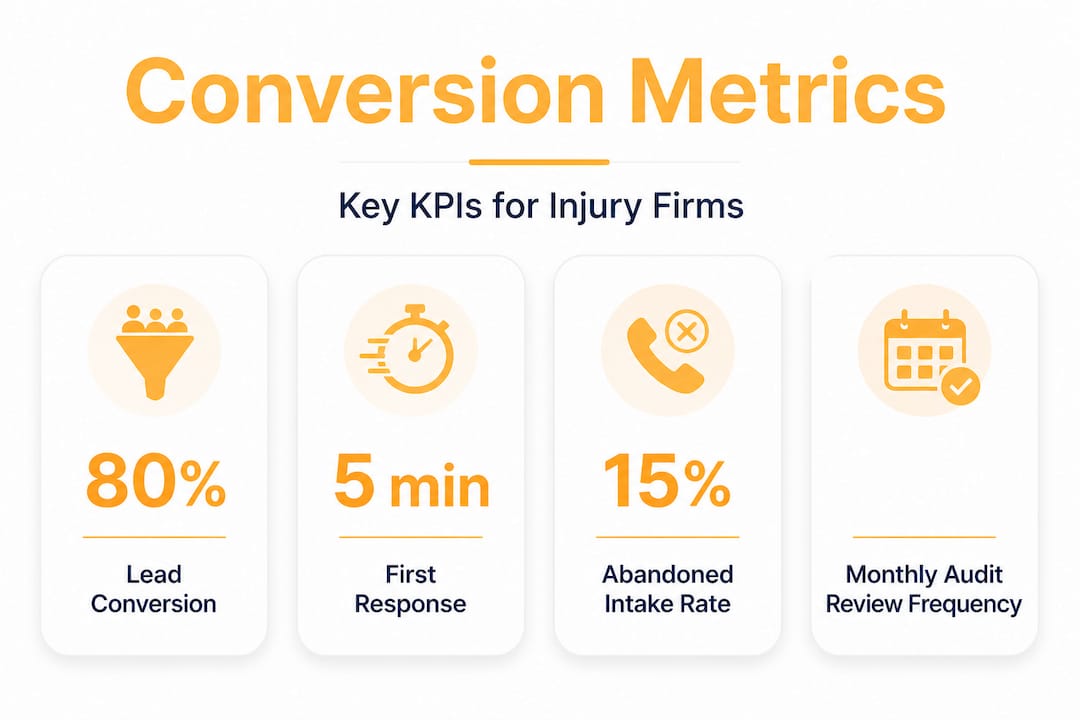
Review these numbers monthly, not quarterly. Personal injury intake moves fast, and a two-month lag in spotting a problem means two months of lost revenue.
When you see improvement, celebrate it with your team. Positive reinforcement builds the culture that sustains great intake. When numbers dip, investigate quickly. Was it a staffing change? A new lead source that sends lower-quality inquiries? A script that stopped working for a new demographic? The answer is always in the data.
Why most law firm conversion advice misses the mark
Here’s the uncomfortable truth that most intake guides won’t tell you: the advice that gets published is almost always written for firms with dedicated marketing teams, robust CRMs, and time to implement complex workflows. That describes maybe 10% of personal injury firms.
The other 90% are running lean. Attorneys are doing intake between depositions. Paralegals are handling follow-up on lunch breaks. The CRM is a spreadsheet with 300 rows and no owner. Generic advice tells these firms to “build a follow-up sequence” without acknowledging that they barely have time to answer the phone.
The real insight is this: speed matters far more than polish, especially early in the intake process. A fast, slightly imperfect call beats a polished voicemail every single time. Potential clients are not grading your word choice. They’re grading how quickly you made them feel like someone gave a damn about their situation.
Most firms fixate on lead volume because it feels like a concrete problem to solve. More ads, more SEO, more referrals. But process quality is the actual force multiplier. Doubling your conversion rate from 20% to 40% has the same revenue impact as doubling your lead volume, and it costs a fraction of the price.
From working with personal injury firms across the country, the single biggest differentiator between firms that grow and firms that stagnate is follow-up discipline. Not fancy scripts. Not the most expensive CRM. Just consistent, empathetic outreach that doesn’t stop after the first attempt. The client intake best practices that actually move the needle are almost always the simplest ones executed with relentless consistency.
Personal touches beat canned responses every single time. A text that says “Hey Sarah, just checking in on how you’re doing after your accident” will always outperform a templated email that starts with “Dear Valued Potential Client.”
Pro Tip: Empathy is not soft. It’s a conversion strategy. Potential clients in personal injury situations are choosing a partner for one of the hardest moments of their lives. The firm that communicates warmth and competence wins.
Supercharge your lead conversion with Attorney Assistant
If you’re ready to act on these proven strategies, here’s how Attorney Assistant can help turn them into results.
You’ve just covered a complete system for converting more leads into signed clients. But knowing the system and running it consistently are two very different things. That gap is where most firms lose ground.
Attorney Assistant exists to close that gap. Our lead follow-up services ensure that no lead goes cold because someone was too busy to make a call. Our 24/7 intake support means a potential client who calls at 11 PM gets a real response, not a voicemail. And if you want to go deeper on conversion strategy, our conversion webinars deliver firm-specific tactics you can implement immediately. Your marketing budget deserves a process that converts. Let’s build it together.
Frequently asked questions
What intake tools help law firms convert more leads?
Automated lead tracking, CRM integrations, and standardized intake scripts significantly improve conversion rates. Using intake specialists alongside proven scripts raises the quality and consistency of every lead interaction.
How quickly should law firms respond to new leads?
The faster the better, with five minutes as the gold standard. Firms that respond within five minutes are over nine times more likely to convert a lead compared to firms that wait even half an hour.
Why is consistent follow-up important in lead conversion?
Most leads don’t sign on the first contact, so consistent follow-up keeps your firm front of mind. Consistent follow-up and onboarding reduce lost leads significantly and build early client trust.
What are the most important metrics to track lead conversion?
Focus on lead-to-client conversion rate, average first response time, and abandoned intake rate. Reviewing conversion data monthly helps you catch and fix problems before they cost you signed cases.
How can law firms improve their client onboarding experience?
Clear communication, guided next steps, and prompt follow-up after signing make clients feel confident about their choice. Strong intake shapes onboarding quality and sets the tone for the entire attorney-client relationship.
Recommended
- Law firm lead management: convert more clients in 2026 | Attorney Assistant
- 10 Lead Conversion Strategies Attorneys Need for Higher Revenue | Attorney Assistant
- Optimize law firm intake and convert 80% more leads | Attorney Assistant
- Lead leakage in law firms: capture more PI cases | Attorney Assistant
Related Articles

Types of Lead Nurturing Strategies for Law Firms in 2026
Discover the best types of lead nurturing strategies for law firms in 2026. Improve client engagement and boost conversion rates today!

Call Flow Customer Service for Law Firms: A Practical Guide
Design a call flow customer service system for your law firm that captures leads, qualifies matters, and signs cases. Practical guide

Fear of Talking on Phone: 7 Practical Confidence Tips
Overcome fear of talking on phone with practical scripts, role-play, exposure exercises, and intake tools built for legal teams.