10 Lead Conversion Strategies Attorneys Need for Higher Revenue

TL;DR:
- Effective intake processes focus on quick response, lead triage, and empathy-driven communication.
- Speed to lead and multi-channel follow-up significantly increase conversion rates and revenue.
- Training staff to recognize red flags and practice empathy is crucial for maximizing client signings.
Most personal injury law firms are not losing revenue because they lack leads. They are losing it because qualified prospects call, fill out a form, or send a message and then never hear back fast enough, never feel heard, or fall through the cracks entirely. The intake process is where revenue is made or lost, and most firms treat it as an afterthought. This article breaks down 10 research-backed strategies to help managing partners at PI firms convert more of the inquiries they already receive, covering everything from lead triage and empathy-driven scripts to retargeting sequences and the KPIs that actually matter.
Table of Contents
- Understand lead types and triage criteria
- Optimize intake process for speed and responsiveness
- Empathy-driven scripts and first impressions
- Lead nurturing: following up and retargeting ‘not-ready’ leads
- Measuring lead conversion success: KPIs and tools
- Why the real conversion battle is won before the first contact
- Boost your law firm’s lead conversion with Attorney Assistant
- Frequently asked questions
Key Takeaways
| Point | Details |
|---|---|
| Triage leads fast | Know which leads need instant attention and prioritize them for highest win rates. |
| Speed and empathy win | Quick, trust-building contact outperforms slow, robot-like responses in turning inquiries to clients. |
| Nurture and retarget | Systematic follow-up turns ‘not-ready’ leads into profitable clients over time. |
| Measure every step | Tracking conversion-related KPIs lets you refine tactics and maximize revenue. |
| Empower your intake team | Tools and training for intake staff boost results more than tech alone. |
Understand lead types and triage criteria
Not every inquiry deserves the same level of urgency. The first step in building a high-converting intake system is knowing which leads need immediate attention and which can wait a few hours. When your staff cannot tell the difference, you end up with attorneys spending time on low-value calls while a case worth $500,000 sits in a voicemail.
High-value case signals worth prioritizing include:
- Clear liability with documented evidence (police reports, witness statements)
- Significant medical expenses already incurred or ongoing treatment
- High policy limits from commercial carriers or underinsured motorist coverage
- Permanent or severe injuries such as spinal damage, TBI, or amputation
Beyond case value, certain red flags like SOL near, government entities, and minors require immediate escalation to an attorney, not a paralegal or intake coordinator. A statute of limitations running out in 30 days is not a scheduling note. It is a crisis that needs a decision today.
Following solid lead management best practices means building a triage system where intake staff can identify priority leads on the very first call. A simple one-page checklist covering case type, injury severity, liability clarity, and any red flags gives your team a repeatable process that does not rely on gut instinct.
Pro Tip: Build a laminated quick-reference triage card for every intake team member. Review and update it quarterly as your case mix evolves.
“40% of inquiries come after-hours and require 24/7 coverage or AI support.”
Triage is not just about speed. It is about sending the right resource to the right lead at the right moment.
Optimize intake process for speed and responsiveness
Once you know who to prioritize, build speed into every part of your intake system. Speed to lead is one of the single biggest predictors of whether a PI prospect signs with you or your competitor. Every minute that passes after a first inquiry reduces your chances of conversion.
Here are the must-have upgrades for a modern PI intake process:
- Mobile-friendly intake forms. Clunky mobile forms lose 70 percent of potential completions. If your form takes more than two minutes to fill out on a phone, you are losing leads before they even reach your team.
- Instant chat or AI response. Deploy a chatbot or AI intake tool that can capture basic information and set expectations immediately, even at 2 a.m.
- After-hours ring assignment. Route after-hours calls to a live answering service or on-call intake specialist rather than voicemail.
- Automated text acknowledgment. Send an immediate SMS confirming receipt of every inquiry so the prospect knows they are not being ignored.
- Two-minute callback SLA. Set a firm internal standard: every new inquiry gets a live call attempt within two minutes during business hours.
Pro Tip: Test your own after-hours intake flow every month. Call your firm’s number at 9 p.m. and submit a form on mobile. You will almost always find something broken.
The ROI math is simple. If your firm receives 80 after-hours inquiries per month and converts 15 percent of them now, improving that rate to 25 percent with better intake optimization tips and better response time adds 8 new cases monthly. At an average case value of $30,000, that is $240,000 in additional annual revenue from leads you were already receiving.

Empathy-driven scripts and first impressions
Getting leads quickly is not enough. How you greet and assess them next shapes every conversion outcome. Personal injury clients are not shopping for a commodity. They are scared, in pain, and often confused about what their rights are. The firms that convert at the highest rates understand this and lead with empathy before they ever ask a qualifying question.
The empathy-first method works like this: acknowledge the person’s situation, validate their stress, and reassure them about next steps before you ask anything about liability or damages. This approach, sometimes called “empathy script, then qualify,” boosts trust and retention significantly compared to opening with legal screening questions.
Key features of an effective empathy script include:
- Acknowledging the stress of the situation in the first 15 seconds
- Active listening cues like “I understand” and “That sounds really difficult”
- Clear reassurance about timelines and what happens next
- A warm handoff to the attorney or case manager with a proper introduction
Beyond scripts, adding a short video introduction from the managing partner or lead attorney on your website and intake confirmation page increases trust measurably. Prospects who see a real face before speaking with your team feel less like they are calling a call center and more like they are reaching out to a real advocate.
A strong law firm intake process and consistent communication strategies turn first impressions into signed retainers. The legal qualification can wait 90 seconds. The human connection cannot.
Lead nurturing: following up and retargeting ‘not-ready’ leads
Even with the best scripts and speed, many high-quality leads need more time and touches. A prospect who was in a car accident last week may not be ready to commit to an attorney today. That does not mean they are a lost cause. In fact, not-ready leads often become the most profitable cases because they have had time to fully document injuries and build stronger claims.
Here is a systematic follow-up sequence that works:
- Day 1: Live call attempt plus automated SMS within two minutes of inquiry
- Day 2: Second call attempt with a personalized voicemail
- Day 4: Email with a helpful guide (example: “What to do after a car accident in your state”)
- Day 7: SMS check-in asking if they have questions
- Day 14: Retargeting ad or email with a client success story
- Day 30: Final outreach offering a free consultation with no pressure
| Follow-up method | Traditional (call only) | Multichannel approach |
|---|---|---|
| Channels used | Phone only | Phone, SMS, email, ads |
| Average touches before conversion | 1 to 2 | 5 to 8 |
| After-hours coverage | None | Automated SMS and email |
| Educational content | No | Yes, guides and resources |
| Re-engagement rate | Low | Significantly higher |
The lead nurturing for lawyers approach shown above works because it keeps your firm top-of-mind without being pushy. Understanding the power of lead nurturing in legal marketing means recognizing that most signed clients needed between 3 and 8 touchpoints before committing.
Measuring lead conversion success: KPIs and tools
Having the right strategies is not enough. Knowing what works is the final piece of a repeatable conversion engine. Without measurement, you are guessing. With it, you can make small adjustments that compound into major revenue gains over time.
Tracking conversion metrics consistently is what separates firms that improve year over year from those that plateau. Start with these core KPIs:
| KPI | Definition | Example target | Tracking tool |
|---|---|---|---|
| Speed to first contact | Time from inquiry to first call attempt | Under 2 minutes | CRM with timestamp logging |
| Qualification rate | % of inquiries that pass initial screening | 40 to 60% | Intake software |
| Signed retainer rate | % of qualified leads who sign | 25 to 40% | CRM pipeline report |
| After-hours conversion rate | % of after-hours leads that convert | 15 to 25% | Call tracking platform |
| Channel ROI | Revenue per lead source | Varies by channel | Analytics dashboard |
Useful tools to track these numbers include:
- CRM platforms like Clio Grow or Lawmatics for pipeline tracking
- Call tracking software like CallRail to attribute leads to specific campaigns
- Intake solutions that log response times and conversion outcomes automatically
- Analytics dashboards that consolidate data from multiple channels into one view
Set a monthly conversion review on your calendar. Pull the numbers, compare them to your targets, and identify one specific area to improve. Reviewing legal marketing KPIs monthly builds a culture of accountability that drives sustained improvement.
Why the real conversion battle is won before the first contact
Most attorneys focus their conversion efforts on the moment a call comes in. Better scripts, faster callbacks, smarter forms. All of that matters. But the firms that consistently outperform their market share do something different: they invest in what happens before the phone rings.
The real conversion battle is won through staff preparation. When your intake team genuinely understands urgency signals, knows how to recognize a red-flag case, and has practiced empathy-driven conversations until they feel natural, conversion rates climb without changing a single piece of technology. Tech tools multiply results, but only when the people using them are trained to think like advocates, not administrators.
Consider hiring an intake specialist whose sole focus is converting inquiries rather than splitting that responsibility across paralegals who are already managing active cases. That single structural change can increase signed retainers by 20 to 30 percent in the first quarter.
Pro Tip: Have a senior attorney sit in on intake calls or listen to recordings monthly. The patterns you find will surprise you and give you specific coaching moments that no software can replicate.
Conversion is a people problem dressed up as a process problem. Fix the people side first, then layer in the tools.
Boost your law firm’s lead conversion with Attorney Assistant
If these strategies feel like a lot to implement alone, that is exactly why Attorney Assistant exists. We built our platform specifically for PI law firms that are tired of watching qualified leads go cold because of slow follow-up, missed after-hours calls, or intake forms that frustrate prospects before they ever speak to a human.
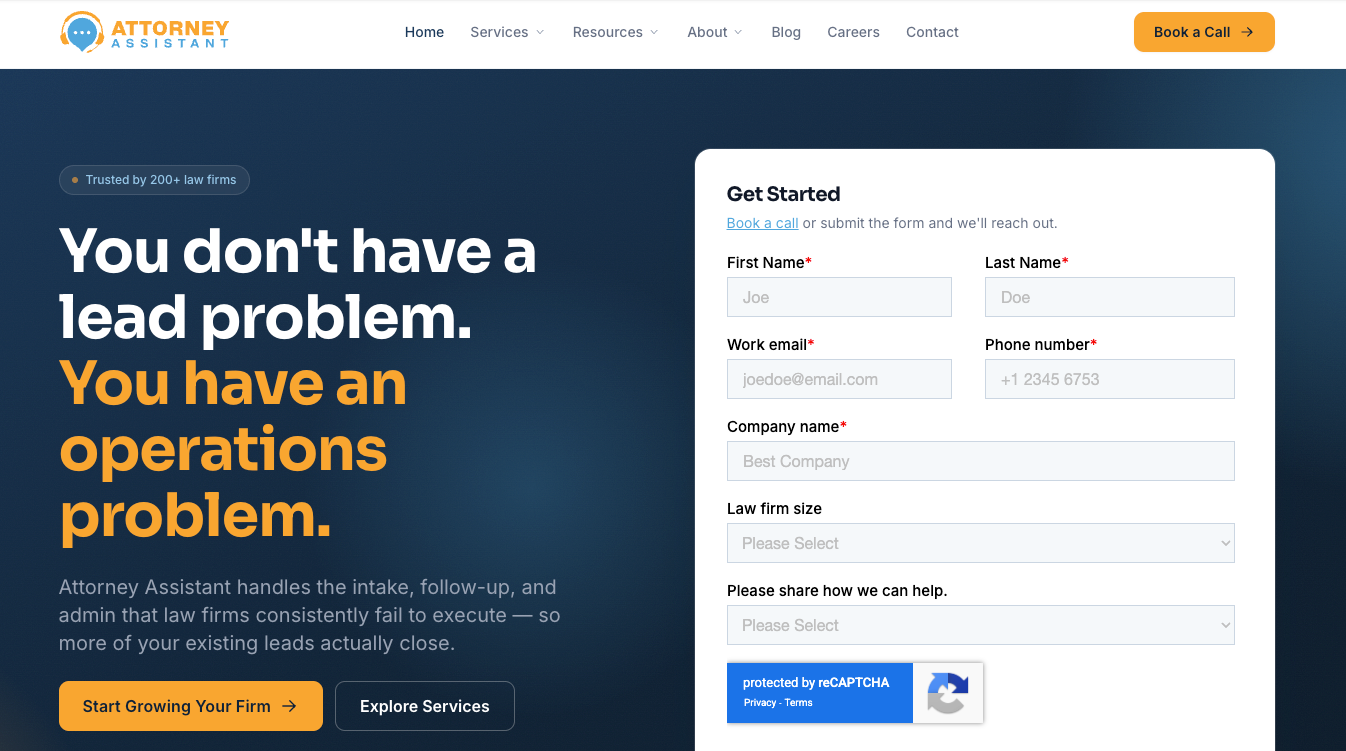
Our intake solutions cover the full lead lifecycle from first contact through signed retainer, with built-in empathy-driven workflows, automated follow-up sequences, and real-time reporting. You can also explore our free law firm tools to start optimizing your process today. When you are ready to see how it works for your specific firm, book a demo and we will walk you through exactly where your current intake is leaking revenue and how to fix it fast.
Frequently asked questions
What lead conversion rate should a PI law firm aim for?
Top PI law firms often reach conversion rates between 25 and 40 percent with modern intake and follow-up systems in place.
How quickly should our intake team respond to a new inquiry?
The best-practice goal is a callback within two minutes, since speed to lead is one of the strongest predictors of whether a prospect signs with your firm.
Can AI really help with after-hours lead conversion?
Yes. AI chat and automated intake tools can cover the 40% of inquiries that arrive after business hours, capturing information and setting expectations until your team follows up.
What is the most common reason potential clients do not convert?
Slow or impersonal follow-up is the top cause, often made worse by clunky mobile forms that lose 70 percent of potential completions before a prospect even reaches your team.
How can we win back ‘not-ready’ or delayed leads?
Stay consistent with value-add follow-ups. Educational guides and retargeting keep your firm top-of-mind until the prospect is ready to commit.
Recommended
- Effective Strategies and Techniques for Generating High-Quality Legal Marketing Leads - Attorney Assistant | Attorney Assistant
- Optimize law firm intake and convert 80% more leads | Attorney Assistant
- Law firm lead management: convert more clients in 2026 | Attorney Assistant
- Lead nurturing for lawyers: increase client conversion | Attorney Assistant
Related Articles

Intake follow-up steps that boost law firm conversions
Stop losing personal injury leads. Learn the step-by-step intake follow-up process that helps law firms respond faster and convert more prospects into signed clients.

Top 3 virtualstaffingadvice.net alternatives 2026
Discover 3 virtualstaffingadvice.net alternatives to improve operational efficiency and client intake processes.

Top law firm growth tips: boost intake efficiency
Discover proven law firm growth tips to boost case intake, streamline follow-up, and maximize marketing ROI for personal injury firms in 2026.