Signs of Poor Lead Management in Your Law Firm
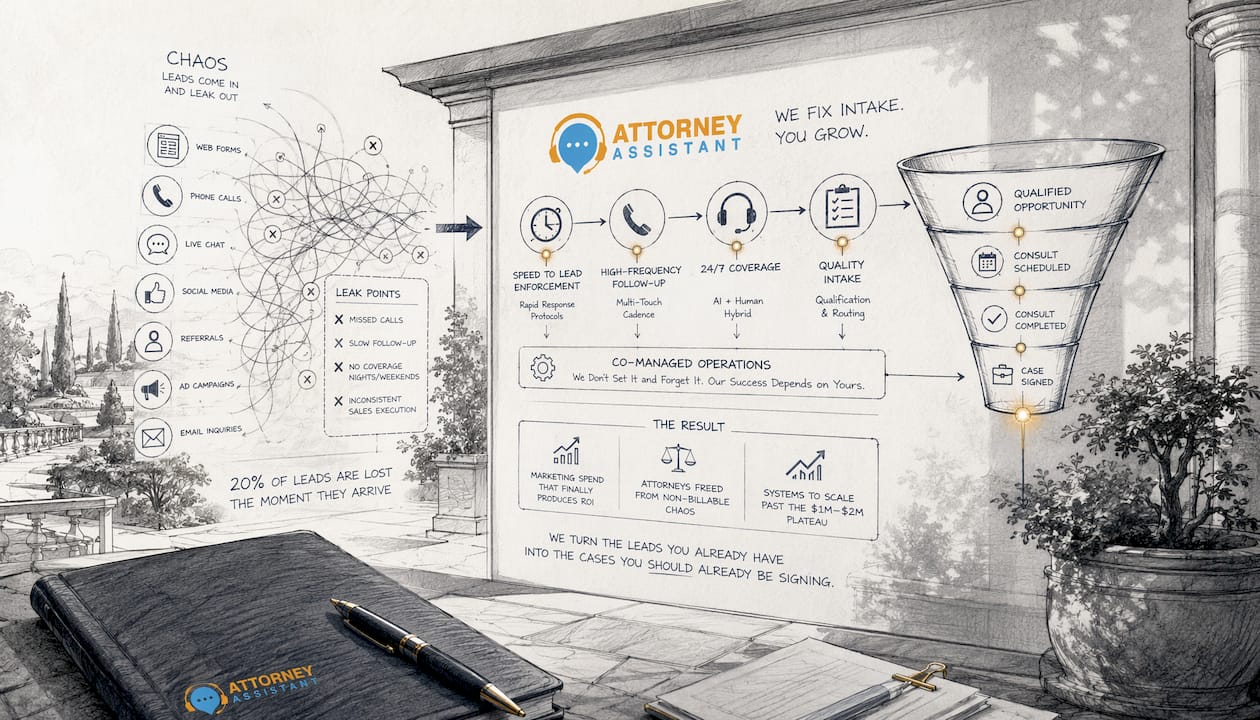
Your firm has a lead management problem if you recognize any of these: calls going to voicemail during business hours, web leads sitting untouched for hours, a steady flow of inquiries that rarely converts to signed cases, intake coordinators handling calls differently every time, and no recordings to review afterward.
Quick red flags to check today:
- Answer rate below a high standard during business hours
- Web leads not contacted promptly after submission
- A substantial share of leads with no follow-up recorded in your CRM
- No call recordings or review process in place
- Intake conversion rate below typical benchmarks despite consistent lead volume
If two or more of these apply, you have a revenue leak, not a marketing gap. Run a basic call log and CRM check before spending another dollar on ads.
Table of Contents
- 1. What the signs of poor lead management actually look like day-to-day
- 2. The KPIs that prove lead leakage and estimate revenue impact
- 3. A fast 7-check audit you can run this week
- 4. Priority fixes: what to change now, next, and later
- Key Takeaways
- The intake problem most firms misdiagnose
- What Attorney Assistant does about lead leakage
- Useful sources for running your audit
- FAQ
1. What the signs of poor lead management actually look like day-to-day
Missed calls and low answer rate
A potential client calls at 5:15 PM on a Friday. They get voicemail. They call the next firm on Google. That is not a hypothetical. It happens at most firms that lack after-hours coverage. Answer rate benchmarks recommend a high level of responsiveness during business hours, and firms below that level show measurable leakage.
Slow follow-up
Speed matters more than most owners expect. Responding very quickly can greatly increase the likelihood of converting a lead compared to slower responses. Most firms call back hours later, if at all.

A notable portion of law firm leads never receive follow-up, and conversion near 7% is common without structured intake processes.
Low conversion despite steady lead volume
Personal injury firms often convert around 10% of leads to signed cases, though rates near 7% are common for firms without a structured intake process. If your volume is consistent but your signed-case count is flat, the problem is intake execution, not traffic quality. Check your qualified rate versus your lead-to-case rate by source before blaming the marketing.
Inconsistent intake scripts and training
When coordinators handle calls differently, conversion varies wildly by person. Price objections, hesitation, requests to “think about it” — trained coordinators convert those moments. Untrained ones lose them. Wide performance variance between staff is a direct signal of missing scripts and no objection-handling framework.
The intake black box
Owners track marketing spend and case outcomes but rarely review the intake call itself. According to the Clio Legal Trends Report, 94% of intake calls are never reviewed. No recordings means no coaching, no feedback loop, and no way to know whether a coordinator is losing cases on every shift.
Poor CRM hygiene
Duplicate contacts, missing phone numbers, leads stuck in the same funnel stage for weeks — these are signs of lost leads in your pipeline. Firms without structured CRM tracking can lose up to 25% of leads simply because they are never properly worked.
No SLAs or follow-up cadence
If no one owns the rule “call back within 5 minutes” and no system enforces it, it does not happen consistently. Most leads require multiple touchpoints before committing. Firms without a defined follow-up sequence abandon viable cases after one attempt.
2. The KPIs that prove lead leakage and estimate revenue impact
Pull these metrics from your call logs and CRM before drawing any conclusions:
| KPI | What it measures | Data source | Benchmark |
|---|---|---|---|
| Answer rate | Live calls answered vs. total inbound | Phone system report | 90%+ during business hours |
| Speed-to-lead | Minutes from inquiry to first contact | CRM timestamp | Under 5 minutes |
| Contact rate | Leads reached vs. total leads | CRM outreach log | 80%+ |
| Qualified rate | Qualified leads vs. total inquiries | CRM stage data | Firm-specific |
| Lead-to-case rate | Signed cases vs. total leads | CRM + case management | 10%+ (PI benchmark), but some reports place the typical nationwide figure closer to 7% without structured processes. |
| Call-to-consult rate | Consults scheduled vs. calls handled | Intake log | 30%+ |
| Consult-to-sign rate | Signed vs. consults completed | CRM close stage | 30%+ post-consult |
Revenue leakage example (A): Your firm receives 80 inbound calls per month. Answer rate is 75%, so 20 calls go unanswered. Average case value is $10,000. If even 10% of those missed calls would have signed, that is 2 cases and $20,000 in monthly revenue lost, or $240,000 per year.
Conversion gain example (B): Improving intake conversion rates by a moderate margin can produce revenue gains comparable to a significant increase in marketing spend, assuming a given lead volume and average case value.
Timeline: Simple operational changes — scripts, call review, scheduled callbacks, CRM hygiene — typically show measurable conversion improvement within 30–60 days. Answer rate and speed-to-lead move first, usually within two weeks of enforcement.
Pro Tip: Break your answer rate down by hour of day. A single gap, say 12–1 PM or after 5 PM, often accounts for the majority of missed calls. That one data point tells you exactly where to add coverage.
3. A fast 7-check audit you can run this week
Run this as a structured review, not a gut check. Document every result.
- Live call answer test. Call your firm’s main number at three different times: mid-morning, lunch hour, and after 5 PM. Record whether a live person answers, how long it takes, and what happens if they do not.
- Web form speed-to-first-contact check. Submit a test inquiry through your website contact form. Timestamp it. Measure how long until you receive a call or email back. Anything over 5 minutes is a problem.
- CRM funnel-stage audit. Pull all leads from the past 90 days. Count how many have no recorded outreach, how many are stuck in the same stage for more than 7 days, and how many have missing contact fields.
- Call recording coverage check. Confirm what percentage of inbound calls are recorded. Spot-check five recent recordings and note whether the coordinator used a script, handled objections, and asked for the consult.
- Follow-up cadence sampling. Pick 10 leads that did not sign on first contact. Check how many received a second or third follow-up attempt. If fewer than half did, your cadence is broken.
- Coordinator variance review. If you have more than one intake coordinator, compare their individual lead-to-consult rates. A gap of more than 10 percentage points signals a training problem, not a staffing one.
- Sample client experience review. Ask a trusted contact to call as a prospective client using a realistic scenario. Have them note wait time, empathy, clarity of next steps, and whether they were asked to schedule.
Stop/go thresholds:
- Answer rate below 80%: significant problem requiring immediate coverage fix
- More than 20% of leads with no recorded follow-up: urgent, assign an owner today
- Coordinator conversion variance above 10 points: training gap, not a hiring gap
- Zero call recordings reviewed in the past 30 days: coaching is impossible
For a structured intake review, Attorney Assistant’s secret-shopper intake audit runs this process with documented findings and a revenue estimate.
4. Priority fixes: what to change now, next, and later
Immediate (0–14 days)
- Set a written answer-rate SLA: 90% during business hours, live answer or callback within 5 minutes.
- Add after-hours coverage or call routing so no call hits voicemail without a live option.
- Enable instant scheduling links on your website so web leads can book a consult without waiting for a callback.
- Assign one person to own CRM hygiene: no lead without a contact date and a next action.
Short-term (2–8 weeks)
- Enable call recording on all inbound lines and schedule weekly 30-minute review sessions.
- Standardize intake scripts with objection-handling language for price, timing, and “I need to think about it.”
- Build a follow-up cadence in your CRM: at minimum, three attempts over seven days for every unclosed lead.
- Review legal intake tips to update scripts with current best practices.
Medium-term (2–3 months)
- Launch monthly secret-shopper calls and tie results to coordinator coaching sessions.
- Build a KPI dashboard showing answer rate, speed-to-lead, and conversion by coordinator, reviewed weekly.
- Automate next-action reminders in your CRM so no lead ages past 48 hours without a touchpoint.
| Action | KPI moved | Timeframe | Expected impact |
|---|---|---|---|
| After-hours coverage | Answer rate | 1–2 weeks | Significant reduction in missed calls |
| 5-minute response SLA | Speed-to-lead | 1–2 weeks | Conversion lift within first month |
| Scripts and objection training | Lead-to-case rate | 4–8 weeks | Measurable coordinator consistency |
| Call recording and review | Coordinator variance | 4–8 weeks | Narrowed performance gap |
| CRM hygiene and cadence | Follow-up rate | 2–4 weeks | Fewer leads lost to inaction |
Pro Tip: The single most scalable staffing pattern is a trained intake coordinator handling first-contact qualification, with attorneys joining only for scheduled consults. Attorneys answering unscheduled intake calls creates a bottleneck that caps growth and burns attorney time on non-billable work. Intake specialist triage is the fix.
Key Takeaways
Poor lead management in law firms is an intake and operations failure, not a marketing problem, and fixing conversion from existing leads delivers more revenue than increasing ad spend.
| Point | Details |
|---|---|
| Answer rate is the first metric | Firms below 90% during business hours lose cases before intake even begins. |
| Speed-to-lead is critical | Responding within 5 minutes can be 21 times more likely to convert than responding after 30 minutes. |
| Follow-up gaps are widespread | A notable portion of law firm leads receive no follow-up, and conversion near 7% is common without a structured process. |
| Conversion math beats ad spend | Raising conversion from 10% to 15% matches the revenue impact of a 50% marketing budget increase. |
| Attorney Assistant | Provides intake coverage, follow-up enforcement, and CRM hygiene to close the gaps this article identifies. |
The intake problem most firms misdiagnose
Most law firm owners who come to Attorney Assistant believe they have a marketing problem. They want more leads. After looking at their call logs, CRM data, and answer rates, the picture is almost always the same: the leads are there. The intake process is losing them.
The intake call is where revenue is won or lost, and 94% of those calls are never reviewed. That is not a technology gap. It is a process gap. Firms that close it, by enforcing response SLAs, recording and reviewing calls, standardizing scripts, and building follow-up cadences, see measurable conversion improvement within 30–60 days. The revenue was already in the pipeline. The question is whether the intake process captures it.
What Attorney Assistant does about lead leakage
Attorney Assistant handles the intake and follow-up work that most firms know they need but never get around to fixing. That means 24/7 live answer coverage so no call hits voicemail after hours, a 5-minute response SLA enforced on every web lead, structured follow-up cadences that run automatically, and CRM hygiene maintained as an ongoing operation, not a quarterly cleanup.
Firms that work with Attorney Assistant stop losing cases to missed calls and slow follow-up. The lead follow-up service is built specifically for this problem. If you want to see the revenue impact before committing, the Lead Revenue Calculator runs the math on your actual call volume and case value. To talk through your firm’s specific gaps, book a 30-minute intake review call.
Useful sources for running your audit
- eNZeti: What Is an Intake Conversion Rate? — Use for conversion rate benchmarks and the 94% unreviewed call statistic when building your call review process.
- eNZeti: How to Measure Law Firm Intake ROI — Use for speed-to-lead evidence and the revenue math behind conversion improvements.
- Taqtics: Legal Intake Conversion — Use for PI firm conversion benchmarks and the intake-vs-marketing-spend comparison.
- Speed.ai: Why Your Law Firm Is Losing Cases at Intake — Use for answer-rate benchmarks, follow-up failure data, and the black-box framing.
- Attorney at Work: 4 Legal Client Intake Mistakes — Use for the FTFT empathy reset and the attorney-as-bottleneck problem.
- Attorney Assistant Lead Revenue Calculator — Use to convert your KPI gaps into a dollar-impact estimate for leadership decisions.
- Attorney Assistant Secret-Shopper Audit — Use to run a structured, documented intake audit with findings and revenue estimates.
- Law Firm Mentor: Intake and CRM Processes — Use for CRM hygiene benchmarks and the 25% lead-loss figure tied to poor tracking.
FAQ
What are the most common signs of poor lead management in a law firm?
Missed calls, slow follow-up, low lead-to-signed-case conversion despite steady volume, inconsistent intake scripts, and no call recordings are the most common indicators; learning from common mistakes to avoid during a Tampa divorce can offer essential tips for intake processes. Any one of them signals revenue leakage.
How quickly should a law firm respond to a new lead?
Within 5 minutes. Research shows that responding within five minutes can be 21 times more likely to convert a lead than responding after 30 minutes or longer.
What conversion rate should a personal injury firm expect from intake?
Personal injury firms commonly convert around 10% of leads to signed cases, but figures near 7% are also reported where no structured process is in place. A post-consult conversion rate of 30% or higher is a healthy benchmark.
How do I know if my intake problem is costing real money?
Pull your missed-call volume, multiply by your average case value, and apply a conservative conversion assumption. A firm missing 20 calls per month at $10,000 average case value loses up to $240,000 per year if 10% of those calls would have signed.
Can fixing intake really replace increasing my marketing budget?
Yes. Raising intake conversion from 10% to 15% produces the same revenue result as a 50% increase in marketing spend, applied to leads you are already receiving.
Recommended
Related Articles

Litigation Support Services: What Law Firms Need to Know
Discover how litigation support services streamline discovery, reduce costs, and improve case outcomes. Learn what to look for in a provider.

Keep the Conversation Going: 8 Intake Follow-Up Tactics
Learn how to keep the conversation going with law prospects using eight practical intake and follow-up tactics, from speed-to-lead to attorney handoffs.

Preferred Method of Contact for Law Firm Intake
Discover how to capture and use the preferred method of contact in legal intake to improve conversions, ensure compliance, and streamline law firm operations.