Best SmartVirtualAssistant.com.au Alternatives in 2026

What are the top US virtual assistant service alternatives to SmartVirtualAssistant.com.au?
The strongest alternatives to SmartVirtualAssistant.com.au for Australian businesses are MyOutDesk, Wishup, ProfitAbility Virtual Assistance, AssistWorld, 24x7 Direct, Virtual Elves, Upwork, and Fiverr. Each serves a different operational need, from specialized real estate transaction support to flexible freelance hiring. The right choice depends on whether you need industry-specific compliance knowledge, round-the-clock availability, or simply a cost-effective way to offload admin tasks.
Australian real estate firms evaluating similar platforms to SmartVirtualAssistant face one consistent challenge: most generic VA services are built for breadth, not depth. Specialized VA firms reduce costly compliance and operational errors compared to general staffing agencies, which matters when your VA is handling listing admin, CRM hygiene, or lead follow-up under state-specific property laws.
| Provider | Best For | Service Types | Industry Specialization | US Market Relevance |
|---|---|---|---|---|
| MyOutDesk | Real estate businesses needing scalable support | Admin, CRM, transaction support, marketing | Real estate, mortgage, insurance | High |
| Wishup | Personalized admin and marketing support | Admin, bookkeeping, marketing, research | Professional services, real estate | High |
| Upwork | Flexible hiring across diverse skill sets | Any freelance skill, project or ongoing | Generalist | Very high |
| Fiverr | Project-based or ad-hoc tasks | Short-term gigs, content, admin, design | Generalist | Very high |
| ProfitAbility Virtual Assistance | Real estate admin and marketing | Transaction coordination, marketing, CRM | Real estate | High |
| Virtual Elves | CRM and client communication management | CRM, back-office, client comms | SMB, real estate | Moderate |
| 24x7 Direct | High-volume lead intake and scheduling | Appointment setting, lead capture, admin | Real estate, financial services | Moderate |
| AssistWorld | Compliance-aware admin and transaction support | Admin, transaction coordination, legal support | Real estate, law firms | High |
MyOutDesk is the most established US-based VA firm with a clear real estate focus. It offers dedicated assistants trained in CRM platforms like KvCORE and BoldTrail, which are standard in US brokerages. For Australian agencies working with US partners or managing cross-border transactions, that platform fluency matters.

Wishup positions itself around high-touch service. Clients get a dedicated VA rather than a rotating pool, and the firm claims a rigorous vetting process before placement. It suits businesses that want someone who learns their workflows rather than starting from scratch each week.
ProfitAbility Virtual Assistance goes narrow on purpose. Its focus on real estate workflows and compliance means its VAs understand the difference between what a transaction coordinator can do and what requires a licensed agent. That distinction is not cosmetic. Transaction coordinators manage contract-to-close processes; VAs handle routine admin and CRM hygiene. Mixing those roles up creates compliance exposure.
AssistWorld covers both real estate and law firm administrative support, which makes it a practical option for firms operating across both sectors. Its compliance-aware positioning is worth noting for Australian businesses that need US-side support aligned with state-specific legal boundaries.

24x7 Direct is built around availability. Round-the-clock appointment setting and lead capture are its core offering, which suits high-volume real estate teams where missed calls translate directly to lost listings.
Virtual Elves combines CRM management with traditional VA tasks, making it a reasonable fit for smaller agencies that want integrated back-office support without hiring a full-time coordinator.
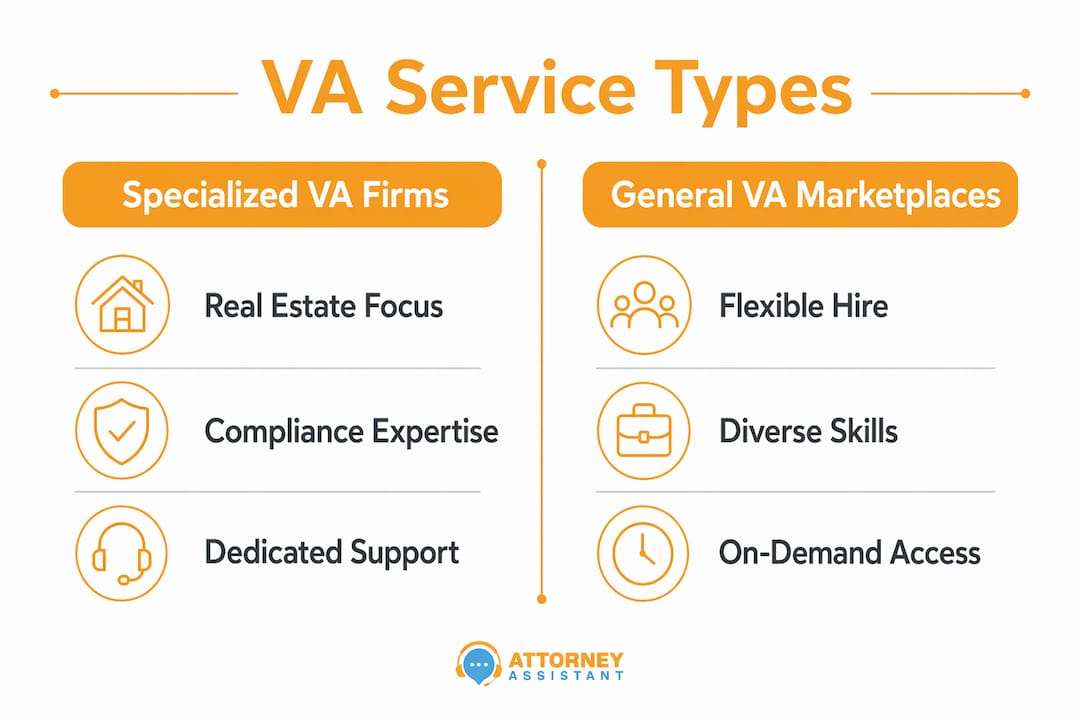
Upwork and Fiverr operate differently from the dedicated VA firms above. Both are marketplaces where you hire individual freelancers. Upwork suits ongoing engagements with vetted professionals; Fiverr is better for discrete, project-based tasks. Neither provides the managed service layer or compliance training that specialized firms offer.
How to choose the right virtual assistant service for your business
The most common mistake Australian businesses make when evaluating virtual assistant services is treating price as the primary filter. Cost matters, but a VA who lacks real estate workflow knowledge or compliance training will cost more in errors than they save in hours.
Key selection criteria:
- Industry specialization: Does the firm train VAs in your specific workflows, including CRM platforms, listing portals, and state-specific compliance requirements?
- Compliance awareness: Australian state laws strictly prohibit non-licensed personnel from signing contracts or providing legal advice. Victoria’s Estate Agents Act 1980 and NSW’s Property and Stock Agents Act 2002 set clear boundaries. Your VA firm must train staff to operate within them.
- Pricing model: Dedicated VA firms typically charge monthly retainers; marketplaces like Upwork bill hourly. Know which model fits your volume before committing.
- Time zone alignment: US-based providers operate on EST or PST, which creates an 14–16 hour gap with Australian Eastern Time. Firms offering 24/7 coverage or asynchronous workflows handle this better than those running standard US business hours only.
- Technology integration: Your VA needs to work inside your existing stack, whether that is Rex, AgentBox, PropertyMe, or a US-based CRM like KvCORE.
- Trial periods and onboarding: Most reputable firms offer a trial or discovery call before full commitment. Firms that skip this step are worth treating with caution.
- Cancellation terms: Month-to-month arrangements give you flexibility; annual contracts lock in savings but reduce exit options if performance drops.
Pro Tip: Before signing with any VA firm, ask specifically which real estate software platforms their staff are trained on. A VA who has never touched your CRM will spend your first month learning it, not working in it.
Specialized real estate VA services provide superior compliance, operational efficiency, and task-specific expertise compared to generic staffing agencies. That gap widens when the work involves anything close to the transaction process.
Hybrid models that combine AI with human VAs are worth prioritizing. AI handles instant triage and scheduling; humans manage complex negotiations and client relationships. For Australian agencies dealing with US time zones, that after-hours AI coverage closes the gap that a human-only VA cannot.
What types of virtual assistant services are available, and what do they offer?
Virtual assistant services fall into several distinct categories, and choosing the wrong type for your operational needs is a common and expensive mistake.
General administrative VAs handle calendar management, inbox triage, data entry, and basic CRM hygiene. They are the most affordable option and the most widely available. Platforms like Upwork and Fiverr are full of them. The limitation is depth: a general admin VA hired through a marketplace will not arrive knowing your listing portal workflows or your state’s tenancy compliance calendar.
Transaction coordinators (TCs) manage the contract-to-close process in real estate. This is a distinct role from a general VA. A TC tracks contingency deadlines, manages disclosure packages, coordinates with title companies, and keeps the compliance checklist current. Nearshore TCs from Latin America combine cost advantages with time zone alignment and US real estate workflow training that generic offshore VA models cannot match.
Specialized real estate VAs sit between general admin and full TC work. They own tasks like listing admin, OFI follow-up, vendor reporting, and CRM tagging, without crossing into the licensed activity that requires an agent.
AI-powered lead qualification VAs represent the fastest-growing category. AI agents reduce lead loss through immediate engagement, qualifying inquiries and booking appointments around the clock. For Australian agencies receiving leads from realestate.com.au or Domain outside business hours, this model closes a real revenue gap.
Marketing and CRM VAs handle social media scheduling, email campaigns, listing copywriting, and CRM data management. Wishup and Virtual Elves both offer this as part of their service mix.
The benefits across all categories include cost savings versus local hires, faster response times, and the ability to scale support without adding permanent headcount. The risk, particularly with offshore generalist VAs, is compliance exposure when tasks drift into licensed territory.
Best practices for working effectively with virtual assistants
Getting value from a VA relationship depends almost entirely on how you set it up, not on how talented the VA is.
Communication and task delegation:
- Define tasks in writing before the engagement starts. A VA who receives verbal instructions and no documentation will spend time clarifying rather than executing.
- Use a shared project management tool, Asana, Trello, or ClickUp, to track tasks and deadlines. This removes ambiguity and creates an audit trail.
- Set a weekly check-in cadence. Fifteen minutes is enough to catch drift before it becomes a problem.
Performance and compliance oversight:
- Establish clear KPIs from day one: response time targets, CRM update frequency, lead follow-up completion rates.
- Review performance monthly, not quarterly. Problems compound quickly in client-facing roles.
- Keep a compliance checklist for any VA touching real estate workflows. Know exactly which tasks require a licensed agent and document that boundary explicitly.
Leveraging hybrid AI-human models:
- Use AI for after-hours lead qualification and appointment booking. AI combined with human staff allows instant lead triage, appointment booking, and follow-up frequency that single-model approaches cannot match.
- Reserve human VAs for tasks requiring judgment: client communication, vendor management, and anything involving negotiation or relationship maintenance.
- Pair your VA’s CRM work with automated lead routing so every inquiry gets tagged, assigned, and followed up without manual intervention.
Managing time zone differences:
- Build asynchronous workflows for tasks that do not require real-time collaboration. Brief your VA at the end of your day so they work through your night.
- For time-sensitive tasks like lead response, prioritize providers with 24/7 coverage or AI-assisted after-hours handling.
- Document your preferred communication style and response time expectations in writing. A VA in a different time zone cannot read your urgency from tone alone.
For law firms specifically, managing virtual assistants effectively requires the same discipline: clear task boundaries, documented workflows, and regular oversight.
What Australian businesses actually experience with US-based virtual assistant services
Australian real estate agencies that have moved to US-based VA services report a consistent pattern: the first 30 days are slower than expected, and the following 90 days deliver the efficiency gains they were promised. The friction is almost always in onboarding, not in the VA’s capability.
The agencies that get the fastest results are the ones that arrive with documented processes. A VA placed into a business with no written workflows spends the first month building them. A VA placed into a business with a clear operations manual starts executing from week one.
Real estate principals who have used dedicated VA firms like MyOutDesk or ProfitAbility Virtual Assistance note that the specialization pays off in fewer errors on compliance-sensitive tasks. The agencies that tried generic marketplace hiring first and then switched to specialized providers consistently describe the same realization: the cost difference was smaller than expected, and the quality difference was larger.
For law firms using US-based VA services, the pattern is similar, as AI Legal Tools improve intake and lead qualification speed while maintaining compliance. Intake and follow-up tasks handled by trained VAs reduce the volume of missed calls and slow responses that cause leads to go cold. The operational gain is not in the VA’s presence alone. It is in the process discipline that a well-run VA engagement forces the firm to build.
Research insight: AI and compliance considerations for real estate-focused virtual assistants
The speed-to-lead gap is the most measurable operational problem in real estate lead management. AI agents address this by qualifying leads and booking appointments immediately, regardless of the time of day. For Australian agencies receiving inquiries from US-based platforms or operating across time zones, that instant response capability directly reduces lead loss.
Compliance is the constraint that AI and generic VAs both run into. Australian state laws draw a hard line: non-licensed personnel cannot sign contracts or provide legal advice. Victoria’s Estate Agents Act 1980 and NSW’s Property and Stock Agents Act 2002 are explicit on this point. Specialized VA firms train their staff to operate within these boundaries. Generic offshore services typically do not.
The firms that get compliance right treat it as a workflow design problem, not a training problem. They define exactly which tasks a VA can own, which require a licensed agent’s review, and which require a licensed agent’s signature. That boundary is documented, not assumed.
Hybrid AI-human models handle the volume problem and the compliance problem simultaneously. AI manages the high-frequency, low-complexity tasks: lead qualification, appointment booking, CRM updates. Humans handle the high-stakes interactions where judgment and licensing matter. For Australian real estate agencies evaluating affordable virtual assistant options, this model delivers the coverage of a larger team at a fraction of the cost.
The revenue impact of fixing the speed-to-lead gap is direct. Operational inefficiencies and broken intake processes cause revenue plateaus. Adding staff without fixing lead capture only increases overhead. The $1M–$2M revenue plateau in real estate agencies is primarily a lead intake problem, not a marketing volume problem.
Key Takeaways
The best virtual assistant service for Australian real estate businesses is the one that matches your compliance requirements, workflow depth, and coverage needs, not simply the cheapest option available.
| Point | Details |
|---|---|
| Specialization beats price | Specialized VA firms reduce compliance errors and workflow gaps that generic offshore services consistently miss. |
| Compliance is non-negotiable | Victoria’s Estate Agents Act 1980 and NSW’s Property and Stock Agents Act 2002 restrict what non-licensed VAs can do; your VA firm must train for this. |
| Hybrid AI-human models win on coverage | AI handles after-hours lead qualification and booking; human VAs manage client relationships and compliance-sensitive tasks. |
| Intake failure drives revenue loss | The $1M–$2M revenue plateau is primarily an intake problem; adding VAs to a broken process adds cost without fixing the leak. |
| Attorney Assistant for law firms | Attorney Assistant addresses intake failure and follow-up gaps for law firms through a co-managed AI-plus-human model. |
The real problem with most VA deployments
Most businesses that struggle with virtual assistant services are not struggling because of the VA. They are struggling because the process the VA was hired to execute does not exist in a documented, repeatable form.
This is especially true in real estate and law. Both sectors run on time-sensitive workflows where a missed step has real consequences: a lead goes cold, a deadline passes, a compliance requirement gets skipped. Dropping a VA into that environment without a clear operational framework does not fix the problem. It adds a person to a broken system.
The agencies and firms that get genuine results from VA partnerships share one trait: they fixed their intake and follow-up processes before they hired. They knew exactly what tasks needed to be done, in what order, and by when. The VA executed a defined workflow, not a vague job description.
Adding virtual assistants to an unmanaged lead intake process creates costs but does not address the root operational failures causing lost leads. That is not a staffing critique. It is an operational one. The solution is to build the system first, then staff it.
For law firms, this plays out in intake. Missed calls, slow follow-up, and inconsistent intake processes are not staffing problems. They are process problems that staffing cannot solve alone. A VA who answers calls but has no intake script, no CRM protocol, and no follow-up cadence will produce inconsistent results regardless of how capable they are.
The firms that scale past the $1M–$2M plateau are the ones that treat lead intake as a system, not a task. They use AI in law firm intake to enforce speed-to-lead, they document their follow-up cadence, and they hold their VA partners accountable to measurable outcomes. That combination, process discipline plus the right VA model, is what actually moves revenue.
Attorney Assistant addresses the intake and follow-up gap law firms keep ignoring
Law firms that have already chosen a VA service for admin tasks often discover a separate problem: their lead intake still leaks. Calls go unanswered after hours, follow-up happens once instead of five times, and signed cases that should have converted never did.
Attorney Assistant is not a VA staffing service. It is an operational fix for the intake and follow-up failures that cost law firms revenue every week. The model combines AI with human support to deliver near-100% call answer rates, high-frequency follow-up, and 24/7 coverage, embedded directly into your firm’s daily operations through a co-management approach.
If you are already using a VA for admin and still losing leads, the gap is in your lead follow-up process, not your headcount. Book a call to see where the leaks are.
FAQ
What is the best virtual assistant company for real estate?
MyOutDesk and ProfitAbility Virtual Assistance are the strongest options for real estate-specific support, given their training in US real estate workflows, CRM platforms, and compliance boundaries. The right choice depends on whether you need transaction coordination depth or broader admin coverage.
What virtual assistant niche is easiest to start with?
General administrative support, including calendar management, inbox triage, and CRM data entry, is the most accessible niche for new VAs and the easiest for businesses to delegate without compliance risk.
Which virtual assistant service works best for law firms?
AssistWorld and Attorney Assistant both serve law firm administrative needs, but Attorney Assistant specifically addresses intake failure and follow-up gaps rather than general admin tasks, making it the stronger fit for firms losing leads through slow response.
How do Australian businesses handle time zone differences with US-based VAs?
The most effective approach is building asynchronous workflows for non-urgent tasks and using AI-assisted tools for after-hours lead qualification and appointment booking, so coverage continues during the gap between Australian and US business hours.
What should I ask a VA firm before signing a contract?
Ask which software platforms their VAs are trained on, what their compliance training covers for your state’s property or legal regulations, whether they offer a trial period, and what their cancellation terms are. A firm that cannot answer these questions specifically is worth avoiding.
FAQ
Can a virtual assistant sign real estate contracts in Australia?
No. Victoria’s Estate Agents Act 1980 and NSW’s Property and Stock Agents Act 2002 prohibit non-licensed personnel from signing contracts or providing legal advice. A VA can prepare and organize documents, but execution requires a licensed agent.
What is the difference between a transaction coordinator and a virtual assistant?
A transaction coordinator manages the full contract-to-close workflow in real estate, including compliance checklists and deadline tracking. A general VA handles routine admin, CRM hygiene, and communication tasks but should not own the transaction process.
How long does onboarding take with a specialized VA firm?
Most specialized VA firms complete onboarding within four to six weeks, including matching, software setup, and workflow integration. Firms that skip a structured onboarding phase typically produce slower results in the first 90 days.
Do hybrid AI-human VA models cost more than human-only services?
Not necessarily. AI handles the high-volume, low-complexity tasks at lower cost per interaction, which often offsets the human VA cost. The total cost depends on volume and the specific firm’s pricing structure.
Recommended
- Top 5 shesagiven.com Alternatives 2026 | Attorney Assistant
- Top 3 virtualstaffingadvice.net alternatives 2026 | Attorney Assistant
- Happy International Virtual Assistants Day! - Attorney Assistant | Attorney Assistant
- The Crucial Role of Case Evaluation: How Virtual Assistants Can Improve Efficiency - Attorney Assistant | Attorney Assistant
Related Articles

10 Business Finance Course Options for Law Firms
Compare 10 business finance course options by level, format, workload, and law-firm relevance, then choose the right fit for your role and goals.

10 Good VoIP App Options for Law Firms in 2026
Compare 10 good VoIP app options for small and mid-sized law firms, including security, integrations, pricing, mobile use, and desk-phone readiness.

10 Insurance Software Companies Worth Comparing
Compare 10 insurance software companies by features, use cases, trade-offs, and implementation fit for carriers, MGAs, brokers, and agencies.